They’re Not the Prettiest Birds, But They Are HUGE!
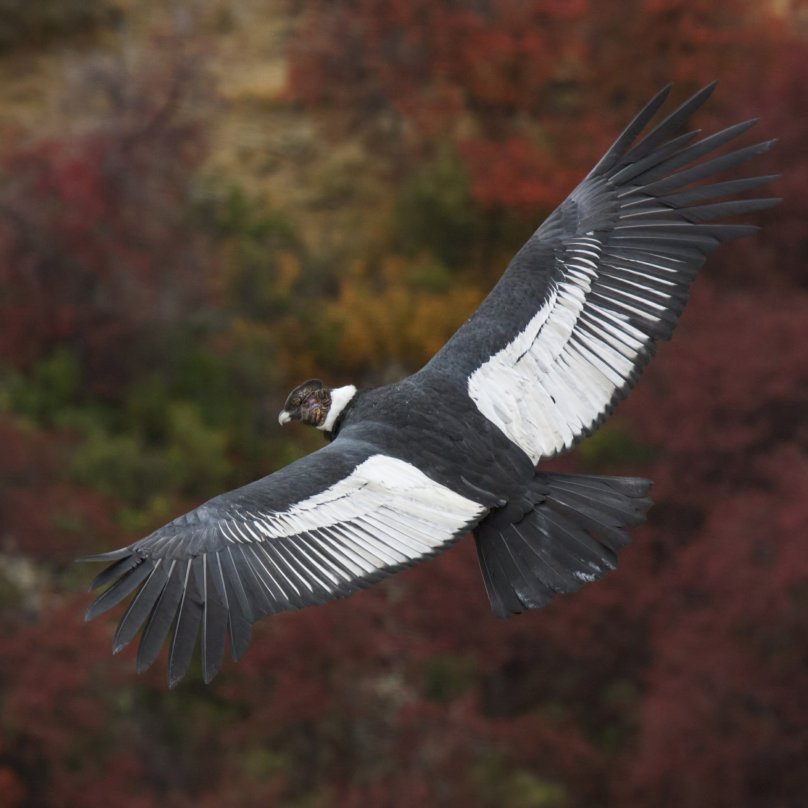
Along the south rim of Peru’s Colca Canyon, midway between Chivay and Cabanaconde is a place called Cruz del Cóndor. We stopped there late one morning waiting for the thermals that bring that condors up from the canyon below. I had a hard time focusing on the birds when they were against a dark background, so I was not able to take the above picture. Below is the best of the ones I shot, up against a blue sky:
Condor at Colca Canyon
To be a good wildlife photographer, you have to be patient … and you have to have the right equipment. Unfortunately, I have only a digital rangefinder camera, and I wasn’t able to stay put and wait for the right shot to happen. So it didn’t.
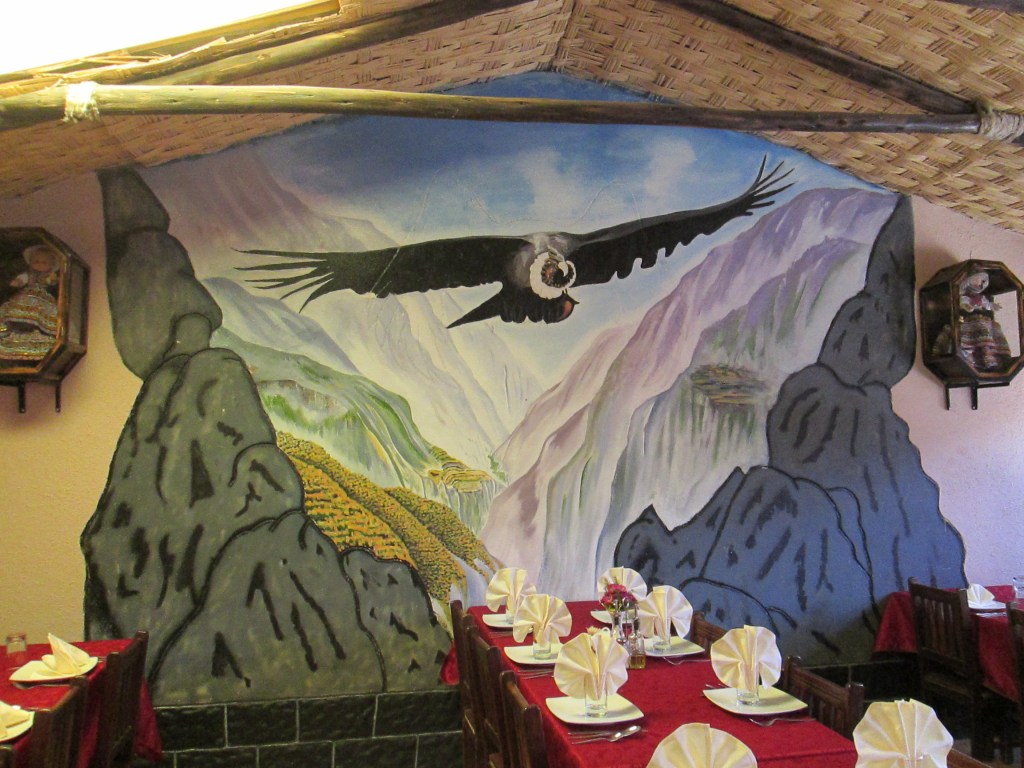
Condor on the Dining Room Wall in Chivay
Here’s one condor I was able to photograph—at the restaurant where we ate lunch after viewing the condors. Then it was on to the high point of the trip—Patopampas at 15,000 feet (4,600 meters)—enroute to Puno and Lake Titicaca.
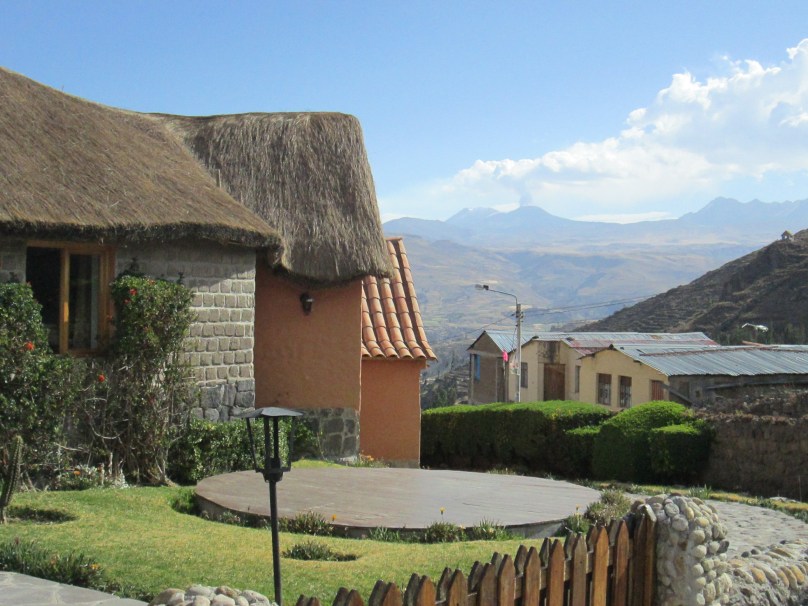
Coporaque, Peru with Volcán Sabancaya Erupting in Background
On my kitchen table, I have two guides to Peru which I consult from time to time. Even at my advanced age, I am thinking of going there once the coronavirus is but a dim memory (should that time ever come). I see in my mind a tour I took from Arequipa to the Colca Canyon area back in 2014.
We were in the Andes at between 12,000 and 15,000 feet (3,600-4,600 meters) altitude. I was chewing coca leaves with an alkaloid to keep me from suffering the effects of soroche, or altitude sickness. With meals, I would drink a tea of maté de coca, which had the same effect. Man was not made to live at that kind of elevation without some assistance. Please note that the difference between coca leaves and cocaine is like the difference between Lipton’s Tea and Bath Salts. At that level, it is simply not a narcotic.
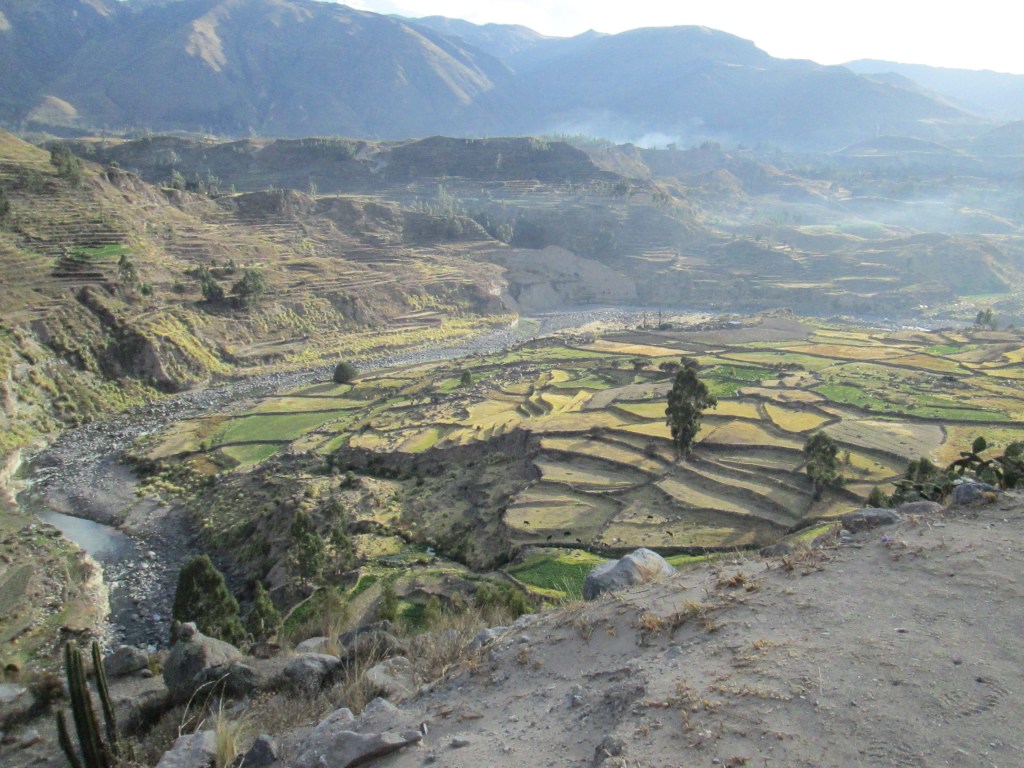
Colca Canyon with Farming Terraces Created by the Inca
As it works its way down to the sea, Colca Canyon becomes even deeper than the Grand Canyon. At its deepest point, it is 10,730 feet (3,270 meters) deep. And the whole canyon is only 43 miles (70 km) long. (Just north is an even deeper canyon: Cotahuasi Canyon at 11,004 feet or 3,354 meters deep.)
There is a place west of Coporaque called Cruz del Cóndor where you can see giant Andean condors rising on thermals from far below. At a wingspread approaching 9 feet (3 meters), it is one of the most incredible things I have ever seen. Later this week, I’ll show you some pictures I took there.
A Fiesta in Chivay, Largest Town Around Colca Canyon
The Colca Canyon area is inhabited by the Cabana and Collagua peoples. It is only about three hours from Arequipa along a high, desolate, and unbelievably picturesque route.
I spent only a single night in Colca, and I would like to remedy that. There are scheduled intercity buses that go from Arequipa to Chivay along the same route I took, and I can probably find a tour guide in Chivay. He might not speak English, but my Spanish is tolerable—if the person I’m talking to is patient.
Bags of Apples from Green Mountain Orchards in Putney, VT
The best apples I ever ate were from Vermont and New Hampshire. Sorry, Washington State, but you’re a distant third. I remember when Martine and I went to New England and Quebec in September 2012. We flew to Boston, rented a car in Salem, and drove to Green Mountain Orchards in Putney, Vermont, where we bought several bags of apples. I swear that for the next three weeks, our car smelled of the tangy Vermont apples.
As good, when we could find it, was unpasteurized apple cider from Vermont and New Hampshire. The pasteurized stuff is just like supermarket apple juice—a big yuck!—whereas the unpasteurized stuff had a tang and a bite that went down well. We indulged at the cost of diarrhea during the early part of our trip, but it was worth it.
We hoped to find good apples in Quebec, but we were sorely disappointed. I guess there’s something about the soil of the Connecticut River valley that separates Vermont from New Hampshire that makes for great apples.
I dream of going back and spending more time in Northern New England.
Still on lockdown from the quarantine, I am dreaming of a vacation that includes Peru, the northern tip of Chile, and the Altiplano region of Bolivia. I may be too old for this trip (at age 76), but I continue to collect information. In terms of transportation, it involves a round trip flight from Los Angeles to Lima, Peru.
There are three legs to this trip.
First I head south in two or three stages to Tacna, Peru, which is on the border with Chile and its Atacama Desert, and over the border to Arica. The stages might include Paracas, Huacachina, and (most definitely) Arequipa.
From Arica, I head northeast to the Bolivian border, possibly stopping at Putre and the Parque Nacional Lauca. From this point until the end of the trip, I am at high altitude, from twelve to fifteen thousand feet (between 3600 and 4600 meters). I will be subject to soroche, or altitude sickness. I will have to use coca leaves and an alkaloid to keep me from becoming seriously ill.
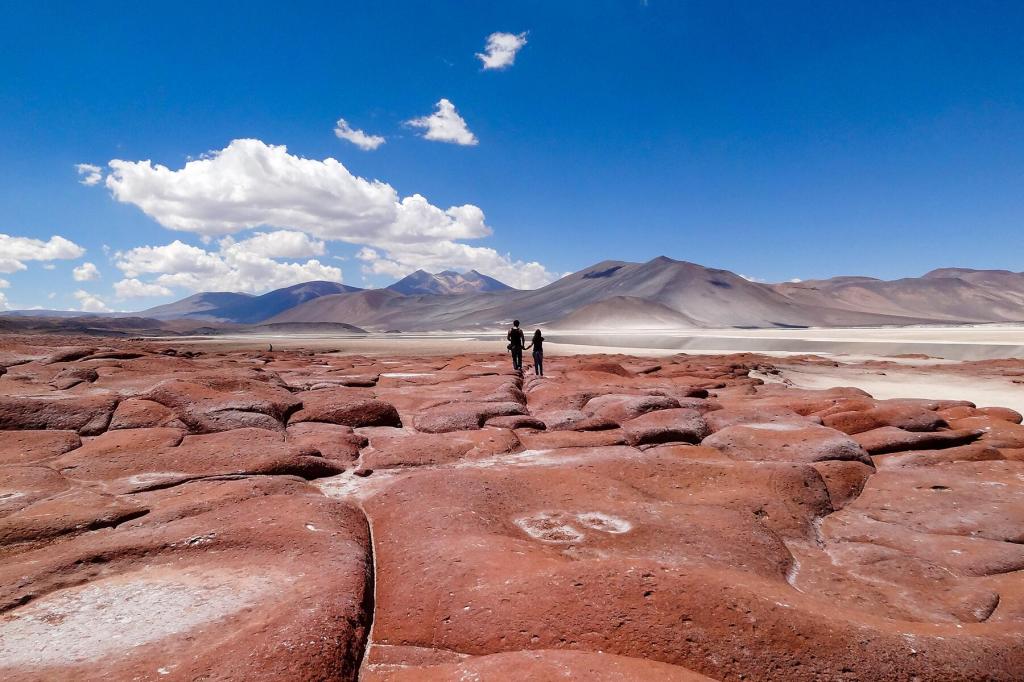
Chile’s Atacama Desert, Which Receives No Rain To Speak Of
From Arica to La Paz, Bolivia is only seven hours by bus, continuing on my northeasterly direction.
I will recover from my bus ride for a few days in La Paz, possibly seeing the ruins at Tiwanaku. Then I head northwest to Copacabana, where I will be on the shores of Lake Titicaca. I will spend a night on the Isla del Sol, and take a bus to Puno in Peru. From Puno, I will take either a bus or train to Cusco, where I will see several local Inca ruins (though not necessarily Macchu Pichu, which I saw in 2015). From Cusco, I fly to Lima and eventually back to Los Angeles.
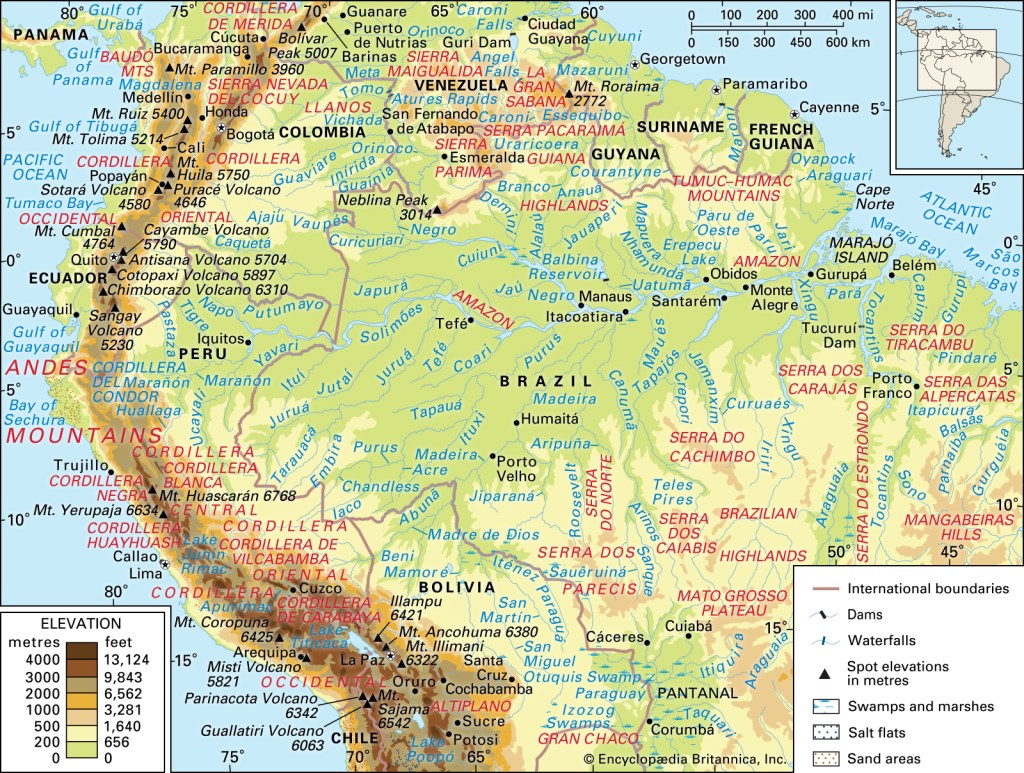
The Whole Trip Is in the Extreme Southwest of This Map
What interests me in this area are, in addition to the mountains and deserts, the cultures of the mountain peoples living in the area. Originally, I was very interested in the Inca, but then I realized that they were not as advanced as I had thought. One exception: Their stonework is amazing. Also, this is the area from which the Spanish conquistadores extracted most of their wealth, leaving behind some incredible churches full of gold, silver, and incredible paintings.
If it turns out I am too old for this trip, I will reluctantly skip Bolivia and continue to head southward in Chile until I reach Santiago.
Things being as they are, I have a hard time thinking of interesting things to write. During the quarantine, I am involved primarily in four activities: food shopping, cooking, reading, and film viewing. There isn’t much I can write about food shopping and cooking, primarily because of Martine’s irritable bowel syndrome (IBS), most of what I cook is pretty bland. When I cook a dish for myself, I tend to go crazy with spices and chiles—because I can!
I would love to write more about places that I have visited recently. Except I have not visited many places recently. There are two reasons for this:
Restaurants are usually closed, and the weather does not encourage picnicking.
If you have to go to the bathroom, you pretty much have to buy gasoline.
I’d love to go driving in the local deserts, but I am uncertain as to filling these two basic needs which all travelers have. Let’s say I want to go to Boron, California, home of the Twenty-Mule-Team Museum. Not only is the museum closed, but I have no idea where I can get food locally, and whether the local restaurants are serving diners outdoors. There is just too much uncertainty.
Sometime this February, I will pay another visit to my brother in Palm Desert. My last visit there was at the end of October. There are some places we can go, and he knows which local restaurants are serving food. (Though the best food there is likely to be cooked by my brother.) To be sure, I will take my camera and try to find some places I can write about.
Until then, you will hear more about my reading and film viewing.
If you actually want to look like an American tourist, stay the hell away from me. When you look at me as if I were a fellow gringo, I will answer you in my rather coarse Hungarian. I don’t want to be anywhere near you with your flip flops, fanny packs, baseball caps, and selfie sticks. You will be the target for anyone who can rip you off in broken English, and I don’t want to be a witness to that.
I remember my friend Janice. Her ex-boyfriend took her to Europe, but they didn’t really see anything. He was what I call an “experiential traveler”: “Hey, look at me. I’m walking on the Champs-Elysées” or “Hey, we’re in Amsterdam. Isn’t this cool?” They took pictures of each other in front of various famous locations which they didn’t take the time to visit. If I were her, I would have dumped his inert corpse into the canal.
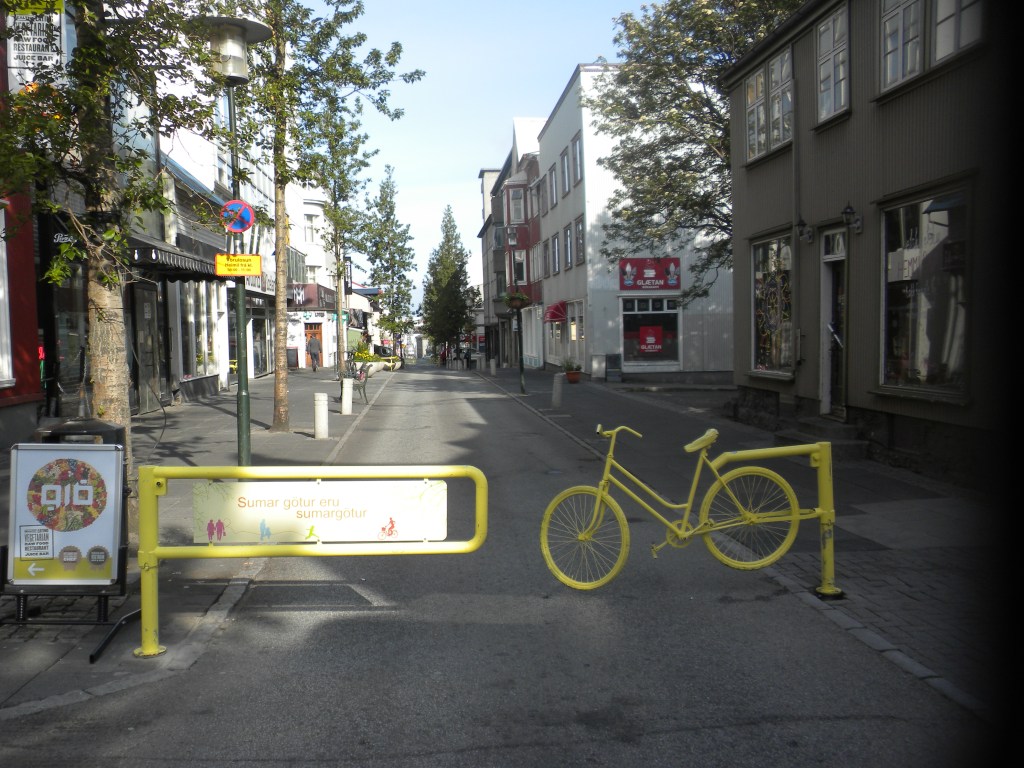
Early Morning on Laugarvegur in Reykjavík, Iceland
The best way to enjoy strange places is to explore them—and not in large groups. I keep thinking of Rudyard Kipling, no mean traveler himself, who wrote in “The Winner”:
Down to Gehenna or up to the Throne,
He travels the fastest who travels alone.
I have on occasion been tempted to replace the word “fastest” with “farthest.” I have done most of my traveling alone, especially as Martine thinks I am too adventurous for her comfort. On the other hand, I have enjoyed traveling with her and on two separate occasions with my brother. But as soon as I find myself in a large group of Americans, I quickly search for the nearest exit.
When I was in Mexico last year, I frequently hired guides by myself at the various Maya ruins I visited. Rather than joining a group that sauntered around absentmindedly, I enjoyed asking questions of the guides, who invariably knew their stuff. As opposed to the tour guide the parents of one of my friends had in Yucatán: He told his boat people tourists that the Maya ruins were built by Egyptians.
I know I must come across like a horrible grump sometimes, but I have had numerous bad encounters in foreign countries with my fellow Americans. And yet, in 2013, when I went to Iceland for a second time, I helped a couple of French tourists find a hotel in Höfn in the Hornstrandir, where no one spoke their language.
Constantinople, Trebizond, Tbilisi, Baku, Samarkand, Bukhara, Tashkent, Lhasa—these are cities I would dearly love to know more about. So when I read Kate Harris’s Lands of Lost Borders: A Journey on the Silk Road, I looked forward to learning more about these magical places. Alas, I was disappointed: The book was more about a bicycle trip with little attention paid to destinations, and most of the attention paid to the roads connecting the destinations.
I had to remind myself that there are two types of travel books. First, there was my preferred kind, which combines personal experiences with history, literature, art, cuisine, and culture—the whole ball of wax! But there is another kind of travel book as well. Call it adventure travel or experiential travel. All mountain-climbing books fall into this category. They can be excellent reads, such as Jon Kracauer’s Into Thin Air, Alfred Alvarez’s Feeding the Rat, or any of Eric Shipton’s great books on mountains he has climbed.
Tibetan Monastery
Kate Harris and her companion Melissa Yule concentrated all their efforts in surviving a multiple-thousand-mile journey involving multiple mountain ranges and passes. It was quite an accomplishment, but it just left me hungry to learn more about Constantinople, Trebizond, Tbilisi, Baku, Samarkand, Bukhara, Tashkent, Lhasa, and points between.
Oh, well, as long as the quarantine and my health last, I’ll have the time to make up that deficit.
Although most of the South doesn’t interest me very much, I would love to visit New Orleans during the two or three weeks of the year when the weather isn’t too oppressive. And I would be delighted to skip the crowds of Mardi Gras.
New Orleans started out under the French flag from 1718 to 1763, then under Spain from 1763 to 1802. It returned to France briefly in 1802 until First Consul Napoleon Bonaparte decided to sell it to the fledgling United States of America in 1803 for $15 million, along with a whole lot of other land totaling 828,000 square miles. The only other flag that flew over the Big Easy were the “Stars and Bars” of the Confederate States of America (1861-1862).
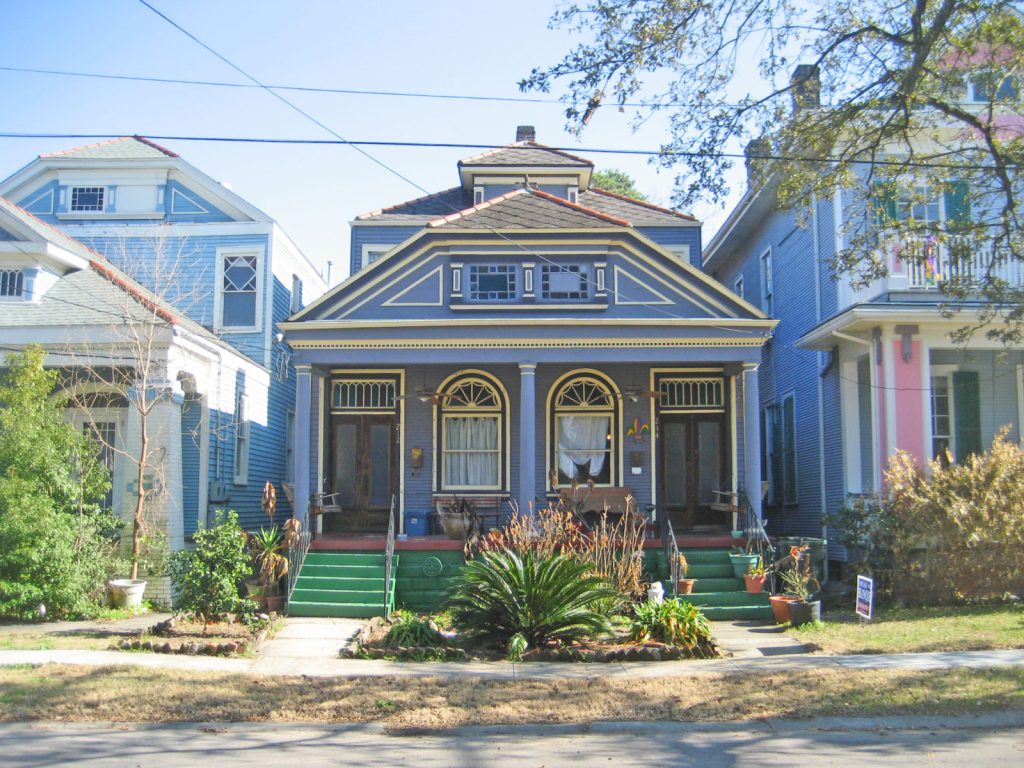
Camelback House in New Orleans
What interests me about the city is its rich cultural (and culinary) history. (How many cities in our country have their own cuisine?)
Close to the city are the Cajun parishes of Louisiana, with their own transplanted French Canadian culture. Martine and I have visited the Maritime Provinces of Canada, from where the Cajuns (Acadians) hailed after they were deported following the French and Indian War. In preparation for some future visit to Louisiana, I have been reading the Dave Robicheaux novels of James Lee Burke. And I am currently in the middle of George Washington Cable’s The Grandissimes.
Until the coronavirus quarantine becomes a thing of the past, I won’t be doing much traveling—though I might go to Puerto Vallarta in Mexico to celebrate my brother’s 70th birthday in April. (That, too, is contingent on the virus.)
The Palace (Left) and the Temple of the Inscriptions at Palenque
One of the most beautiful Maya archeological sites is Palenque in the State of Chiapas. It sits at the edge of the jungle and just before the foothills of the Sierra Madre. My brother Dan and I spent several days there in December 1979. I would give anything to go again.
The name Palenque means “Palisade,” which was given by the Spanish, who saw the ruins as a fortress. By the time the Spanish conquered Mexico, the site had been uninhabited for over eight hundred years. It was around AD 800 that many of the major Maya ceremonial centers were abandoned due to various factors. These included drought, changes in religion and form of government, and other reasons.
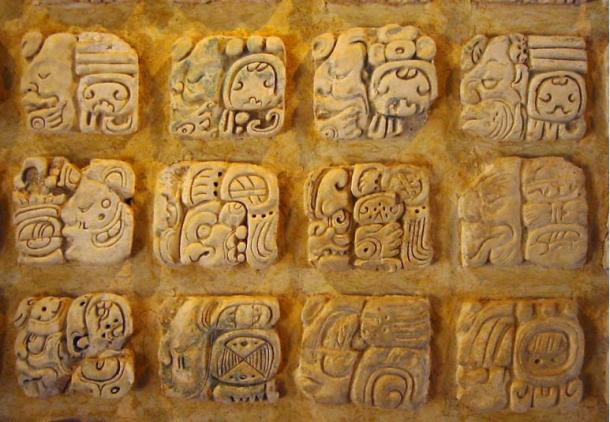
Maya Glyphs from Palenque
According to Maya glyphs that have been recently interpreted by scholars, the Maya name for Palenque is actually translated as “City of Bones.” As the great Mexican archeologist Alberto Ruz Lhuillier discovered, the Temple of the Inscriptions was the tomb of a powerful ruler named Kʼinich Janaab Pakal. In 1979, Dan and I were able not only to climb the pyramid, but snake our way through the tunnel that contained the site of Pakal’s burial chamber.
The ruins could only be described as beautiful. Only Uxmal in Yucatán could be described as its equal for siting and architecture.
Ruins in the Mist at Palenque
I was surprised that my brother seemed to enjoy Palenque as much as I did. It turns out that the region where the ruins are located is a famous coffee-growing region. So Dan, who is a major coffeeholic, found himself drinking endless cups of the stuff.
We were in town around the Christmas season, where we had the opportunity of seeing the posadas whenever we had dinner in the nearby town of Palenque. At one point, we were having dinner when a shoeshine boy came in and began circulating among the diners. When he approached Dan, my brother quietly slipped off his sandals and proffered a large foot clothed in a fuzzy red wool sock. The whole restaurant erupted in laughter.
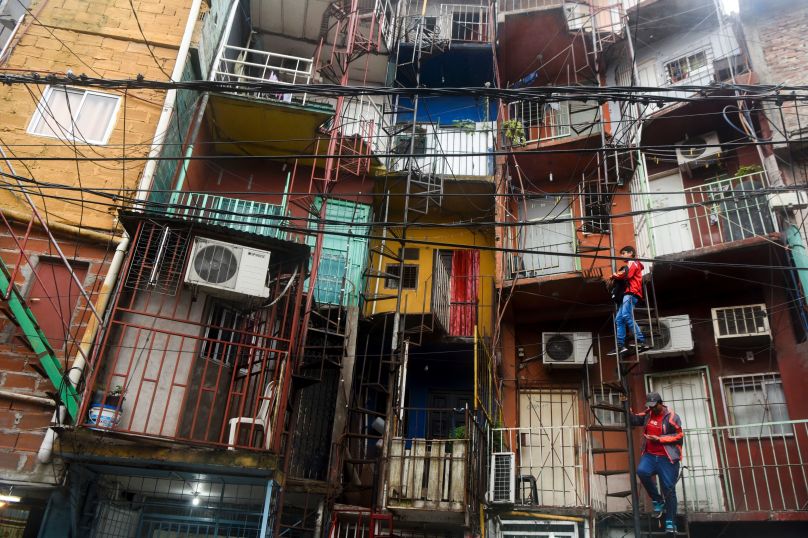
View of Apartments in the Villa 31 Shantytown in Buenos Aires, Argentina, on April 25, 2017
I had a long conversation with my friend Suzanne about the homeless earlier this evening. The increasing poverty displayed by the rising numbers of tent-dwelling homeless bothered both of us, especially as we did not find any easy solution to the situation.
During my travels, I have seen some grinding urban poverty, mostly in Buenos Aires. That was only because the train and bus stations in Retiro border on one of the worst slums in South America, namely Villa 31, one of the Villas Miserias in the Argentine capital. In BA, the ugliest slums tend to be prefaced by the word Villa in their names.
The following YouTube video will give you an idea of the place:
YouTube Video About Villa 31
In 2015, I was at the edge of Villa 31 while walking between the train station and the bus terminal. At the time, I was carrying over $2,000 in Argentinean pesos I had just obtained. A couple in their thirties came up behind me and sprayed me with a combination of steak sauce and mustard. Suddenly, they started wiping the mess with tissues that appeared miraculously in their hands. They tried to get me to go to a restroom where they would help me clean up and strip me of anything of value. But as they were urging me to my left, I suddenly cut right toward a waiting taxi and made my escape. The taxi driver was not happy with a passenger that smelled of steak sauce, but I tipped him well to clean up the upholstery after I left.
I did not visit any of the other famous favelas or shantytowns of South America, but I did get a good look at Villa 31 as my bus sped me toward Puerto Iguazú near the border with Brazil and Paraguay.
The Crowding has Made Villa 31 a Covid-19 Hot Spot
If you have any sort of conscience, you can only feel uncomfortable dealing with so much raw poverty. In the gospels (specifically Matthew 26:11), we are told “The poor you will always have with you.” But we are not told how we can eradicate poverty. Maybe we can’t, but I think it is only right that we be disturbed about it.









 Tarnmoor
You must be logged in to post a comment.