The Cemetery Cats

Homeless Cat at Recoleta Cemetery in Buenos Aires

One of the biggest tourist draws in Buenos Aires is Recoleta Cemetery, surrounded on all sides by a high-toned urban neighborhood. Tourists go mainly to see where Evita Perón is buried (she’s buried there under her maiden name, Eva Duarte, in the Duarte family crypt. In addition to Evita, virtually everyone who was anyone was at Recoleta, including a number of former presidents, as well as numerous generals and admirals. Not buried at Recoleta is Juan Perón, who was refused admission there, buried at Chacarita Cemetery off to the south, and then, after the body was vandalized, moved to a special crypt at the Museo Histórico Quinta 17 de Octubre in the suburb of San Vicente.

Not quite so well known is that Recoleta Cemetery is full of cats. It is one of several public places in B.A. that is infested with felines, including a botanical garden in nearby Palermo. The kind-hearted Argentinians typically feed these cats, so they are not quite 100% feral. They are a bit wild, however, though they recognize their benefactors. I thought the cats wandering the concrete walkways of the Recoleta were a nice touch.


The Totems of the Cowichan

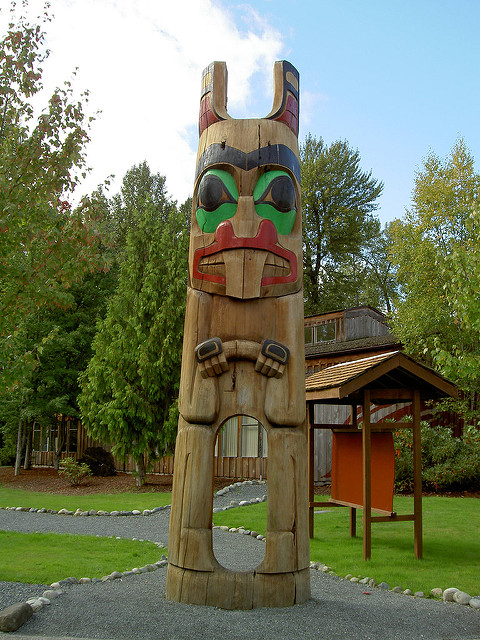
Totem Pole at Cowichan Center, Duncan B.C.

The first vacation I took with a digital camera was to Seattle, Victoria and Tofino (both on Vancouver Island), and the city of Vancouver. One of the highlights of that trip was a visit to Duncan on Victoria Island, roughly midway between Victoria and Nanaimo. The city bills itself as “The City of Totems,” mostly because of the large number of totem poles created by the Cowichan First Nation. At he time (2004), there was a very active visitor center with a restaurant containing Cowichan delicacies and even a program of native dancing.

On that particular vacation, I was traveling alone. Five years later, I repeated my itinerary from 2004. One of the biggest disappointments was the Cowichan visitor center in Duncan. Over a period of five years, neglect had set in. Many of the buildings, including the restaurant, were closed. It seems as if the center were re-positioning itself as a conference site for hire. I guess the economics of using the center as a tourist destination in 2009 were a bit prohibitive. I can only hope they make a comeback: On my first visit, I really liked the place.

Another Cowichan Totem Pole at Duncan

The German-American anthropologist Franz Boas was an expert on the early art of the tribes of the Northwest. His book Primitive Art (1927) attempts to explain how the totem poles functioned in the cultures of the various tribes. It’s a difficult read, but like many difficult reads, eminent worthwhile.


Among the Ruins of Christianity

A Room in the Archbishop’s Palace in Lima, Peru

I started my travels in 1975 with an interest in ancient civilizations. Then, I found myself also visiting the ruins of a much more recent civilization—our own. It reached its apogee in Peru. I was definitely interested in the Inca, but I found the remnants of Christianity in Peru to be even more interesting. Lima in particular was a treasure house of ecclesiastical art, not only in the cathedral and the main churches, but also in the archbishop’s palace, which is just as interesting.

For some reason, I was particularly interested in the depiction of angels in the New World. These were not the hermaphroditic or epicene angels of the mother country, but images of masculine strength that obviously owed something to the images of supernatural beings among the Incas.

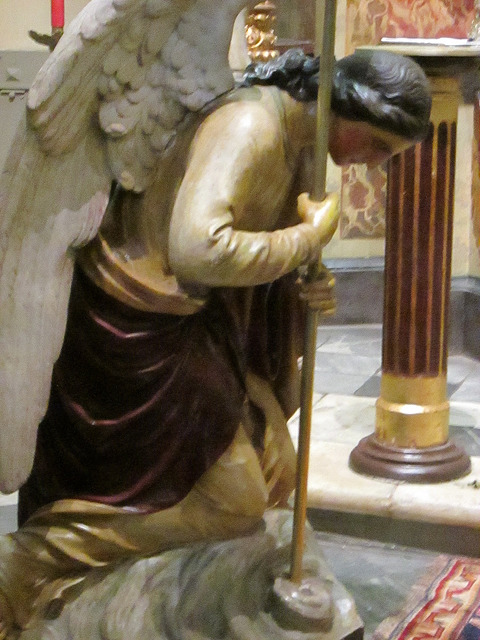
Image of Angel in Lima’s Cathedral

The angel in the above picture appears to be driving a spear into some unformed material, like clay. There is a look of determination on the angel’s face as well as a feeling of strength. Most of the statuary and art in the churches were actually done by Peruvians, and not transshipped from Europe.

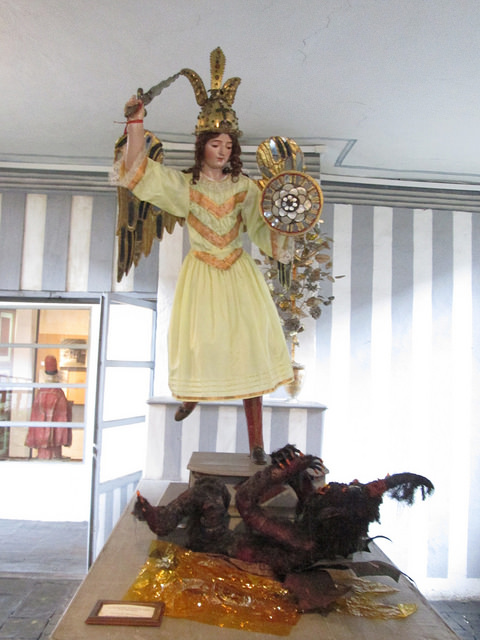
Statue of Angel in the Museo de Las Conceptas in Cuenca, Ecuador

I saw the above statue in the Museo de Las Conceptas in a former convent in Cuenca. He is another one of those militant angels of South America, and one who is in the middle of overcoming a demon. Cuenca has two religious museums. One is the former cathedral on the main square, and the other is in the former convent.

If you find yourself visiting Latin America, you will find some interesting bits of our own history as it has been adapted and modified by the converted natives. Perhaps the most extreme example of this is among the highland Mayans of Chiapas. I don’t have any pictures for you, because I was warned against even taking my camera to Chamula. Some European tourists were killed by the Chamulas by taking photos in the church. My brother and I did see the church. There were statues of Christ, the Virgin, and various saints, but they were covered with stalks of corn. In place of pews, there was a large open space, where the Chamulas lie face down on the floor with arms outstretched, surrounded by lit candles.

As you can see, going to church is a part of my visits to Latin America.


Flying in the Andes

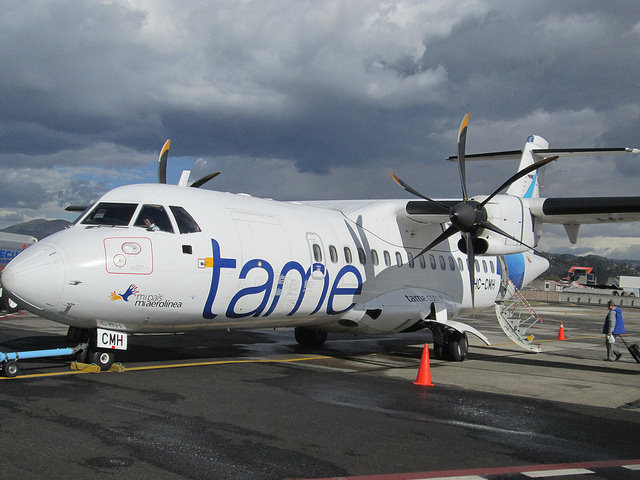
Actually, It’s Anything But Tame

I have flown over the Andes on several airlines: LAN, Avianca, Star Peru, Copa, and TAME. Because we don’t often think about South America, we don’t realize that the Andes are every bit as high, in general, as the Himalayas. I say “in general” because our method of measuring altitude is in flux, largely because the ocean level is in flux due to global warming. If we measure a mountain’s altitude from a point at the center of the earth, the highest mountain on the planet is Chimborazo in Ecuador. That is due primarily to a bulge in the earth around the equator which in effect elevates mountains atop that bulge.

In the past, I used to be disturbed by air turbulence. Now, with all the vacations in South America, I see turbulence as a sign that I am nearing my destination. Virtually all flights from Los Angeles to Lima, Quito, Santiago, or Buenos Aires involve a diagonal path over a chunk of the Andes. This usually takes place in the middle of the night, so I don’t get a chance to see the snowcapped peaks over which we are flying.

That plane in the picture was the plane I flew from Cuenca in the south of Ecuador to Quito. My brother had left a week or so earlier (also on a TAME prop plane), so we had returned the rental car to the Cuenca office of the rental company. I explored a bit on my own, taking a bus to Alausi to take a fascinating train ride; and I also visited a whole lot of museums in Cuenca. There are a zillion museums in Latin America, and most of them are fun even when there are no signs in English.

For my next trip to South America, I hope to fly to Bolivia and return via Buenos Aires. There’s a lot to see in between, even if I have to take a connecting flight part of the way.


Serendipity: “Happiness, Pure and Immaterial”

Dame Freya Madeline Stark DBE (1893-1993)

One of the most incredible women travelers of the Twentieth Century was Freya Stark, who wrote some thirty books about her solo travels in the Middle East during the 1930s, 1940s, and 1950s. I am currently halfway through The Southern Gates of Arabia: A Journey to the Hadhramaut (1936) about her trip to a part of Yemen which is currently at war with Saudi Arabia. Yet she managed to travel around by herself with only one problem: she contracted a wicked case of measles when she visited a harem in Masna’a. Before she came down with her illnesses, she reflects on a moment of pure joy:

When the evening came, and the sweet shrill cry of the kites, that fills the daylight, stopped, ’Awiz appeared with three paraffin lanterns, which he dotted about the floor in various places, and, having given me my supper, departed to his home. The compound with its dim walls, its squares of moist earth planted with vegetables and few trees, grew infinite and lovely under the silence of the moon. The gate of the city was closed now; a dim glow showed where the sentries beguiled their watch with a hookah in the guard house; at more or less hourly intervals they struck a gong suspended between poles, and so proclaimed the hour. And when I felt tired, I would withdraw from my verandah, collect and blow out the superfluous lanterns, and retire to my room. None of the doors shut easily, so I did not bother to lock them; I had refused the offer of a guard to sleep at my threshold, the precaution was so obviously unnecessary. As I closed my eyes in this security and silence, I thought of the Arabian coasts stretching on either hand:—three hundred miles to Aden; how many hundred to Muscat in the other direction? the Indian Ocean in front of me, the inland deserts behind: within these titanic barriers I was the only European at that moment. A dim little feeling came curling up through my sleepy senses; I wondered for a second what it might be before I recognized it: it was Happiness, pure and immaterial; independent of affections and emotions, the aetherial essence of happiness, a delight so rare and so impersonal that it seems hardly terrestrial when it comes.


Travel Without Leaving Home

Vicuñas Seen on the Road to Puno, Peru

Why should I care that you become an armchair traveler rather than an actual traveler? Curmudgeon that I am, if I ran into you on my travels, all eager to talk about your lovely home town of East Jesus, Arkansas, you would be met with a torrent of Hungarian and not a word of English. I would be perfectly happy to see you indulge your desire for travel by reading a book rather than obtruding with your actual presence.

As for myself, I not only like to travel, but I like to read about travel. Here is a list of an even dozen travel classics. Curiously, they are all written by English or American travelers. Not that other peoples have not written travel classics: Only, they tend to be more obscure in the Anglo-American world of publishing. And besides, the English are so damned good at it!

The following are presented in alphabetical order by author:

  • Robert Byron: The Road to Oxiana (1937). Driving through Persia to reach Afghanistan at a time when roads were few and hairy.
  • Bruce Chatwin: In Patagonia (1977). Not everything Chatwin says is 100% true, but it always is 100% fascinating.
  • Lawrence Durrell: Prospero’s Cell, A Guide to the Landscape and manners of Corcyra (1945). All Durrell’s travel books are worth reading.
  • Patrick Leigh Fermor: A Time to Keep Silence (1957). About the first part of a walking tour from Holland to Istanbul, just as the Second World War is about to break out.
  • John Gimlette: At the Tomb of the Inflatable Pig (2003). A fascinating book about Paraguay, its history and people.
  • Graham Greene: The Lawless Roads (1939). Greene’s research for his novel The Power and the Glory, about a trip to Mexico during a persecution of the Catholic Church.
  • Eric Newby: Slowly Down the Ganges (1966). About an attempt to navigate the sacred river of India all the way to the Indian Ocean.
  • Freya Stark: The Valley of the Assassins and Other Persian Travels (1934). By a woman traveling alone in the Middle East!
  • John Steinbeck: The Log from the Sea of Cortez (1951). Travels in the Gulf of California doing oceanographic research.
  • John Lloyd Stephens: Incidents of Travel in Central America, Chiapas, and Yucatán (1841). Travels in Maya land in the middle of a civil war.
  • Paul Theroux: The Old Patagonian Express (1979). The book that inspired my own travels to South America.
  • Colin Thubron: To a Mountain in Tibet (2011). A religious pilgrimage to Mount Meru, a magnet for three religions.

I could have added another twelve without too much further thought. Hell, I could have added another hundred.

Born in Cleveland, we were too poor to afford travel far beyond Northeastern Ohio. That resulted in my case with an insatuiable desire to see the world, which I started to do in 1975. God, how I wish I could live long enough to continue in the same vein.


Føroyar

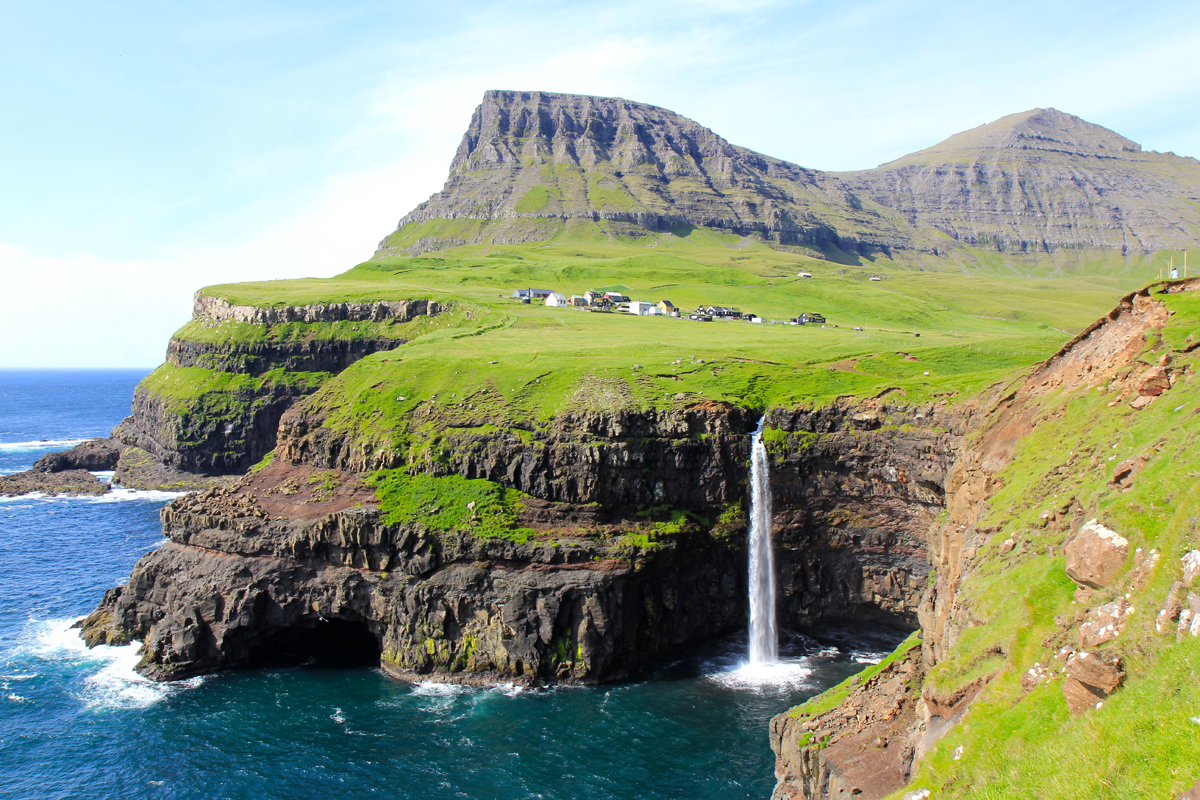
Waterfalls, Cliffs, Raging Seas, Desolation … Looks Perfect!

My brother makes fun of my choice of travel destinations. “You always pick these desolate places,” he says, “like Iceland or Patagonia or the dark side of the Moon.” He, on the other hand, vacations in Fiji or Tahiti or Kauai. I’d like to think it’s because he’s lived inland for most of his life; and—because he works so hard constructing beautiful homes—that beaches have a certain appeal for him.

In the meantime, I have discovered a new European destination that looks incredibly desolate: The Faroe Islands (Føroyar in Faroese), located midway between Norway and Iceland. A semi-independent archipelago, the Faroes is partly controlled by Denmark, especially as regards its economy and security. Some 50,000 people.

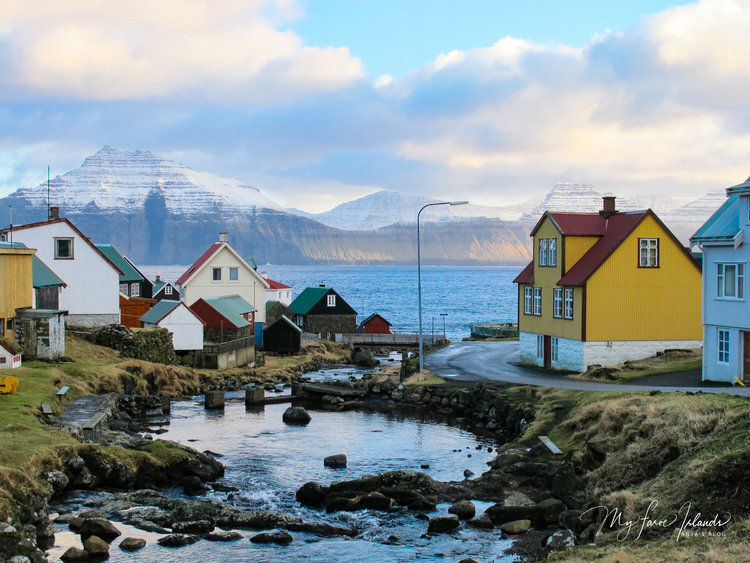
The Village of Gjógv (Try Repeating That 10 Times Quickly)

Like Iceland, the Faroes were originally inhabited by Irish monks, but then their rent was raised by Viking invaders. Right offhand, I would say that this archipelago is the most isolated part of the European continent. My interest was piqued by a BBC photo essay featuring postmasters of some particularly remote locales. I took one look and said to myself: I think that’ll be next—after my upcoming Guatemalan adventure.

Torshavn, Capital of the Faroes

The only thing I might not like about the Faroes is the diet of their inhabitants: pilot whales, puffins, and various odd bits from the sea. Oh, hell, who am I kidding? I’d probably love the stuff.


Pre-Columbian Writing

Detail from the Dresden Codex

At the time the Spanish landed in he New World, there was only one Pre-Columbian culture that had a written alphabet, and that was the Maya. Now I have heard that in earlier centuries, the Zapotecs and Mixtecs of Northern Mexico had a written alphabet, but stopped using it after a certain point. Curiously, the Aztecs and Inca did not have their own alphabet, however advanced they may have been in other respects.

Right now, the only instances we have of writing in Mayan are glyphs at various Maya ruins and four surviving codices that escaped the religious zeal of the Spanish missionaries in destroying what they perceived to be heretical. And since the subject matter related to Maya religion, it was heretical insofar as Christianity was concerned.

The most famous destroyer of Mayan codices was Diego de Landa, the Franciscan Bishop of Yucatán in the 16th century. In a famed book burning conducted in 1562, de Landa had 27 codices burned at Mani. He described the Maya as being disconsolate at the destruction of so much of their culture at one time. Curiously, it was the same de Landa who wrote the Relación de Las Cosas de Yucatán, which preserved an astonishing amount of the culture and language, such that it is still studied by Maya scholars. It is still available in a Dover Publications paperback.

Do you see the dots and dashes in the above detail from the Dresden Codex just above the four seated figures? They are, in order, the numbers 16, 4, 9, 13, zero (yes, the Maya had discovered zero), 5, 12, 2, and 1. As you can probably surmise from this, the dashes represented the number five or a multiple of fives; and a dot, a one or multiple of ones up to four. It was a vigesimal system, meaning to the base 20 rather than base 10 like ours. Very likely, the numbers in the illustration represent a “long count” calendar date fixing a particular event in time. You can read more about Maya mathematics here.

The other interesting thing about the Mayan alphabet is that some symbols were hieroglyphic and stood for an entire word and others phonetic, standing for syllables. This confused scholars for years.

At the time I started visiting the Maya world, only the calendrical symbols had been decoded (mostly thanks to the selfsame good/bad Diego de Landa). In the last forty years, we have discovered that the Maya have a history. We have learned names of rulers and translated descriptions of events commemorated by Maya rulers.


The Narrow Road to the Deep North

Matsuo Bashō by Hokusai

Several times over the last thirty years, I have returned to the 17th century haiku and commentaries by Matsuo Bashō on the subject of travel:

Amid mountains of high summer,
I bowed respectfully before
The tall clogs of a statue,
Asking a blessing on my journey.

There is a quality to Bashō’s writing that makes me want to hit the road. As he wends his way through Shogunate Japan, stopping at temples along the way, I see him as the ideal traveling companion.

This grassy hermitage,
Hardly any more
Than five feet square,
I would gladly quit
But for the rain.

I think of his poem about a ruined castle:

A thicket of summer grass
Is all that remains
Of the dreams and ambitions
Of ancient warriors.

Bashō’s prose, too, has a certain quality that is worth remembering:

Go to the pine if you want to learn about the pine, or to the bamboo if you want to learn about the bamboo. And in doing so, you must leave your subjective preoccupation with yourself. Otherwise you impose yourself on the object and do not learn. Your poetry issues of its own accord when you and the object have become one—when you have plunged deep enough into the object to see something like a hidden glimmering there. However well phrased your poetry may be, if your feeling is not natural—if the object and yourself are separate—then your poetry is not true poetry but merely your subjective counterfeit.

How marvelous! This is what I seek from my travels—not that I write poetry—a “hidden glimmering” that makes itself manifest when I confront it with my entire being.

The name of this post, and of Bashō’s poetic journal, was also used by Australian novelist Thomas Kavanagh in his novel The Narrow Road to the Deep North, which tells of its physician hero’s imprisonment in World War Two Burma building the bridge on the River Kwai made famous by David Lean’s movie.


Quiriguá

Zoomorph at Quiriguá

Now that Martine has returned for the time being, I can turn my attention to other things, like that dream of Guatemala that is taking shape in my mind. One of the Maya ruins that I hope to visit is Quiriguá, which is nestled close to the border with Honduras. As the crow flies, it is not far from the even more spectacular ruins at Copán just over the line into Honduras.

In the 1840s, John Lloyd Stephens and his artist Frederick Catherwood paid visits to Copán, Quiriguá, and Palenque. Below is one of the many stelae at Quiriguá as drawn by Catherwood:

Stela at Quiriguá

Quiriguá is actually a small ruin that can be seen within a couple of hours. The trick is getting there in the first place. As I have mentioned in an earlier post, I have been informed that some shuttles that go to Copán also pay a visit to Quiriguá as part of the return trip to Guatemala City or Antigua. But as I look at the map of Guatemala, I see that the road network is nowhere near the routing of flying crows. It would probably add a couple of hours to the return trip. So I remain skeptical until I can get some information from someone on the ground in Guatemala.