Plotting a Getaway

Isla Mujeres Seen from the Air

The island is a half hour boat ride from Cancun’s Puerto Juarez. It is approximately 4.3 miles (7 km) long and on an average of 0.4 miles (650 meters) wide. In the above photo, you are viewing the eastern tip of the island, known as Punta Sur. The main town and the best swimming beaches are at the far end.

I am in the process of trying to convince Martine to come with me for a week in Isla Mujeres. It would be a low stress visit with lots of great seafood and, at Playa Norte, a beach that has a sand bottom, no waves, no rip tides, no rocks, no seaweed, and plenty of clear, utterly transparent water of the right temperature.

Martine does not like traveling to Mexico (she’s been to Yucatán once and Cabo San Lucas once). I am hoping I can lure her with pictures of a no-fuss, no-muss destination with great seafood, swimming, and shopping. And virtually no automobiles, except for taxis.

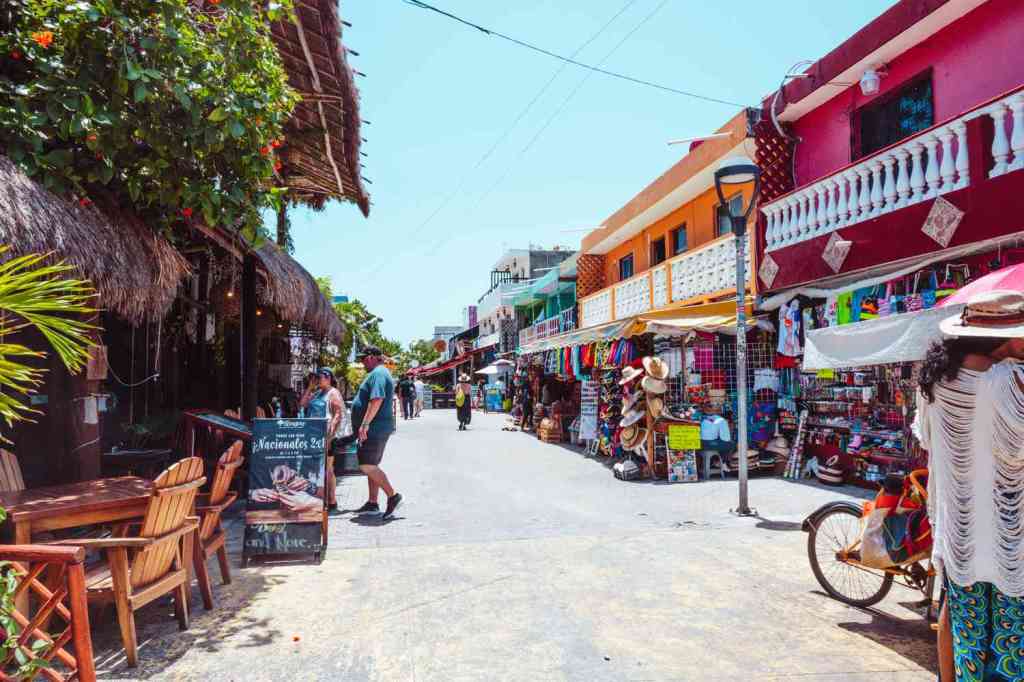
Shopping on Isla Mujeres

Although Isla Mujeres is famous for diving and snorkeling, I have no intention to do either. I have never dived or snorkeled before, and I don’t intend to start at age 80.

I have been watching YouTube videos submitted by Internet Influencers. They have been useful for showing what the place looks like, and how young influencers like to get sloshed when they’re away from home.

Wish me luck with Martine.

I Visit Maximon

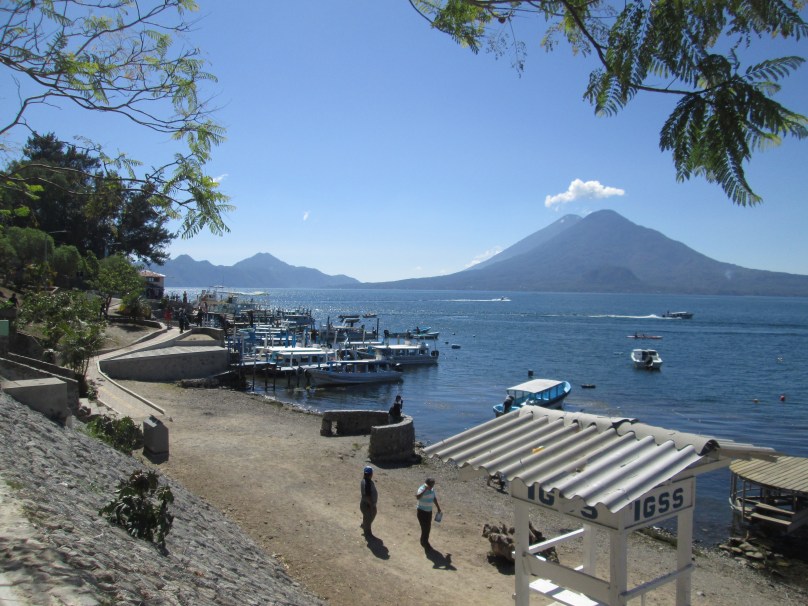
Lago de Atitlán from Panajachel

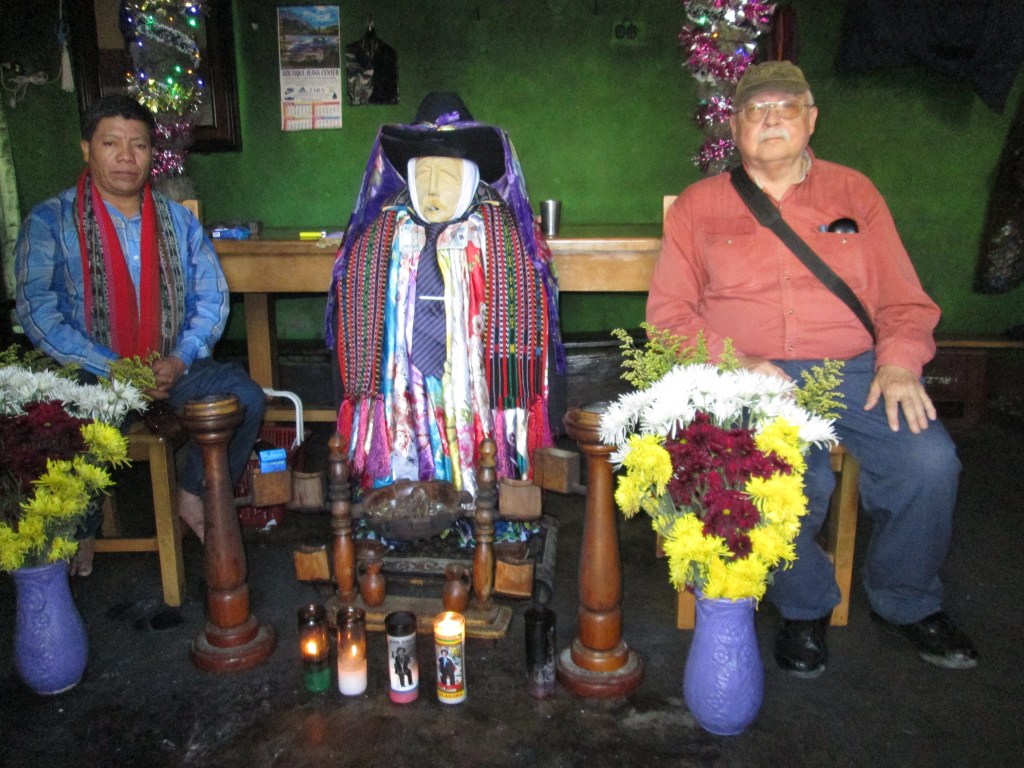
It was 2019 when I spent several weeks in Guatemala and Honduras. After five days in Antigua Guatemala, I took a bus to Panajachel, the main port on the Lago de Atitlán. I very much wanted to meet Maximón, a folk saint or deity based in Santiago de Atitlán, a city that had seen much strife during the persecution of the native Maya people.

According to the National Geographic Society’s website:

Maximón, also known as San Simón, represents light and dark. He is considered a trickster—both a womanizer and protector of virtuous couples. According to legend, the village fishermen traveled frequently for trade and enlisted Maximón to protect the virtue of the wives they left behind. It backfired. Instead, Maximón is said to have disguised himself as a loved one so he could have sex indiscriminately.

Today, Maximón’s effigy resides in a different family’s home every year—his wooden body is dressed in a typical male suit of the region and placed on a petate, or straw mat. Traditionally he was only brought out during Holy Week, but because of high demand from pilgrims, tourists, and brujos (shamans), he is on display year-round.

Those seeking miracles, good health, and love make offerings at his shrine in exchange for his favor—moonshine, hand-rolled cigarettes, and money are his vices of choice. His cofrades, or attendants, spend their days smoking and drinking by his side, and it is considered the highest honor to host him. He is brought out during Holy Week and paraded through the streets before being placed in a different home for the following year.

With Maximón (Center) in Santiago de Atitlán

I made my own offering to Maximón to protect me during my travels, as I had a number of hard-to-get-to Maya ruins still to visit, including Copán in Honduras and Quiriguá and Tikal in Guatemala. He rewarded me with one of my best trips in Latin America.

The Royal Mile

The Busiest Mile in All of Tourism

If you want to see the most concentrated real estate in all of tourism, I recommend the Royal Mile in Edinburgh, Scotland. At one end is Edinburgh Castle. One passes historic pubs and fascinating museums, the towering hulk of St. Giles Cathedral in the center, and ending at Holyroodhouse Palace, from where Mary Queen of Scots ruled.

In my visits to Britain, I have always preferred Scotland to England. The food is better, the history more poignant, and the people more friendly. And then there’s the whisky, which can be ethereal. (In one of my boxes of photos is an image of Martine hugging the distillery at Bowmore on Islay.)

I particularly love the Highlands and Islands. My travels north of Edinburgh have included Stirling, Perth, Oban, Loch Ness, Inverness, and the isles of Iona, Mull, Islay, and the Orkney Mainland.

One can’t walk up to Stonehenge and look at it up close, but one can walk up to the Standing Stones of Stenness and the Ring of Brodgar.

As I sit here in Los Angeles during yet another overlong heat wave, I dream of re-visiting some of the places in Scotland Martine and I have seen and having a good meal of haggis and neaps washed down with a wee drappit of Scotch.

Mexican Rules

Benito Juarez Airport in Mexico City

I was reading Oliver Sacks’s Oaxaca Journal—a book I do not recommend you read unless you are a botanist—when I came across this passage which reminded me of past trips to Mexico:

“What gate do we go from?” everyone is asking. “It’s Gate 10,” someone says. “They told me it was Gate 10.”

“It’s Gate 3,” someone else says, “It’s up there on the board, Gate 3.” Yet another person has been told we are leaving from Gate 5. I have an odd feeling that the gate number is still, at this point, indeterminate. One thought is that there are only rumors of gate numbers until, at a critical point, one number wins. Or that the gate is indeterminable in a Heisenbergian sense, only becoming determinate at the final moment (which, if I have the right phrase, “collapses the wave function”). Or that the plane, or its probability, leaves from several gates simultaneously, pursuing all possible paths to Oaxaca..

. . . . . . . . . . . . . . . . . . . . . . . . . . . . . . . . . .

This reminds me of a trip my brother and I took to Mexico in 1979. We flew into Mexico’s Benito Juarez Airport and were to take a connecting flight to the misnamed city of Villahermosa. Not only was the gate uncertain, not only was the time uncertain, but whether the flight would take place at all was uncertain. (You can read more about it here.) This was a interesting lesson in traveling under Mexican rules.

This was no longer the precise Anglo-Saxon world we had just left behind. There was uncertainty everywhere. If you let it bother you, you will mot enjoy your vacation. If, on the other hand, you take it as a “Heisenbergian” event and hang in there to see how it all sorts out, you not only win but you learn an interesting lesson that, in the end, you can take back home with you.

Tojásleves

The Plaza Mayor in Cuenca, Ecuador

My brother and I were in Cuenca, Ecuador. In a few days, he had to leave to honor a work commitment, while I was to stay behind for another week. On the Plaza Mayor in Cuenca, Dan and I made an interesting discovery. There was a café that served a perfectly authentic Hungarian tojásleves, or egg soup.

When we checked for any Magyar influence in the kitchen, we were met with looks of confusion and consternation. What reminded us so much of our mother’s beloved egg soup was actually a local dish.

Sometimes, one can travel halfway across the world only to find something that reminds one of home. Not always. More often than not, one makes strange new discoveries.

This time, after a couple weeks in Ecuador, Dan and I had a taste that sent us back to our childhood in Cleveland. Here is a copy of the original Hungarian recipe. Only, Mom would add some sour cream in ours.

Some Travelers in the Middle East

Dromedary Camel

In the heat of summer, I tend to read books written by travelers in the deserts of this world. Here are just a few of my favorites, with an emphasis on older sources.

Charles M. Doughty: Travels in Arabia Deserta (1888)

This is the gold standard. Doughty, a poet and Anglican minister, spent months on the Arabian peninsula at some considerable danger to himself. Interestingly, his book inspired one T. E. Lawrence, better known as Lawrence of Arabia, in his own travels during the First World War. In fact, Lawrence wrote the introduction to my Dover edition. By the way, this is not an easy read; but it is a rewarding one.

T. E. Lawrence: The Seven Pillars of Wisdom (1926)

Read Lawrence’s own account of his attempt at mobilizing the Arabs against the German-allied Turkish sultanate. What are the seven pillars of wisdom? Well, actually, Lawrence never made that clear. He planned to write a more massive work but used the original title for the one he finally published.

Sir Richard Francis Burton: Personal Narrative of a Pilgrimage to Al-Madina and Meccah (1855-56)

This one’s a classic. Burton successfully posed as an Afghan doctor and visited the forbidden cities of Medina and Mecca during the Haj pilgrimage, which he describes in great detail. Burton was a linguist and polymath, so he was able to beard the Arabs in their own den.

Freya Stark: Multiple Works

How was a British woman able to travel by herself through the Middle East and still live over 100 years? She wrote over twenty extremely readable books, many of which are still in print today. Check out the list of her works in Wikipedia.

Gertrude Bell: Syria, the Desert& the Sown (1907)

Yes, another of those talented and indomitable British women. This one was well connected with the Foreign Office and had some say in the region’s sad history.

Forest Road 300

The One Major Part of Arizona I Have Not Visited

I am fairly familiar with the desert portions of Arizona, with the sole exception of Phoenix, which I have little interest in visiting. One non-desert part of the state I would like to see is the Mogollon Rim, which runs for some two hundred miles (322 km) as a series of high cliffs in the east central part of the state.

Running along the rim is Forest Road 300.. According to an article in Arizona Highways:

Measured in thousands of feet and hundreds of miles, it’s [the Rim] a massive wall of rock that begins near Arizona’s border with New Mexico and stretches diagonally across most of the state. Through the lens of a camera, a set of binoculars or your own baby blues, the views from the top of the Rim are stunning, and on a clear day, you can see all the way to Mount Lemmon.

The vistas steal the show, but there’s a lot to see along Forest Road 300, which can be approached from the east, near Woods Canyon Lake, or from the west, just north of Strawberry. This listing is written from the west, and it begins with an uphill climb through a thick pine forest—the Mogollon Rim is home to the world’s largest stand of ponderosas. After 1.2 miles, FR 300 intersects what used to be the General Crook Trail, a historic wagon route that was used in the 1870s and 1880s to provide logistical support for General George Crook in the U.S. Army’s war against the Apaches.

From reports I have heard, the road is being paved, to the accompaniment of complaints from the 4×4 community. I don’t know if my Subaru is up to a long isolated ride on an unimproved dirt road, but I’m willing to give it a try.

I hope that Martine and I can pay a visit to the Rim and various other parts of the state early this autumn.

Orozco at Dartmouth

Panel of Orozco’s Epic of American Civilization

One of the things I most loved about my years at Dartmouth College was studying in the Baker Library’s Reserve Room, as it was then called. The Mexican artist José Clemente Orozco (1883-1949). Between 1932 and 1934, he painted a series of murals entitled “The Epic of American Civilization” in the college’s Baker Library.

There is a detailed discussion of Orozco’s mural put out by Dartmouth’s Hood Museum describing all the panels.

The Reserve Room

Sometimes I think it is those murals which first got me interested in going to Mexico. Nine years after I graduated, I finally made it to Yucatán and visited the ruins at Uxmal, Chichén Itzá, Mayapan, and Kabah during a two-week trip in November 1975.

Until I saw Orozco’s work, Mexico and the Pre-Columbian civilizations of the Americas just weren’t on my radar. Afterwards, they became a major preoccupation.

Quetzalcoatl in a Panel of the Orozco Murals

Little did I know in my college years that my interest in the murals would eventually lead me not only to Mexico, but also Argentina, Guatemala, Honduras, Uruguay, Chile, Peru, and Ecuador.

Incident at Retiro

The Retiro Train Station in Buenos Aires

It was November 2015. I had just returned by train from Tigre where I had explored the delta of the Rio Paraná on a boat. That evening, I wanted to take a night bus to Puerto Iguazú to see the famous waterfalls. First I had to get a bus ticket, then take a cab back to my hotel in Recoleta and pick up my luggage, which was being held for me at the desk.

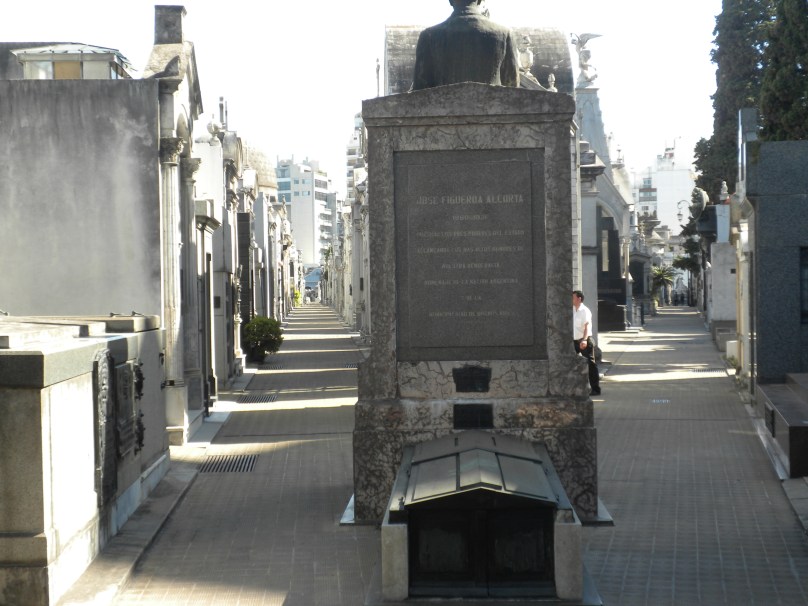
The main Buenos Aires bus station is a couple hundred yards’ walk to the north of the train station, just to the right (not shown) of the train station shown above.

As I walked along the crowded walkway to the bus station, I smelled an odorous mix of steak sauce and mustard that was squirted onto my back by a young couple that was following me. They were exceedingly polite as they applied paper towels to the mess and offered to accompany me to a location on the left where I would be cleaned up.

Cleaned out was more like it. I was familiar with this pickpocket trick. As I was carrying several thousand Argentinean pesos on my person, as well as several hundred dollars cash, I immediately went to my right and hailed one of the numerous cabs that had just dropped someone off at the bus and train stations. I jumped into the cab and asked them to drive me to my hotel in Recoleta.

The cab driver was not happy to be dealing with a rider who made his cab smell weird. Still, he drove me and I gave him a generous tip to clean the steak sauce/mustard smell from the back seat.

I picked up my bags and took another cab—this time directly to Retiro Bus Station, avoiding the walkway between it and the train station. I bought my ticket to Iguazú and got on the bus, still reeking. When, after a good night sleep, I got to my destination, I talked my hotel into laundering my still-smelly clothes.

It was an interesting experience.

The Alabama Hills

Hundreds of Hollywood Films Were Shot in the Alabama Hills

If you take California 14 from Los Angeles through the Antelope Valley to the end, you will find yourself on U.S. 395 near China Lake and Ridgecrest. In another hour or so, you will pass the turn-off for Death Valley in Olancha and soon afterwards the little town of Lone Pine.

Just west of Lone Pine, along the road that takes you to the Whitney Portal, are the Alabama Hills, which if you have seen as many films as I have, may be surprisingly familiar to you. That is because literally hundreds of scenes in Hollywood films were shot there, Here is a short list:

  • Gladiator (2000)
  • Django Unchained (2012)
  • Tremors (1990)
  • The Great Race (1965)
  • Bad Day at Black Rock (1955)
  • How the West Was Won (1962)
  • Gunga Din (1939)
  • Around the World in 80 Days (1956)
  • The Ox Bow Incident (1942)
  • High Sierra (1941)
  • Greed (1924)
  • Ride Lonesome (1959)
  • Three Godfathers (1948)
  • Samson and Delilah (1949)

If you should find yourself driving up that lonely Eastern Sierra highway, you might want to spend an hour or two taking the Alabama Hills loop road and seeing the sights. You can find out more if you should eat breakfast or lunch at the Alabama Hills Cafe in Lone Pine, probably the best eatery for a radius of a hundred miles.

Also highly recommended is the town’s Museum of Western Film History, which memorializes the Westerns shot in the Alabama Hills area.