Japan Has Fujiyama and …

... and Ecuador Has Its Cotopaxi

… and Ecuador Has Its Cotopaxi

Heigh ho! It’s off to Volcano Land again. In Peru, I saw Sabancaya in eruption; while in Chile, I almost had to change my itinerary because of Calbuco, which whose eruption graciously fizzled out before I arrived in South America.

Last year, Cotopaxi erupted, as shown in the above picture. But it was not a major event.

This fall, I hope to stay a night or two in the shadow of Cotopaxi. It’s only a couple hours south of Quito along the Panamerican Highway, so it shouldn’t be too difficult.

South of Quito

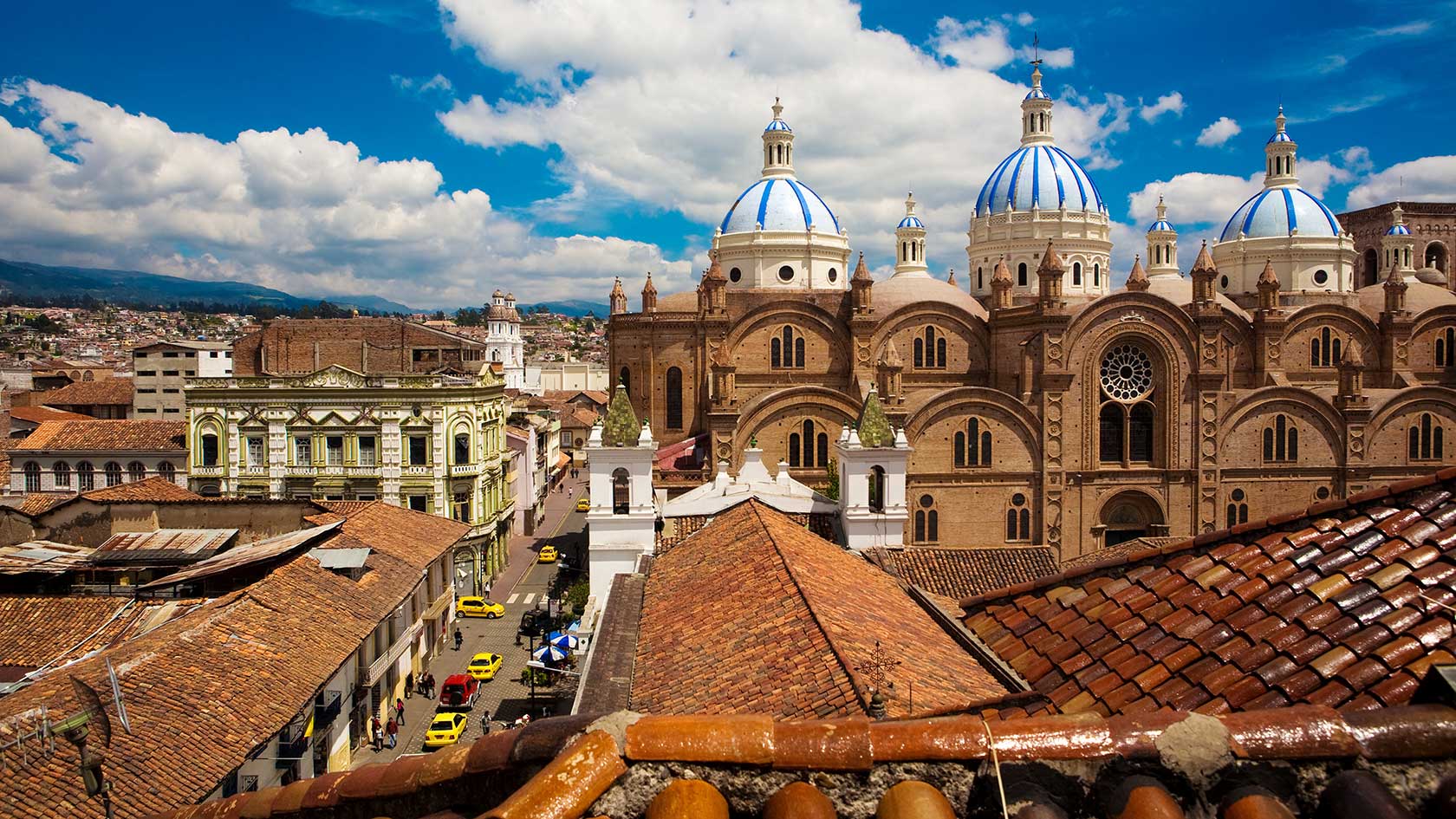
Street Scene, Cuenca, Ecuador

Street Scene, Cuenca, Ecuador

Today my brother and I talked about our upcoming trip to Ecuador. It seems we will be together for only the first two weeks or so of the trip, leaving me to return to Los Angeles separately a week or so later. That would suit me, as well as suiting Dan’s construction schedule in his business. We will probably leave from LAX right after the October 15 tax deadline.

Even though we will rent a car for part of the time, we will likely not have a chance to see four major clusters of destinations in two weeks. First we’ll have to get acclimated to the 9,000 foot altitude of Quito (about three days), then spend several days at and around Otavalo, and then head to the cloud forests around Minto or the Intag Valley to spend some time at a lodge, and finally head south to Cuenca, around which there is a whole large cluster of sites, including the Nariz del Diablo railroad, Mount Cotopaxi, Vilcabamba, and several national parks. Then, of course, one or both of us would return to Quito for Dan’s departure.

Possibly, I will do the southern stretch of the Ecuadorean Andes by myself, traveling by bus. Plans are still in flux around this time. The key thing is that we are in basic agreement about destinations, transport, and accommodations. The main thing I want to avoid is getting stuck in a backpacker hostel. Not that I dislike backpackers; but I do dislike bunk beds and late night loud discussions that disrupt my reading and sleep.


Through the Devil’s Nose

The Nariz del Diablo Train Route

The Nariz del Diablo Train Route

When I go to Ecuador later this year, I hope to take one of the trains that go through parts of the Andes. The only problem is that they are all tourist trains, that is to say, the locals do all their traveling by bus. Most of the routes are scenic fragments of what once were longer routes, back when one could ride the trains with Andean natives carrying their goods to and from market.

The problem is that I tend to dislike traveling with large groups of Americans. That’s when I dummy up and answer all questions in Hungarian. I don’t want to talk about how things are in East Jesus, Arkansas.

At present, the most spectacular route is through the Nariz del Diablo, or Devil’s Nose. It used to be part of the route between Quito and Guayaquil. Now it only goes between Alausi and Sibambe, where there’s a show for the tourists, a small hotel, souvenirs, and a small museum. According to Lonely Planet Ecuador:

Somewhere along the nariz, the old choo-choo (it’s actually more like a retrofitted bus) inevitably derails. Not to worry, though! The conductors ask everyone to get off and by using advanced technology—big rocks and sticks—they steer the iron horse back on track.

I remember taking the Chihuahua al Pacifico Railroad in Mexico between Las Mochis and Divisadero Barrancas some three decades ago, but that was a real train where there were no roads. Half the passengers were train aficionados like me, but there were many campesinos; and Tarahumara women sold tasty snacks at most of the train stops.

In Peru, I took the tourist train between Puno and Cusco, which was an all-day trip that I enjoyed immensely. Also, the only way to get to the Inca ruins at Machu Picchu is to take the train from Poroy or Ollantaytambo to Machu Picchu town. That  wasn’t bad either.

The Market at Otavalo

The Crafts Market at Otavalo in Northern Ecuador

The Crafts Market at Otavalo in Northern Ecuador

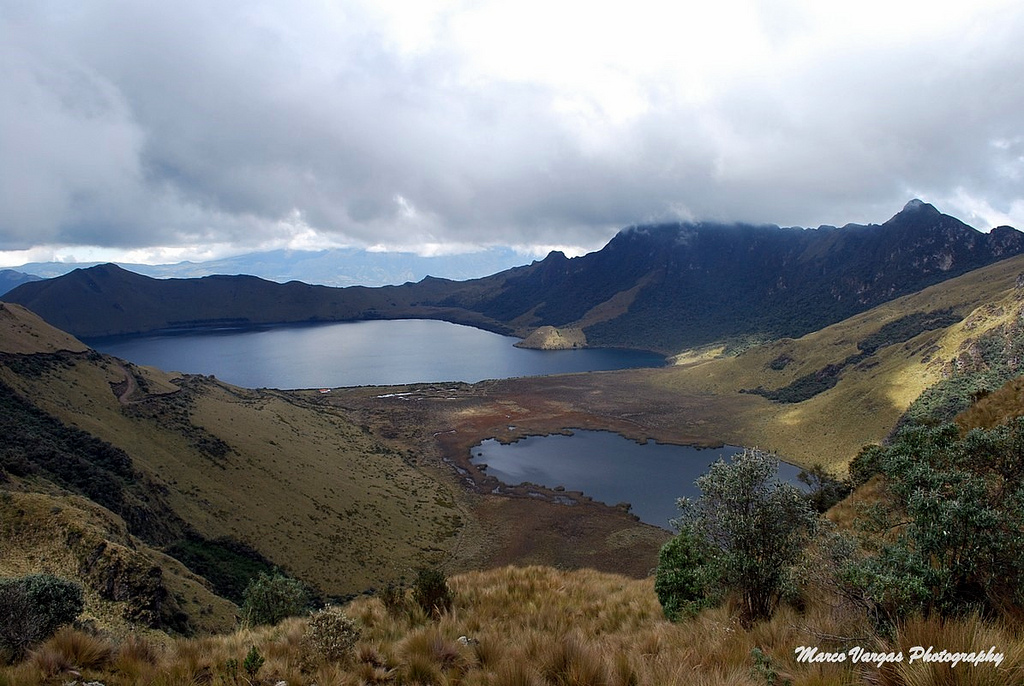
Two hours north of Quito is the town of Otavalo, famed for its textile crafts market. This and some of the surrounding areas look like great destinations. Consider, for example, a hike around the Lagunas de Mojanda, just south of town (see below).

Photo from Marco Vargas Photography

Photo from Marco Vargas Photography

Right now, as my eyes haze over from doing tax returns, is where my mind is. I am back in the Andes, with my brother, and dreaming of Quito and the surrounding countryside—such as the high altitude cloud forests which features dozens of species of wildly multicolored hummingbirds.

Dream on, Jim!

To South America … Again

View of Quito’s Old Town

View of Quito’s Old Town

Once again, Martine does not want to travel with me. Her continuing problems with back pain when sleeping in soft beds and almost continuous irritable bowel syndrome makes her want to stay close to home. This year, I will go to Ecuador, especially to the Andes region.

The good news is that I will not be traveling alone: My brother Dan expressed interest in joining me. The last time we traveled together was in 1979, when we did the circuit Mexico City-Villahermosa-Palenque-San Cristobal de las Casas-Oaxaca-Mexico City. It was the same circuit described by Graham Greene in his book The Lawless Roads (1939). We traveled by air to Villahermosa (not a high point in any sense of the term) and by bus the rest of the way back to Mexico D.F.

Dan and I are, I think, good traveling companions. He’s not very interested in ruins (there aren’t that many in Ecuador), and he is very interested in native crafts (as am I). He has already been to Guayaquil and the Galapagos and said that travel to the latter was much too regimented. I was hoping he didn’t want to go there again because (1) when we’re going is the wrong time of the year (October/November) and (2) Zika.

At this point I’ll tell you a couple of anecdotes about traveling with my brother. We were in Palenque at the time of the Christmas Posadas, and Dan loved the coffee served in the area—it was grown locally. When we were in a café one evening, a shoeshine boy came up to us and asked if we wanted a shine. Dad slipped his foot out of his sandals and set it on the stand. The trouble is: As far as anyone could see, he was wearing only bright red socks. All the locals burst out laughing. No matter, I was wearing leather boots and gave him my business.

Another Palenque incident fortunately turned out the right way. Dan ducked out frequently in the evening to satisfy his coffee cravings while I remained behind reading a book. I heard a commotion in the street, and Dan came up shortly after. Apparently, a police informer tried to sell him “magic mushrooms” (psilocybin), and Dan guessed his intent at once. No sale.

There are some other stories from that trip that I’ll write about some other time.

When Technology Leads You Astray

In Some Places, You Just Can’t Trust GPS

In Some Places, You Just Can’t Trust GPS

This post is dedicated to two hilarious posts from The Iceland Review in which foreign tourists put explicit trust in their GPS systems and were led wildly astray.

In the first instance, reported on February 2 of this year, an American tourist was looking for the Hótel Frón on Laugavegur, the main shopping street in Reykjavík. The only problem is that the website he was relying on listed the address as Laugarvegur 22a. There was a Laugarvegur, as it turns out, in the remote herring fishing town of Siglufjörður in North Iceland, just a few klicks south of the Arctic Circle, some five hours of hard driving past Reykjavík.

No sooner did the Icelanders stop laughing about this incident than the following occurred, as reported in today’s Iceland Review posting:

The Suðurnes police today posted on their Facebook page the story of tourists who had little luck using their GPS. “Remember Noel?” the post begins, referring to the American tourist who accidentally drove to Siglufjörður, North Iceland, in search of a hotel in downtown Reykjavík, putting complete faith in his GPS.

This time, tourists were traveling in a rental car the short distance between Garður and Keflavík International Airport (normally a 15 minute drive) when their GPS convinced them to get off the beaten track, onto a gravel road and from there to a sidewalk. “Unfortunately, a garbage can stood where the gravel road meets the sidewalk; the car slid on an icy patch, hit the garbage can and ended up on top of it, completely stuck.”

Police were called out, but other travelers had already come to the aid of the unfortunate ones when police arrived, managing to get the car off the can. Reportedly, the tourists continued their travels, extremely relieved.

It’s not that I’m a technophobe—I’m not!—but I like to consult maps before driving in an unfamiliar place. I am particularly leery about renting cars at the airport in a strange city. When I have to, I try to fly to an airport in a smaller city in which my chances of getting lost are less. In 2012, I flew to Spokane rather than Seattle when Martine and I drove up to Jasper and Banff National Parks in Canada.

Þorrablót

Now Tell Me You’re Not Hungry

Now Tell Me You’re Not Hungry

Those of you who are vegetarians can stop reading now. Following is a piece from today’s Iceland Review about how Icelanders celebrate the start of Þorri.

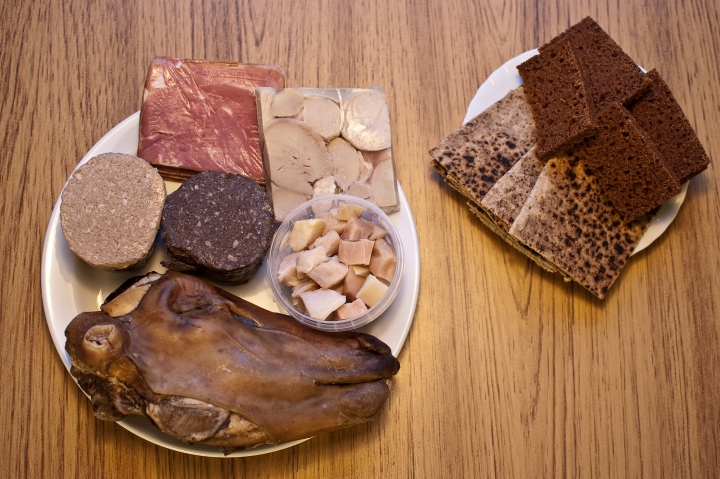
Tomorrow marks the beginning of the old month þorri, which generally is celebrated with traditional Icelandic food, enjoyed at large gatherings called þorrablót, held in various places throughout the month.

The food, typically served as buffet, includes the items listed below:

Dark rye bread, slightly sweet and slowly baked, commonly called þrumari or thunderer, because of the thundering it frequently produces at the rear end of those who enjoy it.

Dried fish, or harðfiskur: extremely addictive, despite its distinguished, strong smell. It’s most frequently enjoyed with a bit of butter.

Putrefied shark, served in tiny cubes the size of sugar cubes, but quite different in taste. These cubes are not for the delicate, but a delicacy to others.

Brennivín, also known as Black Death or aquavit, brewed from potatoes. This beverage is ideal for getting the shark down your throat.

Rotten eggs. The best ones are said to come from the West Fjords. They are indeed rotten and smell rotten.

Rams’ testicles which have been boiled and then cured in whey. You will be spared any further description.

Pressed meat from the heads of lambs, or head cheese, often cured in whey. Don’t let the description scare you away. This is considered delicious.

Liver sausage, made from the liver of sheep, is every child’s favorite. Its cousin, the blood sausage, is also popular, but together we call them slátur, meaning slaughter.

If none of the above is to your liking, rest assured you will like the hangikjöt or smoked lamb, which cannot be missed.

Note that the food above is proof how well our forefathers made use of their resources and let nothing go to waste. For preservation, meat was either smoked or stored in whey, and fish was dried.

So, if you’re invited to a þorrablót, don’t let the chance go by to experience it. Dress up and be ready to dance after dinner. [Or something.]

Serendipity: Camus on Travel

Albert Camus

Albert Camus

The text below is from his posthumously published Literary and Critical Essays:

Without cafés and newspapers, it would be difficult to travel. A paper printed in our own language, a place to rub shoulders with others in the evenings enable us to imitate the familiar gestures of the man we were at home, who, seen from a distance, seems so much a stranger. For what gives value to travel is fear. It breaks down a kind of inner structure we have. One can no longer cheat — hide behind the hours spent at the office or at the plant (those hours we protest so loudly, which protect us so well from the pain of being alone). I have always wanted to write novels in which my heroes would say: “What would I do without the office?” or again: “My wife has died, but fortunately I have all these orders to fill for tomorrow.” Travel robs us of such refuge. Far from our own people, our own language, stripped of all our props, deprived of our masks (one doesn’t know the fare on the streetcars, or anything else), we are completely on the surface of ourselves. But also, soul-sick, we restore to every being and every object its miraculous value. A woman dancing without a thought in her head, a bottle on a table, glimpsed behind a curtain: each image becomes a symbol. The whole of life seems reflected in it, insofar as it summarizes our own life at the moment. When we are aware of every gift, the contradictory intoxications we can enjoy (including that of lucidity) are indescribable.


Flyaway

The Flyaway Bus from UCLA to LAX Airport

The Flyaway Bus from UCLA to LAX Airport

For the five months I was in physical therapy from my broken shoulder, I would walk twice a week past the Flyaway Bus stop at UCLA’s Parking Lot 32 on way way to UCLA Rehab Srvices. Each time, I would get a warm feeling of pleasure, thinking ahead to my next South America vacation. Now that vacation is only a few days away, and I will be trudging from work to Lot 32 to take the Flyaway Bus to the Tom Bradley International Terminal, from which I will take a TAM jetliner to Buenos Aires via Sao Paolo, Brazil.

I was sad to hear that the Flyaway service may be discontinued next year for lack of use. According to the UCLA Daily Bruin, the company that operates the service is running a large deficit and is looking to cut corners. That would be a pity, as the bus stops at all the LAX terminals. I have three other possible alternatives: the Santa Monica #3, the Culver City #6, and the LA Metro #781. All three stop at the Airport Bus Station, from which I have to take a separate free shuttle at the adjacent Lot C. That involves a bit more schlepping with heavy luggage—but I better get used to doing that anyhow.

For now, though, Flyaway is still in business.

A Thin Place

Religious Festival in Chivay

Religious Festival in Chivay, Peru

I was reading an article about a small town in Israel on the BBC News website when I came across an interesting term:

Throughout it all, though, Tzfat has remained a “thin place”.

This Celtic term, invented to describe a place where the distance between Heaven and Earth is compressed, neatly captures a subtle quality that a few places possess. Heaven and Earth, the Celts believed, are often closer than we think. But in thin places, you can feel the divine.

Thin places are often relaxing, but not always. They might be enjoyable, or they might not. What they always possess, though, is the capacity to transform, to strip away the layers of falseness and striving that define so much of our lives, and to reveal something deeper, something more essential.

My most recent encounter with a “thin place” was Colca Canyon high in the Andes. From an elevation of 15,000 feet (4,500 meters) at Patapampa, we dropped down by stages to the town of Chivay, where a religious procession was taking place. My head was buzzing from the high altitude, but I felt that I was in a sacred place, within view of the Apus of the Andes with their snow-covered peaks.

The View Across Colca Canyon Beyond Chivay

The View Across Colca Canyon Beyond Chivay

Chivay was inhabited by a mix of Collaguas and Cabanas in their colorful costumes. While I was wildly snapping pictures, I felt I was not only living in a different layer of reality from the indigenous locals, but I was privileged to see a religious ceremonial that just happened to be taking place when we arrived in the main square. The mountain peoples of Peru have not always been accepting of foreign visitors. Fortunately, I was not part of a large busload of tourists, and I was the only person from my party viewing the procession.

Throughout my stay in Chivay and nearby Corporaque, I felt I was in a thin place. Overhead huge condors rode the thermals, and I was as close as I ever hope to be to the heavens.