Serendipity: Camus on Travel

Albert Camus

Albert Camus

The text below is from his posthumously published Literary and Critical Essays:

Without cafés and newspapers, it would be difficult to travel. A paper printed in our own language, a place to rub shoulders with others in the evenings enable us to imitate the familiar gestures of the man we were at home, who, seen from a distance, seems so much a stranger. For what gives value to travel is fear. It breaks down a kind of inner structure we have. One can no longer cheat — hide behind the hours spent at the office or at the plant (those hours we protest so loudly, which protect us so well from the pain of being alone). I have always wanted to write novels in which my heroes would say: “What would I do without the office?” or again: “My wife has died, but fortunately I have all these orders to fill for tomorrow.” Travel robs us of such refuge. Far from our own people, our own language, stripped of all our props, deprived of our masks (one doesn’t know the fare on the streetcars, or anything else), we are completely on the surface of ourselves. But also, soul-sick, we restore to every being and every object its miraculous value. A woman dancing without a thought in her head, a bottle on a table, glimpsed behind a curtain: each image becomes a symbol. The whole of life seems reflected in it, insofar as it summarizes our own life at the moment. When we are aware of every gift, the contradictory intoxications we can enjoy (including that of lucidity) are indescribable.


Flyaway

The Flyaway Bus from UCLA to LAX Airport

The Flyaway Bus from UCLA to LAX Airport

For the five months I was in physical therapy from my broken shoulder, I would walk twice a week past the Flyaway Bus stop at UCLA’s Parking Lot 32 on way way to UCLA Rehab Srvices. Each time, I would get a warm feeling of pleasure, thinking ahead to my next South America vacation. Now that vacation is only a few days away, and I will be trudging from work to Lot 32 to take the Flyaway Bus to the Tom Bradley International Terminal, from which I will take a TAM jetliner to Buenos Aires via Sao Paolo, Brazil.

I was sad to hear that the Flyaway service may be discontinued next year for lack of use. According to the UCLA Daily Bruin, the company that operates the service is running a large deficit and is looking to cut corners. That would be a pity, as the bus stops at all the LAX terminals. I have three other possible alternatives: the Santa Monica #3, the Culver City #6, and the LA Metro #781. All three stop at the Airport Bus Station, from which I have to take a separate free shuttle at the adjacent Lot C. That involves a bit more schlepping with heavy luggage—but I better get used to doing that anyhow.

For now, though, Flyaway is still in business.

A Thin Place

Religious Festival in Chivay

Religious Festival in Chivay, Peru

I was reading an article about a small town in Israel on the BBC News website when I came across an interesting term:

Throughout it all, though, Tzfat has remained a “thin place”.

This Celtic term, invented to describe a place where the distance between Heaven and Earth is compressed, neatly captures a subtle quality that a few places possess. Heaven and Earth, the Celts believed, are often closer than we think. But in thin places, you can feel the divine.

Thin places are often relaxing, but not always. They might be enjoyable, or they might not. What they always possess, though, is the capacity to transform, to strip away the layers of falseness and striving that define so much of our lives, and to reveal something deeper, something more essential.

My most recent encounter with a “thin place” was Colca Canyon high in the Andes. From an elevation of 15,000 feet (4,500 meters) at Patapampa, we dropped down by stages to the town of Chivay, where a religious procession was taking place. My head was buzzing from the high altitude, but I felt that I was in a sacred place, within view of the Apus of the Andes with their snow-covered peaks.

The View Across Colca Canyon Beyond Chivay

The View Across Colca Canyon Beyond Chivay

Chivay was inhabited by a mix of Collaguas and Cabanas in their colorful costumes. While I was wildly snapping pictures, I felt I was not only living in a different layer of reality from the indigenous locals, but I was privileged to see a religious ceremonial that just happened to be taking place when we arrived in the main square. The mountain peoples of Peru have not always been accepting of foreign visitors. Fortunately, I was not part of a large busload of tourists, and I was the only person from my party viewing the procession.

Throughout my stay in Chivay and nearby Corporaque, I felt I was in a thin place. Overhead huge condors rode the thermals, and I was as close as I ever hope to be to the heavens.


Within a Stone’s Throw

Buenos Aires’s Recoleta Cemetery

Buenos Aires’s Recoleta Cemetery

As I have written on earlier occasions, Recoleta Cemetery is one of the major tourist attractions in Buenos Aires. I have visited it during my two previous trips to Argentina, in 2006 and 2011. And now, I will be staying in a hotel within sight of the tombs on Avenida Azcuénaga. It is possible that the blue-green building in the left background could be on Azcuénaga, but I’m not sure.

One of the nice things about staying in the Recoleta area is that it is full of classical old café/restaurants such as La Biela, El Sanjuanino, El Rincón, La Cocina, La Barra, and the Rodi-Bar—places that have been around for a hundred years or more and become national treasures.

On Saturdays, the Plaza Francia in front of the cemetery is the site of a craft fair  that features leather goods; items made with rhodochrosite, a magnesium carbonate mineral that is the national precious stone of Argentina; and yummy snacks. Nearby is La Biela, under the shade of a giant old ombú tree, where one can enjoy a cold Imperial beer and a light lunch.

I will be leaving a week from Tuesday, and as the time gets closer, I am looking forward to the trip more and more.


Termed Out

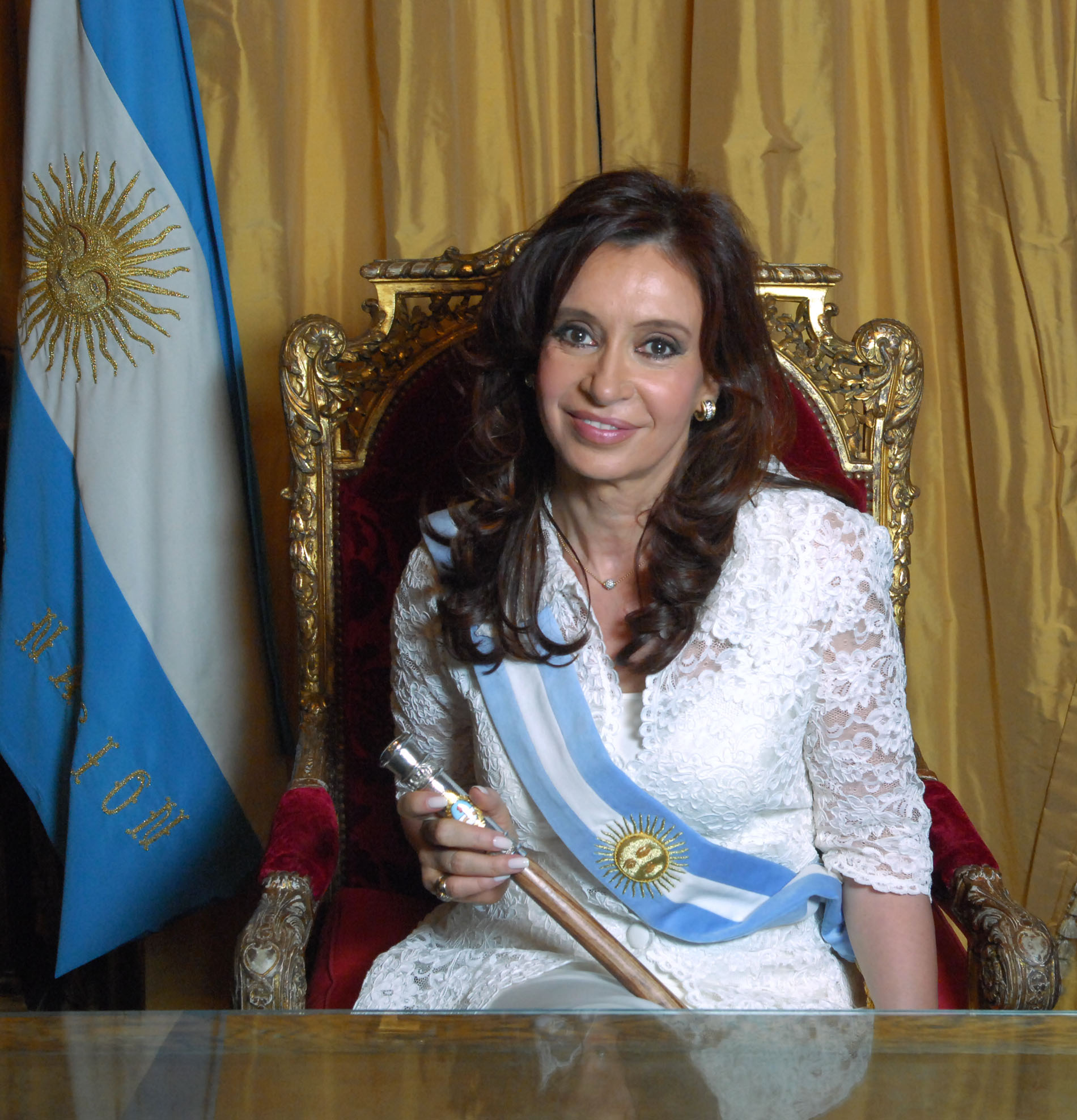
Official Photo of Argentinian President Cristina Fernández de Kirchner

Official Photo of Argentinian President Cristina Fernández de Kirchner

Later this month, a new presidential election will be held in Argentina to replace Cristina Fernández de Kirchner, the widow of the former president, Néstor Kirchner. As long as I have been visiting South America, a Kirchner was at the helm. As far as I could tell from my distant perch in the EEUU, as our country is abbreviated down there, they have been fairly good leaders. And I always enjoyed watching Cristina speak on television, even if I understood a mere fraction of what she had to say.

The previous widow to hold office in Buenos Aires was Isabelita Perón, the wife of former strong man Juan Domingo Perón, who died a scant year after returning from exile in Spain. Isabelita was not nearly in Cristina’s class and was quickly forced out of office.

Because of her looks, Cristina has been the target of some unfair attacks, such as the Italian newspaper Corriere de la Sera publishing a story in 2008 stating that she had gone on a spree at Rome’s famed Enigma Jewelry, purchasing Bulgari earrings, watches, and golden bracelets to the tune of €140,000 while she was attending the Food and Agricultural Organization (FAO) summit of the United Nations. Today, the Buenos Aires Herald announced that Cristina’s suit for defamation was judged in her favor by the Italian courts and that the story was a complete fabrication. The newspaper had to pay €40,000, which she turned around and donated to the children’s hospital in La Plata, where she was born.

It’s hard to believe that Sra. Fernández de Kirchner was born in 1953. The years have been kind to her.

Buenos Aires News in English

My Source for News from Argenina

My Source for News from Argentina

In both 2011 and 2015, I have relied heavily on the website of The Buenos Aires Herald for my news about Argentina, South America, the United States, and also the World. Every day, there is an article about the value of the dollar in pesos—both the official rate and the “blue” rate. Based on the photo above, it is also published in a newsprint edition, which I will check up on when I arrive in B.A.

Occasionally, I will find stories which are not even well covered in the U.S. For instance, Israel has banned most Palestinians from the Old City of Jerusalem for a two day period during Jewish holiday observances.

It is interesting to see that Argentina is still going hammer and tongs after the British for doing oil exploration in what the Brits call the Falklands and the Argentinians the Islas Malvinas. Firms that are involved may have their property confiscated if they should anchor at an Argentinian port.

Restlessness

My Vacation Is Getting Closer

My Vacation Is Getting Closer

In the last few weeks before my vacation, I am feeling restless. All other things aside, here are the books I plan to read before the month is over:

  • Christopher Hill, The World Turned Upside-Down. Revolutionary movements in 17th century England.
  • Guy de Maupassant, Afloat. For my French literature group on Yahoo!
  • Pablo Neruda, Canto General. I plan to visit the poet’s houses in Chile.
  • Macedonio Fernandez, The Museum of Eterna’s Novel, by a friend and hero of Jorge Luis Borges.
  • John Lynch, San Martin: Argentine Soldier, American Hero. A biography of the Founding Father of Argentina.
  • Aldous Huxley, Complete Essays, Vol. 1, 1920-1925.

And that’s probably half of what I will end up reading this month. Only, it’s always more difficult when one faces a deadline. One thing I will not do is stuff my suitcase full of books, nor concrete blocks either. While I am traveling, I will be reading exclusively from my two Kindles.

As usual, I have a dental emergency just before my vacation. Two small pyramidal chunks of tooth came loose the other day, so I will have to go to the dentist tomorrow. Plus I have two medical appointments this month.

Most of my shopping is done, but I will need a new belt: My old one fell to pieces a couple weeks ago. Plus I will have to get some mosquito repellent (for the Iguasu Falls area), and possibly a two-pocket shirt if I can find one. Oh, and I’m sure I’ll find a couple of other things I will need, or at least feel I’ll need.

The picture above is by Paulo Zerbato and nicely expresses what I am feeling right now.

¡Cuidado! Falsificatión Peligro

The Blue Dollar Market Is Centered on Calle Florida

The Blue Dollar Market Is Centered on Calle Florida

There are at least two ways that tourists in Argentina can be passed counterfeit notes. Both ways are common enough that tourists have to know how to tell a real peso from a fake.

In June I wrote a post about Blue Dollars. There are two peso to dollar rates in Argentina: the official one and the “blue” dollar rate, which is available primarily from money changers on Calle Florida in Buenos Aires. When I wrote the post in June, the rate was 9.07 pesos to the dollar at the official rate and 13.00 pesos to the dollar on the blue market. Today the rate is 9.425 pesos to the dollar at the official rate, and 16 to the dollar at the blue rate.

If you stick to the official rate only, you will be paying more for everything; but you will probably not wind up with fake pesos—if you stick to major bank ATMs. (Money changers and dicey private ATMs are a different story.) First of all, to deal on the blue market, you need crisp, fresh Benjamins, that is to say, one hundred dollar notes. When dealing with a money changer, you have to indicate you want money at the blue rate, and you have to be willing to closely examine the bills you get in return. You can look at San Telmo Loft’s posting on “Fake Money in Argentina” for starter. And be sure to take their quiz.

Another common way of getting stuck with counterfeit notes is to use legitimate big bills and having the following happen: Let’s say you give a taxi driver a real 100 peso note. He turns around, gives it back to you, saying it’s a fake. In the meantime, he’s pulled a switch on you. Before handing over a big bill, be sure to memorize the last three digits of the serial number. That way you can accuse the driver of having passed a fake to you. You might not want to be standing where he can run you down at that point.

Fortunately, it’s easy to tell fake from real notes; but note that a lot of fake pesos are in circulation. If you get stuck holding them, there is no real recourse.


Traveling by Mexican Rules

Benito Juarez Airport in Mexico City

Benito Juarez Airport in Mexico City

It all started in 1979. My brother and I were booked on a flight to Villahermosa, Mexico, one of the less enchanting cities of that great land. Suddenly, our flight disappeared off the departure screens, followed by a garbled PA announcement in Spanish. Dan and I looked at each other, and right then and there, we developed the notion of traveling by Mexican Rules.

Consequently, we hunkered down in our seats and waited for new developments. We disbelieved all announcements until we heard one (that was actually clear) that said our “canceled” flight was boarding at Gate 72. We hurried over to the gate and, sure enough, the flight was boarding; and its destination was the unlovely swamp city of Villahermosa. Within two hours, we were landed.

(It turned out that was only the beginning of our problems: We had to find a room in a city where all hotel rooms were block-booked by the Pemex oil monopoly employees. But that’s another story.)

The point I am trying to make is that one has to make allowance for mass confusion, not only when traveling, but even at home. A week ago, we had a freak rainstorm that forced the evacuation of the high rise in which I work. Until I received authoritative word from the building management, I heard no end of estimates of how long it would be before we could return to our offices. They ranged from one hour to two or three hours to half a day. In the end, the building was shut down for the day until the fire department and the Department of Water & Power was sure the transformer in the parking garage would not be flooded.

So when I am in Argentina and Chile in November, I will still be traveling by Mexican Rules. It’s the only way to fly.


La Bandera Oficial

The Official Flag of Argentina

The Official Flag of Argentina

Today, Martine and I went for a walk on the spectacular campus of Pepperdine University in Malibu. It was a hot, but crystal-clear day with clear views toward Catalina and Palos Verdes. What was different today was a display of some 3,000 flags, mostly the stars and stripes. I guessed that they represented the students on campus and their country of origin. Instead, it was a commemoration of the September 11 attacks on the World Trade Center, in which 2,996 people died. The non-American flags represented the country of origin of the victims of the Al Qaeda terrorists.

Toward the end of the display, I stopped by a flag of Argentina. At the same time I felt sad for the Argentinian victim of the attack, I felt a warm glow in anticipation of my upcoming trip to Argentina and Chile in November.

It was Manuel Belgrano who designed the flag in Rosario in 1812 during his country’s war of independence from Spain. It was officially accepted as the nation’s official flag at the Congress of Tucumán on July 20, 1816, complete with the stylized image of the sun. An alternate ornamental version of the flag is minus the sun.

At one point last week, I fell afoul of a clique of rabid Little Englander trolls by suggesting that this flag should by rights be flying over the Falkland Islands. I have since decided to moderate my enthusiasm for all things Argentinian and cede the archipelago to the Brits.