Puerto Iguazu/Foz de Iguaçu

Three of the 200+ Waterfalls at Iguazu National Park

I was exhilarated by the two days I spent viewing the falls at Iguazu. There were trails leading off in all directions, as the falls were in an area several kilometers long.

My only regret is that I was not able to see the falls from the Brazilian side. Although the falls were in Argentina, the best long-distance view was from the city of Foz de Iguaçu. At the time I was there, in 2015, I would have had to pay a heavy fee to cross the border into Brazil.

The Panoramic View of the Falls from Brazil

It is not always possible to see all the sights, and I was content to view the falls from the Argentinean side—close up. Particularly impressive was the most powerful of the falls, the Garganta del Diablo, or Devil’s Throat. Here is a video from YouTube:

If you ever manage to fly the 6,000 miles to Argentina, I highly recommend spending several days at the falls. On the Argentinean side, Puerto Iguazu has excellent tourist amenities.

Puerto Iguazu 2015

Drinking Beer in Puerto Iguazu

I had good reason to celebrate: I had just survived a hamfisted pick-pocketing attempt as I was walking to the Retiro Bus Terminal in Buenos Aires with over 2,000 Argentinean pesos in my wallet. I finally made it to my all-night bus to Puerto Iguazu, where the borders of Argentina, Brazil, and Paraguay meet. I was there to see the falls, which were spectacular (more about that tomorrow).

At Puerto Iguazu, I was in the jungle, right by the massive falls of the Rio Iguazu—all 275 of them. This was my first visit to what I call a monkey jungle. There were monkeys aplenty, as well as coatimundis and picturesque birds.

Colorful Bird at the Local Aviary

I had always been afraid of the jungle because I hate mosquitoes. Curiously, I did not encounter any, though I spent two days viewing multiple falls in the area. I did encounter a lot of coatimundis, but numerous posted signs warned against feeding them: They have a tendency to get aggressive and go on the attack.

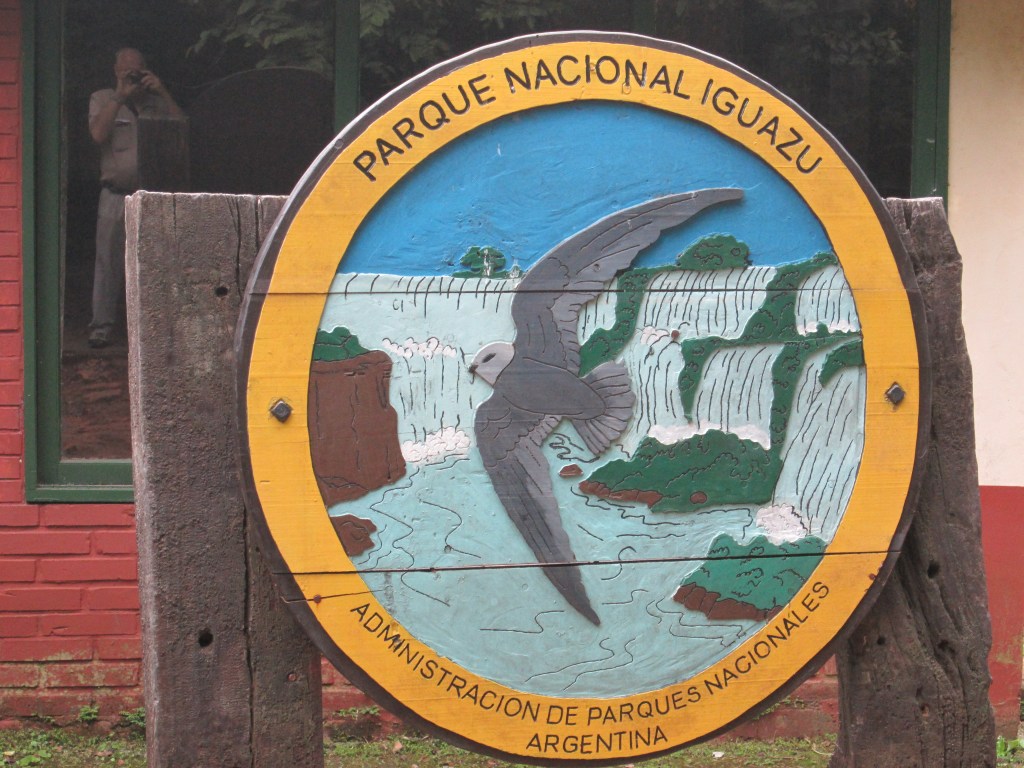
Iguazu National Park Seal

Argentina is a country with numerous national parks. I have visited both the northernmost (Iguazu) and the southernmost (Tierra del Fuego on the Beagle Channel). It is a pity that so few Americans have had the opportunity to visit any of them.

The Ring of Brodgar

Location of Orkney Islands

Just off the Northern tip of Scotland lie the Orkney Islands. You could get there by flying to Kirkwall (when the weather permits), or taking the P & O Ferry St. Ola from Scrabster, just west of Thurso. I have been to Orkney twice, both times crossing the stormy seas of Pentland Firth with my stomach not overly sure of its correct position. The second time was with Martine, who took so much Dramamine that I had trouble shaking her awake to see the Old Man of Hoy as we sailed passed it.

My mind is turning once again to those stormy islands as I read a newspaper column penned by the late George Mackay Brown for The Orcadian between 1979 and 1991. I have loved Brown’s prose and poetry ever since I met him on my first visit to the islands, in September 1976.

The Old Man of Hoy

By the time the St. Ola docked in Stromness, the port where George Mackay Brown lived and called by its Norse name, Hamnavoe, the weather was so bad that Martine thought I had brought her to some Arctic hell. The weather moderated—somewhat. But we had a wonderful time viewing the sights, including the Viking Cathedral of St. Magnus in Kirkwall, the Standing Stones of Stenness, the Ring of Brodgar (which is the new header image for my post), the Neolithic burial chamber at Maes Howe (with runic Viking graffiti), and the stone age village of Skara Brae, once buried by the sands of the North Atlantic.

Places like Orkney, Iceland, Tierra del Fuego in South America, and the deserts of the American Southwest fascinate me. Most Americans would opt for sun, sea, and cocktails as the perfect vacation. Not me!

To the Ends of the Earth

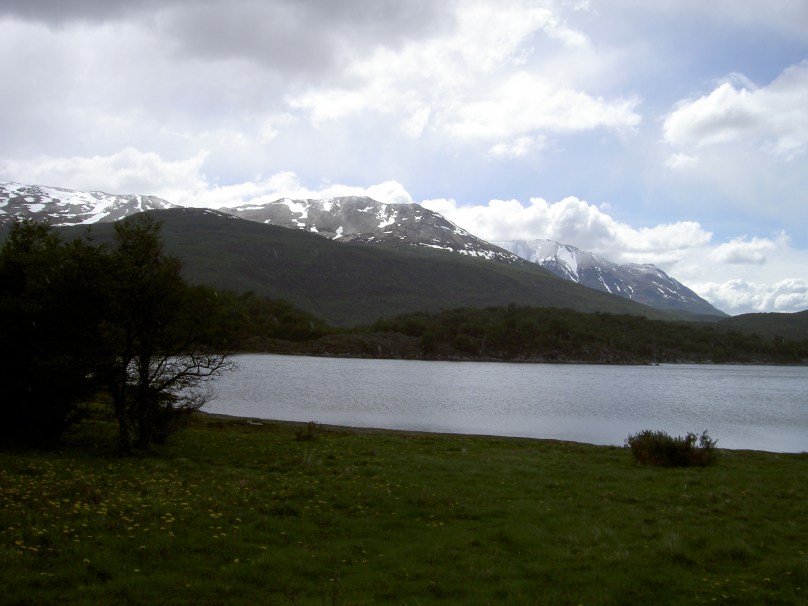
Tierra del Fuego National Park

Twice I have been to the southernmost city on Earth—Ushuaia in the State of Tierra del Fuego. The first time was in 2006, when I broke my shoulder on the high curb when crossing Magallanes at Rivadavia. The second time was when I visited with Martine in 2011.

Actually, there is one populated town south of Ushuaia, but it is maintained by Chile mostly as a naval base and has a much smaller population.

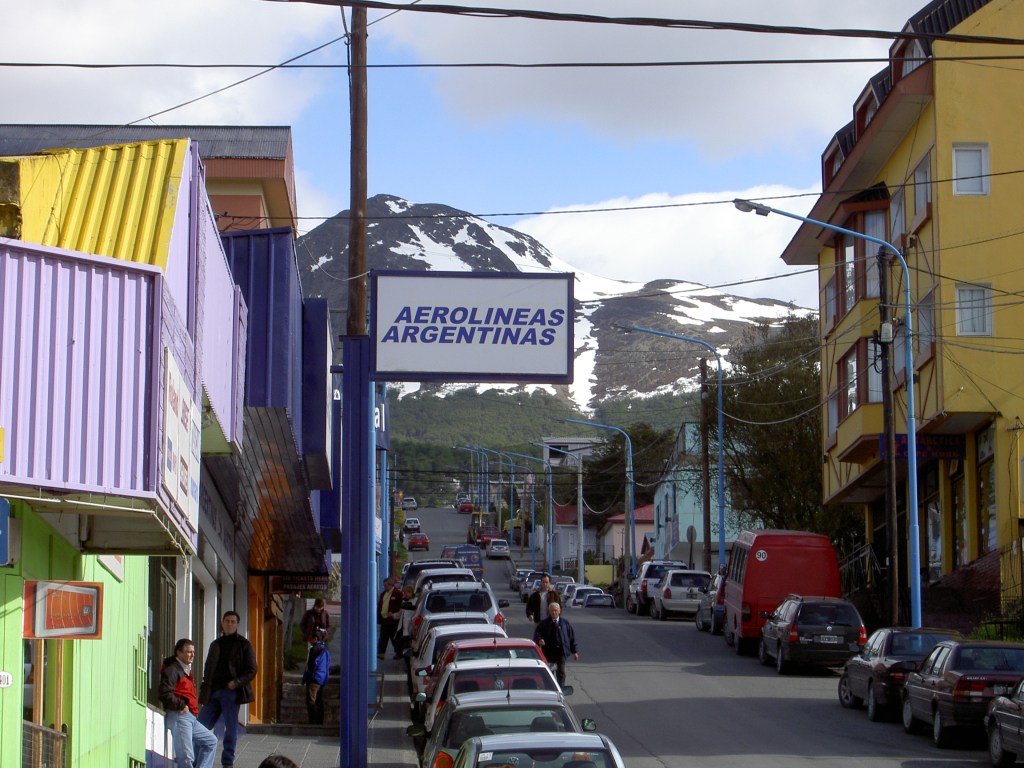
On Rivadavia in Ushuaia Looking North

Ushuaia pretty march marks the southern end of the Andes, which are only a couple thousand feet (610 meters) in altitude, though they are still covered in snow. It can get mighty cold at that latitude, which is only about 600 miles (966 kilometers) across the Drake Channel from Antarctica.

I wouldn’t mind going back to Tierra del Fuego and maybe seeing Punta Arenas and Puerto Williams in Chile. By the way, Puerto Williams is the only town south of Ushuaia—just across the Beagle Channel.

What is there to do in Ushuaia? There are several impressive museums, one of which was formerly a prison. There is Estancia Harberton, which settled by the Bridges family and is written about at length in E. Lucas Bridges’s The Uttermost Part of the Earth, a travel classic. Then there are the Magellanic Penguins on nearby Isla Pajaros; and there is Tierra del Fuego National Park, which ends at the border with Chile.

The Svinafell Troll

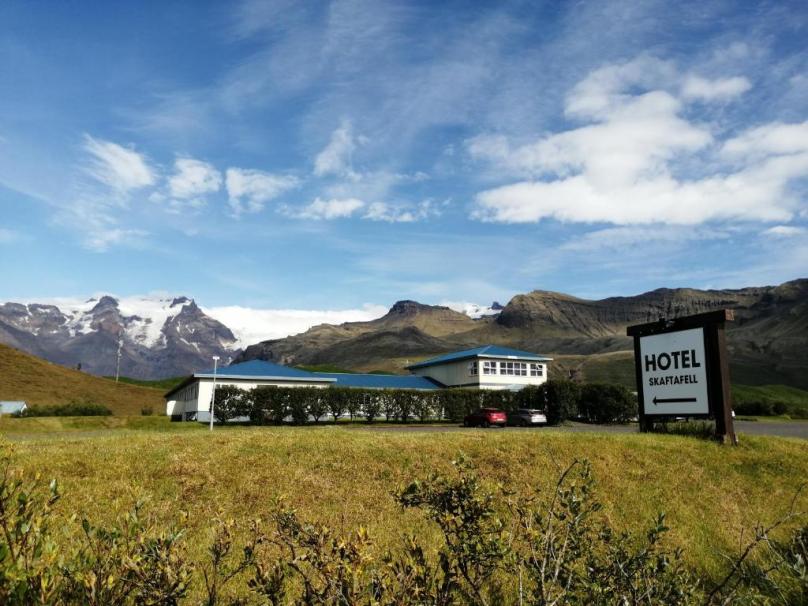
Iceland’s Skaftafell Hotel Hard by Svinafell

It was August 2001. I was spending a couple of nights at the Skaftafell Hotel in Svinafell pictured above. While I was eating dinner in the hotel’s restaurant, I was bothered by a rowdy crew of Americans who were yucking it up at a nearby table. When the leader of the crew stepped out to the restroom, the remaining members started talking about him.

Apparently, the missing partyer was none other than Charles H. Keating, Jr., described by Wikipedia as “an American sportsman, lawyer, real estate developer, banker, financier, conservative activist, and convicted felon best known for his role in the savings and loan of the late 1980s.”

When he returned to the table, he saw that I was looking somewhat disgruntled. To make up for the noise his party was making, he invited me to join them and pay for my meal. I respectfully declined, not wanting to associate myself with someone who was a real estate developer, crooked banker, and worse.

The group was traveling around Iceland in a guided minibus tour of the country.

Charles H. Keating, Jr. (1923-2014)

As a saw the white minibus drive away with its noisy contingent, I though back to the one mention of Svinafell in The Njáls Saga. According to Medievalists.Net:

One of the most prominent sexual insults is when Skarpheðin calls Flosi the bride of the troll of Svinafell, this implies that he is used sexually by the troll. This insult is a form of nið, an insult intended to imply that the object is ragr, a passive homosexual or is used in this way by a man, animal or supernatural creature.

Having followed the saga of Lincoln Savings & Loan in the press, I thought he would make a good partner for the Svinafell Troll. Since he is no longer among the living, that is quite possibly what he is doing now.

Disaster Zone

Boats Stranded by the Disappearance of the Aral Sea

In the deserts of Central Asia sits the ghost of the Aral Sea. The original sea bed, shared by Kazakhstan and Uzbekistan, is the poster child of decades of neglect. The rivers feeding into the sea were canalized to raise cotton. Very little cotton grows there now. In his Chasing the Sea: Lost Among the Ghosts of Empire in Central Asia, Tom Bissell describes meeting up with a couple of small boys in the eerie desert salt and pesticide-laden atmosphere of a community that used to exist on the shores of the sea.

I sat perched half in and half out of the car. The door was wide open, My chin rested upon the shelf of my hand. The sun was going down, the horizon dyed a Creamsicle orange. I watched a skinny, ravaged-looking dog sniff around various piles of refuse. A dog’s life. Then it occurred to me that American dogs have no idea what a dog’s life is. Suddenly, two little boys appeared from behind one of the houses and approached me. They were brothers, clearly. One was taller and certainly older. The other was small, perhaps five years old. The boy’s head was pumpkin-sized, seemingly twice the circumference of his brother’s, who was regarding me coldly. The younger boy smiled, his teeth cavitied and yellow, his skinny body completely naked and covered in dust. The dust was spread so evenly over his body it seemed deliberately applied. His uncircumcized penis looked like a tiny anteater nose. I smiled back at him. “Ismingiz nimah?” I asked. What is your name?

Before the boy could answer, his older brother inexplicably struck him from behind. The boy flopped face-first in the dust. The shove was two-handed and savage, like something out of provincial hockey. A sound, perhaps “Hey—,” filled my mouth. But I did nothing. The younger brother coughed into the dust. He had landed badly, arms at his sides. Now he tried to get to his feet. His brother placed a foot on his naked bottom and, almost tenderly, pushed him back into the dirt. He stared down, having satisfied some obscure but insatiable impulse, and then walked away. I waited for tears, the shrieks and cries of fraternal terror. But no. Nothing at all. The naked dusty child was silent. The dog trotted over and, as the boy picked himself up, he searched the ground blindly with a small pawing hand. Finally, he stood holding a triangular rock. He turned and threw it at the dog, hitting the creature full in the ribs; the dog flinched but otherwise took the blow in silence. The younger boy simply walked away. I made soft kissing sounds to summon the dog. It was understandably skittish, but I persisted. I did not know what else to do. When it slunk over, head lowered and panting, I saw a red spiderlike creature dug into its collarless neck. I extended my hand. The dog bit me and staggered off.

Desert Dreams

Cacti at the Moorten Cactus Garden in Palm Springs

In the next few weeks, I will be making two road trips to the desert. First, this weekend I will spend a long weekend with my brother in Palm Desert. I don’t know how much I’ll be seeing inasmuch as we are in the middle of March Madness. No matter, because a few weeks later, Martine and I will be driving to Tucson, where we will definitely do some concentrated sightseeing.

I love the desert—but not in the summer! Several years ago, Martine and I flew to New Mexico and drove around in a rental car during the month of June. Every day, the temperature was in the three-digit range, often hitting 110° Fahrenheit (43° Celsius). There were times I was afraid to touch the handle of my rented Hyundai lest I leave behind the skin of my hand.

During the cooler months, however, especially when the wind isn’t blowing too strongly, the desert puts forth its most welcoming aspect. And April is one of the nicest times, as the floor of the desert is full of tiny wildflowers.

I don’t know what I’ll find in the Coachella Valley and Southern Arizona, but I have high hopes. And you can be sure that I’ll have some pictures to share with you.

An Upcoming Road Trip?

Saguaro Cacti Near Tucson

Martine has generally not been interested in travel. Lately, however, she mentioned the possibility of two Southwest road trips: One up U.S. 395 and other to Tucson, Arizona. Years ago, Martine had fond memories of a visit to an aunt who lived in Tucson.

I, myself, have never been to Tucson or even Phoenix. My knowledge of Arizona is mostly the area north of I-40 along the Kingman-Williams-Flagstaff-Winslow axis.

Today, I took my car in for its 39,000-mile service so that if we went to Tucson in March or early April, I would not be forced to make any last-minute decisions. Since I am also due to visit my brother in Palm Desert in two weeks, I will try to talk Martine into coming with me. It seems that the Coachella Valley is on the AAA preferred route to Tucson, and it would be killing two birds with one stone.

I will write more about the upcoming trip after I do a bit more research.

Classics of Travel Literature

I have always loved reading classical travel books—even if they were written long ago. Here is a list of some of my favorites, listed below in no particular order:

  • Matsuo Basho, The Narrow Road to the Deep North (1694). This is the earliest book on the list including a poetic rendering of the author’stravels to shrines in Japan, written in haiku.
  • Bruce Chatwin, In Patagonia (1977). A not entirely reliable account of the author’s journeys through Patagonia.
  • John Lloyd Stephens, Incidents of Travel in Central America, Chiapas, and Yucatan (1841). The book that made we want to go to Mexico. Great illustrations by Frederick Catherwood.
  • Paul Theroux, The Old Patagonian Express (1979). Still my favorite of his works, made me want to visit South America.
  • Freya Stark, The Valleys of the Assassins and Other Persian Travels (1934). She traveled alone throughout the Middle East and lived to be 100 years old.
  • Robnert Byron, The Road to Oxiana (1937). A travel book in which the author fails to reach his destination, but what he does see his so interesting that it doesn’t matter.
  • Sir Richard Francis Burton, Personal Narrative of a Pilgrimage to Al Medinah and Meccah (1855-1856). It took incredible gall for an Englishman to pass himself off as an Afghan physician and visit the holiest sites of Islam.
  • Jonathan Raban, Passage to Juneau: A Sea and Its Meanings (1999). Life doesn’t stop just because you want to pilot a yacht to Juneau, Alaska.
  • Ryszard Kapuściński, Travels with Herodotus (2007). A brilliant Polish travel writer tells how the ancient Grfeek historian informed him on his travels.
  • D. H. Lawrence, Sea and Sardinia (1921). It was written in just a few days, but it’s great anyhow.
  • Lawrence Durrell, Bitter Lemons (1957). The author of The Alexandria Quartet describes his years spent on the island of Cyprus in the Mediterranean.
  • Patrick Leigh Fermor, A Time of Gifts (1977). Travels through Central Europe just before the Second World War.

I cannot help but think some of my other favorites are missing. What you won’t find on this list are books like Eat, Pray, Love and such bourgeois fantasies as A Year in Provence. If that’s what you prefer in travel literature, I would prefer that you don’t undertake to read any of my recommendations. Ever.

The Last Time I Was in Argentina

Buenos Aires: Traffic on Calle Florida

It has now been ten years since my last visit to Argentina. Cristina Kirchner was still President of the Republic. I had an itinerary that included a visit to the Foz de Iguazu by the border with Brazil, the Patagonian resort of San Carlos Bariloche, and a bus and boat trip over the Andes to Puerto Varas in Chile.

I revisited the spectacular cemetery at Recoleta where Eva Perón is buried and the port of Tigre by the delta of the Paraná River. On my way to the bus station in Retiro, a serious attempt was made to pick my pocket at a time when I was carrying $2,000 in Argentinean pesos. (I quickly sidestepped to the right and hailed a cab.)

Funerary Statue at Recoleta Cemetery

I got violently ill at a hotel by the Congreso after eating a dubious steak dinner the night before, but I managed nonetheless to catch my bus to Puerto Iguazu and got better after a 10-hour bus ride that passed hundreds of fields where yerba mate was growing.

In sum, it was a great trip. As long in the tooth as I am, I would jump at the chance to visit Argentina again. The long plane ride over the Andes could be brutal, but the country is endlessly fascinating. I especially love Patagonia and Tierra del Fuego.

At the Puerto Iguazu Bus Station

Most Americans have little or no idea of what South America is really like. Over the last twenty years, I have been to Argentina, Chile, Uruguay, Peru, and Ecuador and enjoyed just about every minute of my travels there.