Really Big Bears

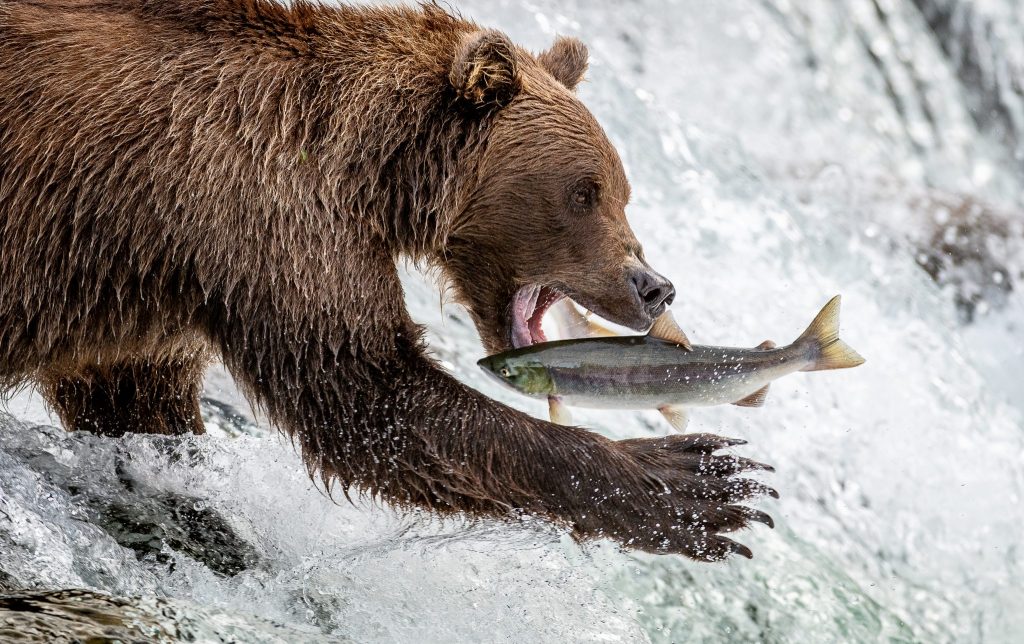
The Brown Grizzly Bears at Katmai National Park Dining on Salmon

If you want to see really big bears, probably the best place to see them is at Katmai National Park in Alaska. You’d have to fly in from such bush plane fields as King Salmon and view them at such locations as Brooks Camp, Hallo Bay, Geographic Harbor, Swikshak Lagoon, or Moraine Creek/Funnel Creek.

At a recent “beauty contest” at Katmai, the winner of Fat Bear Week was a 1,400 pound (635 kg) brown bear named (appropriately) 747, after the jumbo jet.

What makes the bears of Katmai particularly large is the ready availability of lots of salmon, which the bears use to bulk up just before going into hibernation.In other parts of Alaska, an adult male typically weighs between 300 to 900 pounds (136-405 kg) , and females weigh between 205 and 455 pounds (93-206 kg).

It’s not cheap to see the big bears of Katmai: There are no regularly scheduled flights. You’d have to fly charter and either camp or stay at an expensive lodge.

I would dearly love to see them. It’s just a question of money—and lots of it!

Ocosingo

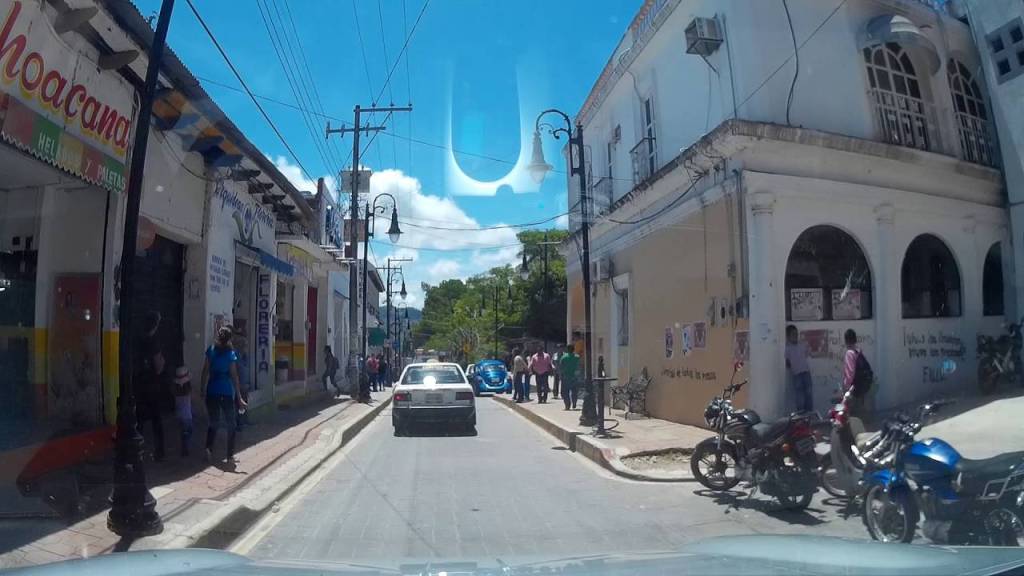
The year was 1979. My brother and I were taking an Autransportes Lacandonia bus from Palenque to San Cristóbal de las Casas. Today, the trip can be done in five hours. Back then, we boarded the reconverted North American school bus at 5:00 AM and got into San Cristóbal eleven hours later.

Enroute, we saw another Lacandonia bus that was run off the road into a ditch. It was surrounded by the passengers who were milling around. Luckily none of them seemed to be hurt. Then, about an hour or so later, as we neared Ocosingo, we were pulled over by the Mexican Army, who searched our luggage for weapons. We were not far from the Guatemalan border, and many Mexicans and even some foreigners were involved in gun-running to the rural Maya combatants across the border.

When we pulled into Ocosingo, a young boy boarded the bus selling something that was wrapped in straw. The boy didn’t understand my Spanish, and I didn’t understand his Tzotzil or Tzeltal Maya, but it didn’t cost much. Apparently, Ocosingo is famous for its queso amarillo (yellow cheese), which actually was pretty good—especially on a bus ride that seemed to take forever.

I wouldn’t mind returning to Ocosingo some day, having some more queso amarillo and visiting the Maya ruins at nearby Toniná. This relatively small Maya site bested the much larger Palenque in battle and got to sacrifice the royal family to their gods.

Every place I have ever visited in Mexico has left an indelible mark on my memory. Faced with a map of the country, I can follow my itinerary from city to city. These included places like Los Mochis, the Barranca del Cobre (Copper Canyon), Mazatlan, Durango, Zacatecas, Guanajuato, San Miguel de Allende, Querétaro, Mexico City, Patzcuaro, Uruapan, Guadalajara, Puerto Vallarta, Puebla, Cholula, Xalapa, Veracruz, Papantla, Oaxaca, and points south too numerous to mention.

Forbidden

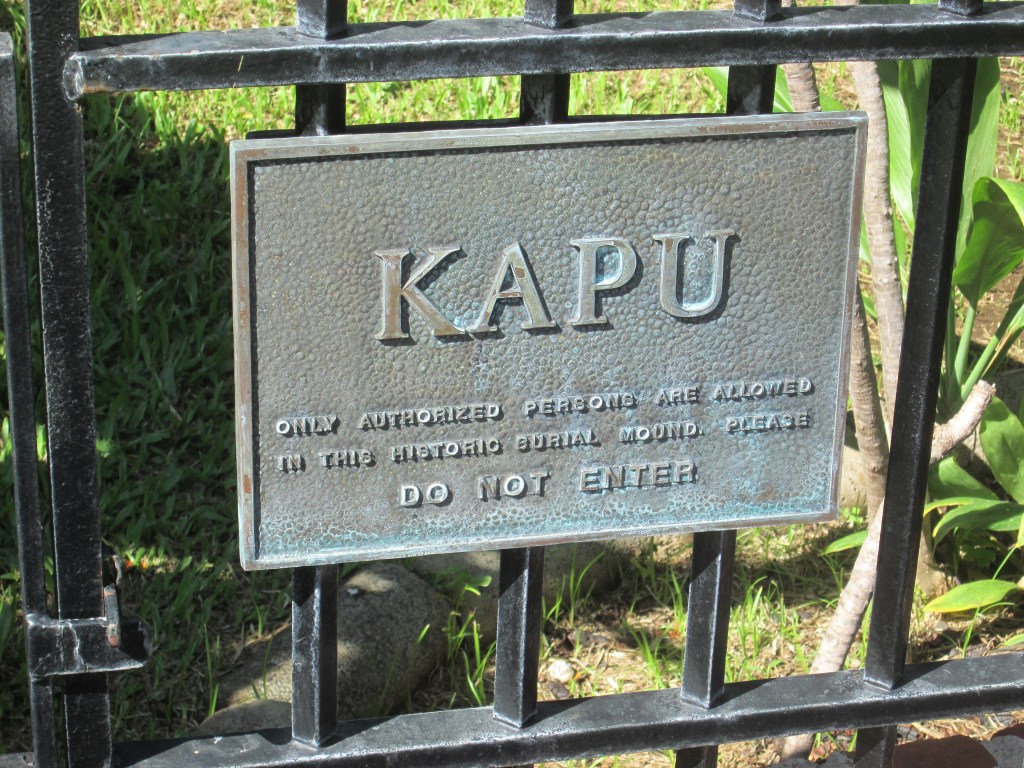
Sign on the Grounds of Iolani Palace

In the southeast corner of the grounds at Iolani Palace is a low mound that bears the Hawaiian language warning “Kapu.” Because the Hawaiian language doesn’t have the sounds of the consonants “t” and “b,” it would not make any sense if the sign red “Tabu.” Yet that is what it means.

Similarly, foods made from the pounded taro root are everywhere. Yet in Hawaiian, the word is written “kalo.” (There is no “r” in the language.)

The forbidden mound contains the remains of many old Hawaiian chieftains, or ali’i. Before the Iolani Palace was built in the late 19th century, there was an earlier, less European-looking palace that housed the great of O’ahu and the outlying islands. The earlier kings of the Kamehameha dynasty were buried there before a mausoleum was built to house their remains a mile or so to the west.

After the bones of the kings were removed, the Hawaiians had trouble identifying the other remains; so they fenced in the mound and made access to it Tabu.

El Dorado

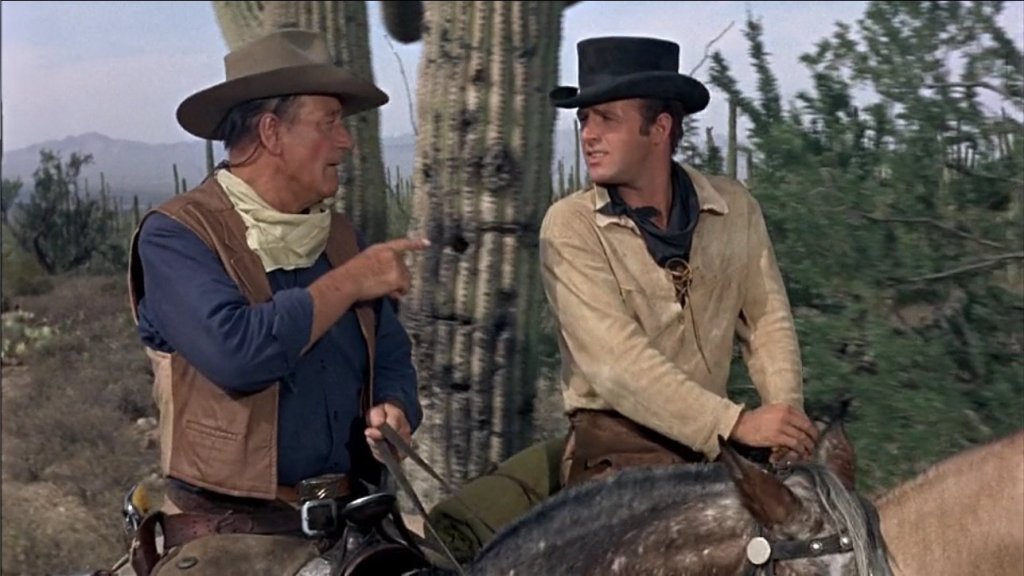
John Wayne and James Caan in Howard Hawks’s El Dorado

Today’s poem was actually a part of one of my favorite Westerns: Howard Hawks’s El Dorado (1966), which is a remake of the same director’s Rio Bravo (1959) starring the same actor, John Wayne. The lines are spoken by James Caan, in his first major role. Edgar Allan Poe, who wrote it, spelled it as one word: Eldorado—and that’s the name he gave to the poem.

Unlike Poe’s knight, I have found El Dorado to be in many places: Iceland, Scotland, Mexico, the Andes in South America, and even—appropriately—parts of the American Southwest.

Eldorado

Gaily bedight, 
A gallant knight,
In sunshine and in shadow,
Had journeyed long, 
Singing a song,
In search of Eldorado. 

But he grew old – 
This knight so bold – 
And o’er his heart a shadow 
Fell, as he found 
No spot of ground 
That looked like Eldorado. 

And, as his strength 
Failed him at length, 
He met a pilgrim shadow – 
‘Shadow,’ said he, 
‘Where can it be – 
This land of Eldorado?‘

‘Over the Mountains 
Of the Moon,
Down the Valley of the Shadow, 
Ride, boldly ride,‘
The shade replied, 
‘If you seek for Eldorado!’

Ushuaia

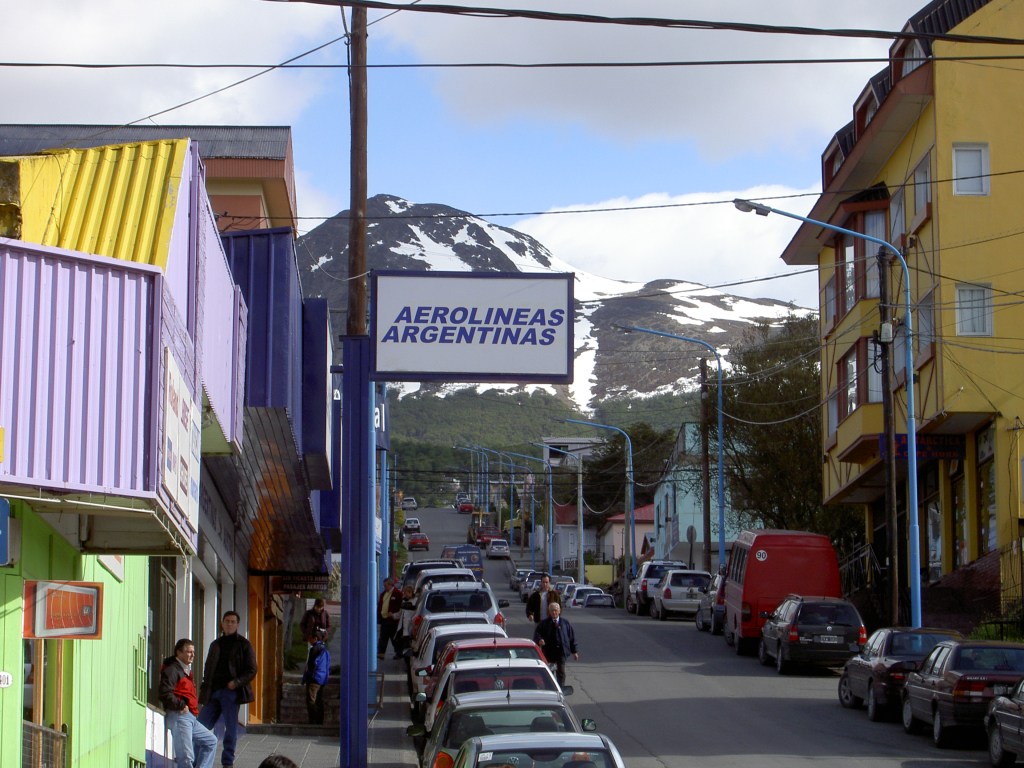
Looking Up Rivadavia

Ushuaia, Argentina is the southernmost city on Earth. There is one town which is further south by a few miles: Puerto Williams, Chile, which is mostly a Chilean naval base. I have never been to Puerto Williams, but I did pass by it on a boat ride on the Beagle Channel to Estancia Harberton. Below is as close as I could get to Puerto Williams without going through Chilean customs:

Puerto Williams from the Beagle Channel

The whole Tierra Del Fuego area, both in Argentina and Chile, is endlessly fascinating. That’s where the Andes comes to an end, sputtering out by Ushuaia and the Dientes de Navarino in Chile. In the above picture, thee are high mountains behind Puerto Williams that are mostly hidden in cloud, though you could make out the rough outline of their summits.

Mark Twain once wrote, “If you don’t like the weather in New England, wait a few minutes.” That is even more true of Tierra Del Fuego. After all, my last day in Ushuaia in 2006 (it was November 15 to be exact), dawned fair and turned into a blizzard. You may say, “Well, it was November, after all!” We were, however, in the Southern Hemisphere, so it was supposed to be like May in the Northern Hemisphere. The truth is, it can snow on any day of the year in Ushuaia.

There are compensations. The cuisine includes king crab (centolla), which is widely available at reasonable prices. The city is chock full of museums, most prominently the so-called Maritime Museum, which was built as a prison to house Argentina’s most dangerous criminals, including Simon Radowitzky, the anarchist responsible for killing a ranking police officer. Ushuaia was for many years Argentina’s Alcatraz.

Ushuaia was where I broke my shoulder in a blizzard. (That’s why I remember November 15, 2006.) The location was the corner of Magallanes and Rivadavia, where I slipped on ice and fell hard with my shoulder on a high curb. They have since put up a traffic signal there, so it is easier to cross the road.

Impressions of Reykjavík

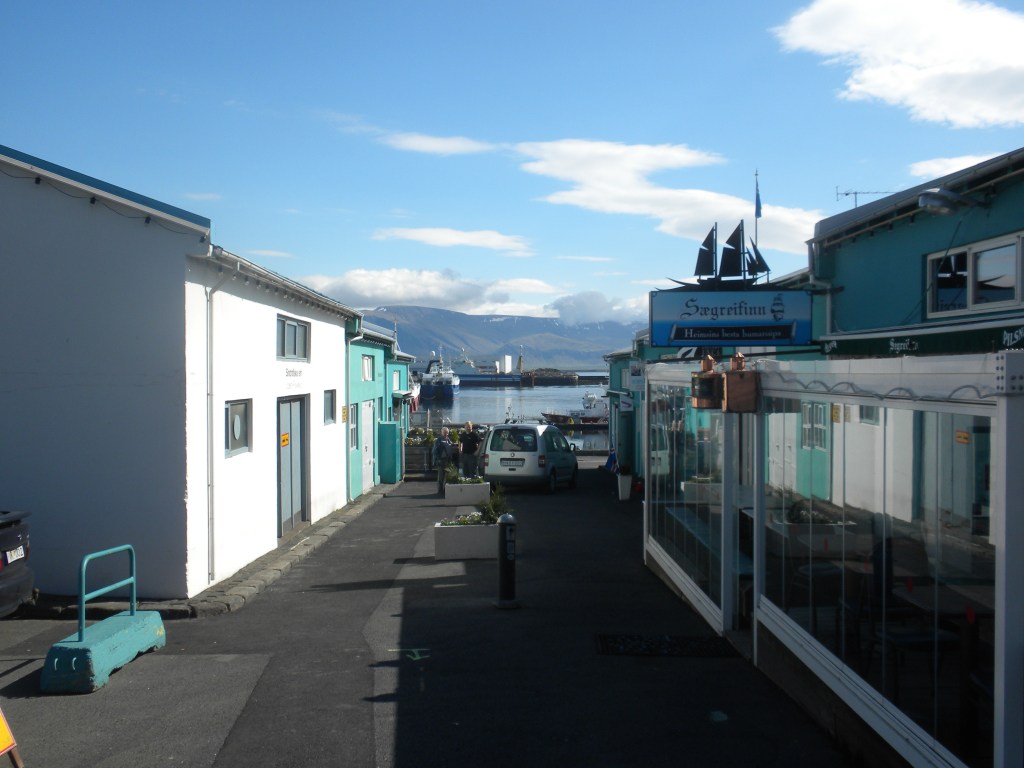
Street Adjacent to Reykjavík Harbor

It’s not the largest European capital, but Reykjavík is to my mind one of the most interesting. Within hailing distance of the Arctic Circle, it can have some of the worst weather imaginable. Yet it is relatively small (about 131,000 souls) and is walkable—if it’s not too windy and wet. You can feed the sea birds by the Tjörn, the municipal pond, but they could just as easily attack you for the goodies you are doling out. The people are friendly, but it seems everyone in town gets shitfaced drunk on the weekend.

There is an air of mystery about the city, which is one reason why the mysteries of Arnaldur Indriðason and Yrsa Sigurdardottir, among others, are so popular.

I have been to Iceland twice, once in 2001 and once in 2013. Both times I fell in love with the city and wished I could stay longer. My first day in 2013 was my favorite. It was near the summer solstice, when it does not get dark until the middle of the night, and then only for a short while. Even after my long flight, I fought jet lag by forcing me to stay up until 7:00 AM Los Angeles time. I even took an evening ghost tour through the local cemetery with the sun still up past 10:00 PM Iceland time.

As I walked the streets of the city, I noticed that many of the buildings had walls of thick corrugated steel, frequently brightly colored. The stucco and chicken wire constructions that protect L.A. from earthquake damage would be blown to bits by the Arctic storms. I ran into one in Myvátn where the rain was blown horizontally through every micro-opening in my parka. And all I was trying to do was to get to the grocery store across the street.

I don’t know if I will ever get to Reykjavík again in this life, but in a way it has never left my dreams. As Edward Gorey once said: “I have fantasies of going to Iceland, never to return.”

In Patagonia

Guanacos by the Fitzroy Massif

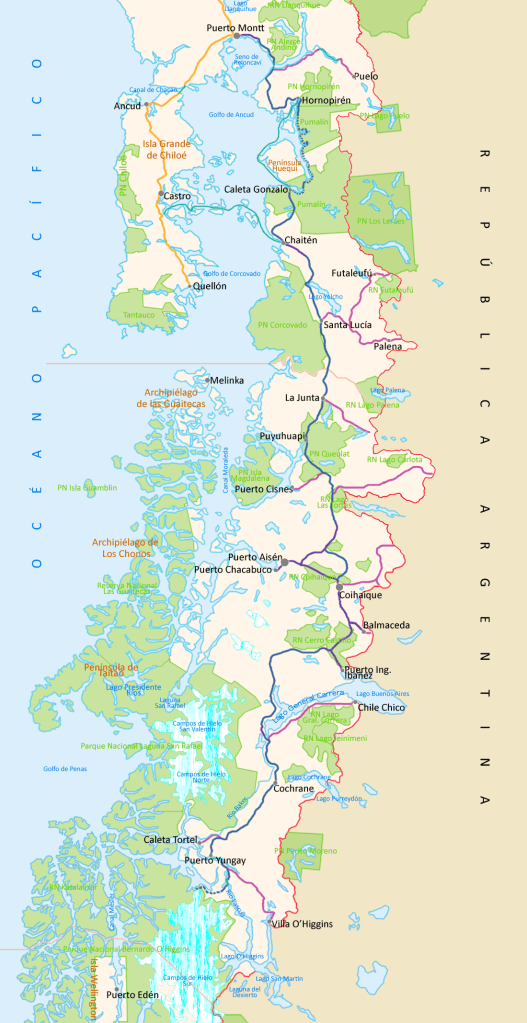
Of all the places I have visited on my travels, I think the most spectacular was Argentinian Patagonia from El Chaltén south to Tierra del Fuego. Twice I have traveled that route, once in 2006 (when I had my trip cut short by a broken shoulder) and once in 2011 with Martine. Although both my finances and remaining years are dwindling, I would like to take another stab at it.

I would like to fly into Ushuaia and take buses north all the way to Buenos Aires. To my right would be the South Atlantic and to my left the windy plains of Patagonia with glimpses of the Andes in the distance.

Argentina is not a destination beloved by North American travelers. The country is full of mostly Spanish-speaking Italians with pockets of Welsh and Croatians. Its main export used to be wool centered in large estancias held by British landowners, but it has become more diversified over time, especially with oil being discovered there.

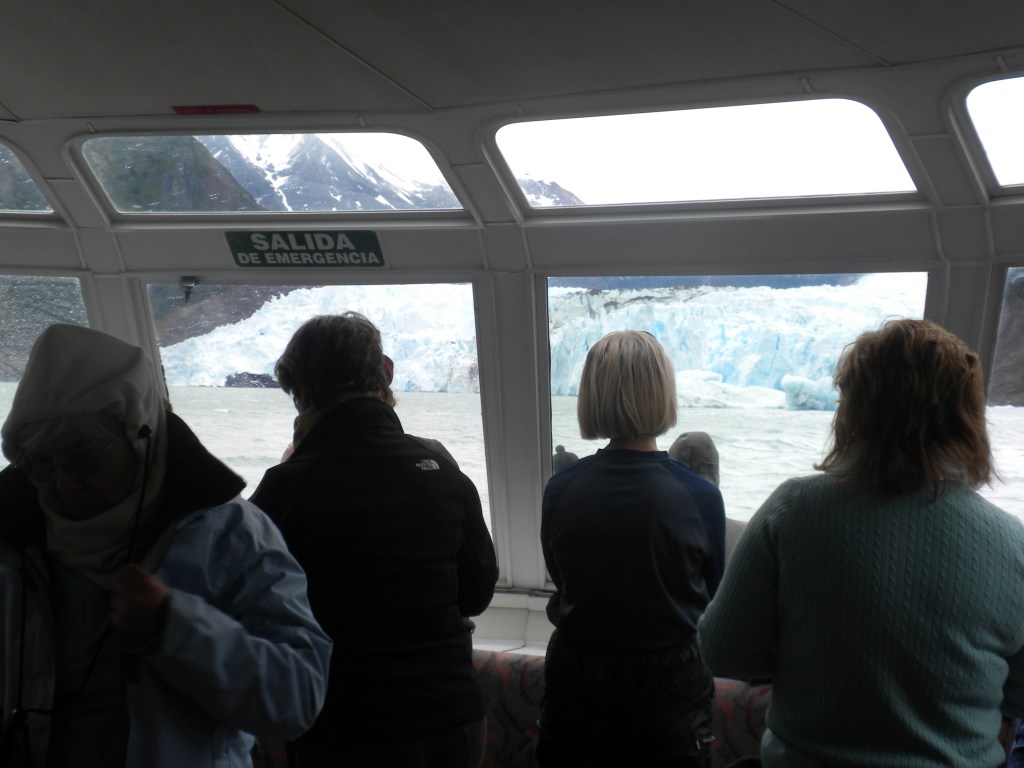
Near El Calafate there are numerous glaciers originating on the eastern slope of the Andes. Martine and I visited the Perito Moreno, Upsala, and Spegazzini glaciers. As the world warms up, many of these glaciers will not be around for the next generation. But it was nice seeing them while we could.

Annapolis Royal

An Amazing Collection of Botanical Art

A few days ago, I wrote about Butchart Gardens on Vancouver Island. I have always enjoyed visiting botanical gardens. Two of the best are on opposite sides of Canada. Martine and I also loved visiting the Annapolis Royal Historic Gardens in Annapolis Royal, Nova Scotia. What I found interesting is that the Canadian gardens looked equally good rain or shine, while the ones in California looked best in sunny weather.

Also, the Canadians did a much better job in labeling the different plants than the American gardens we’ve visited.

One of the neat features of Annapolis Royal is that is only a few footsteps away from Fort Anne, originally built in 1629 to protect shipping. It saw action in five wars, terminating in the French and Indian War (1754-1763). On the northern part of the island is the extensive Fortress of Louisbourg, built by the French in 1713, which played a major role in the French and Indian War.

In general, Nova Scotia was our favorite part of Eastern Canada, followed by the City of Québec. We loved the lobster dinners and the French Acadian culture of towns like Chéticamp, where moose could be viewed from the window of our B&B.

Travels with Chris and Topher

Chris Raney and Topher of Yellow Productions

In doing research for my upcoming Hawaii trip, I ran into a great information resource: Chris Raney of Yellow Productions and his YouTube videos on travel. A resident of Southern California, Chris does his videos with a small stuffed panda whom he calls Topher. (Hmmm: Chris + Topher = Christopher?) Occasionally, he is accompanied by his cute little daughter whom he carries on his back or pushes in a stroller.

I started by watching his video entitled “Cheap Eats Waikiki.” Although it was done several years ago, it was still fairly up-to-date. He has also done videos about his favorite Japanese convenience store on American soil (Lawson Station at the Sheraton Waikiki), things to know before visiting O’ahu, and several other topics—including, for validation purposes, some of his videos about Los Angeles, about which I know a thing or two. He passes the test: Chris knows what he is talking about.

You can see a list of Chris’s videos here.