Just what are the reindeer games that Rudolph the Red-Nosed Reindeer was prevented from participating in? I strongly suspect that it involved buying into the whole michegaas connected with the holiday. Sometimes it seems to me, too, like a weird cult similar to the celebration of potlatch by the Indians of the Northwestern U.S.
Now that I’ve utterly confused you by introducing two unfamiliar terms in the opening paragraph of this post, I will admit to being of two minds about the season. On one hand, it is totally stress-inducing, with endless traditions and practices to make one feel guilty through their non-observance. On the other, it has the potential of bringing happiness to children and even to adults who don’t expect too much out of life.
If you take a close look at Charles Dickens’s A Christmas Carol, you can see it espouses some truly admirable virtues. And, really, it was this novelette by Charles Dickens that was responsible for much of what Christmas has become.
If you expect too much of Christmas, it will disappoint. But if you go for “Christmas Lite,” picking and choosing carefully how deep you step into the morass, you can actually have a pretty good time.
Martine and I are celebrating the holiday simply. Last Saturday, we saw Laurel and Hardy in March of the Wooden Soldiers at the Old Town Music Hall in El Segundo. I ordered a box of Royal Riviera Pears for her from Harry & David. Next Tuesday, I’ll cook up a big pot of beef stew from the New York Times recipe and serve it with Martine’s favorite Hungarian wine: Bull’s Blood of Eger (Egri Bikavér).
Then, of course we’ll look for some of our favorite Christmas films on TV, such as A Christmas Story, the Alastair Sim version of A Christmas Carol, It’s a Wonderful Life, The Bishop’s Wife, and Miracle on 34th Street.
We don’t have a Christmas tree (no room for one), but we did send out a handful of greeting cards to our closest friends.
Decaying Buildings in Ghost Town of Bodie, California
I have visited several ghost towns in California and Nevada, but by far the most impressive is Bodie in Mono County, California. Here you will find no Disney-esque reconstructions: The town is as it was in 1915, when most of its inhabitants decided to relocate elsewhere. And when they left, they left most of their goods behind, where they still are today.
And why shouldn’t they? The town sits at an altitude of 8,379 feet (2,554 meters). To reach its, one takes a washboarded gravel road thirteen miles (21 km) from the end of pavement roughly midway between Mono Lake and the town of Bridgeport. During the winter it is bitterly cold. In fact, the town’s founder, variously called William S. Bodey and Waterman S. Bodey, froze to death in an 1860 blizzard while riding to pick up supplies.
Tomb of the Founder of Bodie, in the Ghost Town’s Cemetery
Bodie was a gold mining town. At its outskirts are the ruins of a large stamping mill which is off limits to tourists because of exposed mine shafts and rusting equipment. For a while around 1880, Bodie had a population of 7,000-10,000 people and was one of the largest cities in the State of California. Over the years, the mines there produced some $34 million in gold and silver (in 1986 dollars).
But like most boom towns, Bodie went bust. Today, the Bodie Historical District is a national and California historical landmark. The state had decided to let Bodie remain as it was when it took over in 1962. No attempt will be made to prop up falling buildings, of which there are many.
Buildings Are Allowed to Collapse
When you visit Bodie, you will see a real ghost town. There are no gunfight re-enactments. In fact there are no services, no cafés, no gift shops. There is a rest room in the parking lot, but little else.
I’ve always loved Henry David Thoreau, and I’ve always loved Edward Abbey. Today I came across a longish essay by Abbey on Thoreau that was by far and away the best thing I ever read about the man from Concord. The first essay in his collection Down the River is entitled “Down the River with Henry Thoreau.” It is at the same time a love letter and a critique.
Writing his thoughts on Thoreau while rafting down the Green River in Utah to where it joins the Colorado, Abbey recognizes the greatness of Thoreau—as well as the fact that he is something of a stick-in-the-mud. Always sociable, he had few real friends other than Ralph Waldo Emerson; Nathaniel Hawthorne thought he was something of a bore. And although he proposed to two local women, he was rejected by both, and very likely died a virgin.
Abbey writes:
Poor Thoreau. But he could also write, in the late essay “Walking,” “The wildness of the savage is but a faint symbol of the awful ferity with which good men and lovers meet.” Ferity—now there’s a word. What could it have meant to Thoreau? Our greatest nature lover did not have a loving nature. A woman acquaintance of Henry’s said she’d sooner take the arm of an elm tree than that of Thoreau.
It is possible that we might not have a good time if we encountered Thoreau in the flesh. But then, I wonder if I would like hanging with Honoré de Balzac or Marcel Proust, hoisting a brewski with Charles Bukowski, drinking tea with Emily Dickinson, or chatting with G. K. Chesterton. What each of this figures created was an edifice more than a personality. One honors the edifice while acknowledging that we might think the personality to be a bit yucky, perhaps even slightly repellent.
It is appropriate to post this poem after learning of the death of Rob Reiner and his wife at the hands of their son Nicholas. You might say it’s about the flip side of a happy family:
This Be the Verse
They fuck you up, your mum and dad. They may not mean to, but they do. They fill you with the faults they had And add some extra, just for you.
But they were fucked up in their turn By fools in old-style hats and coats, Who half the time were soppy-stern And half at one another’s throats.
Man hands on misery to man. It deepens like a coastal shelf. Get out as early as you can, And don’t have any kids yourself.
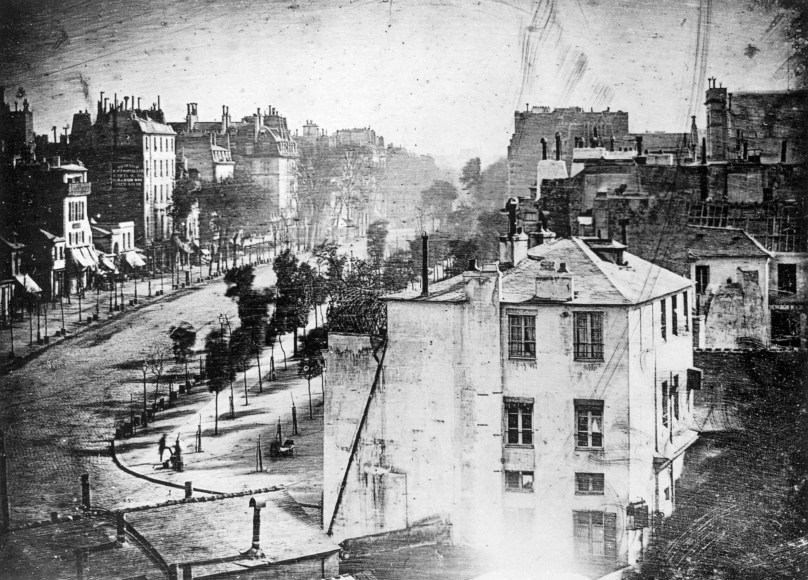
The above photograph is the first one to show a human being. There he is, in the lower left, having his shoes shined. All the pedestrians and carts and carriages have disappeared because this was an eight-hour exposure, ensuring only that static subjects could be recorded. Below is a description of Paris by Honoré de Balzac at the beginning of The Girl with the Golden Eyes (1835) that is anything but static:
One of those sights in which most horror is to be encountered is, surely, the general aspect of the Parisian populace—a people fearful to behold, gaunt, yellow, tawny. Is not Paris a vast field in perpetual turmoil from a storm of interests beneath which are whirled along a crop of human beings, who are, more often than not, reaped by death, only to be born again as pinched as ever, men whose twisted and contorted faces give out at every pore the instinct, the desire, the poisons with which their brains are pregnant; not faces so much as masks; masks of weakness, masks of strength, masks of misery, masks of joy, masks of hypocrisy; all alike worn and stamped with the indelible signs of a panting cupidity? What is it they want? Gold or pleasure? A few observations upon the soul of Paris may explain the causes of its cadaverous physiognomy, which has but two ages—youth and decay: youth, wan and colorless; decay, painted to seem young. In looking at this excavated people, foreigners, who are not prone to reflection, experience at first a movement of disgust towards the capital, that vast workshop of delights, from which, in a short time, they cannot even extricate themselves, and where they stay willingly to be corrupted. A few words will suffice to justify physiologically the almost infernal hue of Parisian faces, for it is not in mere sport that Paris has been called a hell. Take the phrase for truth. There all is smoke and fire, everything gleams, crackles, flames, evaporates, dies out, then lights up again, with shooting sparks, and is consumed. In no other country has life ever been more ardent or acute. The social nature, even in fusion, seems to say after each completed work: “Pass on to another!” just as Nature says herself. Like Nature herself, this social nature is busied with insects and flowers of a day—ephemeral trifles; and so, too, it throws up fire and flame from its eternal crater. Perhaps, before analyzing the causes which lend a special physiognomy to each tribe of this intelligent and mobile nation, the general cause should be pointed out which bleaches and discolors, tints with blue or brown individuals in more or less degree.
By dint of taking interest in everything, the Parisian ends by being interested in nothing. No emotion dominating his face, which friction has rubbed away, it turns gray like the faces of those houses upon which all kinds of dust and smoke have blown. In effect, the Parisian, with his indifference on the day for what the morrow will bring forth, lives like a child, whatever may be his age. He grumbles at everything, consoles himself for everything, jests at everything, forgets, desires, and tastes everything, seizes all with passion, quits all with indifference—his kings, his conquests, his glory, his idols of bronze or glass—as he throws away his stockings, his hats, and his fortune. In Paris no sentiment can withstand the drift of things, and their current compels a struggle in which the passions are relaxed: there love is a desire, and hatred a whim; there’s no true kinsman but the thousand-franc note, no better friend than the pawnbroker. This universal toleration bears its fruits, and in the salon, as in the street, there is no one de trop, there is no one absolutely useful, or absolutely harmful—knaves or fools, men of wit or integrity. There everything is tolerated: the government and the guillotine, religion and the cholera. You are always acceptable to this world, you will never be missed by it. What, then, is the dominating impulse in this country without morals, without faith, without any sentiment, wherein, however, every sentiment, belief, and moral has its origin and end? It is gold and pleasure. Take those two words for a lantern, and explore that great stucco cage, that hive with its black gutters, and follow the windings of that thought which agitates, sustains, and occupies it! Consider! And, in the first place, examine the world which possesses nothing.
Former Poet Laureate of the United States Joy Harjo
This is the ninth time in the last five years that I have posted a poem by Joy Harjo, a Muscogee Creek Indian poet who was once Poet Laureate of the U.S. According to Joy’s notes regarding the poem:
I hadn’t been writing long when I wrote this poem. I believe I was still a student at the University of New Mexico. My first few poems were published in the Thunderbird, the student literary magazine. My voice found itself, then rooted itself in the Sandia Mountains, the Rio Grande River, in the sunrises and sunsets of the Southwest. My voice found a place to eat and drink after traveling through worlds and walking through time, a place to replicate the sense of those worlds in words. That’s when I began writing poetry, real poetry, after those first few published poems. Those first attempts were my calling out for poetry to find me.
Remember
Remember the sky you were born under, know each of the star’s stories. Remember the moon, know who she is. Remember the sun’s birth at dawn, that is the strongest point of time. Remember sundown and the giving away to night. Remember your birth, how your mother struggled to give you form and breath. You are evidence of her life, and her mother’s, and hers. Remember your father. He is your life, also. Remember the earth whose skin you are: red earth, black earth, yellow earth, white earth brown earth, we are earth. Remember the plants, trees, animal life who all have their tribes, their families, their histories, too. Talk to them, listen to them. They are alive poems. Remember the wind. Remember her voice. She knows the origin of this universe. Remember you are all people and all people are you. Remember you are this universe and this universe is you. Remember all is in motion, is growing, is you. Remember language comes from this. Remember the dance language is, that life is. Remember.
At first, I saw nature from the point of view of a Midwesterner. Cleveland had some few beauty spots in its extensive park system, but they tended to be muted. And then there was the matter of Cleveland’s horrible weather.
Then, when I came out to Southern California, I saw that the desert had an entirely different beauty. I am still exploring it slowly. After all, the desert is not an inviting place during the summer months.
In our recent visits to Honolulu, Martine and I visited a couple of botanical gardens, most notably the Foster which abuts Chinatown on the north. We didn’t see any of the other islands, though I am sure there were eye-opening botanical gardens elsewhere, too.
I am eager to visit Alaska. There is yet another order of beauty: Majestic and huge, dwarfing the human scale.
In 1965, John Ford directed a film about Sean O’Casey entitled Young Cassidy. In one scene, William Butler Yeats offers the O’Casey character some advice which has kept rattling around inside my head:
You’re young Cassidy, and that makes your passion effortless and artless. Think towards the day when you are old and the passion is painful and remorseless. What you have now has given you pity. What you must one day find will give you compassion. Age, the winter days, make the chill of the frost as compelling as the heat of the sun. Lovers look towards the time of day when the sun goes down. But give a thought to the time, when as an old man, you’ll be surprised to see the sun come up. The warmth of your girl’s body inspires you now, Cassidy. There will be a time when you must be inspired by the Arctic waste. Prepare for that.
Yes, I can see myself being inspired by the Arctic waste, or the Mojave desert, or the tropical islands of the Pacific. It’s all part of really and truly being where you are, and allowing yourself to be acted upon by all the flavors and colors and tonalities of life.
Move over, Cap’n Jack Sparrow, you’ve met your match! Ol’ Fuzzywig has now committed international piracy by seizing an oil tanker off the Venezuelan coast.
Is it full of gold doubloons? Or possibly silver from the Cerro Rico of Bolivia? No, me buckos, it is full of all kinds of grief for our Presidente, who now has to be worried about being called to the International Court at the Hague to answer for his crimes.
We might not be very good at solving problems in our economy, but we are great at inventing flashy terms that keep us from facing the problem. I can express the problem with an anecdote from my past. When I started working for an accounting firm in 1992, I went out to eat lunch in Westwood Village with my co-workers. We tried and usually succeeded in limiting the cost to $5.00 or less. A third of a century later, the cost of lunch has risen sixfold to approximately $30.00.
And what makes it worse, the food is nowhere near as good as it used to be.
Politicians talk of flattening the inflation rate. But even if they do so, the damage has been done. No one talks about rolling back prices. By relentlessly concentrating on the present day, they are ignoring the fact that the problem we are facing is not “affordability,” but poverty.
And this is what threatens the Trump administration. Our biggest danger is not our borders with our neighbors, but what we ourselves do (or neglect to do) within those borders.
The President can say that he has reduced inflation over a carefully selected stretch of time, but he has done nothing to enable the people who voted for him (and, more particularly, those who didn’t) to live better. Now he thinks that cash giveaways are the answer, even when the amount stated is too low. If your costs will balloon by $5,000 over the next year, what good will $2,000 do? Will he have to repeat the giveaway next year?
And given the present administration’s known problems dispensing cash, I foresee new opportunities for fraudsters.
I know that talking about economics is boring. Just consider this: When I retired in 2018, I thought I had enough in my pension that tide me over for 10-15 years. It didn’t. Next month, I will have to look into getting public assistance.
Why do I love chess so much? Let me count the ways:
It has been around since the 7th century AD.
It is played around the world, with the current champion being from the country of origin, namely, India.
“There are even more possible variations of chess games than there are atoms in the observable universe.” Read about the so-called Shannon Number.
It is possible to improve one’s game by studying games played in the last 200 years.
Hell, the number of reasons I love chess also approaches infinity.
Among the top fifty players in the world today are representatives from Norway, the United States, Germany, India, France, the Netherlands, China, Hungary, Uzbekistan, Vietnam, Azerbaijan, Russia, Slovenia, Serbia, England, Poland, Armenia, Croatia, and Sweden. In fact, the only parts of the world that are under-represented are Latin America and Africa.
I learned to play the game at the age of nine from the Hungarian husband of one of my mother’s friends. Since then, there has never been a time when I didn’t follow the chess news.
That does not mean I’m particularly good at the game. I may be just another patzer, to use the Yiddish term; but I am still working on improving my game whenever I can. Though I may not have too many years left, I never regard the study of chess games and puzzles as time wasted.







 Tarnmoor
You must be logged in to post a comment.