It’s off to the Coachella Valley for me this weekend to spend some time with my brother. I figured it was best to go now before it started to get hot, as it does late in the spring. My next post will probably be on Monday. With luck, I will have some new scenic photographs with desert views.
I usually write favorable reviews of most of the books I read, but this will be an exception. My review won’t hurt the author, as he died in 1844, unloved and unlamented. William Beckford’s Vathek was originally written in French by this British writer and translated into English by another.
It is an oriental fantasy, which means it is lush with weird details and productive of much wretched excess. One reads along this piece of overripe Turkish delight and comes across a sentence like this:
In the morning, which was lowering and rainy, the dwarfs mounted high poles like minarets, and called them to prayers. The whole congregation, which consisted of Sutlememe, Shaban, the four eunuchs, and some storks, were already assembled.
What in coruscating blue blazes were those storks doing there? There is no reason for their existence except to add some local color. And what about Sutlememe, Shaban, and the four eunuchs? Details without a reason for their existence is nothing less than a form of literary cancer. Instead of being organic to the story, the whole thing comes across as a massive inorganic blob.
Characters come on the scene and subplots are born without any reason for their existence:
Dread lady, you shall be obeyed; but I will not drown Nouronihar; she is sweeter to me than a Myrabolan comfit, and is enamoured of carbuncles, especially that of Giamschid, which hath also been promised to be conferred upon her; she therefore shall go along with us, for I intend to repose with her beneath the canopies of Soliman; I can sleep no more without her.
In the end, one feels as if one has swallowed whole a Myrabolan comfit and choked on it.
Read it if you dare, but be prepared to shove the Carbuncle of Giamschid where the sun doesn’t shine. God knows, I did!
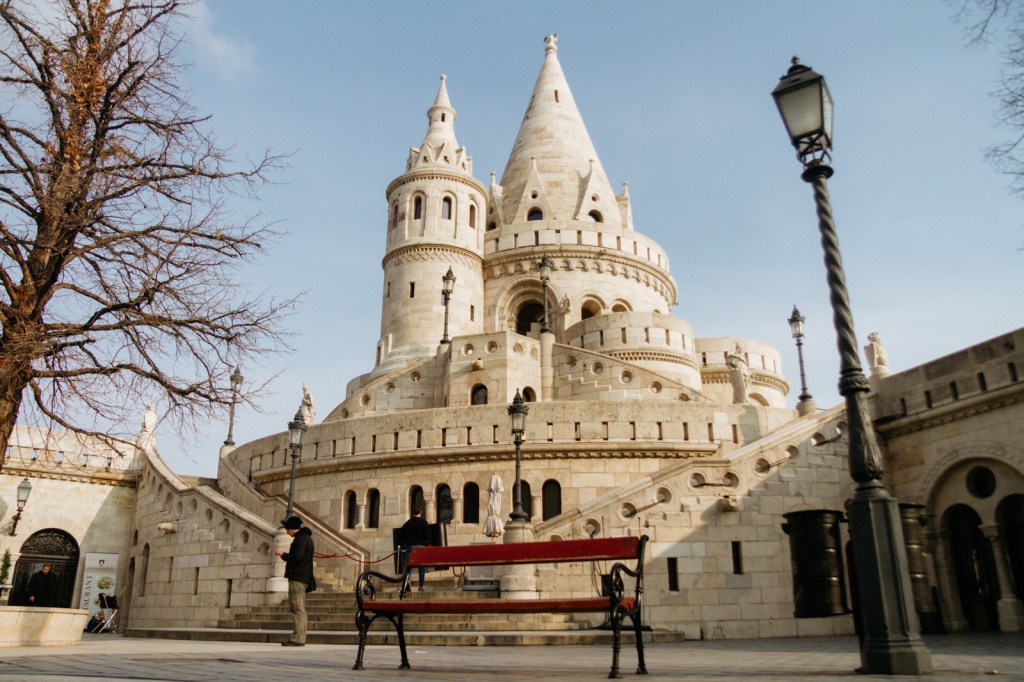
It looks as impressive as all get-out, but the Fisherman’s Bastion (Halászbástya) on Budapest’s Buda bank was actually built between 1895 and 1902 to serve as a viewpoint over the Danube. The myth behind it is that during the Middle Ages, it was the role of the Fishermen’s (Halász) Guild, located in the general vicinity, to protect that reach of the river from invaders.
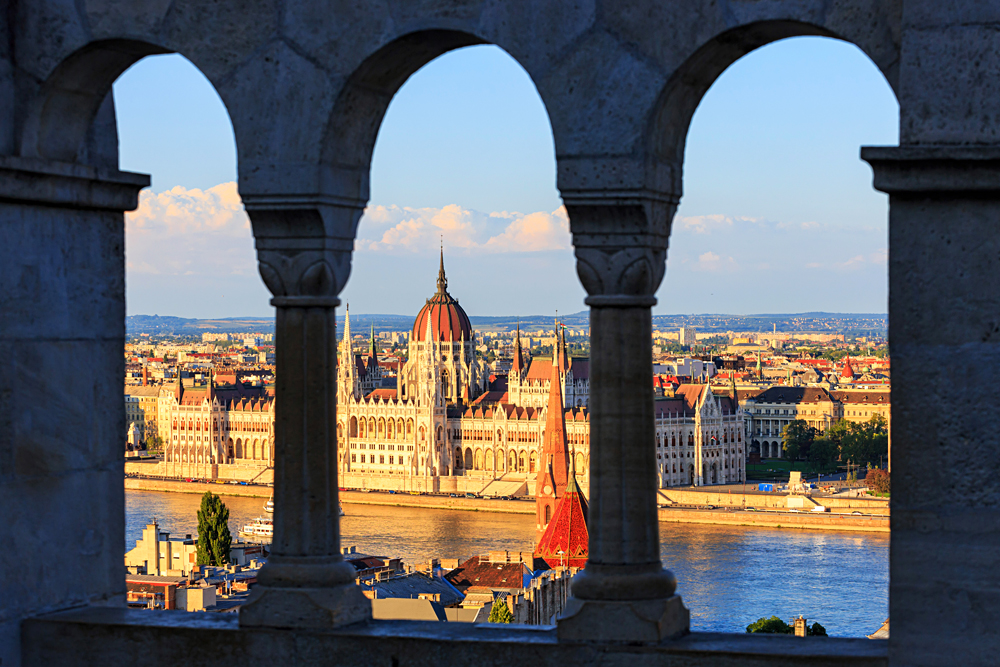
Sitting across the Danube from the Bastion is the Hungarian Parliament, built around the same time. There was a lot of construction in Budapest around that time because 1896 was the thousandth anniversary of the settlement of the Magyar peoples under Arpad in the plain that was to become Hungary.
And here is the view of Parliament from the arches of the Bastion.
I was in Hungary and Czechoslovakia with my parents in 1977 and saw the sights with my cousin Vörös Ilona, who worked for the Hungarian State Railways (MÁV). It was an interesting trip. In addition to Budapest, we hung out at Lake Balaton, visited a huge opera festival in Szeged (where, to stay in a railway workers’ hostel, I had to pretend to be a Hungarian railway worker), and travel to where my father was born in the present day Slovak Republic.
Like Poland, Hungary was on one of the main invasion paths into Europe. Its history was a tragic one, fighting off (not always successfully) the Mongols, the Austrians, the Germans, and the Russians. Now it’s ruled by a rightist dictator named Viktor Orbán, who is smarter than Donald J. Trump, but in the same political ballpark.
If you go to Scotland, the best thing to see are the islands. The concession for RORO (Roll On Roll Off) car ferries to the Hebrides is run by Caledonian MacBrayne. They include longer trips to Stornoway in the Outer Hebrides, as well as a 5-minute sail between Mull and the Sacred Isle of Iona, where the ancient kings of Scotland are buried.
Martine and I have ridden the Caledonian MacBrayne ferries to Mull, Iona, and Islay. In the Middle Ages, the Hebrides were ruled from Islay by the Lord of the Isles, the best known of whom was Somerled (1113-1164). At their height the Lords of the Isles were the greatest landowners and most powerful lords after the Kings of England and Scotland. Today, the Lord of the Isles is Charles, Prince of Wales—though the title is now purely ceremonial.
Above is Kildalton Cross on Islay, where my favorite Scotches are distilled: Laphraoig, Bowmore, Ardbeg, Lagavulin, Bruichladdich, Bunnahabhain, and Caol Ila. They are known for their peat smoke aroma.
When it is safe to travel again, and if I had the money, I would love to go to Scotland and hop aboard Caledonian MacBrayne, going from island to island.
If you are ever interested in seeing a classic British film set in the Hebrides, I highly recommend Alexander Mackendrick’s Whisky Galore! (1949), based on Compton Mackenzie’s novel of the same name. It’s a classic.
Though I understand that the brand-name still exists, the company for which my father worked as a machine-tool builder for many years no longer does. The Lees Bradner Company manufactured gear-hobbing (cutting) machines and thread milling machines, primarily for export.
Alex Paris was for a number of years the shop steward for Mechanics Educational Society of America (MESA), Local 19. He stayed with the firm until the bitter end, when new owner White Consolidated Industries decided to close the factory at West 121st and Elmwood and move the operation to Dexter, Maine to its Fayscott Division in 1975. My father and most of his colleagues decided not to make the move—which was just as well as White sold off the division eleven years later.
Cleveland used to be a major center for the machine tool building industry. No more. In fact, most of that industry is now in China.
You can still find lots of used Lees Bradner machines for sale. Apparently, they had a pretty good reputation.
Titian’s painting of “The Rape of Europa” tells of how Zeus turned himself into a bull, seduced the beautiful Europa, and impregnated her. Here is one version of the tale from Greeka.Com:
The name of Europa is mentioned in many contexts, most of which deal with the divine union between a young girl and Zeus. The most popular myth about Europa says that she was the daughter of Agenor, a Phoenician king, and later became a wife of Zeus, the King of Gods.
According to the legend, Europa was the epitome of feminine beauty on Earth. Zeus once saw her on the seashore of Phoenicia playing with her friends. He was so captivated by her beauty that he fell in love with her and developed a strong desire to possess her. Immediately, he took the form of a white bull and approached her. The bull looked wonderful with its snow-white body and gem-like horns. Europa looked at the extraordinary animal curiously and dared to touch and later hang him because he appeared so calm to her. Later, she was somehow motivated to climb on his back.
As soon as she did so, Zeus ran to the sea and carried her all the way from Phoenicia to the island of Crete. There he regained his human form and mated with her under an evergreen tree. This was the abduction of Europa, who later gave birth to three sons of Zeus, Minos, Rhadamanthys and Sarpedon. These men were known for their fairness and became the three judges of the Underworld, when they died. In fact, Minos founded the town of Knossos and gave his name to an entire civilization, the Minoan civilization.
Zeus loved Europa so much that he showered her with three priceless gifts. The first one was a bronze man, Talos, who served as a guard to her. He was the bronze giant that the Argonauts met and killed in their attempt to shore on Crete. The second was a dog, Laelaps, which could hunt anything she wanted. The last one was a javelin that had the power to hit the target, whatever it was. Europa was later married to one of the kings of Crete, Asterius, who adopted her sons and made her the first queen of Crete.
And here is the Roman poet Ovid’s telling of the legend from The Metamorphoses, as translated by Darrell Hine:
Majesty is incompatible truly with love; they cohabit
Nowhere together. The father and chief of the gods, whose right hand is
Armed with the triple-forked lightning, who shakes the whole world with a nod, laid
Dignity down with his sceptre, adopting the guise of a bull that
Mixed with the cattle and lowed as he ambled around the fresh fields, a
Beautiful animal, colored like snow that no footprint has trodden
And which no watery south wind has melted. His muscular neck bulged,
Dewlaps hung down from his chin; his curved horns you might think had been hand carved,
Perfect, more purely translucent than pearl. His unthreatening brow and
Far from formidable eyes made his face appear tranquil. Agenor's
Daughter was truly amazed that this beautiful bull did not seem to
Manifest any hostility. Though he was gentle she trembled at first to
Touch him, but soon she approached him, adorning his muzzle with flowers.
Then he rejoiced as a lover and, while he looked forward to hoped for
Pleasures, he slobbered all over her hands, and could hardly postpone the
Joys that remained. So he frolicked and bounded about on the green grass,
Laying his snowy-white flanks on the yellowish sands. As her fear was
Little by little diminished, he offered his chest for her virgin
Hand to caress and his horns to be decked with fresh flowers. The royal
Maiden, not knowing on whom she was sitting, was even so bold as
Also to climb on the back of the bull. As the god very slowly
Inched from the shore and the dry land he planted his spurious footprints
Deep in the shallows. Thus swimming out farther, he carried his prey off
Into the midst of the sea. Almost fainting with terror she glanced back,
As she was carried away, at the shore left behind. As she gripped one
Horn in her right hand while clutching the back of the beast with the other,
Meanwhile her fluttering draperies billowed behind on the sea breeze.
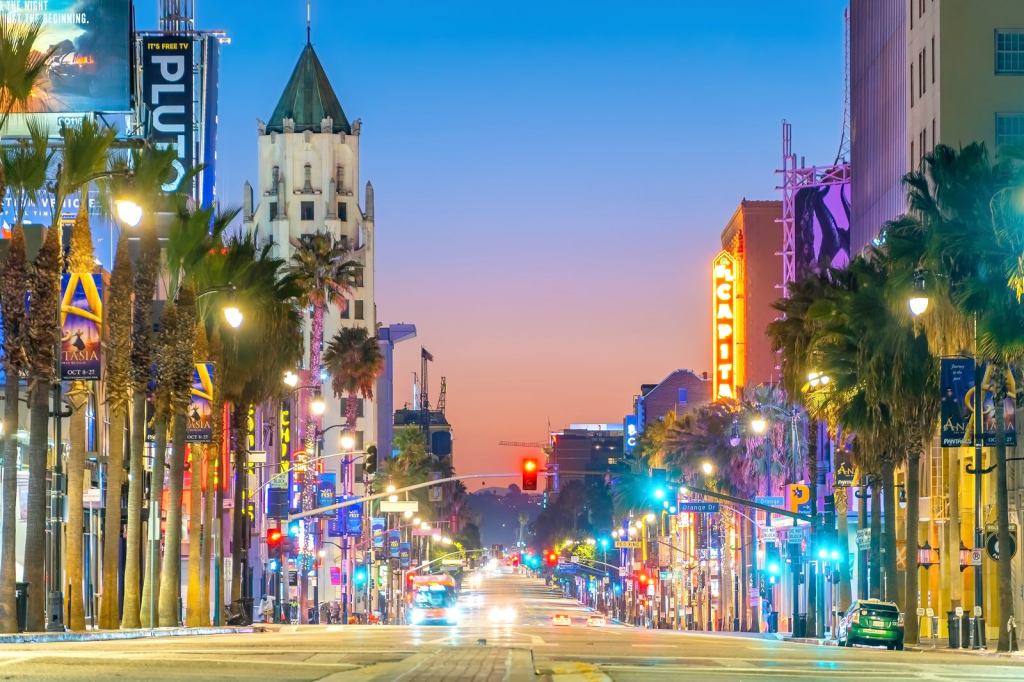
Let’s face it: New York City has it in for us. They have a strange vision of the city that includes only the crescent-shaped area linking downtown, Hollywood, Beverly Hills, Westwood, and Santa Monica. That’s only a tiny slice of LA. The whole country has a population just over ten million people, most of whom do not surf, eat granola, work in the film industry, or belong to a cult.
Over the years, we’ve taken quite a beating. It was William Faulkner who said:
Everything in Los Angeles is too large, too loud and usually banal in concept… The plastic asshole of the world.
Of course, that didn’t stop him from writing screenplays over a period of two decades. In the Wikipedia article on him, it says:
As Stefan Solomon observes, Faulkner was highly critical of what he found in Hollywood, and he wrote letters that were “scathing in tone, painting a miserable portrait of a literary artist imprisoned in a cultural Babylon.” Many scholars have brought attention to the dilemma he experienced and that the predicament had caused him serious unhappiness. In Hollywood he worked with director Howard Hawks, with whom he quickly developed a friendship, as they both enjoyed drinking and hunting. Howard Hawks’ brother, William Hawkes, became Faulkner’s Hollywood agent. Faulkner would continue to find reliable work as a screenwriter from the 1930s to the 1950s.
Although Faulkner did not particularly like Hollywood, he participated in the production of some great films which bear his screen writing credit: Air Force (1943), To Have and Have Not (1944), and The Big Sleep (1946). Not coincidentally, they were all directed by Howard Hawks.
If you see Los Angeles as essentially Hollywood, you will be unhappy here. I was for many years until I saw beyond all the la-la-land rubbish. This is a particularly difficult city for New Yorkers to wrap their heads around. Perhaps it’s because they cannot find egg creams here, whatever those are.
As I sit here to write this blog entry, I am on the receiving end of a concert by the crickets who inhabit my kitchen. For many years, I thought the sound was coming from my Amana refrigerator—until I actually started seeing the crickets, usually as I smashed them with a fly swatter thinking they were one of the mega cockroaches, which, alas, also inhabit this apartment.
The apartment building in which I live is almost as old as I am, having been built around 1946. As I have been told, my building as well as several others in the immediate vicinity, were meant to house the Cleveland Rams, which were soon to be called the Los Angeles Rams. The apartment in which I live could once have been the home of William “Bud” Cooper, Harry “The Horse” Mattos, or Stan Pincura.
I moved in here in 1985. My landlady was the kindly Anna Ficele, who was the original building owner and a terrific cook. After she died in 2001, her slightly retarded son took over, until he passed on a few years later from a life of dissipation. The next owner lasted only a few years. His widow, as I understand it, now owns the papers. Fortunately, we only have to deal with the management company.
We have no intention of complaining about the crickets. I rather enjoy their music.
Pick a place, imply that it is a paradise, write several best-selling books about it, maybe invest in real estate there for the inevitable onrush of rich twits—and you could be said to have wrecked the place for good. I am referring here to Peter Mayle’s A Year in Provence and its 10,000 sequels.
Some thirty years before Mayle started in on his demolition quest, M F K Fischer spent some time with her two daughters in Aix-en-Provence and wrote a far better (though not so well-known) a book with her Map of Another Town: A Memoir of Provence (1964). Fisher obviously loved Provence, but she (M F K stands for Mary Frances Kennedy) was not afraid of presenting it warts and all.
When she first visited Aix, France was still suffering from the war. The town was full of misshapen beggars, many of whom were from Poland and other places that suffered the brunt of Nazi invasion. She tells one story of a French pianist whose house quartered several German officers. Her expensive piano was not to be touched by the pianist, but she was expected to appreciate the musical efforts of her tenants.
I have always loved books about travel, but I have always preferred books which were honest. There are thousands of puff pieces about the four corners of the earth, but they pall rather quickly. To give one example, Jonathan Raban’s excellent Passage to Juneau: A Sea and Its Meanings was not only about travel, but about its author’s life coming apart in the process. The following quote from a review in The Guardian explains it all:
“Journeys,” says Raban, somewhere towards the end of Passage to Juneau, “hardly ever disclose their true meaning until after – and sometimes years after – they’re over.” This book was conceived of as a piece of work, but the professional project is, in the end, wholly subsumed by a floodtide of personal crises that leave the author gasping for air. Did he contemplate keeping them off stage and sticking to the route he’d blithely plotted, back in his Seattle study? Perhaps – but like any good captain, Raban elects in the end to go down with his ship. Passage to Juneau is not the book Raban set out to write. It’s richer, rawer and far, far more rewarding than that.
For this reason, I’ll take M F K Fischer over Peter Mayle any day of the week. I highly recommend her book.
There are many possible pathways through a life. For many, the high point of their lives came early, in high school or college. As they settled down into family life, they rarely ever cracked a book or veered in a different direction. When one talks to them, most of their talk is of their glory days—and their present lives are a long comedown.
Although I was a high school valedictorian who was accepted for a four-year scholarship at an Ivy League college, I never felt I had any real laurels upon which to rest. The first seven years of my life were spent in a Hungarian household, where the Magyar language was the only one spoken. This gave me a slightly different outlook from most others. As I learned English and began to see myself as an American, I also saw myself as something of a hyphenated American who had his feet in two cultures.
During my high school and college years, I was walking around with a pituitary tumor that gave me severe headaches as it pressed against the optic nerve. So my glory days of youth were spent mostly in pain. When I was successfully operated on after I graduated in 1966, I looked like an 11-year-old rather than a college graduate. You can imagine how that affected my self-image.
In the intervening years I had two careers: first, as a computer programmer and director of marketing for a demographic data supplier, and then as a computer specialist and office manager for two tax accounting firms. In both professions, I saw myself as a mercenary who was actually after different game.
Now that I am retired, I am coming into my own as a writer here on this WordPress site. Oh, I am no “influencer.” I have no intention of getting you to buy crap, or anything else. If I am selling anything, it is my thoughts and feelings as a human being living in difficult times. I feel good and am considerably happier than I was during my youth.
It looks as if I am now living through my glory days.








 Tarnmoor
You must be logged in to post a comment.