
Skarp-Hedin in Njalls Saga
We are in Medieval Iceland, and the warrior son of Njall tells a chieftain, “You really ought to pick from your teeth the pieces from the mare’s arse you ate before coming to the Thing [Assembly].”

Skarp-Hedin in Njalls Saga
We are in Medieval Iceland, and the warrior son of Njall tells a chieftain, “You really ought to pick from your teeth the pieces from the mare’s arse you ate before coming to the Thing [Assembly].”

Sod-Roofed Farmhouses at Reykjavík’s Árbær Open Air Museum
There is an old joke that goes: What do you do if lost in an Icelandic forest? Answer: Stand Up.
Because of the Arctic winds that scour the island of Iceland, there are no substantial forests. At one time there were more than there are now., but the early settlers burned them for fuel. Even then, in no case was there enough wood of the right kind to build structures, unless the wood was shipped over at ruinous cost from Scandinavia.
Notice in the above photo the sparing use of wood on the short sides of the above structures. The photo was taken at the Árbær Open Air Museum in Reykjavík, which includes buildings that had been moved to the museum from other parts of the city and country.
Shown below is the layout of the turf house at Stöng in Southwest Iceland:

Farmhouse Layout at Stöng
The single largest room consists of two rows of benches where the residents slept. There was no living room as such, though there was a combined dining room/kitchen on the left. Add a storeroom and a lavatory, and that’s pretty much it.
If you read any Icelandic literature, such as Halldór Laxness’s Independent People, you will find that, before independence, the lives of Icelanders were grim to say the least. Now Iceland is enjoying prosperity due mostly to tourism.
It’s an expensive country to visit, but note that the tourist season is only three months long: from June through August. Some people visit in the winter, mostly to see the Northern Lights, but the weather can be forbidding.

Edgar Allan Poe’s Cottage in the Bronx
There are times when H. P. Lovecraft’s poetry comes across as overripe. But when the subject is Edgar Allan Poe, it seems more appropriate.
Above is the cottage in the Bronx where Poe lived with his young wife Virginia Clemm (married at age 13 to the 27-year-old writer) in the Bronx. I remember visiting it with my mother sometime early in the 1960s.
Where Once Poe Walked
Eternal brood the shadows on this ground,
Dreaming of centuries that have gone before;
Great elms rise solemnly by slab and mound,
Arched high above a hidden world of yore.
Round all the scene a light of memory plays,
And dead leaves whisper of departed days,
Longing for sights and sounds that are no more.
Lonely and sad, a specter glides along
Aisles where of old his living footsteps fell;
No common glance discerns him, though his song
Peals down through time with a mysterious spell.
Only the few who sorcery’s secret know,
Espy amidst these tombs the shade of Poe.
By the way, notice that the initial letters in each line together spell out EDGAR ALLAN POE.
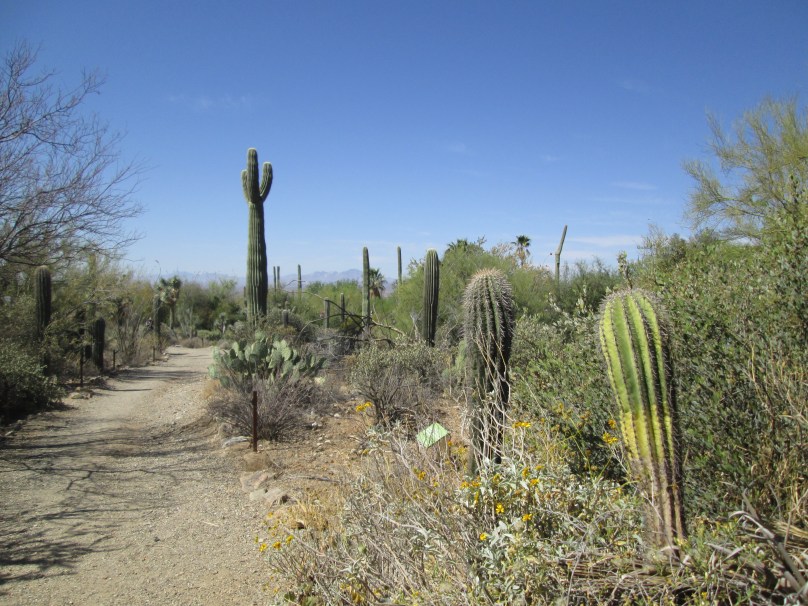
Walkway at the Arizona-Sonora Desert Museum
When Martine and I were in Tucson in April, we ran into 100° Fahrenheit (37° Celsius) temperatures. While we visited the spectacular Arizona-Sonora Desert Museum, I was constantly seeking deep shade and cool water. As a result, we saw only a fraction of the museum’s grounds, which were substantial. There is no doubt in my mind that we must revisit it during the winter months.
In addition to several buildings housing reptiles, birds, fish, and so on, there is a zoo along a pathway that winds through the grounds. I spent a lot of time watching the desert bighorn sheep, because I could view them from a nice shady place. We missed most of the other outdoor zoological exhibits, as well as the desert plants in their immediate vicinity.
To get an idea of the museum’s variety, click here to see the various exhibit categories.
In the vicinity of the museum are a number of other interesting sights:
Until our short visit in April, I had never visited Tucson, though Martine had long ago to visit her aunt living there.
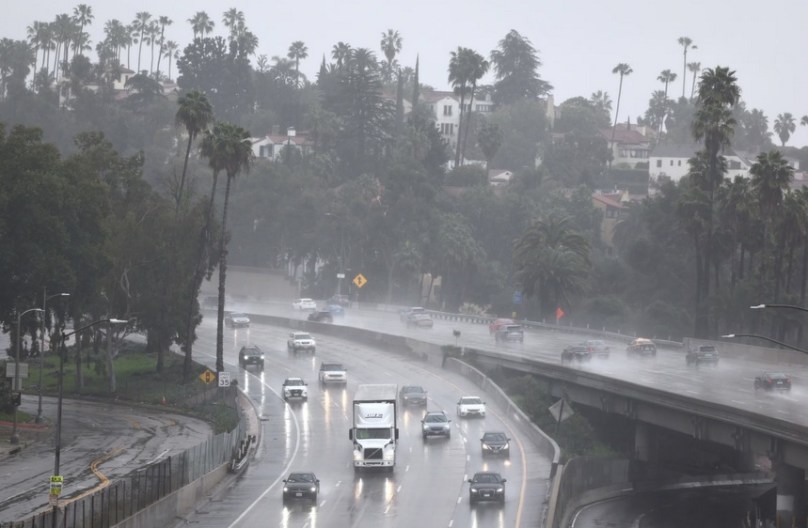
L.A. Caught in the Throes of an “Atmospheric River”
It seems that Southern California is in a perpetual drought, except when we are being drenched by monster rainstorms. I love rain because it makes the surrounding hillsides green, that is, when it doesn’t send those same hillsides sliding into the ocean.
The Los Angeles River is something of a joke for most of the year. (You might remember the car chase scenes in Terminator 2 along its concrete banks.) Right now, it is a raging torrent which I would not dare to approach.
At the supermarket today, I forgot an item on my grocery list for our supper. After watching Fritz Lang’s M (1931) on TCM (Turner Classic Movies), I noticed that the rain was still coming down, so I decided to make do with miscellaneous food items I had lying around the kitchen. Why didn’t I go back to the market? For one thing, it was already dark; and L.A. drivers go crazy when there is anything heavier than a drizzle.
Fortunately, I am a bookworm and a cinephile, so I have no problem entertaining myself. Martine, however, likes to take long walks; and the weather lately has not been conducive.

Tsutomo Yamazaki (Left) in Kurosawa’s High and Low (1963)
This is an unusual thing to say, but if I were to look at all the great film directors with a point of view of selecting the one that would make the best general on the battlefield, my choice would be Japan’s Akira Kurosawa (1910-1998).
Yesterday evening I did not post here because I was watching Kurosawa’s great noir film High and Low for the third time. The tale follows Toshiro Mifune as a shoe manufacturer whose son is kidnapped and held for ransom. Except it turns out that it is actually his live-in chauffeur’s son who is taken. In paying the ransom anyhow, Mifune impoverishes himself, losing his business, his house, and even his furniture.
Why do I feel that Kurosawa would make an able general? In no other film (except one, that I shall mention later) is there so much intelligently conveyed detail that enables a viewer to follow the police investigation in all its aspects during its 143 minute length without feeling lost. And the film gallops along like a 73 minuter Poverty Row quickie.
During its course, Kurosawa takes us into such a realistic picture of heroine addiction that, even today, would be too much for Hollywood to handle.
The only other film that so capably marshals s vast amount of detail is the same director’s Seven Samurai (1954). This is actually a film about a 16th century military campaign in which seven masterless samurai help farmers fight back an invasion of forty mounted bandits who are after their crops. Throughout the film’s 207 minute length, we are aware of what is happening in every part of the battlefield as the samurai and farmers battle the bandits. As with High and Low, the film zips along at a fast pace despite a vast amount of detail without losing its audience.
Compare these with the average current Hollywood production in which 120 minutes seems like a lifetime and the audience is slogging through a swamp shortly after the opening credits.
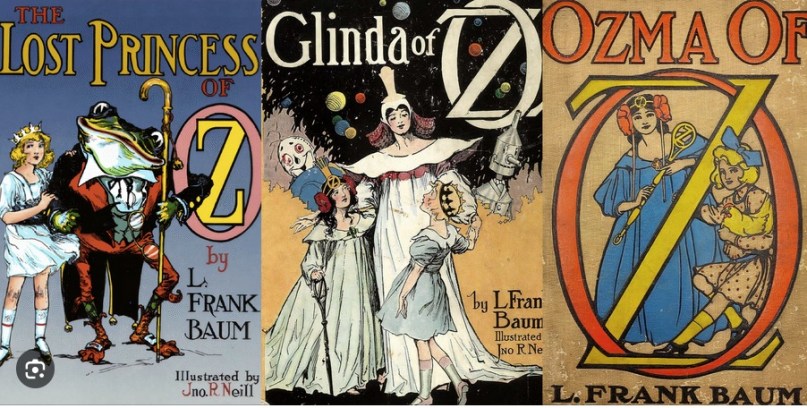
Original Covers of Three of L. Frank Baum’s Oz Books
It’s all well and good to read serious literature, but every once in a while it is good to return to the land of childhood. Why? It is a place where imagination rules, and we can all use a little childlike imagination to see us through the consequences of our bad decisions.
After reading a serious Russian novel (Eugene Vodolazkin’s The Aviator), I decided to read the sequel to L. Frank Baum’s The Wonderful Wizard of Oz, namely: The Marvelous Land of Oz. In all, Baum wrote some fourteen books set in the Land of Oz, and I intend to read all of them—even the ones I have read some decades ago.
In this second book of the series, there is no Wizard, no Dorothy, no Toto, and no Kansas. We do, however, encounter the Scarecrow and the Tin Woodsman and even the Good Witch Glinda. As Baum was no slave to precedent, he introduces several new characters: the boy Tip, Jack Pumpkinhead, an animated sawhorse, and others. There are in addition the moderately bad witch Mombi, the feminist General Jinjur, the Gump (an animated flying machine made of inanimate spare parts), and H. M. Woggle-Bug, T. E. (The H. M. is short for Highly Magnified, and T. E. refers to his being Thoroughly Educated.)
The closest thing to a villain is Mombi, who is allied with General Jinjur and his all-girl army to rule Oz after the Scarecrow and his friends are driven out. Jinjur’s army does not come across as much of a threat, as they are armed only with knitting needles.
I plan to read one Oz book per month until I have finished the series, which I have complete on my Kindle.

American Indian Poet Joy Harjo
One of my favorite American poets is a member of the Muscogee (Creek) Native American Nation, who has served three terms as poet laureate of the United States. Her poetry is simply magical, as the following sample shows:
Don’t Bother the Earth Spirit
Don’t bother the earth spirit who lives here. She is working on a story. It is the oldest story in the world and it is delicate, changing. If she sees you watching she will invite you in for coffee, give you warm bread, and you will be obligated to stay and listen. But this is no ordinary story. You will have to endure earthquakes, lightning, the deaths of all those you love, the most blinding beauty. It’s a story so compelling you may never want to leave; this is how she traps you. See that stone finger over there? That is the only one who ever escaped.

Several days ago, Martine expressed some interest in going to a Walmart … because, well, she hadn’t seen the inside of a megastore for several years. With some reluctance, I drove her to the giant Walmart in Panorama City, at the corner of Roscoe and Van Nuys. Originally, I intended to drop her off and go to a huge bookstore nearby. But then I asked myself, “Do I really need to buy more books?”
That was my mistake. For almost two hours I wandered around the store looking at all the merchandise. In the menswear department, I didn’t see any pants under 30 inches in the inseam. I looked at the shirts: They had flimsy pockets that would dump my reading glasses on the ground every time I bent over.
I guess that for some people seeing so much merchandise and so many services in one place was exhilarating. For me, it was profoundly depressing.
It brought to mind the Atlantic Mills megastore in Bedford, Ohio to which my parents took me. I remember we bought a clunky Recordak tape recorder there. Then there was the huge Fedco Store on La Cienega whose late night pharmacy I had to visit after a visit to the emergency ward for urethral strictures.
I was delighted when I got Martine to agree to leave after purchasing a box of cheap light bulbs. From there, we drove to Otto’s Hungarian Import Store and Deli in Burbank to buy some gyulai kolbasz sausage. We ate lunch nearby at Lancer’s on Victory near Magnolia. It’s one of those 1950s style coffee shops that managed to make it to the 21st century.

I used to subscribe to the New York Review of Books in print form, but I got lazy about reading the issues. Yet I saved all of them and am now reading them, mostly when I go out by myself to lunch. Today, at a local Egyptian Restaurant in Culver City, I read this poem by Diane Seuss in an issue dated June 23, 2022. It’s called “Weeds.”
Weeds
The danger of memory is going
to it for respite. Respite risks
entrapment. Don’t debauch
yourself by living
in some former version of yourself
that was more or less naked. Maybe
it felt better then, but you were
not better. You were smaller, as the rain
gauge must fill to the brim
with its full portion of suffering.
What can memory be in these terrible times?
Only instruction. Not a dwelling.
Or if you must dwell:
The sweet smell of weeds then.
The sweet smell of weeds now.
An endurance. A standoff. A rest.
 Tarnmoor
You must be logged in to post a comment.