
Financialism

Some Wealth Is Real—Based on Actual Products and Services That Fill a Need—Then There Is Financialism

One of the things that really bothers me about this economy is that, increasingly, it is based not on satisfying real needs, but on playing games with finance. According to an essay by Ezra Wasserman Mitchell:

Financialism is a system in which the real economy plays a secondary role to the financial economy, in the process stripping future real economic profits for present consumption. While it bears similarities to the process often identified in the economic literature as “financialization,” it differs both in historical scope and in its suggestion that financialism differs fundamentally from capitalism.

Let me give you several examples:

  • Executives in such “gamed” industries as pharmaceuticals, insurance, or rental real estate get together and decide what level of profit they want for the coming year. In order to achieve their goals, they raise prices to achieve goals that are based on how much money they want—not how much money they can reasonably be expected to earn in the course of business.
  • Crypto-currencies like Bitcoin represent financial speculations divorced from providing products and services. It’s not so much the finger pointing at the moon so much as it is a finger pointing at a finger pointing at the moon.
  • Bank charges and airline nickel-and-dime fees can cause real economic pain that is far removed from the actual value of the services being accounted for.

This came home to me today when I discovered that the forms of insulin I must take for my Type 2 Diabetes have been removed from Anthem Blue Cross’s drug formulary. Outraged, I called Blue Cross and suggested they accompany their “drug not in formulary” notices with ads for cemetery plots and mortuaries. That didn’t go over well with them, but I was pissed. Evidently, if Anthem Blue Cross saw their projected profit as more important than they basic services they provided.


Autobuses de Oriente (ADO)

The Service Area of ADO First Class Buses

There have been many changes since I last visited Southeast Mexico. Among other things, Autobuses de Oriente (ADO) has merged with Ómnibus Cristóbal Colón (OCC) to pretty much monopolize first class bus service in Yucatán. I remember the days when I had to ride the rackety old Unión de Camionéros de Yucatán (UCY) second class buses with their broken seats and cracked windows. There are still a number of second class carriers, but UCY is no more.

Before going any further, allow me to clarify what first class and second class mean. First class buses directly connect larger cities and do not allow passengers to board or alight from a bus between its origin and its destination, unless the city is of a certain size. A bus from Mérida to Mexico City would typically be first class, stopping only in larger cities en route such as Campeche, Ciudad del Carmen, or Coatzacoalcos.

Second class buses connect small towns with larger cities, or with other small towns. When I go from Mérida to Izamal or Uxmal to Campeche, I will have to take a second class bus. The fare will be less per mile, the passengers poorer, and the bus less deluxe. Most importantly, the trip will take longer because passangers can board or exit anywhere they want.

There is also another class of bus usually referred to as combis. These are multi-row vans connecting even smaller cities. Typically, they do not leave until they are full.

ADO Bus at Station Platform

Instead of renting a car, I will travel around Yucatán and Campeche states almost entirely by bus. In some cases, I may join a tour organized by a local travel agency, but only to visit some ruins that are harder to get to via public transportation. When I return from Mexico, I will hopefully have some stories about bus travel in the Sureste region, as well as scads of my own photos.


Haibun: At the Ruins of Dzibilchaltún

The Temple of the Seven Dolls at Dzibilchaltún

A Haibun is a uniquely Japanese medium in which prose and haiku poetry are interspersed. I will attempt to memorialize some of my travel experiences using the Haibun genre from time to time. My intent is to follow the style of Matsuo Bashō:

First look at the ruins
My eyes glued to the chess board
Losing to my guide.

On my first trip to Yucatán in November 1975, I ordered guide services from a company called Turistica Yucateca. The lady who ran the company couldn’t speak a word of English, but we managed to communicate by nouns more or less common to English and Spanish. As my first destination, I chose Dzibilchaltún, about 20  miles north of Mérida. My guide, who had his own vehicle, was Manuel Quiñones Moreno who spoke good English and was well educated. I spent a few minutes looking at the ruins, which were mostly fairly ramshackle; but then he brought out a chess set, and we played several games. I lost all of them.

I have always loved chess, but not with any degree of proficiency.

In any case, I didn’t hold it against Manuel. I hired him the next day to show me the ruins of Acanceh and Mayapán. I kind of wish that Turistica Yucateca were still around, but that was almost half a century ago.

Things change.


Poles Apart

Chanel High School R.I.P.

A strange memory from the past popped into my mind this afternoon as I was heading for the exit of the Century City parking garage. I thought back to our old high school cheer, which was openly contemptuous of Poles. Chanel High (later renamed St. Peter Chanel High) belonged to the North Central Athletic Conference, which consisted of a handful of Catholic high schools, including St. Edward, Elyria Catholic, and—most particularly—St. Stanislaus. I say “most particularly” because we had chosen St. Stan’s to be our official enemy. It was only a few miles away and located in a largely Polish Catholic neighborhood.

When our cheerleaders revealed the following chant, there were a few hard feelings:

OOH sah sah sah!
OOH sah sah sah!
Hit ’em in the head with a BIG KIELBASA!
Put ’em in a barrel
Roll ’em down the street
FIREBIRDS, FIREBIRDS
Can’t be beat!

We, of course, were the Firebirds. Fortunately, during my years at Chanel (1958-1962), we mostly prevailed over St. Stan’s. And it didn’t keep us Hungarians, Slavs, and Italians from enjoying Kielbasa sausages.

Back Then, All Our Cheerleaders Were Male

Once I graduated from Chanel, big changes happened. The biggest of them was the admission of girls. Then, there were a number of black students. Finally, the school was ceded to the Catholic Diocese of Cleveland and was no longer controlled by the Marist order of priests. Around the same time, the name was changed from Chanel to St. Peter Chanel.

Unfortunately, it’s all moot now, as Chanel closed its doors a few years ago and has, I believe, been subjected to the wrecking ball. Sic transit gloria mundi!


Haibun: The Norte

A Norte Storm Lashes the Gulf Coast of Yucatán

A Haibun is a uniquely Japanese medium in which prose and haiku poetry are interspersed. I will attempt to memorialize some of my travel experiences using the Haibun genre from time to time. My intent is to follow the style of Matsuo Bashō:

November norte
White-clad Maya point and laugh
Paper boats bobbing in the street.

It was November 1992. I was in Yucatán with Martine and three friends from work: George Hoole and Jin and Christine Han. On the last day but one of our trip, the peninsula suffered a storm called a norte, because it originated in the United States and gathered strength as it crossed the Gulf of Mexico. The streets of Mérida were flooded: There was no walking without wet stains halfway up the leg. We were staying at the Posada Toledo, an old mansion turned hotel, near the center, worried whether our return flight the next day would be able to take off. Jin Han lightened the mood by carefully folding paper boats and setting them adrift in the street. They aroused considerable hilarity among the passersby.


Traveling with Bashō

Matsuo Bashō (1644-1694) in a Print by Hokusai

I cannot help but see myself in this haiku by the great Japanese poet Matsuo Bashō:

Another year is gone—
A travel hat on my head,
Straw sandals on my feet.

Two weeks from today, I will be in Mérida, Yucatán, reacquainting myself with the world of the Maya. In many ways, Matsuo Bashō is the poet of travel. His book, The Narrow Road to the Deep North, is the ultimate vade mecum for a traveler. The record of a 1,500-mile journey through the main Japanese island of Honshu, it captures with great beauty and subtlety the joys and sorrows of a life on the road.

The sound of a water jar
Cracking on this icy night
As I lie awake.

The extreme conciseness of the haiku form can lead to poetry that is brilliant—or banal. One has to somehow put two ideas together (as the ice and the sleepless traveler) with an absolute minimum of embellishment. Ah, but when it succeeds!

On the withered grass
Shimmering heat waves rise
One or two inches high.

I will, as usual, travel with a blank notebook. I would love to compose haiku relating to my upcoming journey to Mexico. It’s possible, but, alas, not likely. Even though I don’t usually go out evenings (except in Mérida), I will probably find myself too busy reading from my Amazon Kindle, which is fully loaded with hundreds of works of literature and history.


Foreign Lucre

Painter Diego Rivera on Mexico 500 Peso Bank Note

Before visiting any foreign country, I always like to get a supply of banknotes in that country’s currency for the first few days of my trip. So today I headed to Bretton Woods Currency in Brentwood to pick up a couple hundred dollars worth of pesos. The act of handling another country’s currency is always a magical moment for me: I suddenly feel the reality of my impending vacation—in this case, exactly two weeks from today. I got three denominations: 500 Pesos, 200 Pesos, and 100 Pesos.

My favorite is the 500 Peso note, which shows painter Diego Rivera on the front and his wife, the painter Frida Kahlo, on the reverse.


Mexican Patriots Miguel Hidalgo and José Maria Morelos on the 200 Peso Note


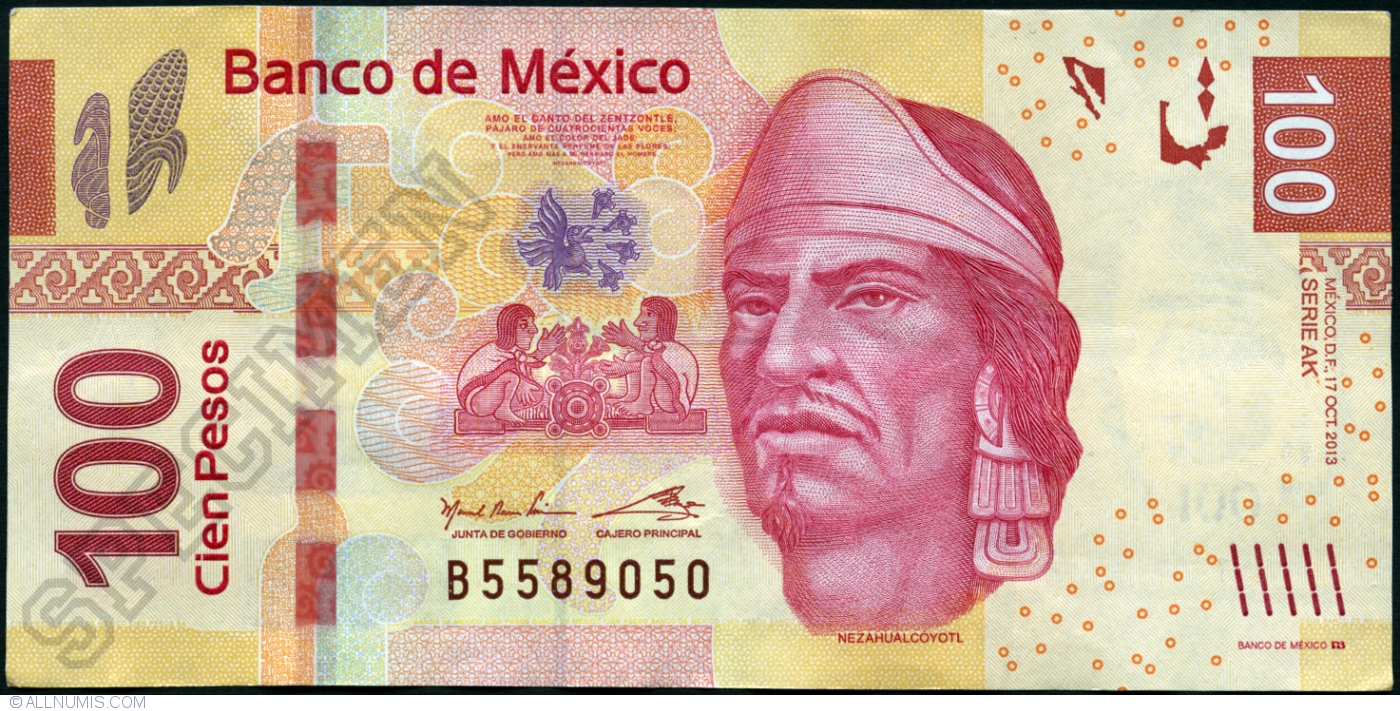
Nezahualcoyotl, Pre-Columbian Poety and Ruler of Texcoco

Above are the 200 and 100 Peso bank notes. I was intrigued by the figure shown on the 100 Peso note of Nezahualcoyotl, “Coyote Who Fasts,” who died some fifty years before Hernan Cortés landed at Vera Cruz with a party of conquistadores.

In the article on him in Wikipedia, I read the following interesting description:

Unlike other high-profile Mexican figures from the century preceding Spanish conquest of the Aztec Empire,  Nezahualcoyotl was not Mexica;  his people were the Acolhua, another Nahuan people settled in the eastern part of the Valley of Mexico, settling on the eastern side of Lake Texcoco.

He is best remembered for his poetry, but according to accounts by his descendants and biographers,  Fernando de Alva Cortés Ixtlilxóchitl and Juan Bautita Pomar,  he had an experience of an “Unknown, Unknowable Lord of Everywhere” to whom he built an entirely empty temple in which no blood sacrifices of any kind were allowed — not even those of animals. However, he allowed human sacrifices to continue in his other temples.

Happy New Year [Insert Year]

The Calendar Is Nothing But an Overlay

In general, I am not big on public holidays. And New Years Day is probably my least favorite. In the past, I have tended to answer the usual enthusiastic “Happy New Year” with the off-putting, “Only a fool celebrates the passing of time.” I am no longer invited to New Years parties, but then none of my friends hold them any more.

Here I am, three weeks away from visiting an ancient society which depended heavily on the calendar (the Maya), while I tend to pooh-pooh the whole idea. I do not read any retrospective articles on the year that was or watch any TV programs that fill the same function; and I most certainly do not stay up past midnight to usher the new year in. I rather think the new year can usher itself in: It knows where the door is. I will not drink any cocktails, and I will probably be abed by 10 pm.

I have no particular feelings about 2019. It had its good points, and it had its bad points. Trump is still in charge of the White House and he hasn’t yet canceled the Bill of Rights. (Maybe this coming year….)

Politics has no magic for me. On one hand, elections involve people who make promises, but really want to exercise power and/or accumulate wealth. And even if my candidate wins, I will likely be disenchanted after a few months—because I forgot this simple fact.

If all this sounds deeply cynical, remember that I am a cynical person. I have seen some three quarters of a century pass by my eyes. There has been love, there has been despair, there has been failure, there has been modest success, there has been hope, there have been disasters. I came close to cashing in my chips in 1966, but I am curiously in fairly good health at the present moment—even if I can’t count on it to last.

So I will still wish you all a Happy New Year, but know that years are all ineluctably mixed. I think Spock had the best greeting: Live long and prosper.


Looking Back at Christmas

The Grier Musser Museum in Los Angeles

The Pico-Union District of Los Angeles is a tough neighborhood with heavy concentrations of Central American immigrants. Yet there on Bonnie Brae Street lies the Grier Musser Museum with its huge collection of antiques and seasonally related memorabilia. During the key holidays of Halloween and Christmas, there are fascinating exhibits of decorations, music boxes, pop-up books, greeting cards, postcards, and other popular culture highlighting the present and past.

Although Martine and I have visited only during those periods, there are also special exhibits for Valentines Day, Chinese New Years, and Independence Day.

Susan Tejada with Christmas Elf

On Saturday, we spent several hours viewing the Christmas exhibits and chatting with Susan and Rey Tejada, the owners (and inhabitants) of the museum. Christmas is now safely in the past, but it was nice to see the constantly growing exhibits that Susan has collected. They represent what we all want the holidays to be like, far from the mayhem in the parking lots and department stores in mega-malls which it has become. Visiting the Grier Musser Museum gives you a picture of what we all want Christmas to be like. It’s actually a nice feeling.


Reservations

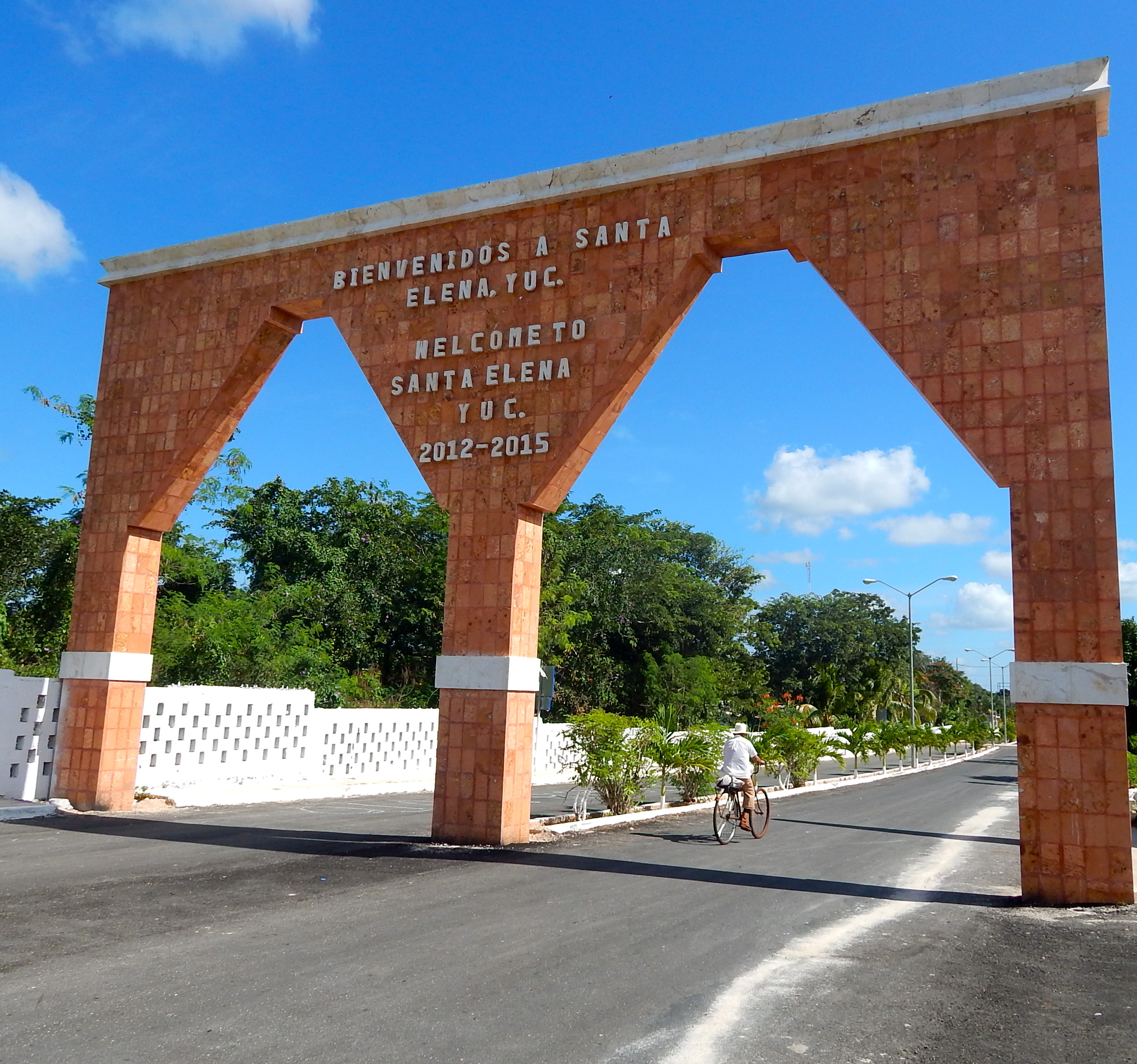
Archway at Entrance to Santa Elena, Yucatán

I am frantically trying to get reservations to hotels in Yucatán—much later than I usually would. It is all due to the problem with my left knee. I wanted some assurance that it was not the beginning of a condition that might rapidly get worse. As a result, I am making reservations a month or so later than I usually would. Unfortunately, a lot of the places I wanted to stay have already been booked, even for such a small town as Santa Elena, which is midway between the ruins of Uxmal and Kabah. I may have to spend big money to stay at the Hacienda Uxmal at the ruins, where I stayed twice before in 1975 and 1992—that is, if I can.

No doubt I will find something. It’s just a little more work than usual.

The Luxurious Hacienda Uxmal Across the Street from the Ruins