A Thin Place

Religious Festival in Chivay

Religious Festival in Chivay, Peru

I was reading an article about a small town in Israel on the BBC News website when I came across an interesting term:

Throughout it all, though, Tzfat has remained a “thin place”.

This Celtic term, invented to describe a place where the distance between Heaven and Earth is compressed, neatly captures a subtle quality that a few places possess. Heaven and Earth, the Celts believed, are often closer than we think. But in thin places, you can feel the divine.

Thin places are often relaxing, but not always. They might be enjoyable, or they might not. What they always possess, though, is the capacity to transform, to strip away the layers of falseness and striving that define so much of our lives, and to reveal something deeper, something more essential.

My most recent encounter with a “thin place” was Colca Canyon high in the Andes. From an elevation of 15,000 feet (4,500 meters) at Patapampa, we dropped down by stages to the town of Chivay, where a religious procession was taking place. My head was buzzing from the high altitude, but I felt that I was in a sacred place, within view of the Apus of the Andes with their snow-covered peaks.

The View Across Colca Canyon Beyond Chivay

The View Across Colca Canyon Beyond Chivay

Chivay was inhabited by a mix of Collaguas and Cabanas in their colorful costumes. While I was wildly snapping pictures, I felt I was not only living in a different layer of reality from the indigenous locals, but I was privileged to see a religious ceremonial that just happened to be taking place when we arrived in the main square. The mountain peoples of Peru have not always been accepting of foreign visitors. Fortunately, I was not part of a large busload of tourists, and I was the only person from my party viewing the procession.

Throughout my stay in Chivay and nearby Corporaque, I felt I was in a thin place. Overhead huge condors rode the thermals, and I was as close as I ever hope to be to the heavens.



Within a Stone’s Throw

Buenos Aires’s Recoleta Cemetery

Buenos Aires’s Recoleta Cemetery

As I have written on earlier occasions, Recoleta Cemetery is one of the major tourist attractions in Buenos Aires. I have visited it during my two previous trips to Argentina, in 2006 and 2011. And now, I will be staying in a hotel within sight of the tombs on Avenida Azcuénaga. It is possible that the blue-green building in the left background could be on Azcuénaga, but I’m not sure.

One of the nice things about staying in the Recoleta area is that it is full of classical old café/restaurants such as La Biela, El Sanjuanino, El Rincón, La Cocina, La Barra, and the Rodi-Bar—places that have been around for a hundred years or more and become national treasures.

On Saturdays, the Plaza Francia in front of the cemetery is the site of a craft fair  that features leather goods; items made with rhodochrosite, a magnesium carbonate mineral that is the national precious stone of Argentina; and yummy snacks. Nearby is La Biela, under the shade of a giant old ombú tree, where one can enjoy a cold Imperial beer and a light lunch.

I will be leaving a week from Tuesday, and as the time gets closer, I am looking forward to the trip more and more.


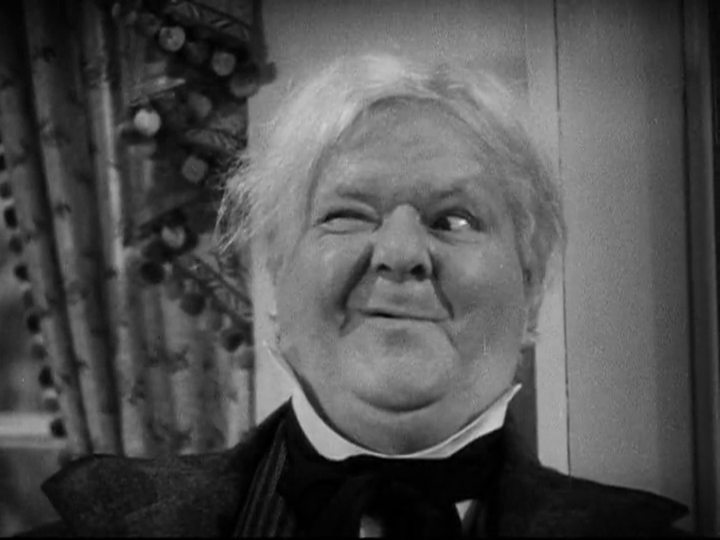
King Charles’s Head

Mr. Dick, Who Cannot Get King Charles I’s Head Out of His Writing

Mr. Dick in David Copperfield, Who Cannot Get King Charles I’s Head Out of His Writing

Today, I attended the European History Meetup Group at the Will and Ariel Durant Branch Library in Hollywood. The subject under discussion was “The King, the Parliament, and the Death of Absolute Monarchy in Great Britain.” We concentrated on the Seventeenth Century, particularly the arrest and trial of Charles I, the rule of Oliver Cromwell as Protector, and the Restoration.

It was for this meeting that I had read Christopher Hill’s great book, The World Turned Upside Down: Radical Ideas During the English Revolution. As usual, for these meetings I am usually more interested in cultural history than names, dates, and battles.

The group leader, Bronislaw Meyler, does an excellent job of introducing the subject and putting all the pieces together.


“Old Dog Trey”

House Select Committee on Benghazi Chairman Trey Gowdy

House Select Committee on Benghazi Chairman Trey Gowdy

The sad affair at Benghazi is probably the most-investigated terrorist event in America’s history. Currently, what we have is the eighth Congressional committee to prate and bray on what Secretary of State Hillary Clinton failed to do to prevent the death of four consular officials in Libya on September 11, 2012. That is seven more committees that investigated the World Trade Center and Pentagon attacks on September 11, 2001 with their thousands of casualties, and seven more than examined the Beirut terrorist bombing attack of October 23, 1983 in which 299 U.S. Marines and French military died.

I guess when the President on whose watch this type of thing is a Republican, he and his people generally get off scot-free. But it was not in the cards in our time.

Politics is a strange animal. By unstinting attacks, it could make the Machiavellian Mrs. Clinton look like a persecuted virgin and martyr and attack dog Trey Gowdy look like one of he Salem witchcraft judges. And the whole committee aims to generate a gotcha moment, in which Mrs. Clinton says something that could be used as a sound bite against her in next year’s presidential race, to be looped thousands of times in negative advertising.

So instead of getting their political victory and singing Gowdyamus igitur to their base, the many political enemies of Mrs. Clinton have drawn the following cards:

Ace Ventura, Pet Detective
Deuce Bigelow, Male Gigolo
Trey Gowdy, Failed Draco Malfoy Look-Alike

I keep saying I don’t want to get drawn into politics, but what’s happening is part of a critical time in our history; and I don’t feel right about remaining silent. Sigh!


Pig

“Probably Bacon Now”

“Probably Bacon Now”

I came across this poem in an excellent article by Joyce Carol Oates in the August 13, 2015 issue of The New York Review of Books. It was quoted in an article about literary imagination entitled “Inspiration and Obsession in Life and Literature.”(When is this woman finally going to get her Nobel Prize? She deserves one five times over.) The poem is called “Pig” and it is by Henri Cole:

Poor patient pig—trying to keep his balance,
that’s all, upright on a flatbed ahead of me,
somewhere between Pennsylvania and Ohio,
enjoying the wind, maybe, against the tufts of hair
on the tops of his ears, like a Stoic at the foot
of the gallows, or, with my eyes heavy and glazed
from caffeine and driving, like a soul disembarking,
its flesh probably bacon now tipping into split
pea soup, or, more painful to me, like a man
in his middle years struggling to remain
vital and honest while we’re all just floating
around accidental-like on a breeze.
What funny thoughts slide into the head.
alone on the interstate with no place to be.

Oates writes in her particle: “(Parenthetically, I should mention that I read this poem when I taught several writing workshops at San Quentin in 2011, on my first meeting with the inmate-writers; in fact, I had to read it twice. The students were fascinated and moved by this poem, in which they saw themselves all too clearly.)”

What’s odd about the poem is that the driver begins to identify with the pig midway through the stanza.


There’s an App for That: A Fantasy

It Was the App to End All Apps!

It Was the App to End All Apps!

It all started in 2016 with an app called OmegApp, available simultaneously for the Android and iPhones. It was inevitable that a program like this would eventually make an appearance. Smart phone callers were running out of people to call, or even text. What OmegApp provided was a robotic interface that appeared to deeply care for anyone who communicated with it. The name of the interface was Tag. If you called Tag, Tag would reciprocate and call you back later, with occasional text messages stroking your ego in the meantime. (Tag’s ultimate message? “You’re IT!”)

Soon, the majority of all cell phone calls and texts were handled by the OmegApp system, which operated on five continents in over sixty languages. Before long, people would distractedly wander the streets with that sh*t-eating grin demonstrating that they were, in fact, wanted and needed by somebody (or something).

Of course, it had an immediately catastrophic effect on traffic—pedestrian, bicycle, and motorized.

In Cleveland, the Dotes twins, Mairzy and Doezy, were struck head-on by the 56A bus as it barreled down East 177th Street. Both the driver and the victims were on Tag at the time. In Santa Monica, a distracted little Lambsy Divey walked off the bluff overlooking the Coast Highway and ended up being run over half a dozen cars, all of whose drivers were texting on Tag.

One would think that there would be an outcry. Unfortunately, there wasn’t. The phone companies were making more money than ever, and those Tag users who didn’t end up a casualty felt happier than before. In fact, talking to Tag was more satisfying than sex and raising a family. In all probability, this may be curtains for the human race: Only the deaf and blind seem to be immune to OmegApp’s blandishments.

Antinomians, Ranters and Republicans

We Are Reliving a Strange Period in English History

We Are Reliving a Strange Period in English History

The Seventeenth Century in England saw some strange happenings. Not only was King Charles I tried for treason and beheaded, but there was an outbreak of religious eccentricity that was at times chaotic and even lunatic. According to Christopher Hill in his book The World Turned Upside-Down: Radical Ideas During the English Revolution:

From, say, 1645 to 1653, there was a great overturning, questioning, revaluing, of everything in England. Old institutions, old beliefs, old values came in question. Men moved easily from one critical group to another, and a Quaker of the early 1650s had far more in common with a Leveller, a Digger or a Ranter than with a modern member of the Society of Friends.

Levellers? Diggers? Ranters? These were just some of the strange splinter groups that flourished during that time. There were also Fifth Monarchists, Seekers, Mechanic Preachers, Grindletonians, Millenarians, Familists, Brownists, and scores of other types of sectaries that were more or less disorganized, frequently localized (especially in the North of England). Some cherry-picked the Bible; others cast the Bible away as more or less a distraction.

What was common to all these groups was that they were antinomian. According to the Theopedia,

Antinomianism comes from the Greek meaning lawless. In Christian theology it is a pejorative term for the teaching that Christians are under no obligation to obey the laws of ethics or morality. Few, if any, would explicitly call themselves “antinomian,” hence, it is usually a charge leveled by one group against an opposing group.

Antinomianism may be viewed as the polar opposite of legalism, the notion that obedience to a code of religious law is necessary for salvation. In this sense, both antinomianism and legalism are considered errant extremes.

Ranter Document, Illustrating Free Love

Ranter Document, Illustrating Free Love

Essentially, antinomians believe that the law comes from inside their minds and hearts, not from any received set of beliefs. It does not matter what many or most people believe. Hill continues:

In the following April troopers in Suffolk were saying they would never disband ‘till we have cut all the priests’ throats.’ Three months earlier, when a group of Presbyterian ministers visited the New Model Army at Oxford, ‘the multitude of soldiers in a violent manner called upon us to prove our calling … whether those that are called ministers had any more authority to preach in public than private Christians which were gifted.’

All men and women, if they had the inner light, were their own prophets and preachers.

Now translate some of this behavior into our own time, with Truthers and Tea Partiers and climate change deniers. The U.S. House of Representatives has dozens of members who thing that whatever they believe is, ipso facto, true. Everything in the news, in magazines, on the Internet is in effect a giant conspiracy and that only they know what is true.

Of course, our own Ranters tend to be Conservative Republicans—though God knows what they are conserving.

At the Greek Tailor’s

It’s Greek to Them

It’s Greek to Them

It’s a stupid little joke, but it highlights an important lack in our education. I saw it as a cartoon in a magazine when I was a child. I understood it at once, but only because I had a good classical education.

A man wearing a toga walks into a Greek tailor shop:

Tailor: Euripides? (“You rip these?”)
Customer: Eumenides! (“You mend these!”)

Euripides was, of course, a great Greek tragedian (ca. 480-406 B.C.), author of Medea and eighteen other surviving plays.

But who was or were the Eumenides? Eumenides was the name of a play by Aeschylus in the Oresteia trilogy, which also consisted of Agamemnon and The Libation Bearers.

Another name for the Eumenides is the Erinyes, probably better known as the Furies, Greek goddesses of vengeance, mostly invoked by the gods when someone has sworn a false oath. I believe the Eumenides gave George W. Bush a hard time over “weapons of mass destruction” in Iraq, from which he is still suffering.

By the time I was in high school, I had read Edith Hamilton’s The Greek Way and The Echo of Greece, as well as a number of the Greek tragedies, so I was fairly conversant with classical literature. Now virtually no one reads the works of ancient Greece and Rome, let alone books about them. But that’s where it all began.

If you don’t know your origins, you won’t know where you’re headed.

Halloween Is Icumen In

Lhude Sing Eek!

Lhude Sing Eek!

We may not go to Halloween parties (I’ve always thought dressing up was for … well … you know), but I find myself celebrating the day in my own way. It has been over fifteen years since we’ve seen any Trick-or-Treaters here (they stick to suburban neighborhoods without stairs to climb), but both of us like horror films—especially the classics—and I am growing increasingly fond of Victorian and Edwardian horror literature.

One of the ways we celebrate is visiting the Grier Musser Museum near downtown L.A., where Susan and Ray Tejada have assembled an outstanding collection of Halloween-related memorabilia, including cards, animatronic gizmos, figurines, and paintings. There are half a dozen rooms full of displays.

This is a museum for which one has to make an appointment, and Susan gives each group a thorough tour during which she turns on all the battery and other electrical figures and answers questions about how she and Ray assembled the collection. On Sunday afternoon, October 26, there will be a special tour with refreshments included.

Other holidays that receive the full treatment are Valentine’s Day, the Fourth of July, and Christmas.


America’s Concentration Camps

Why Not the Germans and Italians?

Why Not the Germans and Italians?

Today, Martine and I returned to the Skirball Cultural Center to see their new exhibit of Ansel Adams photographs of the Manzanar Relocation Center for Japanese-Americans during Wold War Two. In 2010, we had traveled to the Owens Valley to visit the Manzanar site, midway between Lone Pine and Independence. It was there I photographed the above rather disgusting display image.

Manzanar now has an interesting visitor center which is worth a stop on the long highway between Los Angeles and Reno.

In addition to Ansel Adams’s work, there are a number of photos by Dorothea Lange and others, as well as interesting documents relating to the “evacuation” and the maintenance of a system of concentration camps throughout the American Southwest.

Miné and Her Brother Hear the Radio Announcement About the Pearl Harbor Attack

Miné and Her Brother Hear the Radio Announcement About the Pearl Harbor Attack at Breakfast

Down the hall, there was a smaller exhibit of artwork by Miné Okubo, who published a book of sketches called Citizen 13660 about her experiences at the Tanforan and Topaz War Relocation Centers.

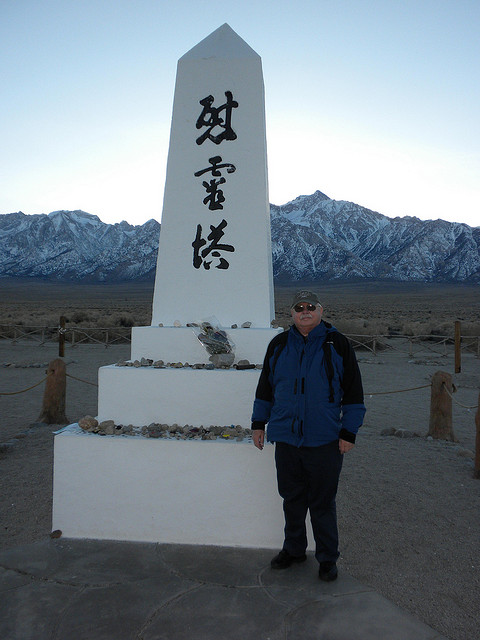
Below is a photo of me taken by Martine at the monument to those who died at Manzanar, in lieu of individual headstones.

Monument to Manzanar’s Dead

Monument to Manzanar’s Dead