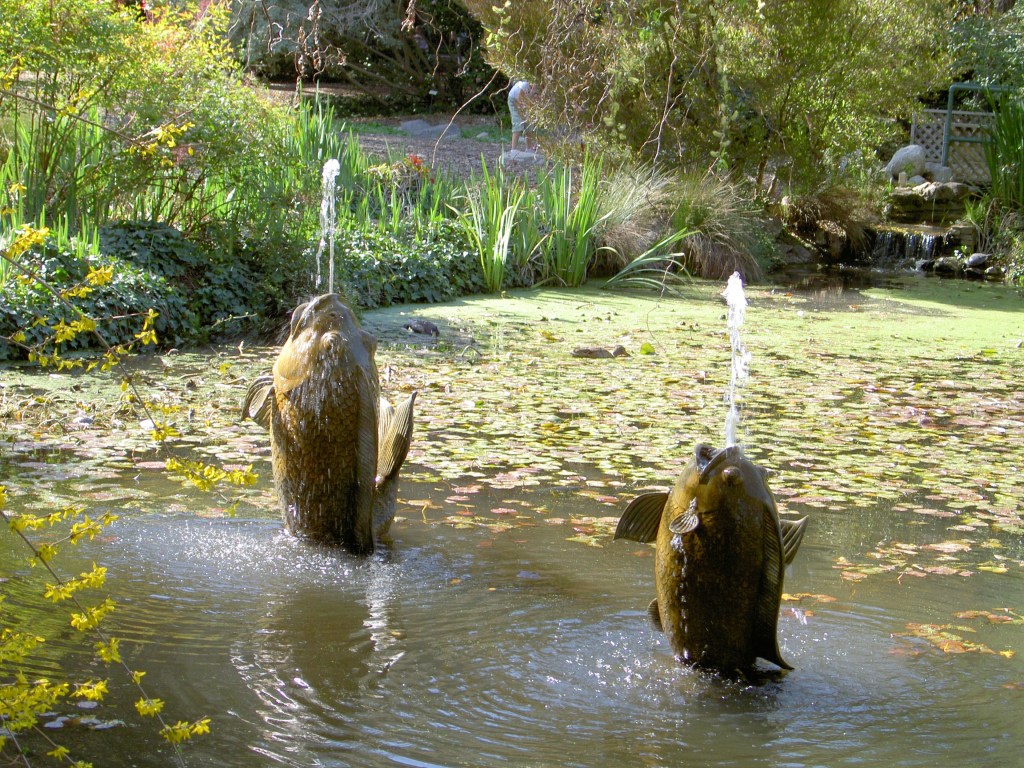
A Different Order of Beauty

Orchids at Honolulu’s Foster Botanical Garden

At first, I saw nature from the point of view of a Midwesterner. Cleveland had some few beauty spots in its extensive park system, but they tended to be muted. And then there was the matter of Cleveland’s horrible weather.

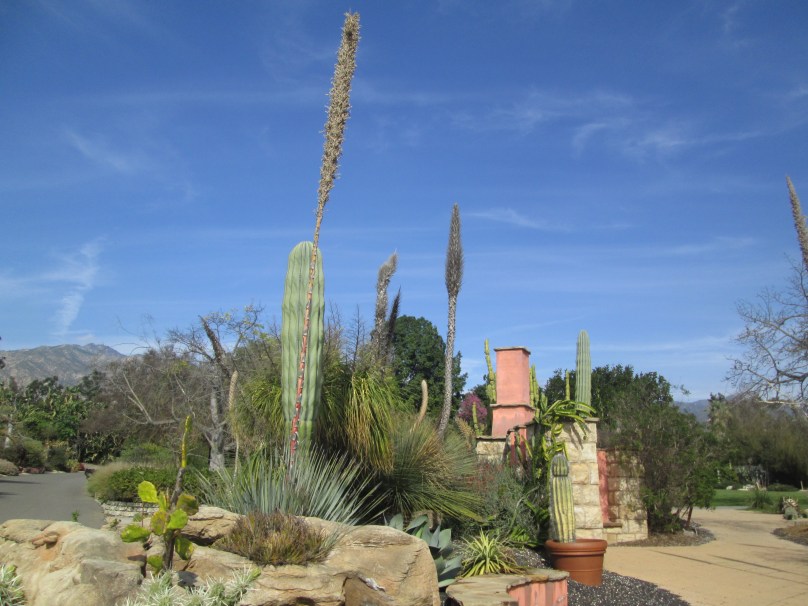
Then, when I came out to Southern California, I saw that the desert had an entirely different beauty. I am still exploring it slowly. After all, the desert is not an inviting place during the summer months.

In our recent visits to Honolulu, Martine and I visited a couple of botanical gardens, most notably the Foster which abuts Chinatown on the north. We didn’t see any of the other islands, though I am sure there were eye-opening botanical gardens elsewhere, too.

I am eager to visit Alaska. There is yet another order of beauty: Majestic and huge, dwarfing the human scale.

In 1965, John Ford directed a film about Sean O’Casey entitled Young Cassidy. In one scene, William Butler Yeats offers the O’Casey character some advice which has kept rattling around inside my head:

You’re young Cassidy, and that makes your passion effortless and artless. Think towards the day when you are old and the passion is painful and remorseless. What you have now has given you pity. What you must one day find will give you compassion. Age, the winter days, make the chill of the frost as compelling as the heat of the sun. Lovers look towards the time of day when the sun goes down. But give a thought to the time, when as an old man, you’ll be surprised to see the sun come up. The warmth of your girl’s body inspires you now, Cassidy. There will be a time when you must be inspired by the Arctic waste. Prepare for that.

Yes, I can see myself being inspired by the Arctic waste, or the Mojave desert, or the tropical islands of the Pacific. It’s all part of really and truly being where you are, and allowing yourself to be acted upon by all the flavors and colors and tonalities of life.

Pirates of the Caribbean

Move over, Cap’n Jack Sparrow, you’ve met your match! Ol’ Fuzzywig has now committed international piracy by seizing an oil tanker off the Venezuelan coast.

Is it full of gold doubloons? Or possibly silver from the Cerro Rico of Bolivia? No, me buckos, it is full of all kinds of grief for our Presidente, who now has to be worried about being called to the International Court at the Hague to answer for his crimes.

Every day, a new outrage!

“Affordability Crisis”

We might not be very good at solving problems in our economy, but we are great at inventing flashy terms that keep us from facing the problem. I can express the problem with an anecdote from my past. When I started working for an accounting firm in 1992, I went out to eat lunch in Westwood Village with my co-workers. We tried and usually succeeded in limiting the cost to $5.00 or less. A third of a century later, the cost of lunch has risen sixfold to approximately $30.00.

And what makes it worse, the food is nowhere near as good as it used to be.

Politicians talk of flattening the inflation rate. But even if they do so, the damage has been done. No one talks about rolling back prices. By relentlessly concentrating on the present day, they are ignoring the fact that the problem we are facing is not “affordability,” but poverty.

And this is what threatens the Trump administration. Our biggest danger is not our borders with our neighbors, but what we ourselves do (or neglect to do) within those borders.

The President can say that he has reduced inflation over a carefully selected stretch of time, but he has done nothing to enable the people who voted for him (and, more particularly, those who didn’t) to live better. Now he thinks that cash giveaways are the answer, even when the amount stated is too low. If your costs will balloon by $5,000 over the next year, what good will $2,000 do? Will he have to repeat the giveaway next year?

And given the present administration’s known problems dispensing cash, I foresee new opportunities for fraudsters.

I know that talking about economics is boring. Just consider this: When I retired in 2018, I thought I had enough in my pension that tide me over for 10-15 years. It didn’t. Next month, I will have to look into getting public assistance.

Approaching Infinity

Why do I love chess so much? Let me count the ways:

  • It has been around since the 7th century AD.
  • It is played around the world, with the current champion being from the country of origin, namely, India.
  • “There are even more possible variations of chess games than there are atoms in the observable universe.” Read about the so-called Shannon Number.
  • It is possible to improve one’s game by studying games played in the last 200 years.
  • Hell, the number of reasons I love chess also approaches infinity.

Among the top fifty players in the world today are representatives from Norway, the United States, Germany, India, France, the Netherlands, China, Hungary, Uzbekistan, Vietnam, Azerbaijan, Russia, Slovenia, Serbia, England, Poland, Armenia, Croatia, and Sweden. In fact, the only parts of the world that are under-represented are Latin America and Africa.

I learned to play the game at the age of nine from the Hungarian husband of one of my mother’s friends. Since then, there has never been a time when I didn’t follow the chess news.

That does not mean I’m particularly good at the game. I may be just another patzer, to use the Yiddish term; but I am still working on improving my game whenever I can. Though I may not have too many years left, I never regard the study of chess games and puzzles as time wasted.

Recovering from Illness

Mother and Daughter by the Sickbed of a Child by Diederik Franciscus Jamin

The above sketch from Amsterdam’s Rijks Museum pretty much describes how I spent most of this week. Something I ate on Tuesday violently disagreed with me, so in addition to the usual messy food poisoning symptoms, I was totally prostrated. Picture Martine at my side feeding me endless glasses of water to avoid dehydration along with hydrocortisone to make up for my body’s inability to produce adrenaline. Without the hydrocortisone, I was likely to die.

To avoid concentrating on the messy details, I would like to present a poem by Robert Louis Stevenson I remember from when I was a boy of ten sleeping in my parents’ bed while I was sick and they were at work. Half the time, my great-grandmother was around to feed me. It presents a very vivid picture of illness seen from the point of view of a child.

The Land of Counterpane

When I was sick and lay a-bed,
I had two pillows at my head,
And all my toys beside me lay,
To keep me happy all the day.

And sometimes for an hour or so
I watched my leaden soldiers go,
With different uniforms and drills,
Among the bed-clothes, through the hills;

And sometimes sent my ships in fleets
All up and down among the sheets;
Or brought my trees and houses out,
And planted cities all about.

I was the giant great and still
That sits upon the pillow-hill,
And sees before him, dale and plain,
The pleasant land of counterpane.

“Filament, Filament, Filament”

Every time I read a poem by Walt Whitman (1819-1892), I kick myself for not being more familiar with his work. Therefore I resolve to read his collection Leaves of Grass in the coming year. The following short poem is one of my favorites:

A Noiseless Patient Spider

A noiseless patient spider,
I mark’d where on a little promontory it stood isolated,
Mark’d how to explore the vacant, vast surrounding,
It launched forth filament, filament, filament, out of itself.
Ever unreeling them, ever tirelessly speeding them.

And you O my soul where you stand,
Surrounded, detatched, in measureless oceans of space,
Ceaselessly musing, venturing, throwing, seeking the spheres to connect them.
Till the bridge you will need be form’d, till the ductile anchor hold,
Till the gossamer thread you fling catch somewhere, O my soul.

“A Great Earthquake”

In his novel Dombey and Son (1848), Charles Dickens had a striking passage about the effect that railroad construction was having on parts of London. I remember this passage vividly from when I first read the book decades ago.

The first shock of a great earthquake had, just at that period, rent the whole neighbourhood to its centre. Traces of its course were visible on every side. Houses were knocked down; streets broken through and stopped; deep pits and trenches dug in the ground; enormous heaps of earth and clay thrown up; buildings that were undermined and shaking, propped by great beams of wood. Here, a chaos of carts, overthrown and jumbled together, lay topsy-turvy at the bottom of a steep unnatural hill; there, confused treasures of iron soaked and rusted in something that had accidentally become a pond. Everywhere were bridges that led nowhere; thoroughfares that were wholly impassable; Babel towers of chimneys, wanting half their height; temporary wooden houses and enclosures, in the most unlikely situations; carcases of ragged tenements, and fragments of unfinished walls and arches, and piles of scaffolding, and wildernesses of bricks, and giant forms of cranes, and tripods straddling above nothing. There were a hundred thousand shapes and substances of incompleteness, wildly mingled out of their places, upside down, burrowing in the earth, aspiring in the air, mouldering in the water, and unintelligible as any dream. Hot springs and fiery eruptions, the usual attendants upon earthquakes, lent their contributions of confusion to the scene. Boiling water hissed and heaved within dilapidated walls; whence, also, the glare and roar of flames came issuing forth; and mounds of ashes blocked up rights of way, and wholly changed the law and custom of the neighbourhood.

In short, the yet unfinished and unopened Railroad was in progress; and, from the very core of all this dire disorder, trailed smoothly away, upon its mighty course of civilisation and improvement.

But as yet, the neighbourhood was shy to own the Railroad. One or two bold speculators had projected streets; and one had built a little, but had stopped among the mud and ashes to consider farther of it. A bran-new Tavern, redolent of fresh mortar and size, and fronting nothing at all, had taken for its sign The Railway Arms; but that might be rash enterprise—and then it hoped to sell drink to the workmen. So, the Excavators’ House of Call had sprung up from a beer-shop; and the old-established Ham and Beef Shop had become the Railway Eating House, with a roast leg of pork daily, through interested motives of a similar immediate and popular description. Lodging-house keepers were favourable in like manner; and for the like reasons were not to be trusted. The general belief was very slow. There were frowzy fields, and cow-houses, and dunghills, and dustheaps, and ditches, and gardens, and summer-houses, and carpet-beating grounds, at the very door of the Railway. Little tumuli of oyster shells in the oyster season, and of lobster shells in the lobster season, and of broken crockery and faded cabbage leaves in all seasons, encroached upon its high places. Posts, and rails, and old cautions to trespassers, and backs of mean houses, and patches of wretched vegetation, stared it out of countenance. Nothing was the better for it, or thought of being so. If the miserable waste ground lying near it could have laughed, it would have laughed it to scorn, like many of the miserable neighbours.

The Decline and Fall of the American Meal

Last night, Martine and I had dinner at a restaurant in Glendale that we have loved for twenty-five years. As soon as we walked in, we noticed some ominous signs. The waitstaff were all young, they were wearing bright new T-shirts imprinted with the name of the restaurant, and there was a brand new illuminated sign. Most seriously, the old owner was not there.

For the first time ever, both Martine and I left the restaurant feeling slightly ill. I almost didn’t make it back to my parked car. And it was lucky that there was a large Mobil gas station at the corner of Brand and Chevy Chase in Glendale, where I was able to dispose of some of the intestinal irritants.

Mind you, I can understand why restaurants are dropping like flies. It is no fun to own or work at a restaurant, especially after the Covid-19 lockdowns. And increasingly, there is more microwaving than cooking taking place in the kitchen—by people who don’t know much about food safety.

Not only in restaurants, but across the board the quality of the American meal has declined precipitously. Even supermarkets are moving away from serving customers who do their own cooking. Recently, I have had problems finding basic food items such as barley or peanut oil. What there is no lack of are frozen meals that taste like cardboard and various “helper” mixes for people afraid to make anything from scratch.

Increasingly, the foods that people eat at home or in restaurants are deficient in nutrition and flavor.

One thing that particularly bothers me is the disappearance of ethnic restaurants as the next generation takes charge. When I first came to Los Angeles, there were loads of great Italian, French, Hungarian, Greek, and other ethnic restaurants. And there were even good cheeseburgers that didn’t look like a 300-pound guy named Rufus sat on them.