In his sonnet entitled “England in 1819,” Percy Bysshe Shelley evinced as great a disgust of what was happening in England during the last days of George III as I do when I look at Trump’s America. Sadly, Shelley did not outlive George III by much: He died in an 1822 boating accident off the coast of Italy.
England in 1819
An old, mad, blind, despised, and dying King; Princes, the dregs of their dull race, who flow Through public scorn,—mud from a muddy spring; Rulers who neither see nor feel nor know, But leechlike to their fainting country cling Till they drop, blind in blood, without a blow. A people starved and stabbed in th’ untilled field; An army, whom liberticide and prey Makes as a two-edged sword to all who wield; Golden and sanguine laws which tempt and slay; Religion Christless, Godless—a book sealed; A senate, Time’s worst statute, unrepealed— Are graves from which a glorious Phantom may Burst, to illumine our tempestuous day.
I am currently reading one of the Buddhist scriptures in its entirety, written in the Pali language as The Questions of King Milinda somewhere between 100 BCE and 200 CE. The book’s description of meditation caught my eye:
The king said: “What, Nâgasea, is the characteristic mark of meditation?”
“Being the leader, O king. All good qualities have meditation as their chief, they incline to it, lead up towards it, are as so many slopes up the side of the mountain of meditation.”
“Give me an illustration.”
“As all the rafters of the roof of a house, O king, go up to the apex, slope towards it, are joined on together at it, and the apex is acknowledged to be the top of all; so is the habit of meditation in its relation to other good qualities.”
“Give me a further illustration.”
“It is like a king, your Majesty, when he goes down to battle with his army in its fourfold array. The whole army—elephants, cavalry, war chariots, and bowmen—would have him as their chief, their lines would incline towards him, lead up to him, they would be so many mountain slopes, one above another, with him as their summit, round him they would all be ranged. And it has been said, O king, by the Blessed One: ‘Cultivate in yourself, O Bhikkus, the habit of meditation. He who is established therein knows things as they really are.’”
Today was Super Bowl Sunday. Yesterday, I said to Martine, “Let’s go somewhere. Everyone will be watching football, so traffic will be light.” And it was—except for the fact that Caltrans shrank the I-405 from six lanes to three for about six miles.
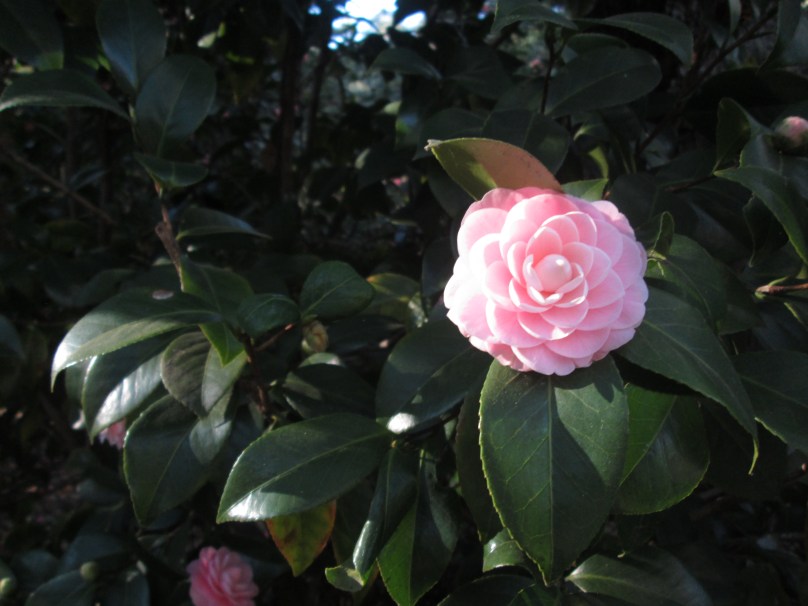
We had lunch at Martine’s favorite Armenian rotisserie chicken restaurant, Sevan Chicken in Glendale. Then we drove to Descanso Gardens and spent three hours there wandering around.
February is not normally known for flowers, but that doesn’t apply to camellias. According to the garden’s website:
There are more than 3,000 kinds of camellias ranging in color, form, and size. Native to Asia, camellias are hardy and have a long blooming season. The two most common species at Descanso are Camellia sasanqua that bloom in fall/winter and Camellia japonica that bloom in winter/spring.
Martine walked around a lot more than I did, but I found several comfortable benches and read from Zen Poems, a collection edited by Peter Harris, in which I found this apt poem:
Camellia Blossoms
My ancient hut’s a ruin, half-hidden under moss— Who’d have his carriage pause before my gate? But my servant boy understands that I’ve beckoned an honoured guest For he leaves unswept the camellia blossoms that fill the ground.
An interesting sidelight: Unlike most Americans, I am not a coffee drinker. My beverage of choice is tea. Interestingly, tea is made from the leaves of the Camellia sinensis, or Chinese camellia.
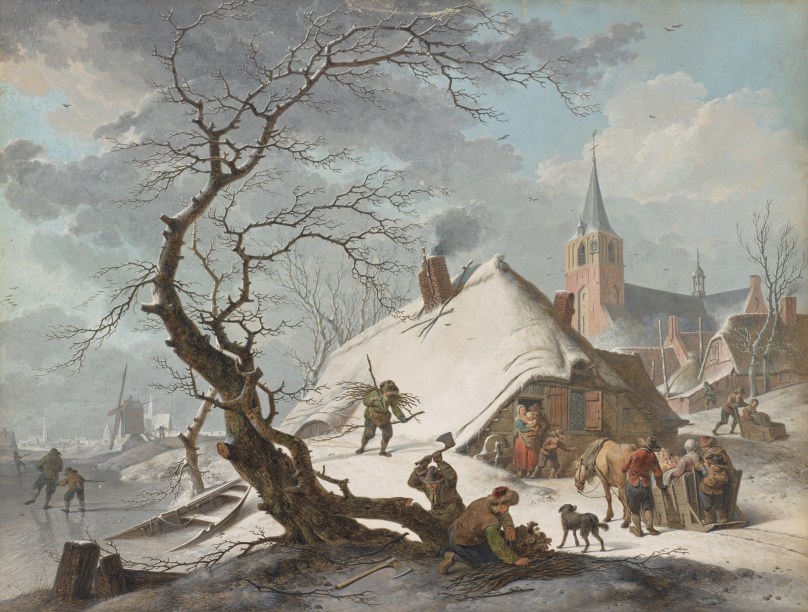
“Winter Scene” by Hendrik Meyer (Dutch, 1744-1793)
Here is one of my favorite paintings in the collection of Los Angeles’s Getty Center. I thought it would be my tribute to the icy winter storms of 2026 (even though I, in Southern California, dis not experience them). According to the Getty website:
Hendrik Meyer illustrated the subject of this watercolor–an idealized version of winter in a Dutch village–in great detail. A barren tree rendered in crisp lines and white highlights, dominates the foreground. The sky is filled with gray clouds, smoke pours from a cottage chimney, and a nearby stream is frozen over. A partially submerged rowboat is covered with snow and ice. Despite the frigid weather, people are outside, keeping warm with activities such as chopping and gathering wood, sledding, and ice-skating. Other elements in the scene also suggest movement: a windmill, chimney smoke, and birds circling or flying in formation. The landscape is filled with delicate textures: grass peeking through snow, a thatched roof, and skaters’ trails on ice.
Meyer’s figured landscapes were produced as finished works for sale. They revived a seventeenth-century tradition of such scenes, hearkening back to Dutch painters such as Pieter Bruegel the Elder, as well as calendar illustrations in medieval books of hours. Artists represented times of the year by showing people engaged in seasonal activities. Winter depictions often featured peasants felling trees, gathering wood, and ice-skating.
I have always loved Dutch painting of the 17th and 18th centuries. Martine and I visited the Rijksmuseum in Amsterdam over twenty years ago featuring Dutch painters of the Golden Age. The exhibit, and the exhibition catalog, has had a major influence on my appreciation of Dutch art.
British Poet George Gordon, Lord Byron (1788-1824)
In that wonderful peak into the lives of two of England’s greatest poets we are indebted to Edward John Trelawny’s Records of Shelley, Byron, and the Author for eyewitness accounts. Although Trelawny was not altogether truthful at times, what would we give to have similar accounts of Shakespeare, Montaigne, and Erasmus, however imperfect?
I forgot that great actors when off the stage are dull dogs; and that even the mighty Prospero, without his book and magic mantle, was but an ordinary mortal. At this juncture Shelley joined us; he never laid aside his book and magic mantle; he waved his wand, and Byron, after a faint show of defiance, stood mute; his quick perception of the truth of Shelley’s comments on his poem transfixed him, and Shelley’s earnestness and just criticism held him captive.
I was, however, struck with Byron’s mental vivacity and wonderful memory; he defended himself with a variety of illustrations, precedents, and apt quotations from modern authorities, disputing Shelley’s propositions, not by denying their truth as a whole, but in parts, and the subtle questions he put would have puzzled a less acute reasoner than the one he had to contend with. During this discussion I scanned the Pilgrim [Byron] closely.
In external appearance Byron realised that ideal standard with which imagination adorns genius. He was in the prime of life, thirty-four; of middle height, five feet eight and a half inches; regular features, without a stain or furrow on his pallid skin, his shoulders broad, chest open, body and limbs finely proportioned. His small highly-finished head and curly hair had an airy and graceful appearance from the massiveness and length of his throat: you saw his genius in his eyes and lips. In short, Nature could do little more than she had done for him, both in outward form and in the inward spirit she had given to animate it. But all these rare gifts to his jaundiced imagination only served to make his one personal defeat (lameness) the more apparent, as a flaw is magnified in a diamond, when polished; and he brooded over that blemish as sensitive minds will brood until they magnify a wart into a wen.
His lameness certainly helped to make him sceptical, cynical, and savage. There was no peculiarity in his dress, it was adapted to the climate: a tartan jacket braided—he said it was the Gordon pattern, and that his mother was of that race. A blue velvet cap with a gold band, and very loose nankeen trousers, strapped down so as to cover his feet; his throat was not bare, as represented in drawings.
It was a hot day, so I decided to take a book and lunch with me to Chace Park. When I arrived there, I was assailed by the pong of scores of sea lions resting on the docks of the Marina. It was decidedly a fishy aroma, and it was noisy with their incessant barking, so I cut my visit short.
As usual, I wondered: Were these seals or sea lions? A quick check of the Internet revealed that they were in fact sea lions. They hung out on the piers in large noisy groups, and they appeared to have small ears.
The park was also crowded with the usual suspects: arrogant crows, watchful sea gulls, and spindly squirrels. Other suspects included a large contingent of the homeless with loud radios. It was exactly conducive for reading. I read a couple of chapters of G. K. Chesterton’s Appreciations and Criticisms of the Works of Charles Dickens and made my way to my parked car to return home.
It was approximately 80° Fahrenheit (27° Celsius) at Chace Park; but the whole vibe was different from the summer, when the sea lions and homeless were less in evidence.
Here is a 1,200-year-old Zen poem by Bai Juyi that was written on the walls of a priest’s cell circa 828. Translated by Arthur Waley, it appears in Peter Harris’s Zen Poems, published by Knopf Everyman’s Library. According to the biographical endnotes:
BAO JUYI (772-846). Also known as Bo Juyi … Bai Juyi was a mid-Tang poet of great versatility. He lived through troubled times, including an official attack on Buddhism that led to the closure of monasteries in 842-5. His own lifelong devotion to Buddhism was eclectic rather than relating to one particular sect. In his admiring biography of Bai the translator Arthur Waley remarked on Bai’s extraordinary compassion, reflected in the tone of much of what he wrote, including his popular ballad, “The Song of Lasting Sorrow.”
Realizing the Futility of Life
Ever since the time I was a lusty boy Down till now when I am ill and old, The things I have cared for have been different at different times, But my being busy, that has never changed. Then on the shore,—building sand-pagodas; Now, at Court, covered with tinkling jade. This and that, equally childish games, Things whose substance passes is a moment of time! While the hands are busy, the heart cannot understand; When there are no Scriptures, then Doctrine is sound. Even should one zealously strive to learn the Way, That very striving will make one’s error more.
I have always admired Arthur Waley. There was a period half a century ago when I sought out his translations of various Oriental texts. In my library are a number of his titles.
I may be revealing myself to be a grouch, but I dislike American travelers who spend the money to visit another country and don’t take the trouble to understand anything of the culture, history, or language of the countries they visit. These are the travelers who, when they ask me questions, get answered in Hungarian.
Perhaps I take my travel too seriously. For instance, when I visited Guatemala in 2019, I read nineteen books on the subject starting in February 2018. Although I frequently hired English-speaking guides at the ruins, I was at the knowledge level of a graduate student in archaeology, with a minor in history and geography.
I keep thinking of a pediatrician friend of mind who went to Europe for the first time with her fiancé and spent only a day or two in each country, just walking around and not even making an attempt to concentrate on the most interesting sights. She wound up marrying the guy and divorcing him shortly thereafter. She felt cheated, having spent so much money and seeing nothing.
It’s like visiting the Grand Canyon and spending all your time walking around the shops and restaurants in Grand Canyon Village.
Looking at the picture above, which was taken from a current American Automobile Association (AAA) travel catalog, I wonder if the young lady standing by the Maya pyramid considered the possibility of sunstroke. Of all the thousands of people who visit Chichén Itzá every day, she was probably the only person not wearing a hat.
Looking more closely at the AAA catalog, I noticed that the ruins are an optional side trip from Cozumel, which is 2-3 hours from Chichén by ferry and bus. The grounds are extensive, as the ruins occupy several square miles. If I had to spend 4-6 hours in transport alone, I would not have much time at the ruins before having to return to my cruise ship. (I spent three days and two nights at a hotel near the ruins on my last trip there.)
Lobby Card for Roger Corman’s Attack of the Crab Monsters
On January 2 of this year, I posted a blog entitled Januarius 2026 in which I stated my intention of reading only books written by authors new to me. At that point, I mentioned a number of authors I was planning to attempt. It is my sad task to tell you that I read only two of the books I mentioned: Colson Whitehead’s The Underground Railroad and Worst Journeys: The Picador Book of Travel.
In all, I read twelve books in January. In addition to the two mentioned above, the list included, in order:
Peter Cheyney’s This Man Is Dangerous, introducing the character of Lemmy Caution, which was taken up by Jean-Luc Godard in his film Alphaville
Ludvík Vaculík’s Cup of Coffee with My Interrogator, A: The Prague Chronicles of Ludvík Vakulík, a Czech novelette about the last days of Communism in Prague
Miklós Vamos’s The Book of Fathers, a fat novel about twelve generations of Magyars surviving (or not surviving) two centuries of Hungarian history
Stuart Stevens’s Night Train to Turkistan: Modern Adventures Along China’s Ancient Silk Road, definitely a “Worst Journey” to Western China and the Uighurs
Marivaux’s Infidelities, an 18th century French play about true love
Patrick Marnham’s So Far from God: A Journey to Central America, including Mexico, another “Worst Journey”
Chris Nashawaty’s Crab Monsters, Teenage Cavemen, and Candy-Stripe Nurses, an entertaining book about the film career of producer/director Roger Corman
Edward John Trelawney’s Records of Shelley, Byron, and the Author by the man who was on hand for the last days of the two great English Romantic poets
Yuri Andrukhovych’s The Moscoviad, a humorous 1990s look at life in Moscow by a Ukrainian who didn’t think too much of Russians
George Woodcock’s Incas and Other Men: Travels in the Andes about a trip to Peru in 1956 by a Canadian professor and his wife
Three of the books were from Eastern Europe satellite countries, and they were of a higher literary standard than most of my other selections. The only other book I liked a lot was Trelawney’s Records of Shelley, Byron, and the Author, which made me resolve to read more poems by Shelley and Byron this year. I also liked the book about Roger Corman’s films: I’ve often thought that Corman was underrated.
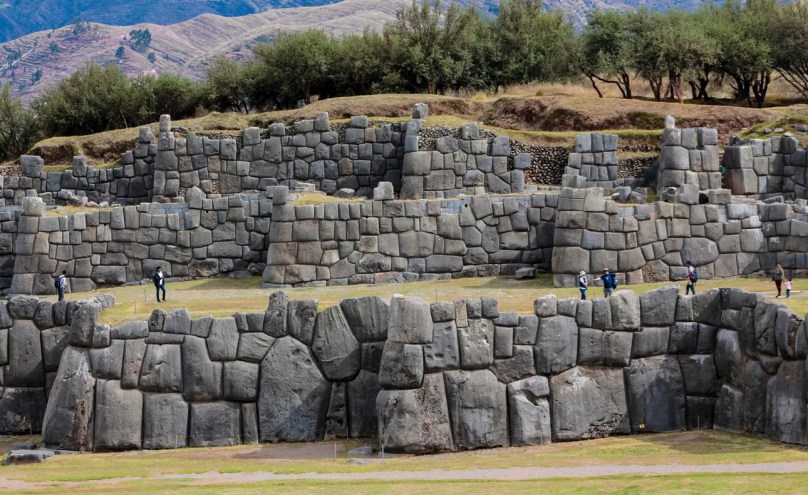
To a generation of Gringo tourists visiting Peru, the impressive ruins at Sacsayhuaman near Cuzco were as often as not pronounced “Sexy Woman.” This will probably persist as long as Americans refuse to learn the intricacies of the Quechua language. When I visited Peru in 2014, I never made it to Sacsayhuaman. I wish I had. I have just finished reading George Woodcock’s Incas and Other Men: Travels in the Andes about a six week trip he took in the Summer of 1956. In it, he had some interesting things to say on page 199 about Sacsayhuaman:
But in fact nothing less than the elaborate centralized organization of the Inca realm at its peak of power could have embarked on such a project [as Sacsayhuaman], and modern scholars are now agreed that the fortress represents the master work of the great public engineers of the fifteenth century. Victor von Hagen, who examined the evidence critically, suggests in his Realm of the Incas that it was started around 1440, not long after Pachacuti began his campaigns of conquest, and that construction took seventy years and employed about 30,000 men, recruited by the mita system of forced labour. The stones seem to have been dragged to the site by teams of men using wooden rollers (presumably brought from the montaña since few trees grew around Cuzco until the eucalyptus was introduced a few decades ago), and to have been placed into position by a complex system of levers and earth ramps. The final shaping and fitting, other archaeologists have suggested, may have been done, after a rough cutting to size, by rubbing the stones against each other, with sand and water between their edges. Again it is largely conjecture, but whatever the methods used to assemble these gigantic walls, their patterns of vast polygonal surfaces have an extraordinary beauty which, combined with the massiveness of the fortress as a whole, make Sacsayhuaman by far the most dramatic building in Peru.







 Tarnmoor
You must be logged in to post a comment.