
To Me, This Was the Highlight of John Clellon Holmes’s Go
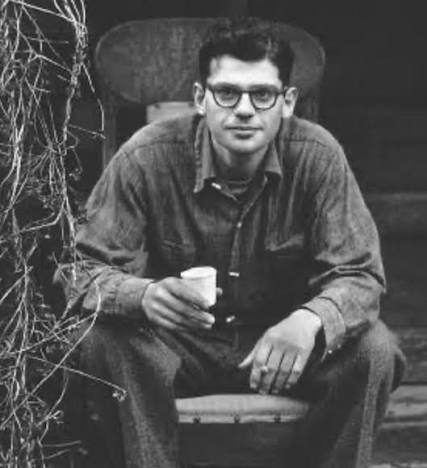
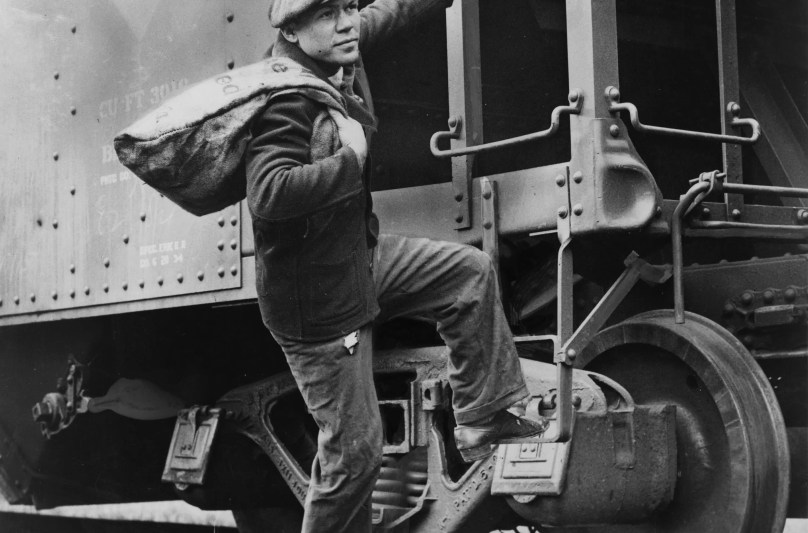
In the book, David Stofsky is Beat poet Allen Ginsberg. His poet and dope fiend friend Ancke (Herbert Huncke) is staying with him and has just been tucked him for the night. The chapter continues:
But that night he had a dream, without trappings, without symbols; a dream of extraordinary clarity while he dreamt it, but which he could not remember at all clearly when he awoke.
He walked down an inky corridor, which like one of those in [his friend] Waters’ building or in his own, and he was out of breath, as if he had come up many long and tiring flights. The door at the end of that corridor did not surprise him, nor, when he opened it without knocking, did the large and shadowy hall beyond it; a hall such as one can rent for fifteen dollars a night in Harlem brownstones; long, the fancy moldings, and dusty crepe streamers giving it a pathetic and abandoned appearance. Nor was he surprised by the throne at one end of it, a throne that was not surrounded by an ambient light, or even very clean and polished, but still somehow regal and entirely proper to the figure sitting there: an aging man of once powerful physique, now vaguely weary, His untrimmed beard fanned out in white folds upon His chest, His eyes shining with muted brightness as only an old man’s eyes can shine out of the limpid stillness of an old face. God.
Stofsky approached, without fear or excitement, and found himself on his knees, looking up, still conscious of his breathlessness. He paused for an instant, peering at the face, realizing an old, skeptical curiosity concerning it which he somehow knew would be tolerated; noting the wrinkles, the faint pink glow of the cheeks, the expression of weary passivity.
Then he began to tell all that had happened since [he had] the visions, endeavoring to stick close to the facts and keep the report brief and accurate. All the same, it seemed to him to take an inexcusable time to go through it all. Finally, reaching Ancke and mentioning his worry over his future, he came to the end.
“I should have had you here before, I know,” God said with an audible sigh. “But then…” And He looked down at Stofsky with an expression of such sadness and such resignation that Stofsky was actually embarrassed to have been the cause of such a look on God’s face.
“But what am I do do next, Sir?” he managed to say.
At that, he thought that God might lean forward and touch his head with one of those large, veinless hands, so gentle and sorrowful was the light which bathed His Face. But He did not.
“How shall I help them now? You see, I’m so confused and tired—,” forgetting that God must know everything.
“You must go back, and even doubt,” God said after a moment’s pause, ”and remember none of this. There’s an end which you shall discover. It waits there for you. Without you, it cannot happen. And it must.”
“But what shall I do?”, wanting, with childlike earnestness, some sign to guide him, to make acceptance easier.
“Being saved is like being damned,” God said with thoughtful simplicity, as though it was one of the unutterable secrets of the universe given to Stofsky now because he had been patient, because he had come so far.
Then God did lean forward until His beard fell straight down into His lap and Stofsky could see the wet brilliance of His large eyes. “You must go,“ He said, “Go, and love without the help of any Thing on earth.”
For a second, Stofsky seemed to recall the words; then remembered a line like that in [the poems of William] Blake, and thought that perhaps this was not God at all, but Blake himself. But then, looking closer, he knew it was God, and thought it wonderful and just that God should quote Blake, too.
As he was about to rise, however, a question rose in his mind, something almost irreverent and certainly mortal, and even though he suspected that he had no right to ask it, he could not let the opportunity pass somehow.
“Things are so terrible,” he began. “The violence, misery, the hate … war and hopelessness … I wonder,” and he gave one fearful and yet challenging glance into Those Eyes. “Why can’t You help all that? Do You know how human beings suffer? … Can you help them, Sir?” [Ellipses are in the original]
God’s face grew dim and drawn, as though the question gave Him pain He knew there was no sense to feel, but pain He took upon Himself in spite of that. He seemed for that moment a majestic and lonely man in His rented hall, on His dusty throne, who had received too many petitioners, too long, and understood too much to speak anything but the truth, even though it could not help.
“I try,” He replied simply. “I do all I can.”
Then Stofsky woke, and it was still dark.He could remember most of it, as though it had just happened, and felt a kind of heavy peace. But very soon he fell off to sleep again, and dreamt no more, and had forgotten when the morning came.
34.052234
-118.243685


You must be logged in to post a comment.