Books Are Dangerous

Bookmarks from The Last Bookstore

Bookmarks from The Last Bookstore

The wording is ominous:

Books are dangerous!
Report to The Last Bookstore
To sell or trade your books
While you still can!

Founded in 2005, The Last Bookstore claims to be California’s largest bookstore, and it may very well be. “What are you waiting for?” its website asks. “We won’t be here forever.”

This is what I call a Filboid Studge marketing campaign, based on the Saki short story entitled “Filboid Studge: The Story of a Mouse That Helped.” I’ve included a link because the story is very short and outrageously hilarious.

The bookstore at the corner of West 5th and Spring Streets in Downtown Los Angeles was one of the highlights of yesterday’s safari by Martine and me. I took eleven books to donate to the store and wound up buying four titles, including Eve Babitz’s Eve’s Hollywood, which I am currently reading with great excitement.

Interior of The Last Bookstore (2nd Floor)

Interior of The Last Bookstore (2nd Floor)

I have been in Los Angeles for half a century now, and I look back at my time here with all the pleasurable hours I spent in bookstores that, for the most part, are no more. There was Papa Bach’s at Santa Monica and Sawtelle; the Westwood Book Company, Butler Gabriel, Campbell’s, Brentano’s, and Borders—all in Westwood; Martindale’s in Santa Monica; Zeitlin & Verbrugge on the West Side; Acres of Books in Long Beach; Brand Books in Glendale; and Pickwick in Hollywood.

They are all gone now. People stare intently at their smart phones and pretend to communicate—but really don’t. They say they could read books on their devices, but never seem to. Perhaps the whole idea of the book is dying while a new generation willfully enslaves itself to a handheld electronic device.

So kudos to The Last Bookstore. Be defiant! Be a dinosaur! Wave your standard proudly!


Ghost Train to Anywhere

Paul Theroux on One of His Mythical Train Rides

Paul Theroux on One of His Mythical Train Rides

For almost forty years, I have been traveling around the world with Paul Theroux—starting with his train ride books The Great Railway Bazaar (1975) and The Old Patagonian Express (1979) to whatever I could get my hands on. Even when I said to myself, “This guy is altogether too snarky,” I followed his adventures with an interest bordering on zeal.

Only now do I realize he is one of the great influences on my life. It was not until November 1975 that I began my own travels (other than back and forth between Los Angeles and Cleveland). My visit to Yucatán opened my eyes and was followed by trips to Britain, Hungary, Czechoslovakia, and a lot more of Mexico. It was as if the floodgates were open, and my eyes were focussed on the world at large, and not just at whatever place I was living at the time.

I have glorious memories of my trips, even the first one to Argentina, when I broke my right shoulder in a blizzard in Tierra del Fuego. I was hooked, and have been ever since.

Yeah, I Second the Motion!

Yeah, I Second the Motion!

A few days ago, I finished reading Theroux’s Ghost Train to the Eastern Star (2008) in which I found the following quotes which resonated with me:

Often on a trip, I seem to be alive in a hallucinatory vision of difference, the highly colored unreality of foreignness, where I am vividly aware (as in most dreams) that I don’t belong; yet I am floating, an idle anonymous visitor among busy people, an utter stranger. When you’re strange, as the song goes, no one remembers your name.

Also, it doesn’t matter any more who’s topping the charts. Taylor Swift doesn’t mean anything to me; and if Kim Kardashian’s ass were offered to me on a silver platter, I would not too politely refuse. I have climbed the Mayan pyramids at Uxmal and Chichén Itzá. I have taken a fall at Magallanes and Rivadavia in Ushuaiah and injured myself. I have visited two Communist Eastern European countries before 1989. I have seen things most people have not seen, and it has changed me forever.

It seemed to me that this was the whole point of traveling—to arrive alone, like a specter, in a strange country at nightfall, not in the brightly lit capital but by the back door, i9n the wooded countryside, hundreds of miles from the metropolis where typically people didn’t see many strangers and were hospitable and did not instantly think of me as money on two legs.

Being a traveler is being something of a loner. I am certainly that. But I wouldn’t have it any other way. I will travel as long as I can.


Meeting Marcel

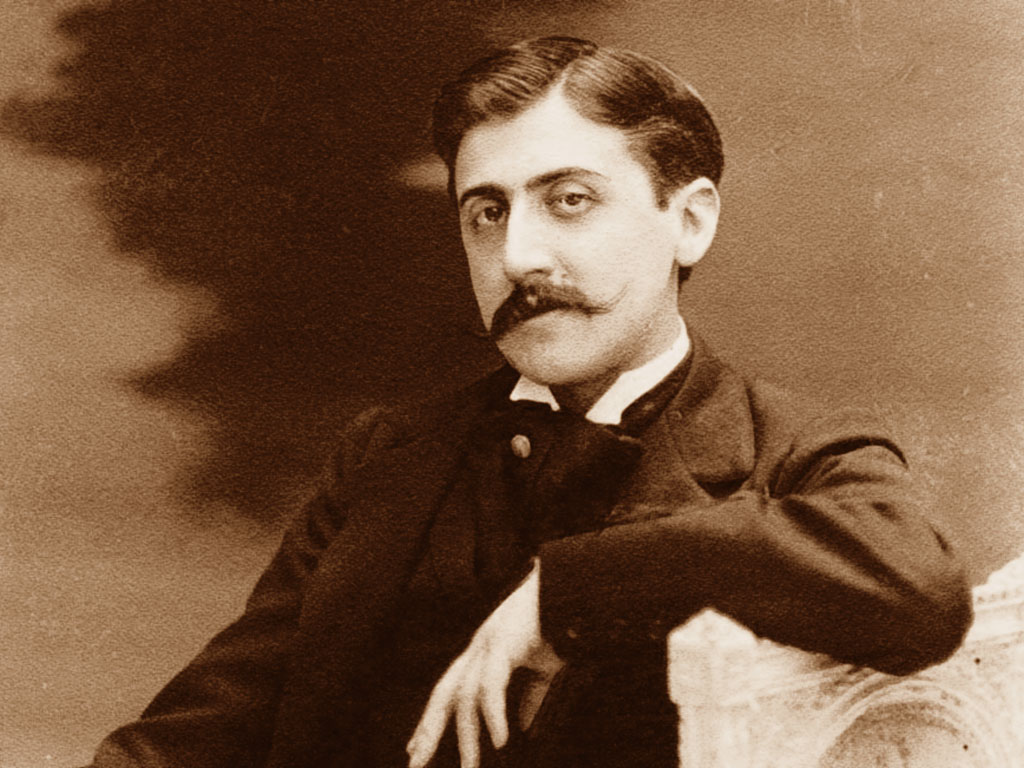
Marcel Proust

Marcel Proust

It is always interesting to read one great writer’s judgment on another. Such was François Mauriac about his meeting in February 1918 with Marcel Proust:

He seemed rather small to me, stoopshouldered in his tight-fitting jacket, his thick black hair shadowing his pupils, dilated, it appears, by drugs. Stuffed into a very high collar, his starched shirtfront bulging like a breastbone, he cast on me a nocturnal eye whose intensity intimidated me.

At the end of the great first chapter in his book Proust’s Way, Mauriac pays homage to the brilliance of his colleague:

The integral history of a young life, of its loves, its friendships, its weaknesses, its intellectual or religious crises, offers the vast proportions of the history of the ideas and customs at a certain epoch as they are reflected in a single spirit. And a long old age would not be enough to complete the account or to exhaust its drama.

As I slowly wend my way through A la recherche du temps perdu—for the third time—I can vouch for that. I will never be finished with his intense vision of the life of one particular individual and his milieu some century and a quarter ago in a distant European country.


One-Trick Ponies

Many Countries Are Too Small or Obscure for More Than One Great Writer

Many Countries Are Too Small or Obscure for More Than One Great Writer

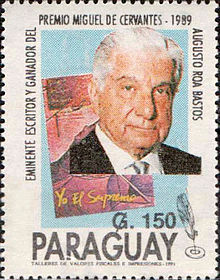
The photo above is of a snake devouring a lizard in Paraguay’s Gran Chaco, one of the most desolate areas on earth. And yet Paraguay gave birth to Augusto Roa Bastos (1917-2005), author of  The Son of Man and I the Supreme, two works that would be better known if their author were not from Paraguay.

Iceland’s claim to fame is the Nobel-Prize-winning novelist Halldór Kiljan Laxness (1902-1998), who wrote many novels that were translated into English, the most famous of which is Independent People. And yet his name is frequently mentioned by people who are carping about the Nobel Prize Committee’s penchant for obscure works. In this case, however, they were dead wrong; and the critics have some learning to do.

Talk about obscure, what about Bosnia? That little country’s literary star is Ivo Andrić  (1892-1975), whose most famous work is The Bridge on the Drina, a work which I think is necessary if you want to understand the tragic and horribly snarled history of the Balkans.

Augusto Roa Bastos

Augusto Roa Bastos

The doyen of South African literature is J. M. Coetzee (1940-Present), author of Waiting for the Barbarians and other excellent novels, plus several penetrating collections of literary essays.

Peru’s most famous author is Mario Vargas Llosa (1936-Present) who is his country’s only Nobelist, and who is also famous for having beaten up Colombia’s most famous author Gabriel García Márquez (1927-2014) in an argument over a woman’s honor. Gave him quite a shiner, in fact!

I guess the point I am trying to make is that it’s worth the effort to go farther afield than those well-traveled paths through the United States, England, and France. I made made many literary discoveries in strange places—a practice which I definitely intend to continue.

A corollary to this: There are many small countries which have rich literatures. Hungary and Portugal immediately come to mind. But there is also Australia, which I am finding is quite the treasure trove.


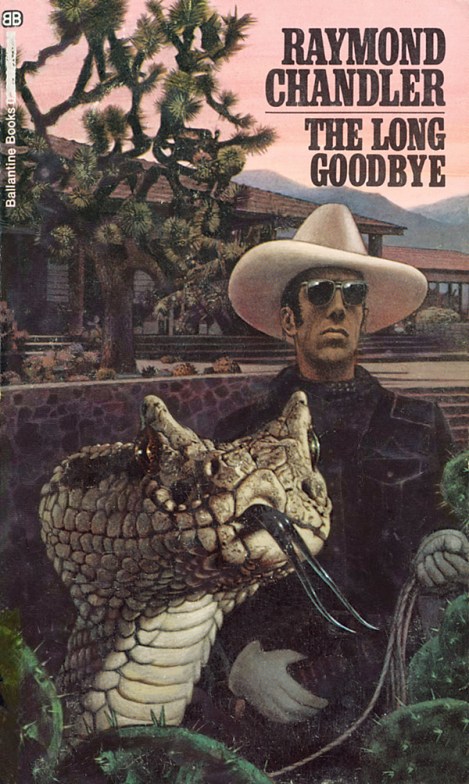
The Long Goodbye


The First Time I Read This Edition

The First Time I Read This Edition

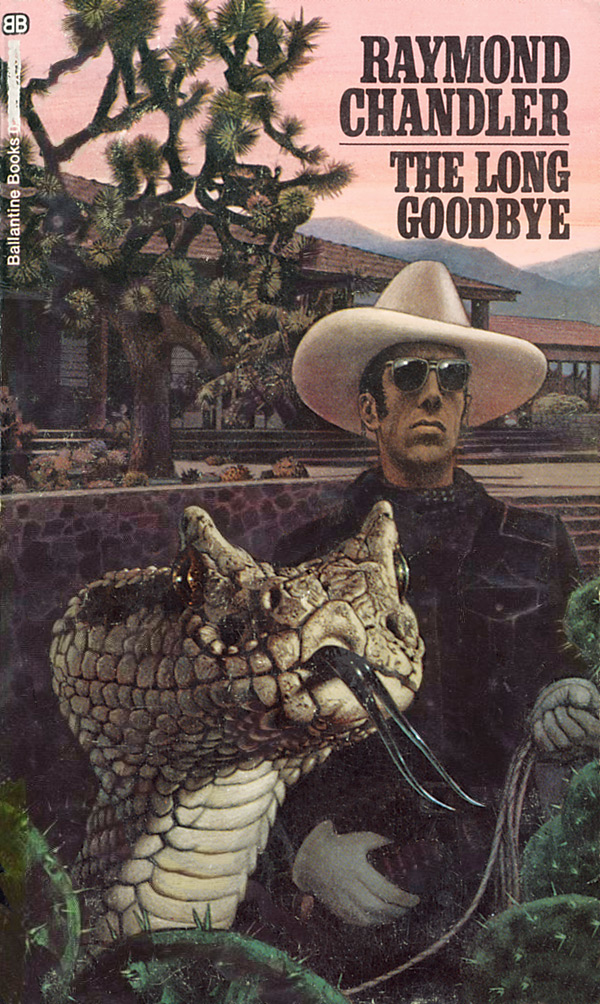
The following is based on my review of Raymond Chandler’s The Long Goodbye for Goodreads.Com:

I had read The Long Goodbye many years ago, and liked it. In the meantime, I have aged—not exactly like a fine wine, but aged nonetheless—and found myself loving Raymond Chandler’s penultimate work. I might even go so far as to say it is his masterpiece, though back then I liked The Big Sleep and Farewell My Lovely more.

This time I detected the raggedness. Chandler’s wife, Cissy, was dying and he felt more vulnerable. This is no tight Agatha Christie thriller than runs like a Swiss clockwork. Not by a long shot. It’s about a nasty, persistent evil that, once you poke it with a stick, keeps coming back to snare you and hurt you. Somehow, Chandler’s detective Marlowe walks the straight and narrow path and comes out alive at the end:

I was as hollow and empty as the spaces between the stars. When I got home I mixed a stiff one and stood by the open window in the living room and sipped it and listened to the groundswell of the traffic on Laurel Canyon Boulevard and looked at the glare of the big angry city hanging over the shoulder of the hills through which the boulevard had been cut. Far off the banshee wail of police or fire sirens rose and fell, never for very long completely silent. Twenty-four hours a day somebody is running, somebody else is trying to catch him. Out there in the night of a thousand crimes people were dying, being maimed, cut by flying glass, crushed against steering wheels or under heavy tires. People were being beaten, robbed, strangled, rape, and murdered. People were hungry, sick, bored, desperate with loneliness or remorse or fear, angry, cruel, feverish, shaken by sobs. A city no worse than others, a city rich and vigorous and full of pride, a city lost and beaten and full of emptiness.
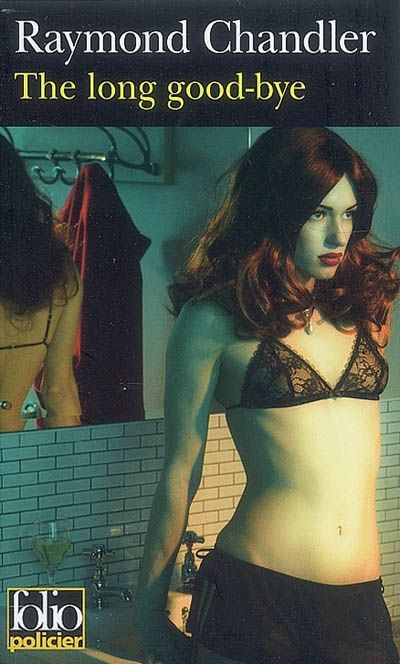
A French Edition of The Long Goodbye

A French Edition of The Long Goodbye

And mind you, this is just the background in which a series of murders and/or suicides take place that call Marlowe’s actions into question and put him in personal peril, such as the time four toughs waylay him in his own house. They included the following:

A man was sitting across the room with his legs crossed and a gun resting sideways on his thigh. He looked rangy and tough and his skin had that dried-out look of people who live in sun-bleached climates. He was wearing a dark brown gabardine-type windbreaker and the zipper was open almost to his waist. He was looking at me and neither his eyes nor the gun moved. He was as calm as an adobe wall in the moonlight.

That last short sentence inspired writer Walter Mosley to begin writing his own series of detective novels featuring Easy Rawlins.

I feel I have not rendered justice to this great novel—probably because it is still working its way through my bloodstream and opening channels in my body that I did not know existed.

[Not] The Nobel Prize for Literature

Yet Another Great Writer Who Never Received a Nobel

Yet Another Great Writer Who Never Received a Nobel

I don’t have too much good to say about the Swedish Academy, which decides who will receive the Nobel Prize for Literature. If you look at the list of its recipients, it would not take too much effort to produce a list of as great as or even greater literary figures who have not received the laureate. Let me take a stab at it:

  • Kobo Abe (Japan), Woman in the Dunes
  • Chinua Achebe (Nigeria), Things Fall Apart
  • Ryunosuke Akutagawa (Japan), Rashomon
  • Jorge Amado (Brazil), Gabriela: Clove and Cinnamon
  • W. H. Auden (UK), Poetry
  • Georges Bernanos (France), Mouchette
  • Jorge Luis Borges (Argentina), Ficciones
  • Joseph Conrad (UK/Poland), Nostromo
  • Richard Flanagan (Australia), The Narrow Road to the Deep North
  • Graham Greene (UK), The Heart of the Matter
  • Vassili Grossman (Russia), Life and Fate
  • Henry James (US/UK), The Ambassadors
  • James Joyce (Ireland), Ulysses
  • Yashar Kemal (Turkey), Memed, My Hawk
  • Gyula Krúdy (Hungary), The Red Post Coach
  • Stanislaw Lem (Poland), Solaris
  • Osip Mandelstam (Russia), Poetry
  • Vladimir Nabokov (US/Russia), Lolita
  • Fernando Pessoa (Portugal), The Book of Disquiet
  • Marcel Proust (France), In Search of Lost Time
  • Arkady and Boris Strugatsky (Russia), Roadside Picnic
  • Italo Svevo (Slovenia), Confessions of Zeno
  • Leo Tolstoy (Russia), Novels and Stories
  • Mark Twain (US), Novels and Stories
  • Evelyn Waugh (UK), Brideshead Revisited
  • Virginia Woolf (UK), Mrs Dalloway

As you can see, I have not overloaded the list with the names of American authors, in the interests of being fair. If I wanted to, I can add names like Philip Roth, Ursula K. Le Guin, Joyce Carol Oates, Philip K. Dick, Cormac McCarthy, James Baldwin, Ralph Ellison, and a few others.

These can replace such figures as the following, whose reputations have not kept up with the times: Bjornsterne Bjornson, José Echegaray, Giosue Carducci, Rudolf Christoph Eucken, Paul von Heyse, Verner von Heidenstam, Karl Adolph Gjellerup, Henrik Pontopiddan, Carl Spitteler, Jacinto Benavente, Grazia Deledda, Erik Axel Karlfeldt, Pearl S. Buck, Frans Eemil Sillanpaa [SIC], Johannes Vilhelm Jensen, Earl Russell, and a few dozen others—mostly Scandinavian nonentities which at one time were highly thought of by a couple dozen mouldy Swedish academics. (Please forgive me for being lax about the diacritical marks in the above names.)


The Return of Januarius

Janus: God of New Beginnings

Janus: God of New Beginnings

Just as there are drinking games, there can also be reading games. Such is my annual Januarius tradition, which I’ve been doing for more than fifteen years now. I merely wedded the name of Janus, the two-faced god of new beginnings, withthe month of January: During that month, I only read books by authors whom I have never before read.

So far this month, I have completed:

  • Helgi Olafsson’s Bobby Fischer Comes Home: The Final Years in Iceland, a Saga of Friendship and Lost Illusions
  • Zachary Karabell’s Peace Be Upon You: A Story of Muslim, Christian, and Jewish Coexistence
  • Leonid Tsypkin’s Summer in Baden-Baden
  • Stan Jones’s Shaman Pass
  • Pierre Boulle’s The Face of a Hero

… and the month is not yet half over. I am looking forward to reading works by Sjón (the Icelandic novelist), Yashar Kemal, and Thomas Flanagan—among others.

So far, Leonid Tsypkin is my favorite of the five, with the author’s insight into the life of Fyodor Dostoyevsky and his wife Anna Grigori’evna, though all were pretty good.


Restlessness

My Vacation Is Getting Closer

My Vacation Is Getting Closer

In the last few weeks before my vacation, I am feeling restless. All other things aside, here are the books I plan to read before the month is over:

  • Christopher Hill, The World Turned Upside-Down. Revolutionary movements in 17th century England.
  • Guy de Maupassant, Afloat. For my French literature group on Yahoo!
  • Pablo Neruda, Canto General. I plan to visit the poet’s houses in Chile.
  • Macedonio Fernandez, The Museum of Eterna’s Novel, by a friend and hero of Jorge Luis Borges.
  • John Lynch, San Martin: Argentine Soldier, American Hero. A biography of the Founding Father of Argentina.
  • Aldous Huxley, Complete Essays, Vol. 1, 1920-1925.

And that’s probably half of what I will end up reading this month. Only, it’s always more difficult when one faces a deadline. One thing I will not do is stuff my suitcase full of books, nor concrete blocks either. While I am traveling, I will be reading exclusively from my two Kindles.

As usual, I have a dental emergency just before my vacation. Two small pyramidal chunks of tooth came loose the other day, so I will have to go to the dentist tomorrow. Plus I have two medical appointments this month.

Most of my shopping is done, but I will need a new belt: My old one fell to pieces a couple weeks ago. Plus I will have to get some mosquito repellent (for the Iguasu Falls area), and possibly a two-pocket shirt if I can find one. Oh, and I’m sure I’ll find a couple of other things I will need, or at least feel I’ll need.

The picture above is by Paulo Zerbato and nicely expresses what I am feeling right now.

The Wonderful Wizard of … Mo?

Oz Was Just One of L. Frank Baum’s Invented Worlds

Oz Was Just One of L. Frank Baum’s Invented Worlds

If great stories constitute one of the riches of the earth, then America has nothing to be ashamed of. We may not have the Brothers Grimm, we might not have Hans Christian Anderson, we might not have Boccaccio—but we do have L. (short for Lyman) Frank Baum. He gave us not only The Wonderful Wizard of Oz (1900) but sixteen sequels! (And they’re all pretty good!)

Then there are the other invented worlds, such as the one represented by The Surprising Adventures of the Magical Monarch of Mo and His People (1900), written the same year he created Oz. That’s only the beginning, for Baum’s fertile mind was busily at work for the last nineteen years of his life, and did not rest until he populated his fairylands with hundreds of characters and situations that not only amaze children, but not a few adults as well. Like me, for instance.

Now with the advent of e-books, it is possible to get virtually all of Baum’s work for free, or for pennies. You can try Kindle, or even Gutenberg.Com, which also contains the original illustrations. If you need cheering up, try one of his lesser-known books, which contain a wealth of treasures.


Summer in Balbec

The Viking Penguin Edition of Proust Edited by Christopher Prendergast

The Viking Penguin Edition of Proust Edited by Christopher Prendergast

It has been beastly hot in Southern California, but I have been diverted from mere animal sweating by reading Marcel Proust’s In the Shadow of Young Girls in Flower as translated by James Grieve. Although his translation is considered the bastard orphan of the series as pictured above, I still loved it—after reading the authoritative C. K. Scott-Moncrieff translation twice.

Generally, it takes me a whole decade to go through the entire In Search of Lost Time, but it’s time well spent. I hope to tackle The Guermantes Way (again, for the third time) after my vacation; and I hope to live long enough for at least one or two more complete re-readings.

Many who have tackled Swann’s Way have been put off by its opening, in which young Marcel schemes for about fifty pages to have his mother come in to his bedroom and kiss him goodnight despite his father’s general disapproval of the practice. Then there are those long sentences that seem to go on forever—but which carry a significant amount of meaning in the process. Once you get over those two hurdles, the rewards come fast and furious.

Chief among those rewards is being in the mind of Marcel, the narrator. (He never gives his last name.) His hopes and desires are sketched with such intensity that few have experienced in this life. These relate to his family, his acquaintances, his heroes, his reading, his knowledge of art (just tracking the paintings he mentions is a full-time job), and his loves.

In the Shadow of Young Girls in Flower is mostly about his two main loves, Gilberte Swann and Albertine Simonet. In the first volume of the book, he reluctantly gives up on Gilberte, who has on occasion treated him contemptuously. Still, he hangs out with her parents hoping to demonstrate to the daughter that he is worthy of her attention.

In the second volume, Marcel is with his grandmother at the seaside resort of Balbec. There, he meets Robert de Saint-Loup, who becomes his friend, and the “little gang” of girls that become his obsession. Of the latter, Marcel toys with Andree, Rosemonde, and Gisele, but his real obsession is for Albertine. The book just stops short of the relationship with her actually commencing. (That, and Marcel’s anxieties about Albertine, are for the later volumes.)

Reading Proust takes a long time: I devoted two weeks to this book, but I loved every minute of it.