From Point A to Point B

UPS Freight Jets

There is a growing branch of literature which consists of nonfiction. How is that possible? The Nobel Prize for Literature in 1996 was awarded to Svetlana Alexievich of Belarus for her work, which consists primarily of interviews of people affected by the nuclear accident at Chernobyl or the Soviet War in Afghanistan. As for Americans, we have John McPhee, who has written a series of nonfiction works of high literary quality.

I have just finished reading his Uncommon Carriers, which deals, in turn, with long-haul truckers; a place in France where ships’ pilots are trained; boats that tow barges on American rivers; the parcel sorting services of UPS; and mile-and-a-half-long coal trains. In between, there is a delightful essay by the author about retracing the route of Henry David Thoreau and his brother John described in A Week on the Concord and Merrimac Rivers—which I had read when it was first published in the New Yorker.

McPhee likes to take what looks like a boring subject that nobody would write about and turn it into a gem. For instance, there is that tetralogy he wrote about American geology beginning with Basin and Range and ending with Assembling California. One would think that McPhee’s books might be a tad boring, but they never are.

To date, I have read—in the order of publication—the following ten McPhee titles:

  • The Crofter and the Laird
  • Pieces of the Frame
  • Giving Good Weight
  • Basin and Range
  • In Suspect Terrain
  • La Place de la Concorde Suisse
  • Rising from the Plains
  • The Control of Nature
  • Looking for a Ship
  • Uncommon Carriers

There’s not a single boring read in the bunch. Each McPhee I read whets my appetite for more.

Deep in Cinnabon America

Universal City’s City Walk

Universal City’s City Walk

There are parts of Los Angeles that are no really for Angelenos. They are for the Flyover People who come to see a fake-o version of my city. I paid my 35¢ and took the Metro Rail downtown, transferring to the Red Line subway to get me to Universal City. I used to enjoy going there more when Gladstones 4 Fish was located there, but now there are other glitzy (mostly chain) restaurants that promise more than they deliver.

The whole place was crawling with tourists, including many Chinese and Japanese who were taking cellphone photographs of everything. I had a decent Smokehouse Burger at Johnny Rocket’s, and wandered around seeing the sights. In my hands was a book, Hunter S. Thompson’s Generation of Swine about the craziness of the 1980s. Well, Thompson is gone now, but things are crazier than ever. For one thing, I was probably the only person in the place who was carrying a book. Everybody else was playing with their smart phones, taking pictures of the sights, and of each other, proving conclusively that they were in striking distance of the sights.

I am of an age which confers a certain degree of invisibility. I have no tattoos, no beard, no wrinkled camouflage shorts with dozens of pockets, no smart phone. I felt like some ancient saurian dripping with mud that had just crawled out of a primitive past. But then, did I have anything in common with the scads of tourists? Not really, nor did I have anything against them. We were just inhabiting different planes of existence.

In the end, I felt good about myself. I felt I had nothing to prove. I left my camera at home, and didn’t take any pictures with my flip phone. I did read a few chapters of Hunter Thompson, and I felt that was good.


The Book Collectors

Antiquarian Book Shows Are Not for Everybody

Antiquarian Book Shows Are Not for Everybody

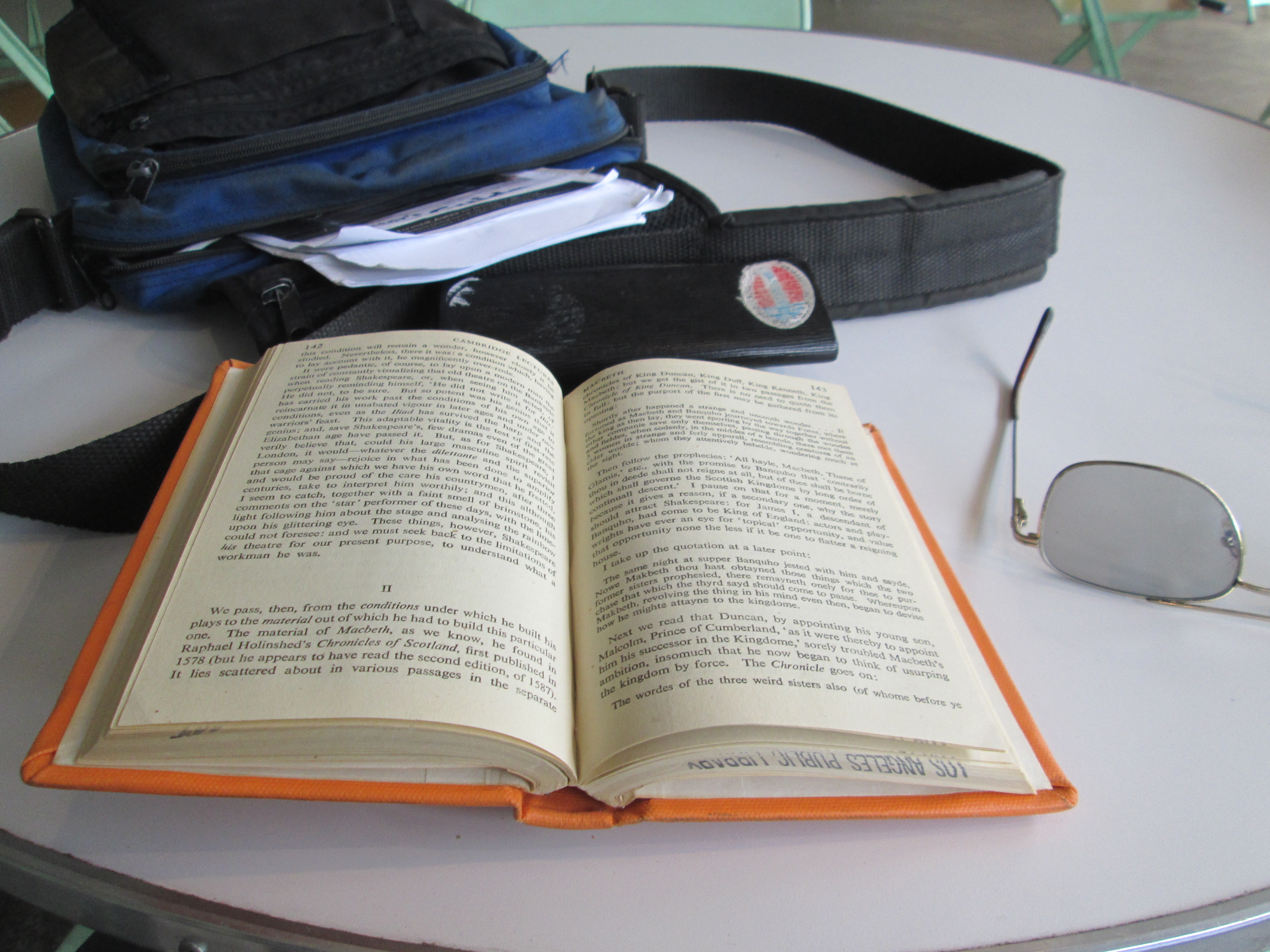
Today, I went to an antiquarian book show. I used to go to them in years past and succeeded in making a number of finds; but now I find the market has priced itself into the stratosphere. There were beautiful centuries-old leatherbound books, immaculate Faulkners and Steinbecks with perfect dust jackets, and prices ranging into the thousands of dollars.

If I owned a Bugatti or Talbot Lago, I would probably not drive it around town lest some uninsured drunken sot would T-bone it. Likewise, if I spent thousands of dollars for first editions, I would not pull the books off the shelf, read them, and underline the significant passages in ball point ink.

There are half a dozen books I have purchased because they looked really good, usually consisting of titles which I already owned in reading copies. I own a signed G. K. Chesterton, for example, that I would never profane by reading. I have some friends who would never read a paperback book, or who pooh-pooh ever reading an e-book. I am not so fastidious. The only time I would bypass an e-book is if I were reading nonfiction that contained useful maps, illustrations, bibliographies, and indexes. I would probably prefer to read Dickens with the Cruickshank illustrations, or Lewis Carroll with the Tenniel illustrations.

By and large, I am a consumer of books. Many of my best titles are ratty, old, and with damaged spines. Some (shudder!) have been underlined by previous owners. Some are sturdy ex-library editions bound in buckram.

I own a few books that would interest an antiquarian book collector, but generally, they wouldn’t waste their time with me.


My Best of 2016

Heavily Weighted Toward 20th Century Fiction

Heavily Weighted Toward 20th Century Fiction

Below is a list of the ten best works of fiction (or near-fiction) that I read in 2016. No re-reads were included, which is probably why the twentieth century is over-represented. Three of the works (the first three listed below) purport to be straight non-fiction, but include fictional elements. They are listed below in alphabetical order by last name of the author:

  • Alexievich, Svetlana. Zinky Boys: Soviet Voices from the Afghanistan War. Powerful stuff. Her concept of literature as interviews works really well because she’s great at getting people to open up.
  • Babitz, Eve. Eve’s Hollywood. Mostly autobiographical essay by the “It Girl” of the 1960s, with some fictional interpolations.
  • Barnes, Julian. Levels of Life. What it really means to lose someone you love.
  • Cohen, Albert. Belle de Seigneur. A thousand-page novel about illicit love in early 20th century France.
  • Flanagan, Richard. The Narrow Road to the Deep North. Probably a more realistic re-telling of the whole Bridge on the River Kwai story by a great Australian writer.
  • Modiano, Patrick. In the Café of Lost Youth. I am liking this French novelist more and more all the time.
  • Saer, Juan José. The Clouds. A tale of madness in Argentina in the 1800s.
  • Simenon, George. The Clockmaker. One of the mystery writer’s romans dur, about a father and his delinquent son.
  • Stevenson, Robert Louis and Lloyd Osbourne. The Ebb-Tide. Recommended by Jorge Luis Borges in one of his interviews, one of RLS’s best.
  • Wells, H G. Tono Bungay. A classical 19th century Victorian novel, decidedly not sci-fi.

The funny thing about this list is its variety. Is it because I’ve read most of the classical fiction repertoire already?

In 2017, I’m continuing my long-range project of reading most of Fyodor Dostoyevsky’s work along with Joseph Frank’s five volume biography. And, of course, I’m still casting my nets wide to find the best of world literature.


The Journalist

Svetlana Alexievich, Winner of the 2015 Nobel Prize for Literature

Svetlana Alexievich, Winner of the 2015 Nobel Prize for Literature

I have only read two of her books so far, but they were both knockouts. First, there was Zinky Boys (1991), about the Soviet experience in Afghanistan. Now, added to that is Voices from Chernobyl: The Oral History of a Nuclear Disaster (1997). Both books are descriptions of incredible suffering, and they are both powerful disincentives from enlisting in the Soviet military.

Svetlana Alexievich (b. 1948) is usually described as a Belorussian journalist, though she herself rejects the title: She has been known to edit the first person testimonials from one edition to the next, which is a big no-no for oral historians, but the mark of an imaginative writer. I do not mind, because I will accept 99-44/100% accuracy if it involves stylistic or other improvements.

Both Afghanistan and Chernobyl were unspeakable disasters that seemed to go on forever (the latter is still claiming victims), and you cannot hope for a better introduction to both than read Alexievich’s books.

In Voices from Chernobyl, the wife of one Soviet soldier who was involved in the cleanup says:

They say, “Chernobyl,” and they write, “Chernobyl.” But no one knows what it is. Something frightening opened up before us. Everything is different for us: we aren’t born the same, we don’t die the same. If you ask me, How do people die after Chernobyl? The person I loved more than anything, loved him so much that I couldn’t possibly have loved him more if I’d given birth to him myself—turned—before my eyes—into a monster. They’d taken out his lymph nodes, so they were gone and his circulation was disrupted, and then his nose kind of shifted, it grew three times bigger, and his eyes became different—they sort of drifted away, in different directions, there was a different light in them now, and I saw expressions in them I hadn’t seen, as if he was no longer himself but there was still someone in there looking out. Then one of the eyes closed completely.

I do not recommend reading the book on a full stomach. The same with Zinky Boys:

We were combing through a village. You fling open the door and throw in a grenade in case there’s a machine-gun waiting for you. Why take  a risk if a grenade could sort it out for you? I threw the grenade, went in and saw women, two little boys and a baby in some kind of box making do for a cot.

You have to find some kind of justification to stop yourself going mad. Suppose it’s true that the souls of the dead look down on us from above?

I know that we considered the Soviets to be our enemies, but these books describe scenes that one wouldn’t wish upon one’s worst enemy.


Regarding Henry

Henry Miller (1891-1980)

Henry Miller (1891-1980)

Is Henry Miller famous? Or is he just infamous? Or is he both?

I have just finished reading a book of his essays, reviews, and prefaces entitled Stand Still Like the Hummingbird (1962) and find myself alternately idolizing and deploring the man’s work. Of course, he is probably most famous for his novels featuring S-E-X, especially The Tropic of Cancer (1934). And yet, he can write like a Bodhisattva, as in the essays “The Hour of Man” and “The Immorality of Morality.”

In the latter essay, he wrote what I regard as the definitive answer as to how to live in the era of Trump:

Neither would I urge one to run away from the danger zone. The danger is everywhere: there are no safe and secure places in which to start a new life. Stay where you are and make what life you can among the impending ruins. Do not put one thing above another in importance. Do only what has to be done—immediately. Whether the wave is ascending or descending, the ocean is always there. You are a fish in the ocean of time, you are a constant in an ocean of change, you are nothing and everything at one and the same time. Was the dinner good? Was the grass green? Did the water slake your thirst? Are the stars still in the heavens? Does the sun still shine? Can you talk, walk, sing, play? Are you still breathing?

And yet, in another essay entitled “To Read or Not To Read,” Miller brags about reading fewer books “I tried to make it clear that, as a result of indiscriminate reading over a period of sixty years, my desire now is to read less and less.”

One of Miller’s Water Colors

One of Miller’s Water Colors

Is it perhaps because Miller also sees himself as a painter, particularly of water colors? The ones I have seen are pretty good, and I shouldn’t be surprised if the author likes the act of pure creativity involved in coming up with these scenes, which he does not paint from life.

In the end, I see Henry Miller as, at times, gifted by his muses—and at other times merely producing when the muses aren’t present. There is a certain lack of consistency in his work. I will continue to read him for the times I find he is spot on.

Quito’s English Bookshop

Mark Horton at the English Bookshop

Mark Halton at the English Bookshop

My brother had left a few days earlier, and I was due to fly back to Los Angeles the next day. Martine had given me strict instructions to bring back five Ecuador 2017 calendars that we could distribute as gifts, so I walked around the Mariscal district of Quito. A couple weeks earlier, Dan and I had stopped in at the English Bookshop at the corner of Calama and Diego de Almagro to ask if he had an Ecuador or Quito street atlas. The owner, Mark Halton, gave us a couple of good leads—though, alas, we could not find any such animal.

So, on this (dire) election day, I stopped back at the English Bookshop and got into an interesting discussion with Mark. He was kind enough to brew me an excellent cup of tea, and we had a wide-ranging conversation about books, politics, technology, and a variety of other subjects. He even told me where I could find the calendars. And they were exactly where he pointed me. There were just five left, and I bought all of them.

Mark has a large selection of hardbound and paperback books, mostly in English. It is a fun place for travelers to pick up some interesting titles and sit down and talk books.

If I ever find myself in Quito again—and I hope I do—I will make a point of stopping in at the English Bookshop and Mark’s excellent hospitality.

One of the Two Books I Bought There

One of the Two Books I Bought There

L.A. Writers: James Ellroy’s Dark Places

James Ellroy, Age 10, with His Murdered Mother

James Ellroy, Age 10, and His Murdered Mother

Given his childhood, it is no wonder that the vision of crime novelist James Ellroy is full of dark places. At the age of 10, he experienced being orphaned when his divorced mother, Jean, was raped and murdered. To this date, the crime has not been solved. But it has resonated through the work of its littlest victim.

To date, I have read seven of his novels, most of which are set in Los Angeles. You can believe me when I say that the author’s L.A., the sun doesn’t shine much. He is perhaps most famous for his L.A. Quartet, which consists of:

  • The Black Dahlia (1987)
  • The Big Nowhere (1988)
  • L.A. Confidential (1990)
  • White Jazz (1992)

As a reviewer for National Public Radio wrote, “His L.A. might not be a city of angels, but the devils he conjures up tell one hell of a tale.”

At times, Ellroy twists the English language into a strange rhythm, as if he were the American Louis Ferdinand Céline. Some of his books, such as White Jazz and American Tabloid, are sometimes difficult to read because of their driving, staccato style. But the energy keeps you moving along. When you are finished with one of his books, you need to relax a bit.

I just finished reading Blood on the Moon (1984), which is set on an axis from West Hollywood (“Boys’ Town”) to Silverlake, with occasional visits to the LAPD’s Parker Center downtown. The novel has a fine local feel that is the hallmark of a real L.A. writer. He may have set some stories elsewhere, but L.A. is somehow the real center of his oeuvre.

Below is a picture of the writer as he is today:

James Ellroy Today

James Ellroy Today

I met the author several years ago when he spoke at the Los Angeles Times Book Festival back when it was still being held at UCLA. I remember his strange description of how he spent his hours alone in the dark, carrying on imaginary conversations with women who were not in the room with him.

Dark. Strange. Indeed—but also brilliant.


The Photographer and the Cañar

St. Anthony Day Parade

St. Anthony Day Parade

In preparation for my trip, I am reading Judy Blankenship’s excellent Cañar: A Year in the Highlands of Ecuador. Although the text is excellent, what impressed me the most were Judy’s photographic portraits in black and white of the Cañar villagers she and her husband Michael got to know in the time they spent in the indigenous Andean area some two hours north of Cuenca. Unfortunately, these portraits must be well protected, because I was unable to hijack any of them to show you. (I guess you’ll just have to get your hands on the book.)

Below is one of Judy’s pictures in black and white of the Carnaval parade in Curreucu:

Carnaval Parade in Curreucu

Carnaval Parade in Curreucu

Although Judy Blankenship is not a professionally trained ethnologist, she could have fooled me. Her description of marriage, entrada (betrothal), funeral, and other rituals makes for delightful reading—not to mention her photography workshops for indigenous women and even a few nuns. Below is a photograph of the author:

Judy Blankenship

Judy Blankenship

At this point, I have not read anything else by her; but I do believe it would be worth hunting down some of her other work, most especially her photographs.

Slow Days, Fast Company

Eve Babitz

Eve Babitz

The following is based on a book review I published on Goodreads.Com yesterday:

In the 1960s and 1970s, when I used to dread the approach of another lonely weekend, I wished I could meet a girl like Eve Babitz, intelligent, articulate, and drop-dead beautiful. And there she was, living just a few miles from me in Hollywood while I was in Santa Monica. Describing a friend of hers, “she lacked that element, raw and beckoning, that trailed like a vapor” behind her.

Like her first book, Eve’s Hollywood, Slow Days, Fast Company: The World, the Flesh, and L.A. is a series of seemingly biographical essays with a hefty admixture of fiction. Where the first book talked about Eve’s teeny-bopper years in the 1960s, in her second she becomes the lovely, knowing score girl that everyone wants to meet … and bed. She hung out with the likes of Jim Morrison, Steve Martin, artist Ed Ruscha, and gallery owner Walter Hopps.

Highly Recommended

Highly Recommended

What she writes about in Slow Days, Fast Company is about her friendships and relationships with people who are usually not identified with their last names; and even their first names could have been modified. In the end, it doesn’t matter a bit. Eve knows success, and how it twists people so they becoming boring “celebrities” who rely on drugs and booze to get through the day. She writes:

But everyone knows that it would have been much better to have been popular in high school when your blood was clean, and pure lust and kisses lasted forever, Chocolate Cokes in high school are better than caviar on a yacht when you’re forty-five. It’s common knowledge.

Eve Babitz knew herself far better than most people, and she had a wicked sense of humor, as in this exchange:

The very next night I was having dinner with this fashionable young rich man who looked at me as I smoothed some paté over some toast and said, “You better watch out with that stuff. It’ll make you fat.”

“Well, gee,” I said to him, “there are so many perfect women, it’s just horrible you have to spend time sitting here with me.”

Horrible indeed! No use being morose about it, however. Even if I never found an Eve Babitz, I can appreciate her discriminating mind even at this distant remove. This is a girl who did not believe in the viability of most relationships: “The real truth is that I’ve never known any man-woman thing to pan out (it may pan out to them, of course, but couples in middle age who don’t speak to each other are not my idea of a good movie.)”

Eve Babitz in her time and place—Los Angeles in the 1960s and 1970s—was as good as they come. She is in many ways the best that Los Angeles has to offer. If you read her books, I think you will understand why.