
Encountering an Old Friend

A Book That Greatly Influenced My High School Years

A Book That Greatly Influenced My High School Years

There it was on the shelf of Iliad Book Store in February 2009: A not-too-beat-up copy of the Committee on College Reading’s Good Reading, circa 1964. Naturally, I picked it up if for no other reason than to walk down memory road when I was a voracious reader. (And, if you read this blog, you know of course that I still am.)

I was the valedictorian of my class of 1962 at Chanel High School in Bedford, Ohio—a school that no longer exists. First it changed its name to Saint Peter Chanel, then, some years later, the Catholic Diocese of Cleveland shut it down. Even though I was in excruciating pain from a tumor that was pressing on my optic nerve, I still read as much as I could. On weekends, I would take the 56A bus downtown, stop in at Schroeder’s Bookstore on Public Square, and then spend some time at the main library, which was built in 1925.

What I felt I needed were books that served as a bibliographic reference to what I ought to be reading. That’s what Good Reading did. There were individual chapters by different members of the Committee on College Reading, all faculty members at various colleges. Just to give an example, here are some of Robert Clark White’s recommendations for 20th Century Continental Novels:

  • Samuel Beckett: Molloy
  • Albert Camus: The Stranger and The Plague
  • Karel Čapek: The War with the Newts
  • André Gide: The Counterfeiters
  • Jaroslav Hasek: The Good Soldier Schweik
  • Hermann Hesse: Steppenwolf and Siddhartha
  • Franz Kafka: The Trial
  • Thomas Mann: Buddenbrooks, The Magic Mountain, and The Joseph Tetralogy
  • Marcel Proust: The Remembrance of Things Past
  • Jean-Paul Sartre: Nausea and Troubled Sleep

These are not bad titles for the time. I probably would have added something by Iceland’s Halldor Laxness and Portugal’s Fernando Pessoa, but these are mere cavils. Thanks largely to this book, my attention was directed to great writers in every field. And the book covered more than literature: There was also history, philosophy, religion, anthropology, physical sciences, and other subjects.

I was such an earnest young student. Even while on the bus, I would pore over books such as Norman Lewis’s 30 Days to a More Powerful Vocabulary and Word Power Made Easy, taking all the quizzes in the books over and over until I got a perfect score. Despite all the physical pain, I had a good childhood, starting with what my loving parents gave me and adding what I could along the way.


On Re-Reading

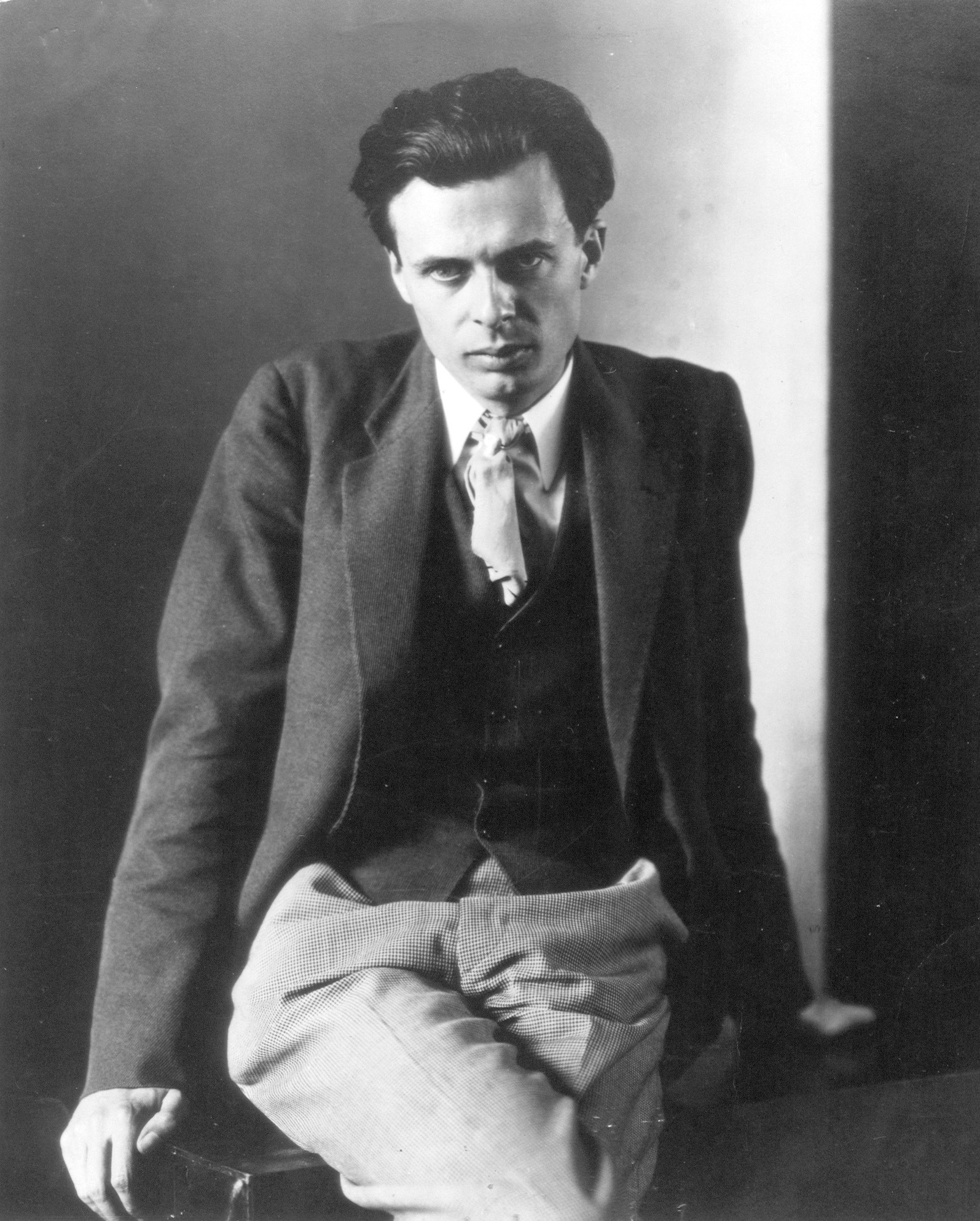
Aldous Huxley (1894-1963)

Aldous Huxley (1894-1963)

As Juan Vidal wrote for National Public Radio:

The best books are the ones that open further as time passes. But remember, it’s not because they changed. Every letter and punctuation mark is exactly where it always has been, and where it will remain forever. It’s you who are different; it’s you who’s been affected by the depth of your experience. And it’s you that has to grow and read and reread in order to better understand your friends.

I have just finished re-reading Aldous Huxley’s first novel, Crome Yellow, written in 1921 at the beginning of his career. In 1975, I was abashed by the romantic failures of Dennis Stone, the book’s narrator, with whom I identified because of my own experiences at that time. Now I see that Huxley not only was living through his own callow youth, but very neatly encapsulated for all time that obsessiveness with our own tactical failures can result in even more serious strategic failures in this life. Dennis fails with Anne Winbush, but his consciousness of failure prevents him from seeing Mary Bracegirdle, who is interested in him.

There are some books I re-read on a regular basis. Most notably: Marcel Proust’s In Search of Lost Time. I am now in my third reading of the seven-volume novel, and ready to start re-reading the third volume, The Guermantes Way. Then there are works like The Iliad and The Odyssey, Don Quixote, Dante’s Divine Comedy, Balzac’s Comédie Humaine, and any number of great books that I want to re-investigate because I have changed. To re-read is to measure that change.

When I was in my thirties, I loved Aldous Huxley and read many of his works. Now I think I’m about to check out his novels, stories, and essays again. The years have sped on, and we are all a work in progress.


Serendipity: Books and Brain Pickings

“A Marvellously Noble and Transcendent Chimera”

“A Marvelously Noble and Transcendent Chimera”

I do not follow many blog sites; though every once in a while, I find one that is superb. Such is Brain Pickings, which I have now included among my links.

The following observation on reading comes from Hermann Hesse’s My Belief: Essays on Life and Art, by way of Brain Pickings:

The great and mysterious thing about this reading experience is this: the more discriminatingly, the more sensitively, and the more associatively we learn to read, the more clearly we see every thought and every poem in its uniqueness, its individuality, in its precise limitations and see that all beauty, all charm depend on this individuality and uniqueness — at the same time we come to realize ever more clearly how all these hundred thousand voices of nations strive toward the same goals, call upon the same gods by different names, dream the same wishes, suffer the same sorrows. Out of the thousandfold fabric of countless languages and books of several thousand years, in ecstatic instants there stares at the reader a marvelously noble and transcendent chimera: the countenance of humanity, charmed into unity from a thousand contradictory features.

A Book of Essays I Will Have to Read

A Book of Essays I Will Have to Read

Good books lead everywhere, but especially to places worth going.


Doctor Destouches and Mister Hyde

Louis-Ferdinand Céline

French Author Louis-Ferdinand Céline

There are some writers in which critical opinion is inevitably polarized. Especially Louis-Ferdinand Céline, who committed the unpardonable sin of being politically incorrect to the nth degree. On one hand, he was the kindly Doctor Destouches, who ministered to the health needs of the poor without overcharging them. On the other, he wrote three anti-Semitic pamphlets in the lead-up to the Second World War that endeared him to the Nazi occupation forces and earned death threats from the French Resistance.

Not mentioned in the above paragraph is the fact that Céline wrote two of the greatest books of the 20th Cemtury: Journey to the End of the Night (1932) and Death on the Installment Plan (1936). His postwar trilogy about his travails for his “war crimes” is almost as great: Castle to Castle (1957), North (1960), and Rigadoon (1961).

The Young Céline

The Young Céline

In his biography of the author, Patrick McCarthy aska:

What remains alive of Céline? When one looks beyond his period and and beyond all the different roles he played, what remains of the man and his work? His life was dedicated to probing the pain that men feel at their contact with the world. Each person knows, as he goes about his daily round, that one part of himself does not join in. It remains outside, permanent and untouched. One tries to ignore it but it is there. It was Céline’s destiny to face this “otherness”: to look hard at it and to liberate it. It rushes out in his work as fear: the fear of man abandoned to himself. In Céline’s vision this fear engulfs all existence. It expresses itself in many ways: as pain, loneliness, hatred and pity. These are the guiding demons of Céline’s work—inseparably interwoven. But beyond all of them is this fundamental and total fear. It explains why reading Céline is such a shattering experience. It is not that fate dominates or that death lies in wait. It is that every moment the “otherness” is rampant. It runs around screaming that the nightmare is real and the waking hours only a dream. It imposes on the reader a very special kind of pain—reminiscent perhaps of Shakespeare’s wildest moments in King Lear.

When interviewed by an Italian journalist, American poet Charles Bukowski ended by saying, “Don’t shout so much. And read Céline.” That’s good advice.

Books Are Dangerous

Bookmarks from The Last Bookstore

Bookmarks from The Last Bookstore

The wording is ominous:

Books are dangerous!
Report to The Last Bookstore
To sell or trade your books
While you still can!

Founded in 2005, The Last Bookstore claims to be California’s largest bookstore, and it may very well be. “What are you waiting for?” its website asks. “We won’t be here forever.”

This is what I call a Filboid Studge marketing campaign, based on the Saki short story entitled “Filboid Studge: The Story of a Mouse That Helped.” I’ve included a link because the story is very short and outrageously hilarious.

The bookstore at the corner of West 5th and Spring Streets in Downtown Los Angeles was one of the highlights of yesterday’s safari by Martine and me. I took eleven books to donate to the store and wound up buying four titles, including Eve Babitz’s Eve’s Hollywood, which I am currently reading with great excitement.

Interior of The Last Bookstore (2nd Floor)

Interior of The Last Bookstore (2nd Floor)

I have been in Los Angeles for half a century now, and I look back at my time here with all the pleasurable hours I spent in bookstores that, for the most part, are no more. There was Papa Bach’s at Santa Monica and Sawtelle; the Westwood Book Company, Butler Gabriel, Campbell’s, Brentano’s, and Borders—all in Westwood; Martindale’s in Santa Monica; Zeitlin & Verbrugge on the West Side; Acres of Books in Long Beach; Brand Books in Glendale; and Pickwick in Hollywood.

They are all gone now. People stare intently at their smart phones and pretend to communicate—but really don’t. They say they could read books on their devices, but never seem to. Perhaps the whole idea of the book is dying while a new generation willfully enslaves itself to a handheld electronic device.

So kudos to The Last Bookstore. Be defiant! Be a dinosaur! Wave your standard proudly!


Ghost Train to Anywhere

Paul Theroux on One of His Mythical Train Rides

Paul Theroux on One of His Mythical Train Rides

For almost forty years, I have been traveling around the world with Paul Theroux—starting with his train ride books The Great Railway Bazaar (1975) and The Old Patagonian Express (1979) to whatever I could get my hands on. Even when I said to myself, “This guy is altogether too snarky,” I followed his adventures with an interest bordering on zeal.

Only now do I realize he is one of the great influences on my life. It was not until November 1975 that I began my own travels (other than back and forth between Los Angeles and Cleveland). My visit to Yucatán opened my eyes and was followed by trips to Britain, Hungary, Czechoslovakia, and a lot more of Mexico. It was as if the floodgates were open, and my eyes were focussed on the world at large, and not just at whatever place I was living at the time.

I have glorious memories of my trips, even the first one to Argentina, when I broke my right shoulder in a blizzard in Tierra del Fuego. I was hooked, and have been ever since.

Yeah, I Second the Motion!

Yeah, I Second the Motion!

A few days ago, I finished reading Theroux’s Ghost Train to the Eastern Star (2008) in which I found the following quotes which resonated with me:

Often on a trip, I seem to be alive in a hallucinatory vision of difference, the highly colored unreality of foreignness, where I am vividly aware (as in most dreams) that I don’t belong; yet I am floating, an idle anonymous visitor among busy people, an utter stranger. When you’re strange, as the song goes, no one remembers your name.

Also, it doesn’t matter any more who’s topping the charts. Taylor Swift doesn’t mean anything to me; and if Kim Kardashian’s ass were offered to me on a silver platter, I would not too politely refuse. I have climbed the Mayan pyramids at Uxmal and Chichén Itzá. I have taken a fall at Magallanes and Rivadavia in Ushuaiah and injured myself. I have visited two Communist Eastern European countries before 1989. I have seen things most people have not seen, and it has changed me forever.

It seemed to me that this was the whole point of traveling—to arrive alone, like a specter, in a strange country at nightfall, not in the brightly lit capital but by the back door, i9n the wooded countryside, hundreds of miles from the metropolis where typically people didn’t see many strangers and were hospitable and did not instantly think of me as money on two legs.

Being a traveler is being something of a loner. I am certainly that. But I wouldn’t have it any other way. I will travel as long as I can.


Meeting Marcel

Marcel Proust

Marcel Proust

It is always interesting to read one great writer’s judgment on another. Such was François Mauriac about his meeting in February 1918 with Marcel Proust:

He seemed rather small to me, stoopshouldered in his tight-fitting jacket, his thick black hair shadowing his pupils, dilated, it appears, by drugs. Stuffed into a very high collar, his starched shirtfront bulging like a breastbone, he cast on me a nocturnal eye whose intensity intimidated me.

At the end of the great first chapter in his book Proust’s Way, Mauriac pays homage to the brilliance of his colleague:

The integral history of a young life, of its loves, its friendships, its weaknesses, its intellectual or religious crises, offers the vast proportions of the history of the ideas and customs at a certain epoch as they are reflected in a single spirit. And a long old age would not be enough to complete the account or to exhaust its drama.

As I slowly wend my way through A la recherche du temps perdu—for the third time—I can vouch for that. I will never be finished with his intense vision of the life of one particular individual and his milieu some century and a quarter ago in a distant European country.


One-Trick Ponies

Many Countries Are Too Small or Obscure for More Than One Great Writer

Many Countries Are Too Small or Obscure for More Than One Great Writer

The photo above is of a snake devouring a lizard in Paraguay’s Gran Chaco, one of the most desolate areas on earth. And yet Paraguay gave birth to Augusto Roa Bastos (1917-2005), author of  The Son of Man and I the Supreme, two works that would be better known if their author were not from Paraguay.

Iceland’s claim to fame is the Nobel-Prize-winning novelist Halldór Kiljan Laxness (1902-1998), who wrote many novels that were translated into English, the most famous of which is Independent People. And yet his name is frequently mentioned by people who are carping about the Nobel Prize Committee’s penchant for obscure works. In this case, however, they were dead wrong; and the critics have some learning to do.

Talk about obscure, what about Bosnia? That little country’s literary star is Ivo Andrić  (1892-1975), whose most famous work is The Bridge on the Drina, a work which I think is necessary if you want to understand the tragic and horribly snarled history of the Balkans.

Augusto Roa Bastos

Augusto Roa Bastos

The doyen of South African literature is J. M. Coetzee (1940-Present), author of Waiting for the Barbarians and other excellent novels, plus several penetrating collections of literary essays.

Peru’s most famous author is Mario Vargas Llosa (1936-Present) who is his country’s only Nobelist, and who is also famous for having beaten up Colombia’s most famous author Gabriel García Márquez (1927-2014) in an argument over a woman’s honor. Gave him quite a shiner, in fact!

I guess the point I am trying to make is that it’s worth the effort to go farther afield than those well-traveled paths through the United States, England, and France. I made made many literary discoveries in strange places—a practice which I definitely intend to continue.

A corollary to this: There are many small countries which have rich literatures. Hungary and Portugal immediately come to mind. But there is also Australia, which I am finding is quite the treasure trove.


The Long Goodbye


The First Time I Read This Edition

The First Time I Read This Edition

The following is based on my review of Raymond Chandler’s The Long Goodbye for Goodreads.Com:

I had read The Long Goodbye many years ago, and liked it. In the meantime, I have aged—not exactly like a fine wine, but aged nonetheless—and found myself loving Raymond Chandler’s penultimate work. I might even go so far as to say it is his masterpiece, though back then I liked The Big Sleep and Farewell My Lovely more.

This time I detected the raggedness. Chandler’s wife, Cissy, was dying and he felt more vulnerable. This is no tight Agatha Christie thriller than runs like a Swiss clockwork. Not by a long shot. It’s about a nasty, persistent evil that, once you poke it with a stick, keeps coming back to snare you and hurt you. Somehow, Chandler’s detective Marlowe walks the straight and narrow path and comes out alive at the end:

I was as hollow and empty as the spaces between the stars. When I got home I mixed a stiff one and stood by the open window in the living room and sipped it and listened to the groundswell of the traffic on Laurel Canyon Boulevard and looked at the glare of the big angry city hanging over the shoulder of the hills through which the boulevard had been cut. Far off the banshee wail of police or fire sirens rose and fell, never for very long completely silent. Twenty-four hours a day somebody is running, somebody else is trying to catch him. Out there in the night of a thousand crimes people were dying, being maimed, cut by flying glass, crushed against steering wheels or under heavy tires. People were being beaten, robbed, strangled, rape, and murdered. People were hungry, sick, bored, desperate with loneliness or remorse or fear, angry, cruel, feverish, shaken by sobs. A city no worse than others, a city rich and vigorous and full of pride, a city lost and beaten and full of emptiness.

A French Edition of The Long Goodbye

A French Edition of The Long Goodbye

And mind you, this is just the background in which a series of murders and/or suicides take place that call Marlowe’s actions into question and put him in personal peril, such as the time four toughs waylay him in his own house. They included the following:

A man was sitting across the room with his legs crossed and a gun resting sideways on his thigh. He looked rangy and tough and his skin had that dried-out look of people who live in sun-bleached climates. He was wearing a dark brown gabardine-type windbreaker and the zipper was open almost to his waist. He was looking at me and neither his eyes nor the gun moved. He was as calm as an adobe wall in the moonlight.

That last short sentence inspired writer Walter Mosley to begin writing his own series of detective novels featuring Easy Rawlins.

I feel I have not rendered justice to this great novel—probably because it is still working its way through my bloodstream and opening channels in my body that I did not know existed.

[Not] The Nobel Prize for Literature

Yet Another Great Writer Who Never Received a Nobel

Yet Another Great Writer Who Never Received a Nobel

I don’t have too much good to say about the Swedish Academy, which decides who will receive the Nobel Prize for Literature. If you look at the list of its recipients, it would not take too much effort to produce a list of as great as or even greater literary figures who have not received the laureate. Let me take a stab at it:

  • Kobo Abe (Japan), Woman in the Dunes
  • Chinua Achebe (Nigeria), Things Fall Apart
  • Ryunosuke Akutagawa (Japan), Rashomon
  • Jorge Amado (Brazil), Gabriela: Clove and Cinnamon
  • W. H. Auden (UK), Poetry
  • Georges Bernanos (France), Mouchette
  • Jorge Luis Borges (Argentina), Ficciones
  • Joseph Conrad (UK/Poland), Nostromo
  • Richard Flanagan (Australia), The Narrow Road to the Deep North
  • Graham Greene (UK), The Heart of the Matter
  • Vassili Grossman (Russia), Life and Fate
  • Henry James (US/UK), The Ambassadors
  • James Joyce (Ireland), Ulysses
  • Yashar Kemal (Turkey), Memed, My Hawk
  • Gyula Krúdy (Hungary), The Red Post Coach
  • Stanislaw Lem (Poland), Solaris
  • Osip Mandelstam (Russia), Poetry
  • Vladimir Nabokov (US/Russia), Lolita
  • Fernando Pessoa (Portugal), The Book of Disquiet
  • Marcel Proust (France), In Search of Lost Time
  • Arkady and Boris Strugatsky (Russia), Roadside Picnic
  • Italo Svevo (Slovenia), Confessions of Zeno
  • Leo Tolstoy (Russia), Novels and Stories
  • Mark Twain (US), Novels and Stories
  • Evelyn Waugh (UK), Brideshead Revisited
  • Virginia Woolf (UK), Mrs Dalloway

As you can see, I have not overloaded the list with the names of American authors, in the interests of being fair. If I wanted to, I can add names like Philip Roth, Ursula K. Le Guin, Joyce Carol Oates, Philip K. Dick, Cormac McCarthy, James Baldwin, Ralph Ellison, and a few others.

These can replace such figures as the following, whose reputations have not kept up with the times: Bjornsterne Bjornson, José Echegaray, Giosue Carducci, Rudolf Christoph Eucken, Paul von Heyse, Verner von Heidenstam, Karl Adolph Gjellerup, Henrik Pontopiddan, Carl Spitteler, Jacinto Benavente, Grazia Deledda, Erik Axel Karlfeldt, Pearl S. Buck, Frans Eemil Sillanpaa [SIC], Johannes Vilhelm Jensen, Earl Russell, and a few dozen others—mostly Scandinavian nonentities which at one time were highly thought of by a couple dozen mouldy Swedish academics. (Please forgive me for being lax about the diacritical marks in the above names.)