Borges, Milton, and the Rose

“A Rose and Milton”

“A Rose and Milton”

What do these writers have in common: Homer, John Fante, Benito Pérez Galdós, John Milton, and Jose Luis Borges? For at least part of their lives, all were blind. So when Argentinian poet Jorge Luis Borges honors Milton, it is by way of acknowledging a common fate. The name of this poem is “A Rose and Milton”:

A Rose and Milton

From the generations of roses
That are lost in the depths of time
I want one saved from oblivion,
One spotless rose, of all things
That ever were. Fate permits me
The gift of choosing for once
That silent flower, the last rose
That Milton held before him,
Unseen. O vermilion, or yellow
Or white rose of a ruined garden,
Your past still magically remains
Forever shines in these verses,
Gold, blood, ivory or shadow
As if in his hands, invisible rose.

Of course, Milton could not see the color of that last rose he beheld. He could not see whether that last rose was spotless and perfect. Whatever that rose was, it was unperceived by the great poet who held it in his hands; it might as well have been invisible, or, just as well, resplendent in its glory.

The poet talks about being allowed by Fate to handle that last rose that Milton held. I could just see the ironic smile playing on Borges’s face. Very Zen, in effect.

“That Came to Pass This Also May”

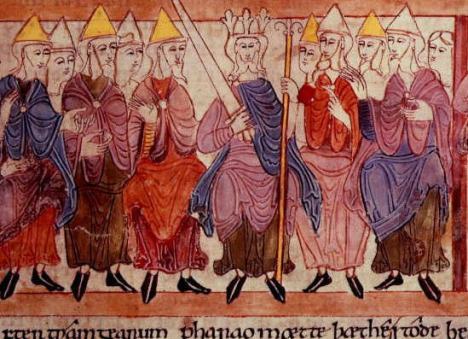
Anglo-Saxon Court

Anglo-Saxon Court

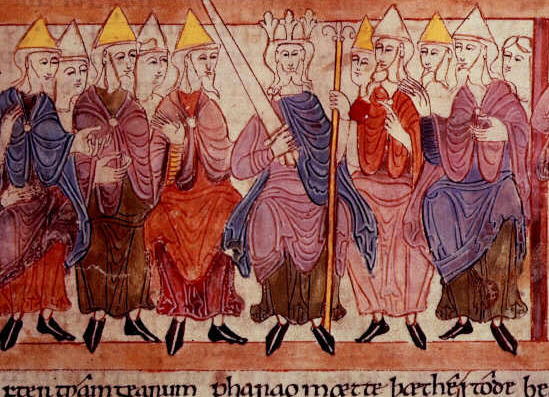
This blog posting consists of three views of an Anglo-Saxon poem called “Deor.” First I suggest you click here to see the poem being recited aloud in the original language.

Next, here is Seamus Heaney’s translation of the poem in modern English:

Welund himself knew misery by worms.
The brave man knew hardship,
had to himself for company sorrow and longing,
winter-cold misery; He often found woe,
since Nithhad by force laid a thin sinew-bond onto the better man.

That came to pass, this also may!

Beadohilde was not as sorrowful from her brothers’ death
as from her own thing,
that she certainly understood that she was pregnant;
She was never able to think confidently,
about what she should do.

That came to pass, this also may!

We found out that for Maethhilde,
many became the bottomless embraces of the Geat,
that the sorrowful love deprived her of all sleep.

That came to pass, this also may!

Theodric possessed for thirty winters the city of Maeringa;
That was known to many.

That came to pass, this also may!

We discovered the wolfen thought of Ermanaricus;
He occupied widely the people of the kingdom of the Goths.
That was a harsh king.
Many a man lived bound to sorrows,
woe in expectation,
often wishing that this kingdom was overcome.

That came to pass, this also may!

He lived sorrowful, deprived of joy,
he grew dark in his spirit,
it seemed to him that the troubles would be endless.
I might then think that throughout this world the wise Lord changes enough,
shows honour to many a man, true splendor,
a portion of woes to some.

That I by myself wish to tell,
that I once was a scop of the Heodenings,
dear Lord.

The name ‘Deor’ was mine.

I had for many winters a good fellowship, a loyal lord,
until now Heorrenda, a man skilled in poetry,
received a privilege that the protecting lord once gave to me.

That came to pass, this also may!

Finally, here is the written poem in the original Anglo-Saxon:

Welund him be wurman    wræces cunnade.
Anhydig eorl    earfoþa dreag,
hæfde him to gesiþþe    sorge ond longaþ,
wintercealde wræce,    wean oft onfond,
siþþan hine Niðhad on    nede legde
swoncre seonobende    on syllan monn.
Þæs ofereode,    þisses swa mæg!
Beadohilde ne wæs    hyre broþra deaþ
on sefan swa sar    swa hyre sylfre þing:
þæt heo gearolice    ongieten hæfde
þæt heo eacen wæs—    æfre ne meahte
þriste geþencan,    hu ymb þæt sceolde.
Þæs ofereode,    þisses swa mæg!
We þæt Mæðhilde    monge gefrugnon
wurdon grundlease    Geates frige,
þæt hi seo sorglufu    slæp ealle binom.
Þæs ofereode,    þisses swa mæg!
Ðeodric ahte    þritig wintra
Mæringa burg—    þæt wæs monegum cuþ.
Þæs ofereode,    þisses swa mæg!
We geascodan    Eormanrices
wylfenne geþoht;    ahte wide folc
Gotena rices.    Þæt wæs grim cyning.
Sæt secg monig    sorgum gebunden,
wean on wenan,    wyscte geneahhe
þæt þæs cynerice    ofercumen wære.
Þæs ofereode,    þisses swa mæg!
Siteð sorgcearig    sælum bidæled,
on sefan sweorceð,    sylfum þinceð
þæt sy endeleas    earfoða dæl.
Mæg þonne geþencan    þæt geond þas woruld
witig dryhten    wendeþ geneahhe,
eorle monegum    are gesceawað,
wislicne blæd,    sumum weana dæl.
Þæt ic bi me sylfum    secgan wille,
þæt ic hwile wæs    Heodeninga scop,
dryhtne dyre.    Me wæs Deor noma.
Ahte ic fela wintra    folgað tilne,
holdne hlaford,    oþþæt Heorrenda nu,
leoðcræftig monn    londryht geþah,
þæt me eorla hleo    ær gesealde.
Þæs ofereode,    þisses swa mæg!

There are only two letters of the alphabet that are unfamiliar to most of us. There is the thorn (Þ), which is pronounced like the soft th in thick. Next is the edh (ð), pronounced like the hard th in then.

Notice how the poetic line is broken into two fragments, with the additional space indicating a pause.

After a while, the recurring refrain Þæs ofereode,    þisses swa mæg!—“That came to pass, this also may”stands out like the heart of Anglo-Saxon philosophy. The gentle fatalism of that refrain is one of the things we lost when Harold Godwinsson died at Hastings in 1066 with a Norman arrow in his eye.

I now know why Jorge Luis Borges was so intent on learning Anglo-Saxon towards the end of his life. It is a beautiful language and lends itself well to poetry.

Serendipity: Vikings in Black and White

Skarphedinn the Viking Warrior from Njal’s Saga

Skarphedinn the Viking Warrior from Njal’s Saga

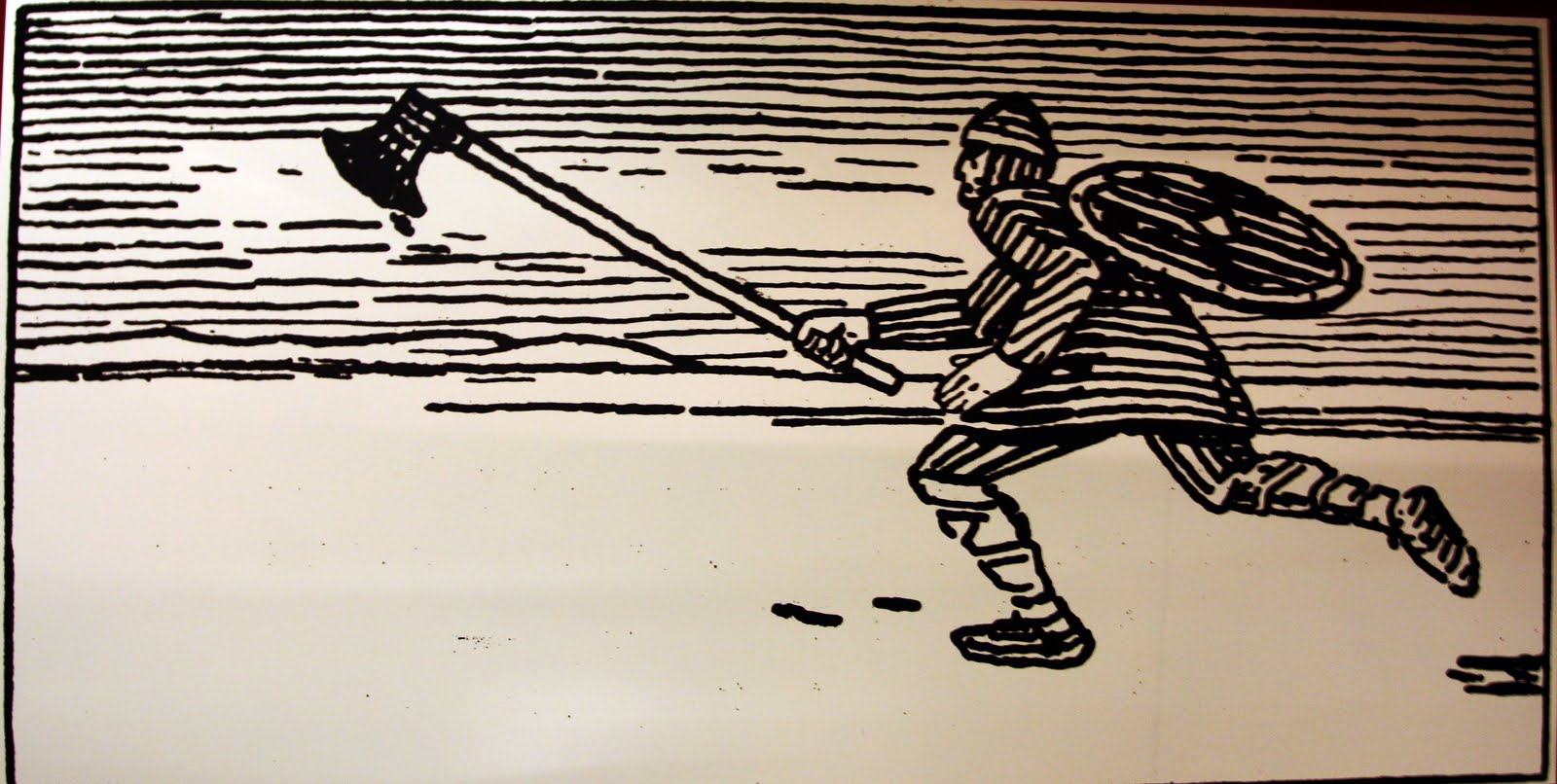
It took a blind poet to note something very interesting about Nordic literature at the time of the Vikings. On October 21, 1966, the Argentinian poet Jorge Luis Borges gave a class on Anglo-Saxon literature at the University of Buenos Aires. The book consists of notes recorded by the lecturer’s students and translated and published by New Directions in a volume entitled Professor Borges: A Course on English Literature. When the I read the following this morning at Los Angeles’s Central Library, I had chills up and down my spine:

And further south is what the Norse historians called Blaland, “blue land,” “land of blue men,” or rather Negroes, because they mixed the colors up a little. Besides one word, sölr, which means “yellowed” and is used to describe fallow fields and the sea, they have no colors. The snow is often spoken of, but they never say the snow is white. Blood is spoken of, but they never say it is red. They talk about the fields, but they never say they are green. We don’t know if this is the result of some kind of colorblindness or if it was simply a poetic convention. The Homeric Greeks said “the color of wine.” But we don’t know what color wine was for the Greeks; they don’t talk about colors, either. On the other hand, Celtic poetry that is contemporaneous or prior to Germanic poetry, contains an abundance of colors—it’s full of colors. There, every time a women is mentioned, they speak about her white body, her hair the color of gold or fire, her red lips. They also talk about green fields, and specify the colors of fruits, etcetera. In other words, the Celts lived in a visual world; the Norse did not.

At the time Borges gave this literature, his blindness was almost complete, though he was able to detect the color yellow.

A Halo for Judas Iscariot?

Twelve Apostles—All With Haloes—Watching Christ Entering Jerusalem

Twelve Apostles—All With Haloes—Watching Christ Entering Jerusalem

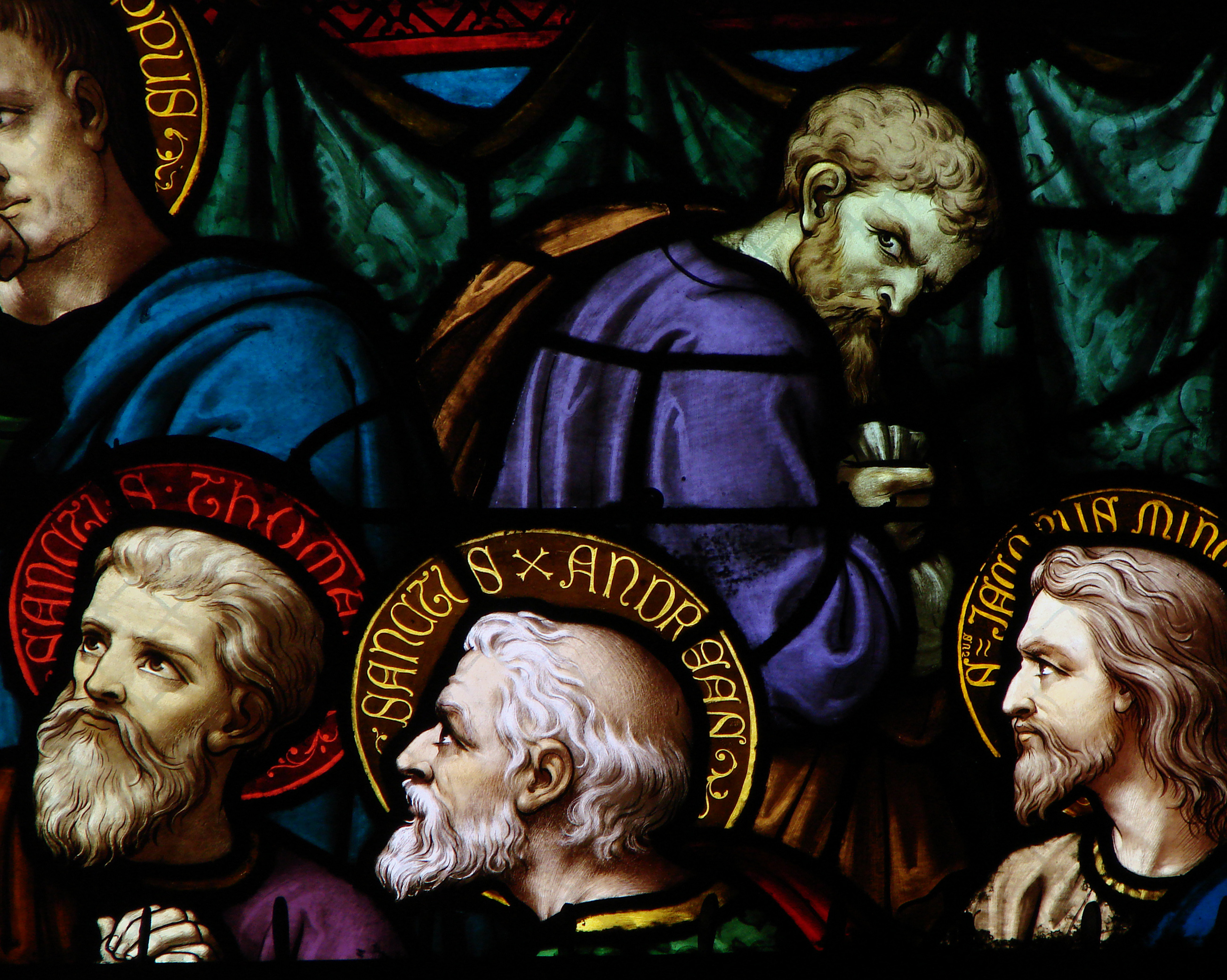
Today Martine and I attended the Valley Greek Festival at St. Nicholas Greek Orthodox Church in North Hills. Please excuse the lack of sharpness in the above photo. What is clear is that twelve men wearing haloes are watching Christ enter Jerusalem on Palm Sunday. Now, my question is this: If these men are, in fact, the Apostles, why do all twelve have haloes, which would invariably include Judas Iscariot?

It was not until after Palm Sunday that Judas ratted the Messiah out to the Sanhedrin for thirty pieces of silver. Afterwords, he felt remorse and hanged himself with a halter.

After Christ’s resurrection, Judas was replaced by Matthias:

Matthias was selected to replace Judas as recorded in Acts 1:15-26. The other man who was also in consideration was named Joseph or Barsabas, and surnamed Justus. Lots were cast and eventually Matthias was chosen. Acts 1:24-26 records the following, “And they prayed and said, “You, O Lord, who know the hearts of all, show which of these two You have chosen to take part in this ministry and apostleship from which Judas by transgression fell, that he might go to his own place.” And he was numbered with the eleven apostles.” The Bible is sparse on additional details relating to Matthias, but it does say that Matthias was with Jesus since His baptism until his resurrection. Besides the book of Acts, Matthias isn’t mentioned anywhere else in the Bible. According to historical sources Matthias lived til 80 A.D. and spread the gospel on the shores of the Caspian and Cappadocia.

Judas Is Pointedly Depicted Without a Halo at the Cathedral of Moulins

Judas Is Pointedly Depicted Without a Halo at the Cathedral of Moulins

Note that at this time, Paul was not an apostle. He was known as Saul and actively persecuted the Christians until, on the road to Damascus, God spoke to him from the heavens:

As he neared Damascus on his journey, suddenly a light from heaven flashed around him. He fell to the ground and heard a voice say to him, “Saul, Saul, why do you persecute me?”

“Who are you, Lord?” Saul asked.

“I am Jesus, whom you are persecuting,” he replied. “Now get up and go into the city, and you will be told what you must do.”

The men traveling with Saul stood there speechless; they heard the sound but did not see anyone. Saul got up from the ground, but when he opened his eyes he could see nothing. So they led him by the hand into Damascus. For three days he was blind, and did not eat or drink anything.

— Acts 9:3–9, NIV

One final observation. In his short story (in the form of an essay) entitled “Three Versions of Judas” published in Ficciones, Argentinian writer Jorge Luis Borges speculated on a different role for Judas Iscariot in the story of Man’s Redemption:
God became a man completely, a man to the point of infamy, a man to the point of being reprehensible—all the way to the abyss. In order to save us, He could have chosen any of the destinies which together weave the uncertain web of history; He could have been Alexander, or Pythagoras, or Rurik, or Jesus; He chose an infamous destiny: He was Judas.
*  *  *  *  *
What, in fact, do I believe? I think twelve holy men depicted as wearing haloes are shown watching Christ enter Jerusalem. It is merely interesting to speculate whether Judas is one of them.

Do Not Give Up

Borges Takes On the I Ching

Borges Takes On the I Ching

My mind is still on Hexagram 52 (see yesterday’s post). It seems that Jorge Luis Borges had something to say about the ancient Chinese book of divination (and philosophy) that is germane to the discussion. It is called “For a Version of I Ching”:

The future is as immutable
As rigid yesterday. There is nothing
That is no more than a single, silent letter
In the eternal and inscrutable
Writing whose book is time. He who walks away
From home has already come back.
Our life Is a future and well-traveled track.
Nothing dismisses us. Nothing leaves us.
Do not give up. The prison is dark,
Its fabric is made of incessant iron,
But in some corner of your cell
You might discover a mistake, a cleft.
The path is fatal as an arrow
But God is in the rifts, waiting.

I love the poem’s final four lines. Here they are in Spanish:

Pero en algún recodo de tu encierro
Puede haber un descuido, una hendidura,
El camino es fatal como la flecha
Pero en las grietas está Dios, que acecha.

Happiness perhaps lies in discovering that mistake (descuido, which could also be translated as “neglect” or “omission”) or cleft (hendidura) and taking advantage of it. But then, is God waiting to entrap us anew, or to welcome us for evading His net?

On The Other Hand

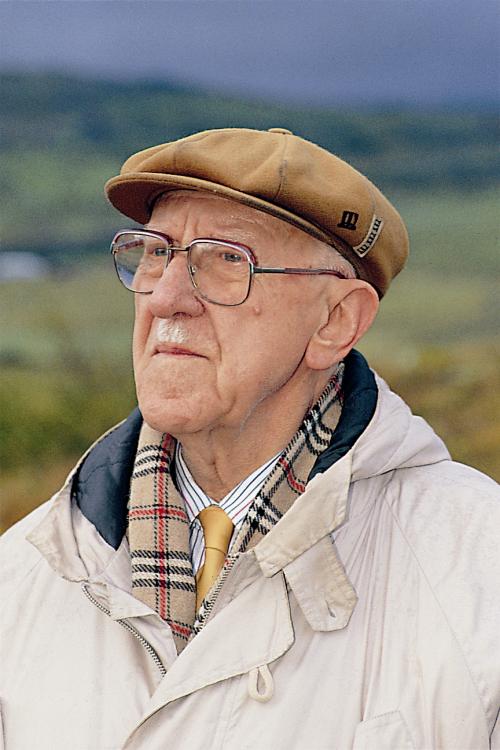
Icelandic Author Halldór Laxness (1902-1998)

Icelandic Author Halldór Laxness (1902-1998)

In yesterday’s blog post, “[Not] The Nobel Prize for Literature,” I blasted the Swedish Academy for awarding prizes to a lot of mediocre writers who have not stood the test of time. As with all annual awards in the arts—and I include the Oscars and the Pulitzer Prizes in this as well—there are a goodly number of clinkers, but there are also some real finds.

Probably the one Nobelist whose work I have discovered and grew to love, perhaps the greatest is Halldór Laxness, Iceland’s sole laureate in literature. In the last few years, I’ve read mot of his work that is available in English translation, including such masterworks as Independent People, Iceland’s Bell, The Atom Station, and World Light.

Although no one I know has ever read any Laxness, I regard him as a giant of world literature. In 2013, I even visited his house in Mosfellsbaer (see below).

Gljúfrasteinn, Home of Halldór Laxness

Gljúfrasteinn, Home of Halldór Laxness

Other Nobelist authors whose work is little known today, but whose work I love,are Knut Hamsun of Norway, Ivan Bunin of Russia, François Mauriac of France, Ivo Andrić  of Yugoslavia, and Miguel Ángel Asturias of Guatemala.

Sometimes, the awards like the Nobels are useful, when they are not tainted by politics. It is said that Jorge Luis Borges of Argentina lost his chance at the prize when he accepted an honor from Chilean dictator Augusto Pinochet. At that point, one leftist member of the Swedish Academy essentially said, “Over my dead body!”

“Things That Might Have Been”

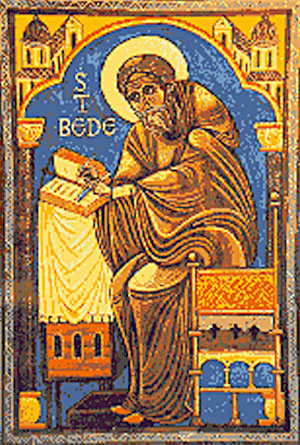
Saint Bede

Saint Bede the Venerable

In the waning days of 2015, here is a simple poem by Jorge Luis Borges entitled “Things That Might Have Been.” Think of them as a head start for your New Year’s Resolutions.

Things That Might Have Been

I think of things that weren’t, but might have been.
The treatise on Saxon myths Bede never wrote.
The inconceivable work Dante might have had a glimpse of,
As soon as he’d corrected the Comedy’s last verse.
History without the afternoons of the Cross and the hemlock.
History without the face of Helen.
Man without the eyes that gave us the moon.
On Gettysburg’s three days, victory for the South.
The love we never shared.
The wide empire the Vikings chose not to found.
The world without the wheel or the rose.
The view John Donne held of Shakespeare.
The other horn of the Unicorn.
The fabled Irish bird that lights on two trees at once.
The child I never had.

Serendipity: Documents of the Ultra-Terrain World

“Blue Harbor” by Xul Solar

“Blue Harbor” by Xul Solar

While in Buenos Aires last month, I visited the museum of painter Xul Solar, friend of Jorge Luis Borges. It was Borges who wrote the prologue to the museum’s catalog, which is reproduced here in its entirety:

Man versed in all disciplines, curious of all enigmas, father of writings, languages, utopias, mythologies, guest of hell and heavens, chessplayer author and astrologist, perfect in indulgent irony and friendly generosity, Xul Solar is one of the most outstanding events of our epoch. There are minds which profess the truth, others indiscriminate abundance: the large creativity of Xul Solar does not exclude the strict honesty. His paintings are documents of ultra-terrain world, of metaphysical world in which gods take the form of the imagination of the ones dreaming. The passionate architecture, the happy colours, the many circumstantial details, the labyrinths, the dwarves and angels unforgettably define this delicate and monumental art.

The taste of our time vacillates between the more lineal preference, the emotive transcription and the realism of wall painters: Xul Solar renews, in his ambitious way of being modest, the mystic painting of the ones who do not see with physical eyes in the sacred world of Blake, Swedenborg, yogis and bards.


Serendipity: The Ombú

Ombú Tree in Recoleta, Buenos Aires

Ombú Tree in Recoleta, Buenos Aires

I first grew curious about the Ombú trees of the Pampas when I read W. H. Hudson’s Tales of the Pampas. Following is the beginning of his short story entitled “The Ombú”:

IN ALL THIS DISTRICT, though you should go twenty leagues to this way and that, you will not find a tree as big as this ombú, standing solitary, where there is no house; therefore it is known to all as “the ombú,” as if but one existed; and the name of all this estate, which is now ownerless and ruined, is El Ombú. From one of the higher branches, if you can climb, you will see the lake of Chascomus, two thirds of a league away, from shore to shore, and the village on its banks. Even smaller things will you see on a clear day; perhaps a red line moving across the water—a flock of flamingos flying in their usual way. A great tree standing alone, with no house near it; only the old brick foundations of a house, so overgrown with grass and weeds that you have to look closely to find them. When I am out with my flock in the summer time, I often come here to sit in the shade. It is near the main road; travellers, droves of cattle, the diligence, and bullock-carts pass in sight. Sometimes, at noon, I find a traveller resting in the shade, and if he is not sleeping we talk and he tells me the news of that great world my eyes have never seen.

They say that sorrow and at last ruin comes upon the house on whose roof the shadow of the ombú tree falls; and on that house which now is not, the shadow of this tree came every summer day when the sun was low. They say, too, that those who sit much in the ombú shade become crazed. Perhaps, sir, the bone of my skull is thicker than in most men, since I have been accustomed to sit here all my life, and though now an old man I have not yet lost my reason. It is true that evil fortune came to the old house in the end; but into every door sorrow must enter—sorrow and death that comes to all men; and every house must fall at last.

Do you hear the mangangá, the carpenter bee, in the foliage over our heads? Look at him, like a ball of shining gold among the green leaves, suspended in one place, humming loudly! Ah, sefior, the years that are gone, the people that have lived and died, speak to me thus audibly when I am sitting here by myself. These are memories; but there are other things that come back to us from the past; I mean ghosts. Sometimes, at midnight, the whole tree, from its great roots to its topmost leaves, is seen from a distance shining like white fire. What is that fire, seen of so many, which does not scorch the leaves? And, sometimes, when a traveller lies down here to sleep the siesta, he hears sounds of footsteps coming and going, and noises of dogs and fowls, and of children shouting and laughing, and voices of people talking; but when he starts up and listens, the sounds grow faint, and seem at last to pass away into the tree with a low murmur as of wind among the leaves.

As a small boy, from the time when I was able, at the age of about six years, to climb on to a pony and ride, I knew this tree. It was then what it is now; five men with their arms stretched to their utmost length could hardly encircle it. And the house stood there, where you see a bed of nettles—a long, low house, built of bricks, when there were few brick houses in this district, with a thatched roof.

The ombú in the photograph stands in front of La Biela, an old café that Jorge Luis Borges and his friend and collaborator Adolfo Bioy Casares used to frequent. It is on Plaza Francia not far from the entrance to Recoleta Cemetery.

.

Serendipity: A Yellow Rose

Italian Poet Giambattista Marino (1569-1625)

Italian Poet Giambattista Marino (1569-1625)

Over the last couple of days, I have been re-reading Jorge Luis Borges’s A Personal Anthology. For the nth time, I was struck by this short piece, which I reproduce here in its entirety. It is called “A Yellow Rose.” The Translation is by Anthony Kerrigan.

The illustrious Giambattista Marino, whom the unanimous mouth of fame—to use an image dear to him—proclaimed the new Homer and the new Dante, did not die that afternoon or the next. And yet, the immutable and tacit event that happened then was in effect the last event of his life. Laden with years and glory, the man lay dying in a vast Spanish bed with carved bedposts. It takes no effort to imagine a lordly balcony, facing west, a few steps away, and, further down, the sight of marble and laurels and a garden whose stone steps are duplicated in a rectangle of water. A woman has placed a yellow rose in a vase. The man murmurs the inevitable verses which—to tell the truth—have begun to weary him a little:

Blood of the garden, pomp of the walk,
gem of spring, April’s eye …

Then came the revelation. Marino saw the rose as Adam might have seen it in Paradise. And he sensed that it existed in its eternity and not in his words, and that we may make mention or allusion of a thing but never express it at all; and that the tall proud tomes that cast a golden penumbra in an angle of the drawing room were not—as he had dreamed in his vanity—a mirror of the world, but simply one more thing added to the universe.

This illumination came to Marino on the eve of his death, and, perhaps, it had come to Homer and Dante too.