Republicans

What Comes First? The Death of the Republican Party or the Death of Our Democracy?

As much as I hate talking about politics in America, I cannot shut up when I see one of our two political parties attempt to destroy the country even as they destroy their own party. It’s like a race to the bottom—that shit pit of death cults and failed states.

I can hardly believe that over 70 million Americans have drunk the Republicans’ poisoned Kool-Aid. I regret to say that the woman I love is one of them. Martine not only refuses to get the shots protecting against Covid-19, but she keeps trying to show me “evidence” from right-wing websites which the AM talk radio pundits cite for their over-the-air lies. Take a look at Natural Health News for its take Defending Health, Life and Liberty (followed, of course, by the obligatory American flag).

These people are the enemy. Follow their advice, and risk dying. Martine is convinced that the Covid shots are more dangerous than the disease they were formulated to fight. She says that her health is too fragile for the shots. How would she fare, however, if she contracted the coronavirus? Better? I don’t think so.

If Martine doesn’t want to take the vaccine, I’m not going to force her. But I have nothing but contempt for her “news” sources. The Republican cultists have created their own plastic bubble of destructive falsehoods in which they, and perhaps ultimately all of us, are weakening and perhaps failing.


America First?

Dragging Our Flag Down Into the Mire

Sometimes, I think the United States was destroyed by our victory in the Second World War. It seemed that we found ourselves alone at the top of the heap even as we were surrounded by countries in ruins. That’s when the hubris set in. We were free to make mistakes, lots of mistakes, while trumpeting our prowess.

In an article for The New York Review of Books for November 19, 2020, Pankaj Mishra wrote:

In Radical Hope: Ethics in the Face of Cultural Devastation (2006), Jonathan Lear writes of the intellectual trauma of the Crow Indians. Forced to move in the mid-nineteenth century from a nomadic to a settled existence, they catastrophically lost not only their immemorial world but also “the conceptual resources” to understand their past and present. The problem for a Crow Indian, Lear writes, wasn’t just that “my way of life has come to an end.” It was that “I no longer have the concepts with which to understand myself or the world…. I have no idea what is going on.”

It is no exaggeration to say that many in the Anglo-American intelligentsia today resemble the Crow Indians, after being successively blindsided by far-right insurgencies, an uncontainable pandemic, and political revolts by disenfranchised minorities. For nearly three decades after the the end of the cold war, mainstream politicians, journalists, and business people in Britain and the US repeatedly broadcast their conviction that the world was being knit together peaceably by their guidelines for capitalism, democracy, and technology. The United States itself appeared to have entered, with Barack Obama’s election, a “post-racial age,” and Americans seemed set, as President Obama wrote in Wired a month for Donald Trump’s election, to “race for new frontiers” and ”inspire the world.”

Well, that didn’t happen. We had Trump for four years, and suddenly it appeared that we were headed for the dissolution of everything we held dear, while dumbasses from Red States crawled out of their caves and began to shake the foundations of our democracy.

It’s not over yet by a long shot. The one sentence I remember from my high school civics textbook is, “Eternal vigilance is the price of liberty.” So we had best wake up.

Social Distancing Follies

The Adventist Health.White Memorial Medical Plaza in East Los Angeles

Today, I drove Martine for an ophthalmologist appointment in East Los Angeles. I went up to the waiting room with her, but was asked to leave because of social distancing requirements. So what happened? I had to stand in the corridor, which was full of other family members who weren’t really social distancing. And there wasn’t any seating to be had.

There is a bridge over César Chavez Boulevard (visible in the above photo), which would be an ideal place to sit—except it was posted all over with signs saying that, because of social distancing, no one may sit down there.

Perhaps one cannot catch the ’Rona when one is on one’s feet. At least, that seems to be the prevailing assumption. If the medical receptionist can’t see you in the corridor, then presumably you are, by definition, social distancing. ¡Que idiota!

Diamond Princess

The USS Petri Dish, I Mean the USS Diamond Princess

I have just watched a brief HBO documentary about the cruise ship Diamond Princess, whose passengers had the unenviable role of being the first people outside of China to come down with the coronavirus. It was called “The Last Cruise” (which it was for the 14 passengers who died of the virus).

In all my travels, I have avoided cruise ships—not because of the spread of infectious diseases, but because I don’t like to be in the position of having to be nice to the same bunch of wealthy strangers for multiple days in a row and because I don’t like my vacations to be highly regimented.

Another reason: I remember a cartoon in the New Yorker a number of years ago in which we saw a cruise ship whose name was S.S. All You Can Eat. Even under normal conditions, I’m fighting the “Battle of the Bulge” and certainly don’t need unlimited access to calorific foods.

The documentary consisted largely of cell phone videos taken by passengers and crew. It was evident that the filmmakers were aghast at the conditions of the crew, who were forced to associate with one another in close quarters while an epidemic ranged throughout the ship.

The ship sailed between Yokohama and several ports in Southeast Asia including Okinawa, Hong Kong, and a Vietnamese port not named. As the ship was homeward bound to Yokohama, it was discovered that a passenger boarding in Hong Kong had come down with Covid-19. When the ship reached Yokohama, it was put on quarantine for over a month, as cases spread like wildfire through the ship, infecting some 700+ passengers and an unspecified number of crew members. Passengers who had come down with the virus were carted off to Japanese hospitals.

Eventually, most of the American passengers were put on a military aircraft and returned to the U.S.

Vaccinated!

My Covid-19 Vaccination Card (with Date of Birth Obliterated)

Yesterday I finally got my second Pfizer Covid-19 second dose. As my doctor predicted, I came down this morning with a slight fever, some chills, and achy shoulders. I hated to think that I would die of the ’rona after all the quarantining I did over the last year. I went all the way out to Kaiser Permanente Hospital in Baldwin Park, where it all went down like clockwork.

Weekend in the Desert

Looking Up from the Book I Was Reading, This Was the View

It was good to see my brother again after four months of quarantining alone with Martine. Because she hates the desert (having lived and work for two years in Twentynine Palms), Martine stayed behind in L.A. and engaged in several cleaning projects which would have been difficult with me tromping about the place.

Dan and my sister-in-law Lori were, as usual, excellent hosts. Dan went out of his way to cook several gourmet meals including a vegetarian lasagna with eggplant and spinach as well as corned beef and cabbage with potatoes and carrots. We didn’t visit many places, because the Coachella Valley is still under a Covid-19 lockdown. But I did manage to read two whole books sitting in Dan’s back yard. The weather was perfect, an even 70° Fahrenheit (21° Celsius) with an occasional cool breeze.

The photo above was taken from the chair in which I was reading Hilaire Belloc’s Selected Essays and Jon Krakauer’s Classic Krakauer: Essays on Wilderness and Risk. (I love reading essays, as I consider myself to be something of an essay writer, but in a small way.)

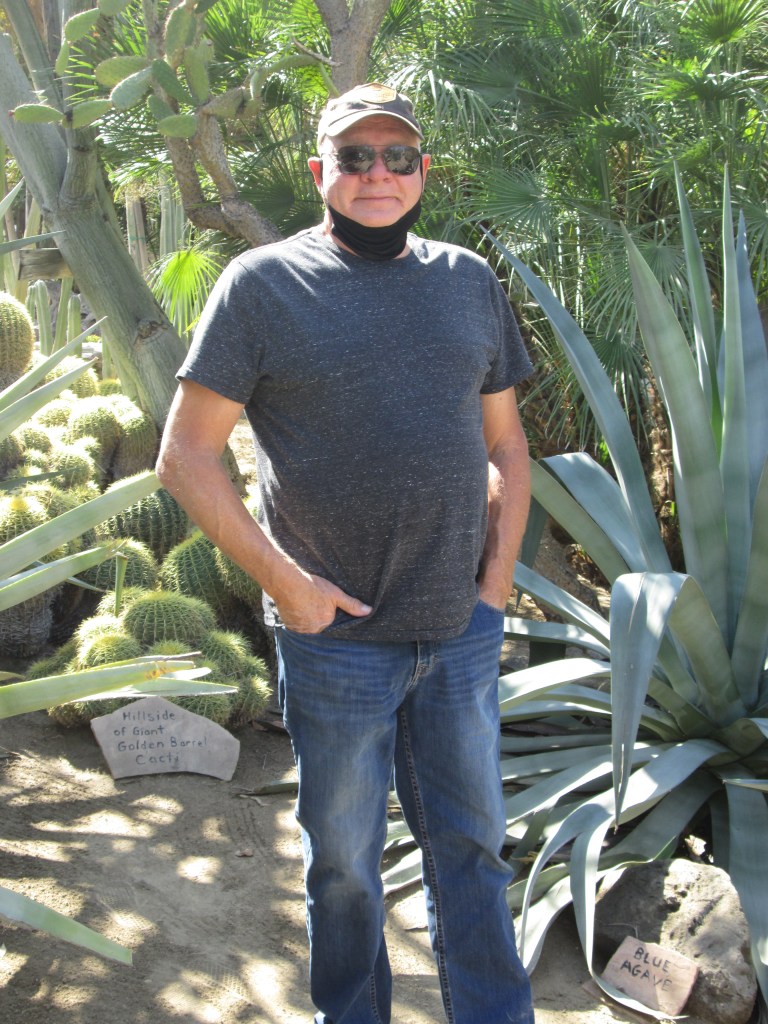
My Brother Dan at the Moorten Cactus Garden in Palm Springs

Because Dan lives in the lower desert of California, I would not venture to visit him during the blazingly hot summer months. I hope that he can make it to L.A., or I will have to wait until the fall to drive out again.

Getting the Vaccine

Today I Got My First Covid-19 Vaccine Injection

Earlier this week, I talked to my doctor. She recommended I get either the Pfizer or the Moderna Covid-19 vaccine, preferably through Kaiser-Permanente. So this morning, Martine and I drove to the Kaiser hospital in Baldwin Park, roughly three quarters of an hour from home. Why so far? Apparently, the Kaiser representative who set up the appointment is in another city and is not familiar with Los Angeles. No matter. I got there in plenty of time and got the first shot.

Although Martine was with me, she opted not to be vaccinated. She listens to AM talk radio a lot, and the pundits there kept emphasizing how dangerous the vaccine is. Martine tends to be hypersensitive, so she thought she would probably suffer some horrible reaction if she got the shot. Well, I got my shot (it was the Pfizer vaccine); and it didn’t feel any different than getting my annual flu shot at Walgreen’s.

The vaccination setup at Kaiser was very well organized. As part of the process, they gave me an appointment for the second shot on Saturday, March 15.

I can hardly wait until this whole coronavirus outbreak is a thing of the past.

The French Have a Phrase for It

The Paris Metro at the Stalingrad Stop

You know the colloquial expression for it: Work, work, work! (and several variants thereof). But the French have a more picturesque phrase to describe the thankless boredom of life under the Coronavirus outbreak:

Métro, Boulot, Dodo

According to the Thought.Co website from 2019, the term is explained as follows:

The informal French expression métro, boulot, dodo (pronounced [may tro boo lo do do]) is a wonderfully succinct way of saying you live to work. Métro refers to a subway commute, boulot is an informal word for work, and dodo is baby talk for sleeping.

The English equivalents—the rat race, the same old routine, work work work—don’t quite capture the same sense of constant movement, and a more literal English translation, “commute, work, sleep,” isn’t as poetic as the French.

The Quarantine Makes Us Boring

An Empty Restaurant

Things being as they are, I have a hard time thinking of interesting things to write. During the quarantine, I am involved primarily in four activities: food shopping, cooking, reading, and film viewing. There isn’t much I can write about food shopping and cooking, primarily because of Martine’s irritable bowel syndrome (IBS), most of what I cook is pretty bland. When I cook a dish for myself, I tend to go crazy with spices and chiles—because I can!

I would love to write more about places that I have visited recently. Except I have not visited many places recently. There are two reasons for this:

  1. Restaurants are usually closed, and the weather does not encourage picnicking.
  2. If you have to go to the bathroom, you pretty much have to buy gasoline.

I’d love to go driving in the local deserts, but I am uncertain as to filling these two basic needs which all travelers have. Let’s say I want to go to Boron, California, home of the Twenty-Mule-Team Museum. Not only is the museum closed, but I have no idea where I can get food locally, and whether the local restaurants are serving diners outdoors. There is just too much uncertainty.

Sometime this February, I will pay another visit to my brother in Palm Desert. My last visit there was at the end of October. There are some places we can go, and he knows which local restaurants are serving food. (Though the best food there is likely to be cooked by my brother.) To be sure, I will take my camera and try to find some places I can write about.

Until then, you will hear more about my reading and film viewing.

A Portuguese Plague Diary

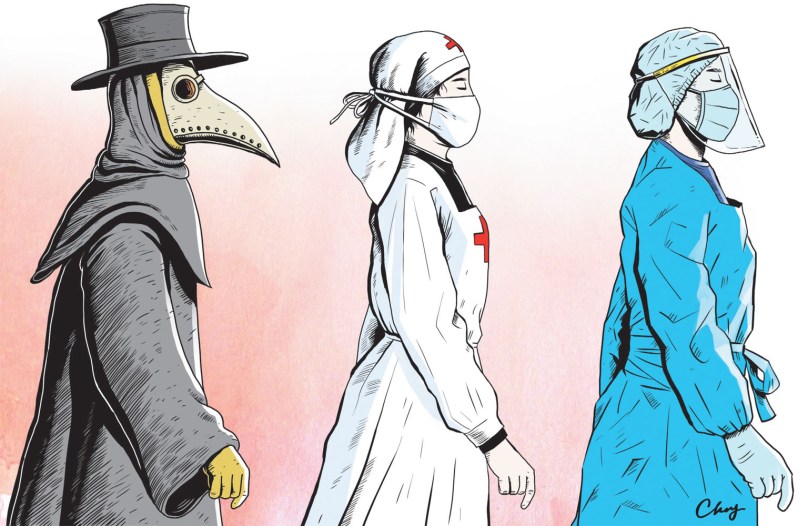
The Costumes Might Be Different, But It’s the Same Thing

The following are quoted from Gonçalo M. Tavares’s “My Plague Diary,” excerpts of which were published in the June 5, 2020 issue of the Times Literary Supplement:

For days, a violent poster campaign on the streets of the capital: if you are reading this, our condolences. You don’t want to be shut up at home, but in a coffin instead.

This poster worries more about your family than you do.

If you go out, you kill. If you go out, you die. If you go out and get sick, don’t complain. In any case, you won’t be able to complain.

If you have just gone out to visit your family, say goodbye to them.

At the entrance to the Metro: here’s hoping you don’t read me, here’s hoping you don’t die.

A lot of Brazilian prisoners are writing goodbye letters to their families. They say they’re getting sick. Coughing, fever, cries for help in a number of cells.

A picture from two weeks ago, jackals in the streets of Tel Aviv. They are hungry and they’ve lost their fear. Because they are hungry they’ve lost their fear. They need to go back to having fear or food, somebody says.

A friend from Brazil writes to me: “I wish I had a loudspeaker, like this guy in Ipanema.” They say he’s on the tenth floor, opposite the beach, and he’s set his speaker up on the balcony. And from all the way up there he was issuing warnings through his loudspeaker: Hey, lad in the blue shirt, the one on the bike, yeah, you! You’re going to get coronavirus, you know. Hey, lady in the flowery swimsuit, with your hair done and the red lipstick, yes you! You’re going to get coronavirus, you know…! She lives in Rio. She’s terrified.

Unemployment reaches 1929 Great Depression levels in the USA, and in Guatemala, women on the side of the road are holding a white flag. They wave the white flag when a car or a motorbike passes. They are unemployed, they ask anyone who stops for food.

Maria Branyas, aged 113, is now the oldest person to beat the novel coronavirus.

Dizziness, I’ve got to check this out. Too many days like this. Lying down, I’m fine, but sometimes it’s good to be on two feet. They don’t seem like days—but days in the middle of something. As if the day even when it is finished were not complete. It is always between one thing and another. These days are always the middle sibling. A need for lightness; feeding the dogs organizes my time; without their hunger I would surely be having more dizzy spells.

Two actions of resistance. You must wait or clean. How long does evil remain on a surface? Think about evil that can be eliminated by cleaning.

Doesn’t matter what you think, what matters is what you do.