I think we underestimate the poems of Edgar Allan Poe. Here’s one of his best, on the subject of life being but a dream. “Deceptively simple?” you might ask. Perhaps, but that is their strength.
A Dream Within a Dream
Take this kiss upon the brow! And, in parting from you now, Thus much let me avow — You are not wrong, who deem That my days have been a dream; Yet if hope has flown away In a night, or in a day, In a vision, or in none, Is it therefore the less gone? All that we see or seem Is but a dream within a dream.
I stand amid the roar Of a surf-tormented shore, And I hold within my hand Grains of the golden sand — How few! yet how they creep Through my fingers to the deep, While I weep — while I weep! O God! Can I not grasp Them with a tighter clasp? O God! can I not save One from the pitiless wave? Is all that we see or seem But a dream within a dream?
For Halloween, I’ve decided to excerpt as short short story in its entirety from Thomas Ligotti’s excellent collection entitled Noctuary.
One May Be Dreaming
Beyond the windows a dense fog spreads across the graveyard, and a few lights beam within hazy depths, glowing like old lamps on an empty street. Night is softly beginning.
Within the window are narrow bars, both vertical and horizontal, which divide it into several smaller windows. The intersections of these bars form crosses. Not far beyond the windowpanes, there are other crosses jutting out of the earth-hugging fog in the graveyard. To all appearances, it is a burial ground in the clouds that I contemplate through the window.
Upon the window ledge is an old pipe that seems to have been mine in another life. The pipe’s dark bowl must have brightened to a reddish-gold as I smoked and gazed beyond the window at the graveyard. When the tobacco had burned to the bottom, perhaps I gently knocked the pipe against the inside wall of the fireplace, showering the logs and stones with warm ashes. The fireplace is framed within the wall perpendicular to the window. Across the room are a large desk and a high-backed chair. The lamp positioned in the far right corner of the desk serves as illumination for the entire room, a modest supplement to those pale beacons beyond the window. Some old books, pens, and writing paper are spread across the top of the desk. In the dim depths of the room, against the fourth wall, is a towering clock that ticks quietly.
Those, then, are the main features of the room in which I find myself: window, fireplace, desk, and clock. There is no door.
I never dreamed that dying in one’s sleep would encompass dreaming itself. I often dreamed of this room and now, near the point of death, have become its prisoner. And here my bloodless form is held while my other body somewhere lies still and without hope. There can be no doubt that my present state is without reality. If nothing else, I know what it is like to dream. And although a universe of strange sensation is inspired by those lights beyond the window, by the fog and the graveyard, they are no more real than I am. I know there is nothing beyond those lights and that the obscured ground outside could never sustain my steps. Should I venture there I would fall straight into an absolute darkness, rather than approaching it by the degrees of my dying dreams.
For other dreams came before this one—dreams in which I saw lights more brilliant, a fog even more dense, and gravestones with names I could almost read from the distance of this room. But everything is dimming, dissolving, and growing dark. The next dream will be darker still, everything a little more confused, my thoughts … wandering. And objects that are now part of the scene may soon be missinfg: perhaps even my pipe—if it was ever mine—will be gone forever.
But for the moment I am safe in my dream, this dream. Beyond the window a dense fog spreads across the graveyard, and a few lights beam within hazy depths, glowing like old lamps along an empty street. Night is softly beginning.
Here is a poem by Jorge Luis Borges of Argentina that mentions the butterfly dream by Zhuangzi that I wrote about in yesterday’s post.
Signs
for Susana Bombal
Around 1915, in Geneva, I saw on the terrace of a museum a tall bell with Chinese characters. In 1976 I write these lines:
Undeciphered and alone, I know in the vague night I can be a bronze prayer or a saying in which is encoded the flavor of a life or of an evening or Chuang Tzu’s dream, which you know already, or an insignificant date or a parable or a great emperor, now a few syllables, or the universe or your secret name or that enigma you investigated in vain for so long a time through all your days. I can be anything. Leave me in the dark.
About that last line: Remember that for the last thirty or forty years of his life, Borges was blind.
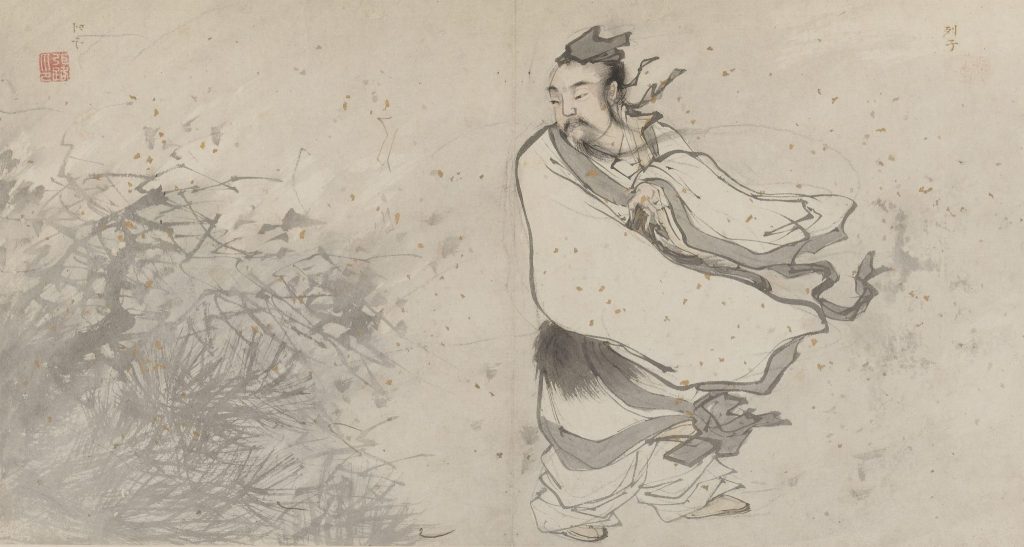
Zhuangzi, also known as Chuang Tzu, was a Chinese sage who lived around the 4th Century BC. There is a famous parable of his in which he talks about dreaming he was a butterfly. It is a simple parable that requires no explanation:
Zhuangzi’s Butterfly Dream Parable
Once upon a time, I, Zhuangzi, dreamt I was a butterfly, fluttering hither and thither, to all intents and purposes a butterfly.
I was conscious only of my happiness as a butterfly, unaware that I was Zhuangzi.
Soon I awakened, and there I was, veritably myself again.
Now I do not know whether I was then a man dreaming I was a butterfly, or whether I am now a butterfly, dreaming I am a man.
Between a man and a butterfly, there is necessarily a distinction.
The transition is called the transformation of material things.
Probably the only line that requires an explanation is the last one. I rather like the translation of the last line shown on this website: “This is called ‘Things Change.´”
I had a strange dream last night. I was waiting for the bus to Siegmaringen. The name was clearly imprinted in my mind even though I don’t think I knew anything about the South German city. But then, that’s dream logic for you. That is to say, no logic.
A bus came by and stopped in front of me. The destination noted on the display above the front window of the bus said only “Error3.” I asked the driver whether it was headed for Siegmaringen. He nodded yes and I boarded. End of dream.
In many ways, that’s me all over. I wasn’t deterred by the “Error3” destination and forged ahead. Did I get there? Both the ride and my putative arrival in Siegmaringen were not part of the dream. So if you see me riding the Error3 bus, please don’t forget to wave.
The following is a dream that poet Joy Harjo, a Creek/Mvskoke Indian, had when she was a child and it was feared that she had polio. The excerpt comes from her book Crazy Brave: A Memoir.
It was shortly after the polio scare that I began to dream the alligator dream.
I am a young girl, between four and five years old. It’s early in the morning. I delight in my feet touching the ground and in the plant beings who line the trail to the river. I breathe in playful energy from small, familiar winds as I walk to get water for the family. The winds appear to part the tall reeds through which I walk with my water jar.
An alligator whips me suddenly to the water and pulls me under. I struggle, and then I am gone. My passing from earth is a quick choke. To my mourning family, my life has been tragically ended. They did not see that I entered an underwater story to live with alligators and become one of them.
I believe now that I had the beginnings of polio. The alligators took it away. It is possible. The world is mysterious.
This post is about the things that scared me as a child. In it, I go back as far as I can in my memory banks, back to before I was two years old. There are three things that scared me around that age.
First and foremost was … would you believe … toilet training. We were living in the Hungarian Buckeye Road neighborhood of Cleveland, and my great grandmother was living with us. She was born in Felcsut (pronounced FEL-choot) in the province of Fehérmegye (don’t even TRY to pronounce that one) sometime around 1880. She was old school. Not only that, she didn’t particularly like me at that time because I was the son of that fuszóru Tóth (cock-nosed Slovak) who was my father. (She was later to love my brother me and me, but never my father.) Therefore, she was fairly brutal about my toilet training.
I remember my nightmares at the time. I was seated on the toilet and the walls of the bathroom would close in on me with the roaring sound of a steam locomotive. That occurred fairly regularly as I recall.
As an infant in the crib, I had a boogeyman which I couldn’t exactly describe, only that I knew him as the Lobogó (LOH-boh-goh), which is one of the Hungarian words for flag. It’s odd, because I wasn’t afraid of flags as such, just that word that sounded so sinister to me. My Mom would kid me that there was never any danger from the Lobogó.
Finally, I remember a series of nightmares I had in which I was being chased by a lion. My Mom and Dad must have taken me to the zoo, because how would I know about the existence of lions. This was at least two years before I ever saw a television set. It could have been in a fairy tale that my mother told me. She would make up wonderful stories about a fairy princess (tündérleány) in the dark forest (sötét erdő). A lion must have wandered into one of her tales.
The image above, which is the flag of Irkutsk Oblast in Siberia, combines the dread Lobogó (flag) with my lion nightmares. I particularly like the red eyes.
Sorry for all the Hungarian words, but at the time I didn’t know a word of English, or even that the English language existed.
The following is one of the short short stories from Barry Gifford’s Sad Stories of the Death of Kings. It was one of the best stories in the book, and I thought at once of sharing it with you. The first paragraph is a scene from the movie Lost Horizon.
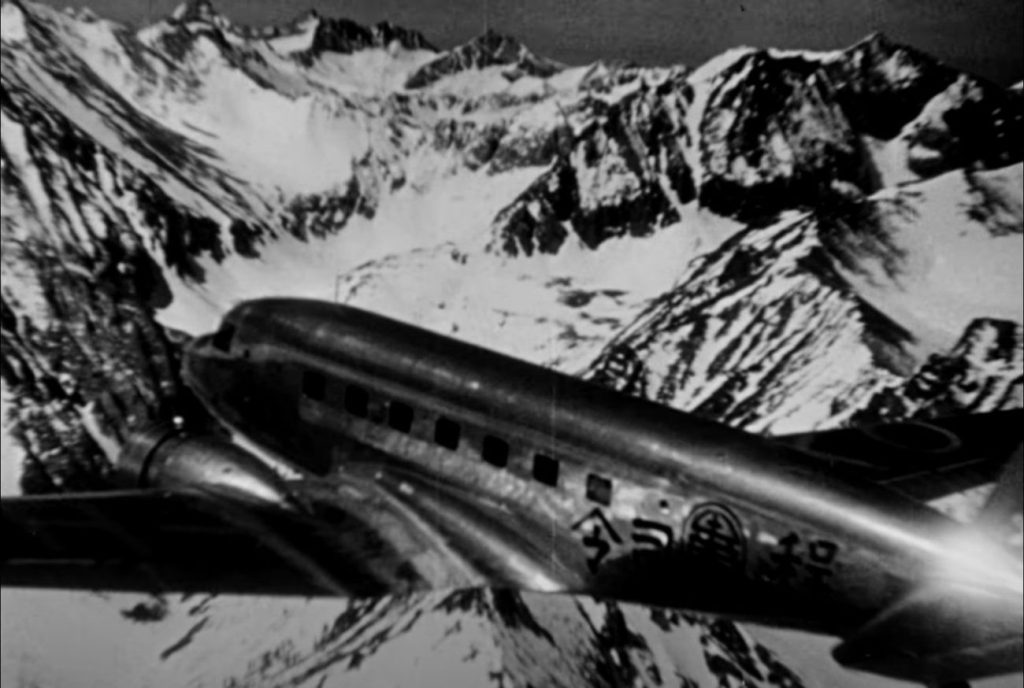
The little plane was barely visible through dense night fog as it sat on the ground. Then the engine turned over and the single propeller started to rotate, scattering mist as the plane nudged forward, feeling its way toward the runway. Chinese soldiers suddenly burst out of the airport terminal and began firing their rifles furiously in an attempt to prevent the plane from taking off. Tiny lights from the aircraft’s cabin winked weakly from within its whitish shroud while the plane taxied, desperately attempting to gather speed sufficient for takeoff. The soldiers stood confused, firing blindly and futilely until the aircraft lifted into blackness and escape.
Roy fell asleep after watching this opening scene of the film Lost Horizon. He liked to watch old movies late at night and in the early morning hours, even though he had to be up by 7:00 a.m. in order to be at school by eight. On this particular night, Roy dreamed about four boys his age, fourteen, in Africa, who discover a large crocodile bound by rope to a board hidden in bushes, abandoned by the side of a dusty dirt road. A stout stick was placed vertically in the crocodile’s mouth between its upper and lower jaws in order to keep the mouth open as widely as possible and prevent its jaws from snapping shut.
The crocodile could not move or bite, so the boys decided to drag it by the tail end of the board to a nearby river and release it. As they approached the river’s edge, it began raining hard and the ground suddenly became mushy and very slippery. To free the crocodile, they placed the board so that the croc’s head faced the river. One of the boys tore a long, sinewy vine from a plant and cautiously wound it around the stick. Another boy had a knife and prepared to cut the rope. The other two boys kept a safe distance. The boy with the knife sliced the rope in two at the same time the other boy tugged forcefully at one end of the vine, pulling out the stick. The crocodile did not immediately move or close its enormous mouth. The boys stood well away from it, watching. After a few moments, the crocodile hissed loudly and slowly slithered off the board and wobbled to the water’s edge, slid into the dark river and disappeared from view. The boys ran off as the downpour continued.
When Roy woke up, it was a few minutes before seven. He turned off the alarm before it could ring and thought both about the plane fleeing Chungking and the African boys rescuing the crocodile. What was the difference, he wondered, between waking life and dream life? Which, if any, was more valid or real? Roy could not make a clear distinction between the two. He decided then that both were of equal value, two-thirds of human consciousness, the third part being imagination. The last plane from Chungking took off with Roy aboard, bound for the land of dreams. What happened there only he could imagine.
Combination Bus/Self-Propelled Railroad Car in Alausi, Ecuador
Last night I had a vivid but inconclusive dream, which I would like to summarize here. I was waiting in a suburban area for a train to pick me up. There were two tracks, for trains going in either direction. I was uncertain that the train to Sacramento would stop for me, as I was not sure where I was standing was a station. I was thinking that I should have caught the train in downtown Los Angeles, where it originated.
So, with several other people who were in the same situation, I walked southward through a railroad tunnel to what I hoped was a legitimate station. I noticed that, inside the tunnel, the two tracks had merged into one, and that there were only a few widely scattered indentations in the wall of the tunnel to avoid being crushed by any oncoming trains. I noticed that the walls of the tunnel were covered by what looked like tall pieces of perfectly straight bamboo.
Fortunately, no trains came while we were in the tunnel. On emerging, I noticed an area of large broken stones, like an abandoned quarry in which many others were waiting for trains. I was told this was the station for Newhall. (Actually, in real life, Newhall has a rather nice and very proper station.)
Suddenly, several adults were marshaling high school students, who were looped around with a large chain to keep them together. With equal suddenness, a number of self-propelled railroad cars painted yellow/orange and shaped like school buses showed up to take them to their destinations.
I continued to wait, but was cheered when tickets were being collected and shoved through slots cut into a large rock; and there were signs that my train was approaching.
Did the train stop for me? Did I board it? I’ll never know, because I woke up noticing that I had forgotten to set the alarm to wake me at 7:30 AM.
Apparently, I have this phobia of getting lost. When my brother and I were in Ecuador last October, we could not find any street atlases; though, it wouldn’t have done us any good if we had them, because outside the central tourist area of the cities, there were no street signs. Dan made fun of me for my meltdowns when we wandered off what maps we had. There mus have been an incident in my childhood when getting lost from my Mommy and Daddy terrified me. I wrote a blog about this entitled Where the Streets Have No Name. (Sorry, Edge and Bono!)
Where this is all leading to is a dream I had last night. I was traveling alone in the City of London. Having been there five or six times and having expended fierce amounts of shoe leather each time, I have a good picture of the city permanently resident in my head. I was trying to find a bookstore near Charing Cross Road, but had no idea where I was. And, even more peculiar, there did not appear to be any Underground or Tube stations on the inadequate map I had.
I had had some sort of meeting and was wandering around the city with some of the participants. At one point, they decided to stop and have an impromptu cricket match, which fortunately did not last long. When they stopped, we kept wandering in an easterly direction, coming on a square with a large Catholic church and a troupe of nuns ministering to the need of a large bump encampment. I thought to myself, “Gee, I had no idea there were so many bums in London.”
In the end, the dream just came to a stop. (Did I wake up at that point?) Although I jnever got to my bookstore nor to any other recognizable monument or building, I was more perplexed than terrified.
Thi9s is not the first time I got lost in my dreams. In none of them did my reaction rise to nightmare levels, but it is an interesting recurring theme—sort of like having to give a public speech while buck naked.







 Tarnmoor
You must be logged in to post a comment.