Visiting the Equator

The Yellow Painted Line Is Supposedly the Equator

In November 2016—a time of evil omen for the United States—my brother Dan and I visited Ecuador. One of our destinations was latitude zero, the line of the equator. The Ecuadorians built a big park with museums. a planetarium, and restaurants at a place they called La Ciudad Mitad del Mundo—“Middle of the World City.” The line of the equator was as it was defined by scientists in the 18th century.

The only problem was that the actual equator line is some 250 meters to the north of Middle of the World City. But this was not determined until GPS was invented.

Dan and I didn’t much care that the Middle of the World City was slightly misplaced. It was a nice park, and the real equator line didn’t have as big a budget. So it goes.

Dan Paris with the Equator Monument in the Background

It’s always a tricky business to identify the location of the poles, the tropics, as well as the equator. Did you know, for instance, that because the earth is not a perfect sphere, if one were to identify the tallest mountain on the planet based not on its height from sea level, but from an imaginary point at the center of the earth, the tallest mountain would not be Everest but Ecuador’s own Mount Chimborazo? Don’t believe me? Check out this website from the National Oceanic and Atmospheric Administration.

Tojásleves

The Plaza Mayor in Cuenca, Ecuador

My brother and I were in Cuenca, Ecuador. In a few days, he had to leave to honor a work commitment, while I was to stay behind for another week. On the Plaza Mayor in Cuenca, Dan and I made an interesting discovery. There was a café that served a perfectly authentic Hungarian tojásleves, or egg soup.

When we checked for any Magyar influence in the kitchen, we were met with looks of confusion and consternation. What reminded us so much of our mother’s beloved egg soup was actually a local dish.

Sometimes, one can travel halfway across the world only to find something that reminds one of home. Not always. More often than not, one makes strange new discoveries.

This time, after a couple weeks in Ecuador, Dan and I had a taste that sent us back to our childhood in Cleveland. Here is a copy of the original Hungarian recipe. Only, Mom would add some sour cream in ours.

At the Equator

Straddling the Yellow Line Indicating the Equator

When I was in grade school, I couldn’t tell the difference between Ecuador the Country and the Equator (Latitude 0). In November 2016, my brother and I traveled to both the country and the zero latitude. Just north of Quito is a park called Ciudad Mitad del Mundo, or “Middle of the Worlkd City.” Dan and I took in the exhibits and spent the night at a nearby hotel perched atop a crater that hung over a heavy fog prior to driving to the cloud forest town of Mindo.

Actually, the equator as currently defined is 790 feet (240 meters) north of the yellow line. Like many similar geographic markers, it tends to move around. Take, for instance, the Tropic of Cancer. According to Wikipedia:

The Tropic of Cancer’s position is not fixed, but constantly changes because of a slight wobble in the Earth’s longitudinal alignment relative to the ecliptic, the plane in which the Earth orbits around the Sun. Earth’s axial tilt varies over a 41,000-year period from about 22.1 to 24.5 degrees, and as of 2000 is about 23.4 degrees, which will continue to remain valid for about a millennium. This wobble means that the Tropic of Cancer is currently drifting southward at a rate of almost half an arcsecond (0.468″) of latitude, or 15 m (49 ft), per year. The circle’s position was at exactly 23° 27′N in 1917 and will be at 23° 26’N in 2045. The distance between the Antarctic Circle and the Tropic of Cancer is essentially constant as they move in tandem. This is based on an assumption of a constant equator, but the precise location of the equator is not truly fixed.

How Far Do We Have to Move This Thing?

You know, I can actually feel that wobble sometimes. But then, if you’re going to sink millions of dollars into a park, you can’t always be re-drawing the line.

Cuy

BBQ Guinea Pig (Cuy)

In the Andes, one of the main sources of meat are guinea pigs. They are easy to raise, particularly if you don’t give them names or regard them as pets. The above picture was taken in Otavalo, Ecuador, famous for its Saturday tianguis, or market.

I have eaten many local foods, but never bothered to sample cuy, mostly because it is regarded as being full of tiny bones. According to one website:

All over Peru, towns honor the importance of cuy to their cuisine. Pachamanca, a traditional cooking method involving earthen ovens, often features guinea pig meat. A mural in the main cathedral of Cusco depicts Jesus and his disciples eating guinea pig at the Last Supper. During an annual festival in the town of Churin, residents celebrate cuy by dressing the animals up in colorful costumes. And across the country, townspeople gather and eat guinea pigs in honor of folk saints as part of a celebration known as jaca tsariy.

Guinea Pig Served at the Last Supper

In Chivay, Peru, I ate alpaca, which wasn’t half bad. I had the opportunity to eat edible clay at Sillustani, Peru; but I passed on it. That didn’t protect me from getting a horrible case of travelers’ diarrhea aboard a boat on Lake Titicaca.

In general, I took to the local cuisines of the Andean countries I visited. Perhaps one of the most interesting phenomena was the prevalence of chifas, Chinese restaurants, in all but the smallest towns. Even at Machu Picchu, I had a tasty wonton soup in the cool of the evening before my trip up the mountain.

Return from Ecuador

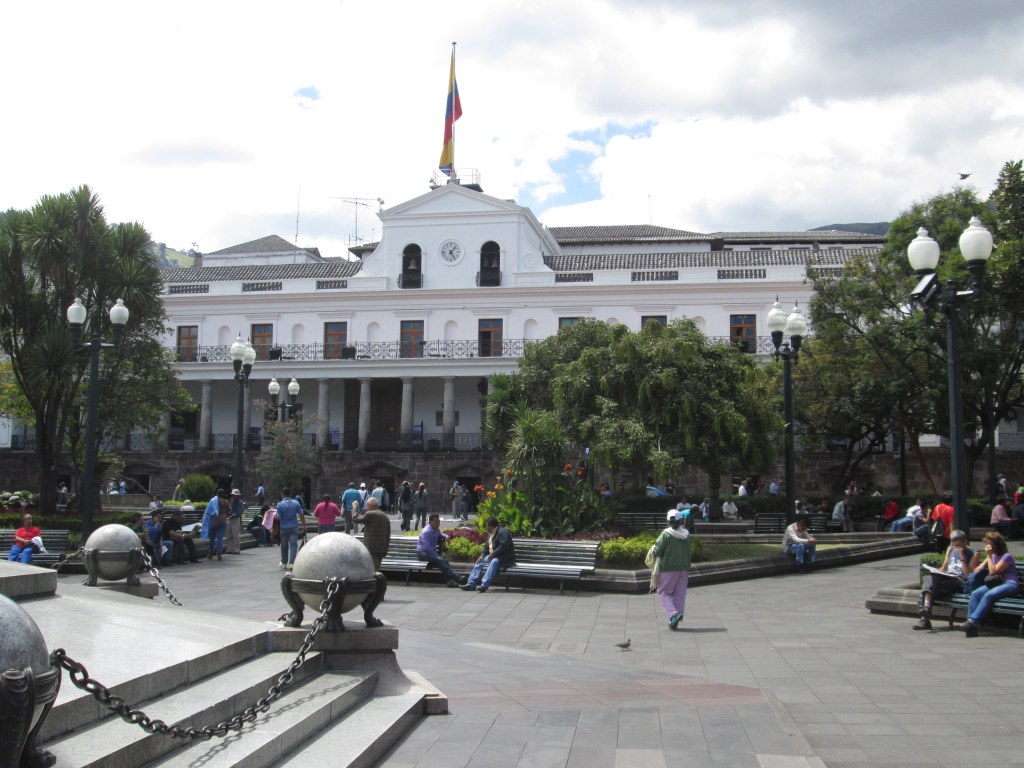
La Plaza Grande in Quito, Ecuador

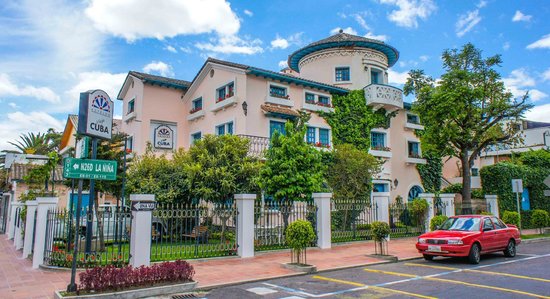
I returned from my last vacation in South America under a dark cloud. It was November 9, 2016. I had spent a sleepless night at the Viejo Cuba Hotel on La Niña in Mariscal watching the election returns on CNN. I could not believe my eyes. Twenty times I would shut off the television and try to drift off to sleep; and twenty times I sprang awake and turned it back on because I could not believe my eyes.

Despite my dislike for Hillary Clinton, I had gone to considerable trouble to vote for her before flying off to Ecuador. I had to drive all the way to Norwalk on the I-105 in a heinous traffic jam. And now I would have to return to the United States to see my country attempt to survive the next four years under a malicious buffoon.

I managed to compose myself enough to take a taxi to Mariscal Sucré International Airport and catch my return flight on Copa Airlines to Los Angeles via Panama City.

When I landed at LAX, though, I was conscious of being in a different country than the one I had left three weeks before. Quite suddenly, all kinds of disreputable figures emerged from their hidey-holes into the broad daylight. And now, even though the Lardfather is no longer president, I feel the ground has shifted beneath my feet. The look on my face is of a skeptical vigilance.

Nightmare in Quito

The Center of Quito, Ecuador

Roughly four years ago today, I had the worst night of my life. Curiously, I was on the last night of my vacation in Ecuador at the time. It was election night in the USA, and I made the mistake of tuning in on CNN for the voting coverage. Big mistake!

I could not believe my eyes that Trump was winning. Not that I liked Hillary Clinton, but I thought her opponent was—at best—a total buffoon. There I was at the Hotel Viejo Cuba in the relatively posh La Mariscal district, waking up every few minutes and compulsively turning on the television.

When I finally stumbled out of bed in the morning, I knew I had to get a cab to the airport—but I didn’t want to return to the United States! That night, I had lost faith in my fellow Americans. How could they do such a thing to themselves, acting against their own interests.

The Hotel Viejo Cuba in Quito

It is now 9:20 PM in Los Angeles, and I don’t have any idea how the final count will go. But I still distrust the American voter—even more, if that is possible. There are some Trump-voting states that I would never want to visit, such as West Virginia and North Dakota. And I feel somewhat queasy about some of the rural areas in California.

Whatever happens tonight, I am not the same person I was before the 2016 results came in.

An Incredible Richness

Altar in the Archbishop’s Palace in Lima, Peru

It was not until I visited Peru five years ago that I realized that the Inca were not the only game in town. In fact, I found the old Catholic churches with their ornate ornamentation was equally interesting. After all, the Inca had no written language and left no books until the Spanish taught them how to write. And yet the Catholic church in Peru was incredibly powerful. A visit to the great old churches of Lima led me to think that the Church in Peru was the recipient of as much gold and silver as the King of Spain.

In the south of Peru was San Luis Potosí, where there was an entire mountain of silver called to this day the Cerro Rico, the “Rich Hill.” The silver was sent to Lima, from where it was transshipped to Panama, where the conquistadores marched it across the isthmus to Colón, where it was loaded onto Spanish treasure ships and sent to Spain.

Altar at Lima’s Cathedral

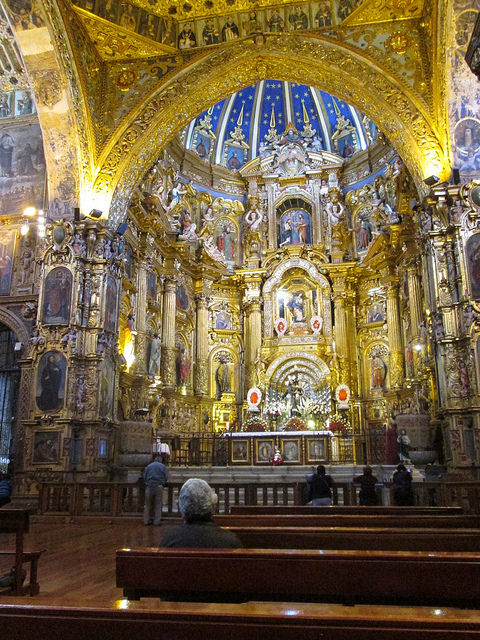
Of course, much of these Peruvian riches never made it to Spain, thanks to the ravages of pirates and storms at sea. Whatever was given to the church, however, went into the churches of Lima and the rest of the Hispano-America. I cannot count the number of times I would walk into a church and be struck by all the gold used in the altars and in gilding the statues and frames of the paintings on display. Look, for instance, at the picture below of the Company of Jesus Church in Quito, Ecuador:

PICQuitoCompanyOfJesus

The Main Altar of the Company of Jesus (Jesuit) Church in Quito, Ecuador

It was nice to see the Inca ruins, but the remnants of a once-triumphal Catholicism were far more impressive. Granted that the Inca were perhaps the world’s greatest stonemasons, but the Spanish civilization is far richer.

Flying in the Andes

Actually, It’s Anything But Tame

I have flown over the Andes on several airlines: LAN, Avianca, Star Peru, Copa, and TAME. Because we don’t often think about South America, we don’t realize that the Andes are every bit as high, in general, as the Himalayas. I say “in general” because our method of measuring altitude is in flux, largely because the ocean level is in flux due to global warming. If we measure a mountain’s altitude from a point at the center of the earth, the highest mountain on the planet is Chimborazo in Ecuador. That is due primarily to a bulge in the earth around the equator which in effect elevates mountains atop that bulge.

In the past, I used to be disturbed by air turbulence. Now, with all the vacations in South America, I see turbulence as a sign that I am nearing my destination. Virtually all flights from Los Angeles to Lima, Quito, Santiago, or Buenos Aires involve a diagonal path over a chunk of the Andes. This usually takes place in the middle of the night, so I don’t get a chance to see the snowcapped peaks over which we are flying.

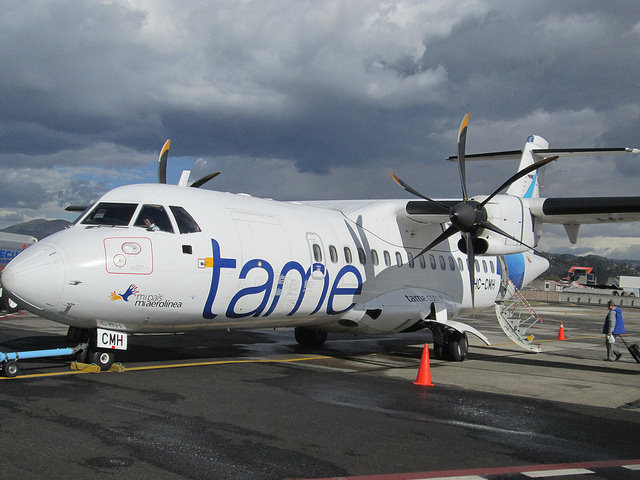
That plane in the picture was the plane I flew from Cuenca in the south of Ecuador to Quito. My brother had left a week or so earlier (also on a TAME prop plane), so we had returned the rental car to the Cuenca office of the rental company. I explored a bit on my own, taking a bus to Alausi to take a fascinating train ride; and I also visited a whole lot of museums in Cuenca. There are a zillion museums in Latin America, and most of them are fun even when there are no signs in English.

For my next trip to South America, I hope to fly to Bolivia and return via Buenos Aires. There’s a lot to see in between, even if I have to take a connecting flight part of the way.


Portrait of a Sucker

Scene in the Crafts Market, Otavalo, Ecuador

There is nothing quite like the crafts market of a Latin American city like Chichicastenano, Guatemala; Otavalo, Ecuador; or Cusco, Peru. One wonders down narrow ways awash with color and aglitter with native ingenuity. There are times when I felt bad for not buying far more handicrafts than I could reasonably be expected to carry—especially the textiles. What I do buy is usually small enough to fit into the single bag with which I travel.

I remember the first time I felt this way. I was in San Cristóbal de las Casas in Chiapas, Mexico. It was December 1979, and I was fascinated by the Highland Maya textiles. It was then that a little Chamula girl, no older than eight or nine, sold me a little doll in native costume that she had made herself (or so she said). As she was describing it in her Highland Mayan dialect of which I knew not a single word, and stroking it as if it were something rare and magical, my heart melted and I bought the doll. I still have it on one of my bookshelves, resting against the Latin American literature section.

At some point, I’ll take a picture of it so that you can all see what I sucker I am. I suppose it is better than being heartless.

What, Me, Getting Lost?

This Image Is Practically Engraved in My Memory

Apparently, I have this phobia of getting lost. When my brother and I were in Ecuador last October, we could not find any street atlases; though, it wouldn’t have done us any good if we had them, because outside the central tourist area of the cities, there were no street signs. Dan made fun of me for my meltdowns when we wandered off what maps we had. There mus have been an incident in my childhood when getting lost from my Mommy and Daddy terrified me. I wrote a blog about this entitled Where the Streets Have No Name.  (Sorry, Edge and Bono!)

Where this is all leading to is a dream I had last night. I was traveling alone in the City of London. Having been there five or six times and having expended fierce amounts of shoe leather each time, I have a good picture of the city permanently resident in my head. I was trying to find a bookstore near Charing Cross Road, but had no idea where I was. And, even more peculiar, there did not appear to be any Underground or Tube stations on the inadequate map I had.

I had had some sort of meeting and was wandering around the city with some of the participants. At one point, they decided to stop and have an impromptu cricket match, which fortunately did not last long. When they stopped, we kept wandering in an easterly direction, coming on a square with a large Catholic church and a troupe of nuns ministering to the need of a large bump encampment. I thought to myself, “Gee, I had no idea there were so many bums in London.”

In the end, the dream just came to a stop. (Did I wake up at that point?) Although I jnever got to my bookstore nor to any other recognizable monument or building, I was more perplexed than terrified.

Thi9s is not the first time I got lost in my dreams. In none of them did my reaction rise to nightmare levels, but it is an interesting recurring theme—sort of like having to give a public speech while buck naked.