Where Once Poe Walked

Edgar Allan Poe’s Cottage in the Bronx

There are times when H. P. Lovecraft’s poetry comes across as overripe. But when the subject is Edgar Allan Poe, it seems more appropriate.

Above is the cottage in the Bronx where Poe lived with his young wife Virginia Clemm (married at age 13 to the 27-year-old writer) in the Bronx. I remember visiting it with my mother sometime early in the 1960s.

Where Once Poe Walked

Eternal brood the shadows on this ground,
Dreaming of centuries that have gone before;
Great elms rise solemnly by slab and mound,
Arched high above a hidden world of yore.
Round all the scene a light of memory plays,
And dead leaves whisper of departed days,
Longing for sights and sounds that are no more.

Lonely and sad, a specter glides along
Aisles where of old his living footsteps fell;
No common glance discerns him, though his song
Peals down through time with a mysterious spell.
Only the few who sorcery’s secret know,
Espy amidst these tombs the shade of Poe.

By the way, notice that the initial letters in each line together spell out EDGAR ALLAN POE.

“Alone”

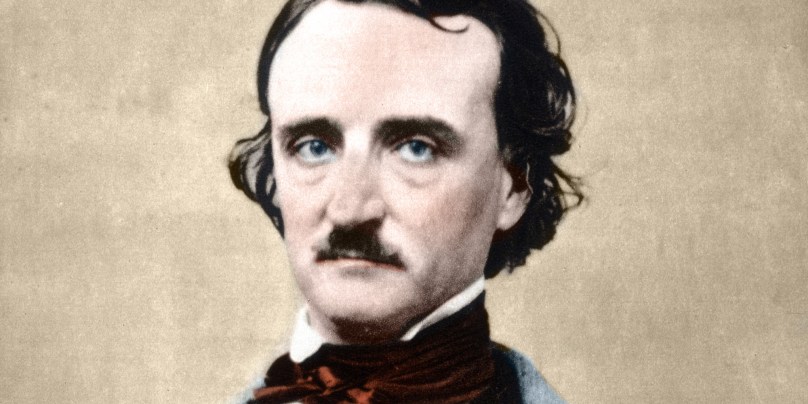
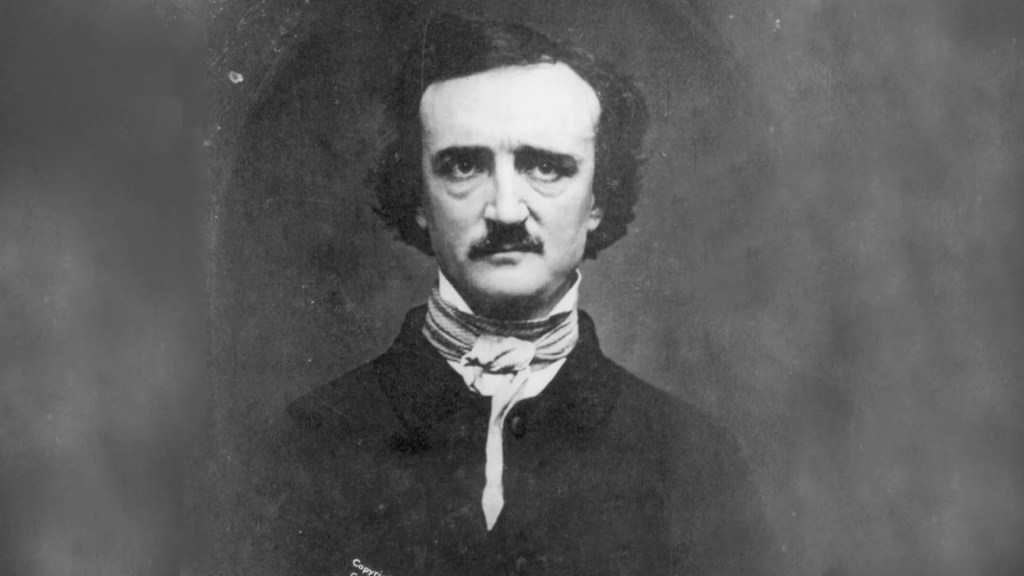
Edgar Allan Poe (1809-1849)

Here’s an early poem by Edgar Allan Poe:

Alone

From childhood’s hour I have not been
As others were—I have not seen
As others saw—I could not bring
My passions from a common spring—
From the same source I have not taken
My sorrow—I could not awaken
My heart to joy at the same tone—
And all I lov’d—I lov’d alone—
Then—in my childhood—in the dawn
Of a most stormy life—was drawn
From ev’ry depth of good and ill
The mystery which binds me still—
From the torrent, or the fountain—
From the red cliff of the mountain—
From the sun that ’round me roll’d
In its autumn tint of gold—
From the lightning in the sky
As it pass’d me flying by—
From the thunder, and the storm—
And the cloud that took the form
(When the rest of Heaven was blue)
Of a demon in my view—

Notorious

Edgar Allan Poe (1809-1849)

As part of my Halloween reading, I am reading Penguin Books’ The Portable Edgar Allan Poe. After having read numerous popular editions of Poe, I decided to concentrate on an edition that took him seriously as one of the greatest literary figures of the young Republic.

There is little doubt in my mind that Poe is a genius. At the same time, there is little doubt in my mind that Poe was anything but warm and fuzzy as a person. He admitted as much in his story “MS. Found in a Bottle” (1832): “Of my country and of my family I have little to say. Ill usage and length of years have driven me from the one, and estranged me from the other.”

Later in the same paragraph:

I have often been reproached with the aridity of my genius; a deficiency of imagination has been imputed to me as a crime; and the Pyrrhonism of my opinions has at all times rendered me notorious.

Looking back at Poe’s life, one can see him constantly produce brilliant stories and poems, yet struggle to earn a living or find happiness in marriage or family. He was orphaned at the age of two and had a tempestuous relationship with his stepfather John Allan, whose last name he adopted as his middle name.

Over and over again, we find that the characters in life died young of consumption. Poe did not react well: He took to the bottle. In fact, he died of alcohol poisoning at the age of forty, though the newspapers of the time blamed “congestion of the brain” or “cerebral inflammation.”

It requires some extra discipline for me to forget Poe’s unhappy life and concentrate on his works. Let’s face it: some very unhappy people have created works of such vivid imagination that made him ever so much more than the lunatic that critic Rufus Wilmot Griswold described as walking “the streets, in madness or melancholy, with lips moving in indistinct curses, or with eyes upturned in passionate prayers, (never for himself, for he felt, or professed to feel, that he was already damned).”

Poe’s life is a closed book, but his works will live on forever.

A Dream Within a Dream

Edgar Allan Poe (1809-1849)

I think we underestimate the poems of Edgar Allan Poe. Here’s one of his best, on the subject of life being but a dream. “Deceptively simple?” you might ask. Perhaps, but that is their strength.

A Dream Within a Dream

Take this kiss upon the brow!
And, in parting from you now,
Thus much let me avow —
You are not wrong, who deem
That my days have been a dream;
Yet if hope has flown away
In a night, or in a day,
In a vision, or in none,
Is it therefore the less gone
All that we see or seem
Is but a dream within a dream.

I stand amid the roar
Of a surf-tormented shore,
And I hold within my hand
Grains of the golden sand —
How few! yet how they creep
Through my fingers to the deep,
While I weep — while I weep!
O God! Can I not grasp
Them with a tighter clasp?
O God! can I not save
One from the pitiless wave?
Is all that we see or seem
But a dream within a dream?

El Dorado

Edgar Allan Poe (1809-1849)

I am currently in the middle of the riches of Van Wyck Brooks’s The Times of Melville and Whitman (published 1947), devouring each chapter slowly, mining it for information on obscure 19th century American authors. I am even paying close attention to all the footnotes, in which I found this excerpt of a letter from Edgar Allan Poe to F. W. Thomas written on February 14, 1849. The subject was why Poe wasn’t interested in joining the Gold Rush:

Talking of gold and temptations at present held out to ‘poor-devil authors,’ did it ever strike you that all that is really valuable to a man of letters—to a poet in especial—is absolutely unpurchasable? Love, fame, the dominion of intellect, the consciousness of power, the thrilling sense of beauty, the free air of heaven, exercise of body and mind, with the physical and moral health which result—these and such as these are really all that a poet cares for—then answer me this—why should he go to California?

In fact, Poe wrote a poem on the subject:

Eldorado

Gaily bedight,
A gallant knight,
In sunshine and in shadow,
Had journeyed long,
Singing a song,
In search of Eldorado.

But he grew old—
This knight so bold—
And o’er his heart a shadow
Fell as he found
No spot of ground
That looked like Eldorado.

And, as his strength
Failed him at length,
He met a pilgrim shadow—
“Shadow,” said he,
“Where can it be—
This land of Eldorado?”

“Over the Mountains
Of the Moon,
Down the Valley of the Shadow,
Ride, boldly ride,”
The shade replied—
“If you seek for Eldorado!”

If the poem sounds vaguely familiar, it was quoted in its entirety in a Howard Hawks Western made in 1967 called, suitably enough, El Dorado. The film starred John Wayne, James Caan, and Robert Mitchum.

Poe-Pourri

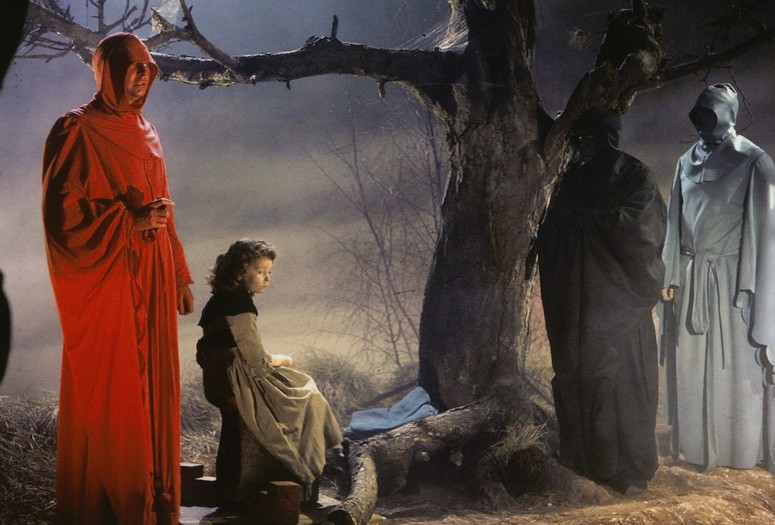
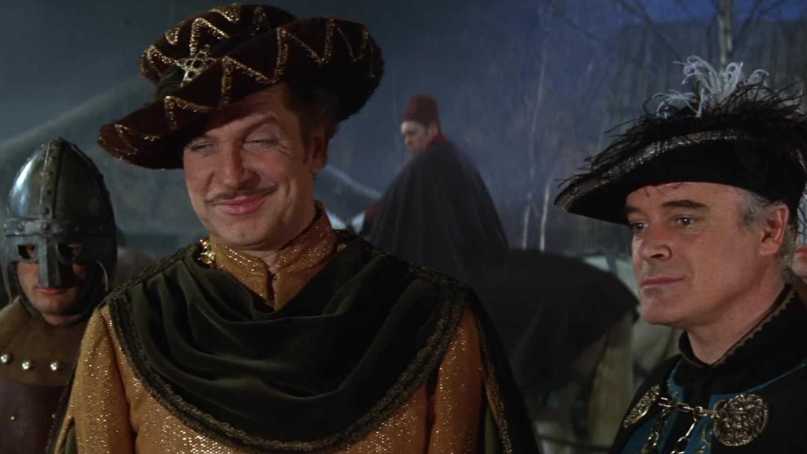
Scene from Roger Corman’s Masque of the Red Death (1964)

One of the most entertaining film series of the 1960s consists of the eight Edgar Allan Poe titles directed by Roger Corman and, for the most part, starring Vincent Price. In order by year, these consist of:

  • The House of Usher (1960)
  • The Pit and the Pendulum (1961)
  • The Premature Burial (1962) starring Ray Milland
  • Tales of Terror (1962)
  • The Raven (1963)
  • The Haunted Palace (1963) actually based on H. P. Lovecraft
  • The Masque of the Red Death (1964)
  • The Tomb of Ligeia (1964)

All the films are very loosely based on Poe originals (except for The Haunted Pa;lace, which is very Poe-like). Last Wednesday, I sat through The Pit and the Pendulum, The Raven, and Masque of the Red Death on Turner Classic Movies’ tribute to Roger Corman, who died earlier this year.

Although some regard him as the ultimate schlockmeister, Corman knew how to make an entertaining film that came in on time and under budget. So what if they were not quite faithful to Poe’s (or Lovecraft’s) originals: They were fun to watch, even if we felt superior to them.

I remember some other likeable Corman classics like Attack of the Crab Monsters (1957), in which the eponymous monsters looked like a crumpled old knapsack, and Creature from the Haunted Sea (1961), in which the creature looked like an overgrown stuffed animal. The first named film is one of Martine’s all-time faves, such that she obtained a signed still from Beverly Garland, the star.

And yet at least two of the titles—The Raven and Masque of the Red Death—are, to my mind, two of the best American films produced in the 1960s.

El Dorado

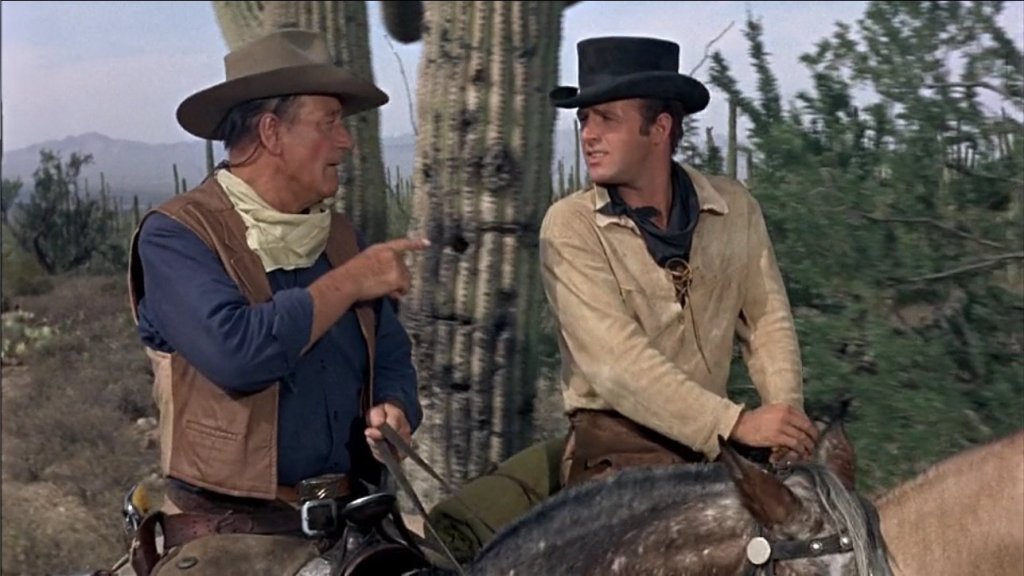
John Wayne and James Caan in Howard Hawks’s El Dorado

Today’s poem was actually a part of one of my favorite Westerns: Howard Hawks’s El Dorado (1966), which is a remake of the same director’s Rio Bravo (1959) starring the same actor, John Wayne. The lines are spoken by James Caan, in his first major role. Edgar Allan Poe, who wrote it, spelled it as one word: Eldorado—and that’s the name he gave to the poem.

Unlike Poe’s knight, I have found El Dorado to be in many places: Iceland, Scotland, Mexico, the Andes in South America, and even—appropriately—parts of the American Southwest.

Eldorado

Gaily bedight, 
A gallant knight,
In sunshine and in shadow,
Had journeyed long, 
Singing a song,
In search of Eldorado. 

But he grew old – 
This knight so bold – 
And o’er his heart a shadow 
Fell, as he found 
No spot of ground 
That looked like Eldorado. 

And, as his strength 
Failed him at length, 
He met a pilgrim shadow – 
‘Shadow,’ said he, 
‘Where can it be – 
This land of Eldorado?‘

‘Over the Mountains 
Of the Moon,
Down the Valley of the Shadow, 
Ride, boldly ride,‘
The shade replied, 
‘If you seek for Eldorado!’

House of Horrors

Mummified Corpses in Guanajuato’s Museo de las Momias

In this month of Halloween, I thought I would make mention of the most horrific museum I have ever visited, the Museo de las Momias (that is, Mummies) de Guanajuato.

Imagine to yourself a museum consisting of corpses dug up in a Mexican mining town that have been naturally mummified because of the mineral content of the soil. Many were interred during a cholera epidemic which filled the local cemetery to such an extent that the town had to charge a fee for the right to remain buried. According to Wikipedia:

The human bodies appear to have been disinterred between 1870 and 1958. During that time, a local tax was in place requiring a fee to be paid for “perpetual” burial. Some bodies for which the tax was not paid were disinterred, and some—apparently those in the best condition—were stored in a nearby building. The climate of Guanajuato provides an environment which can lead to a type of natural mummification, although scientific studies later revealed that some bodies had been at least partially embalmed. By the 1900s the mummies began attracting tourists. Cemetery workers began charging people a few pesos to enter the building where bones and mummies were stored.

When I visited Guanajuato in the late 1980s, my introduction to the museum was itself grim: A young father was carrying a child’s coffin on his shoulders to be buried, with no one else in the family following him.

Shades of Edgar Allan Poe: The Wikipedia entry continues with this grim fact:

One of the mummies who was buried alive was Ignacia Aguilar. She suffered from a strange sickness that made her heart appear to stop on several occasions. During one of these incidents, her heart appeared to stop for more than a day. Thinking she had died, her relatives decided to bury her. When her body was disinterred, it was noticed that she was facing down, biting her arm, and that there was a lot of blood in her mouth.

The only way I kept the contents of my stomach under control while I was in the museum was the extent to which I busied myself taking pictures. None of these are in this post, as they have yet to be converted to JPEG files from the Kodachrome slides I was then shooting.

Even a writer like Ray Bradbury had trouble seeing the displays of mummies in the museum:

The experience so wounded and terrified me, I could hardly wait to flee Mexico. I had nightmares about dying and having to remain in the halls of the dead with those propped and wired bodies. In order to purge my terror, instantly, I wrote ‘The Next in Line.’ One of the few times that an experience yielded results almost on the spot.

A Movie for 2020

Vincent Price as Prince Prospero and Patrick Magee as Alfredo

As we approach Halloween, I propose a 1964 film by Roger Corman as the perfect paradigm for our year of coronavirus and Trump—namely, The Masque of the Red Death.

The story concerns a gathering of wealthy friends (let’s call them billionaires) of Prince Prospero at his castle while the Red Death plague rages through the land. It is my favorite Roger Corman film, with elegant color photography by Nicholas Roeg.

Unfortunately, the character of Vincent Price’s Prospero, nasty as he may be, is played by too interesting an actor to be a stand-in for Donald J. Trump—though he wealthy guests are perfect. One can imagine the My Pillow Guy and the founder of Goya Foods at this party.

You might also want to read the Edgar Allan Poe story from which the film is drawn. You can find it here.

Death Is Stalking the Land in Masque of the Red Death

In the end, Prince Prospero and all his guests come down with the Red Death, which they had so studiously tried to avoid. And curiously, the character is plays the personification of the deathly plague is, once again, Vincent Price.

“Perhaps the Most Interesting Book of Travel Ever Published”

Edgar Allan Poe (1809-1849)

As soon as I saw that one of the fans of travel writer John Lloyd Stephens was none other than Edgar Allan Poe, I was intrigued. Although I have the lengthy Library of America collection of Poe’s Essays and Reviews, I could not find any mention of Incidents of Travel in Central America, Chiapas and Yucatán among the reviews, I did find this intriguing note on the Internet. It is from an 1841 issue of Graham’s Magazine:

We are not prepared to say that misunderstandings of this character will be found in the present “Incidents of Travel.” Of Central America and her antiquities Mr. Stephens may know, and no doubt does know, as much as the most learned antiquarian. Here all is darkness. We have not yet received from the Messieurs Harper a copy of the book, and can only speak of its merits from general report and from the cursory perusal which has been afforded us by the politeness of a friend. The work is certainly a magnificent one — perhaps the most interesting book of travel ever published. An idea has gone abroad that the narrative is confined to descriptions and drawings of Palenque; but this is very far from the case. Mr. S. explored no less than six ruined cities. The “incidents,” moreover, are numerous and highly amusing. The traveller visited these regions at a momentous time, during the civil war, in which Carrera and Morazan were participants. He encountered many dangers, and his hair-breadth escapes are particularly exciting.

I find it interesting that Poe committed himself so far without actually having a copy of the book in hand. Perhaps he saw the proofs or an advanced copy, as he hints above. I will continue to search to see whether Poe actually did write a more comprehensive review of the book.