Why We Fight

How the Axis Powers Planned to Divide the Spoils

In my senior year in college, the frontal headaches from my pituitary tumor (which I didn’t know I had) typically lasted twelve hours, usually noon to midnight. It was at midnight that I would begin to do my homework assignments. Naturally, as an upperclassman I stayed away from classes that began before noon.

The headaches didn’t come every day, usually every other day on the average.So, half the time, I took my classes with the tumor pressing on my optic nerve. I had complained about it at the student infirmary several times, but my real pain was pooh-poohed by the doctors and nurses—which left me thinking I was a terrible wuss.

Around that time, I hung around at Fairbanks Hall, headquarters of Dartmouth Films, which acted as an audio-visual service for the college, and which ran the Dartmouth Film Society, of which I was second in command. In the evenings, I would check out what 16mm film prints had been ordered for various classes and, if the titles interested me, I would screen them for myself.

This is how I watched the “Why We Fight” series of U.S. World War 2 propaganda films, which were produced under the supervision of the man who directed It’s a Wonderful Life, namely Frank Capra, who served as a Major in the Army Signal Corps. Capra served directly under General George C. Marshall in directing or supervising these films. They consisted of:

  • “Prelude to War” (1942)
  • “The Nazis Strike” (1943)
  • “Divide and Conquer” (1943)
  • “The Battle of Britain” (1943)
  • “The Battle of Russia” (1943)
  • “The Battle of China” (1944)
  • “War Comes to America” (1944)

Not part of the series, but viewed by me around the same time, was “Know Your Enemy: Japan” (1945), which was embarrassingly racist.

Other films I remember from this period are two French musicals directed by René Clair (Sous les toits de Paris and Le million, made in 1930 and 1931 respectively). Then there was a French documentary directed by Nelly Kaplan entitled Abel Gance, hier et demain (1963). Once I got to Los Angeles, I made every effort to see as many of Gance’s films as I could. His silent biopic Napoléon (1927) is one of the greatest films ever made.

When I wasn’t screening films for myself, I would chat with my friend Peter Jensen, who was using Dartmouth Films’ Movieola to edit a film he had made based on a Chekhov short story.

Dartmouth Films had a major impact on my life.
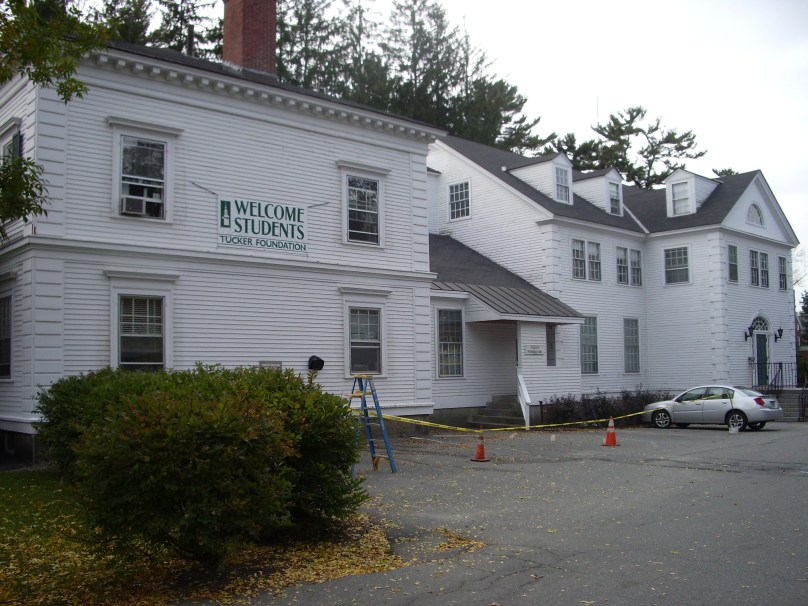
Fairbanks Hall

Fairbanks Hall As It Is Today

In the picture above, the left half of the building shown was added some time after I graduated from Dartmouth College in 1966. To see the Fairbanks Hall that I knew and loved, put your hand over the left half of the picture.

When I was a freshman at Dartmouth, I paid a visit to Fairbanks Hall in its old location just north of Baker Library. I heard that Dartmouth Films, which occupied the building, was showing free films. One day, I wondered into the small auditorium and saw Carl Theodor Dreyer’s 1943 masterpiece Day of Wrath (Vredens Dag) about witchcraft in the 17th century. The Danish film electrified me. I had seen a handful of foreign films back in Cleveland, but nothing this good.

That year, the Hopkins Center for the Arts had its grand opening, and the Dartmouth Film Society was able to screen films in the center’s large and fancy auditorium. At the time, I was planning on being an English major; but suddenly new possibilities opened up. The Film Society inaugurated the Hopkins Center auditorium with the world premier of John Huston’s Freud.

In my sophomore year, the college lifted Fairbanks Hall from its north campus location and plunked it down in the middle of the parking lot between Massachusetts Hall and the Hanover, New Hampshire cemetery. I started hanging out there, having long conversations with Blair Watson, who headed up Dartmouth Films, and David Stewart Hull, his assistant.

By my junior year, I was an active member of the Dartmouth Film Society; and the next year, I was its assistant director. By that time, my pituitary tumor was causing intense pain, usually in the form of frontal headaches which started just before noon and (for some reason) ended around midnight. In between those hours, I figured I could screen films for myself on the 16mm projector. I dropped in daily to see what films had been received for screening in classes around campus and threaded the projector if any of them looked interesting. There was a small screening booth I could use for the purpose.

Among the highlights of the films I saw that year were the Frank Capra Why We Fight films made to show Americans why we were fighting in the Second World War; Nelly Kaplan’s great documentary about the films of Abel Gance; René Clair’s French musicals Sous les toits de Paris and Le million; and a whole host of other highly miscellaneous films.

While in Fairbanks, I usually ran into my friend Peter, who was busy editing one of the films he had shot. Today, he lives some twenty-five miles south of me.

Fairbanks Hall had a major influence on my choice of graduate school. I had received a citation for excellence in a class on film history; and I decided to apply to the UCLA film school for an advanced degree in motion picture history and criticism.