Another Day, Another Nationality

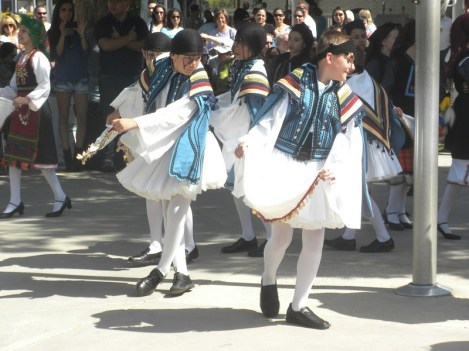
Costumed Children Waiting to Dance

Yesterday was Scottish, today was Greek. Every Memorial Day weekend, Saint Nicholas Greek Orthodox Church in North Hills puts on a three-day Greek festival with food, dancing, and vendors. It is one of three Southern California Greek festivals that Martine and I attend. For Martine, the main attraction is spanakopita, Greek spinach and cheese pie, the baked goods redolent of honey and nuts, and he beautifully decorated church.

My preference is to see the children dancing. As they go through their steps, members of their family step forward and shower the dancers with one-dollar bills, which are picked up after the performance. And, although I was raised as a Roman Catholic, I have always had a warm spot in my heart for the Greek Church.

I sometimes wonder what will happen in the years to come as the younger generation grows more detached from the values of their parents. Many of the older parishioners still speak to one another in demotic Greek, while the children are just American kids trying to make their own way in the world. When the girls in the above picture grow up, will the old ways matter to their own children? What about the Greek language? the cuisine? even the religion?

Are we seeing the last florescence of children trying to adhere to their parents’ folkways? Perhaps not. Trumpf to the contrary, America is still seeing waves of immigrants, mostly from Asia and Latin America. As a Hungarian, I am closer to the European ethnic ways; though the Central Americans and Koreans and Persians also have a lot to offer.

The Dance Goes On

Little Girls in Greek Costumes

Little Girls in Greek Costume

Yesterday afternoon, Martine and i went to the Valley Greek Festival at St. Nicholas in North Hills. It was a cool overcast day, but people came from all over the Valley to party. Unfortunately, there were some signs of increased organization and decreased quality, especially in the food service area. But it’s still fun, what with all the music and Greek dancing. (No, I didn’t dance: I was not born with the ability to move in time to music without causing pain to my dancing partners’ feet.)

We took our usual tour of the church. Greek Orthodox churches can be pretty spectacular, and St. Nicholas is one of them. In case you were wondering, yes, it’s Saint Nick, Santa Claus, after whom the church is named. For some reason, this year there was no Question and Answer session with one of the parish priests, which I rather miss. Although I was raised a Catholic, I have a lingering admiration for Orthodoxy.

Doctrinally, the major difference between Catholicism and Orthodoxy is a single word—filioque—in the Nicene Creed. Also, their priests can be married; whereas Roman Catholic clergy must remain celibate. Curiously, there are several different rites of he Catholic Church, under Papal jurisdiction, in which marriage is also permitted.


Don’t Let the “Ballet Skirts” Fool You

Boys from St. Nicholas Greek Orthodox Church in Macedonian Costume

Boys from St. Nicholas Greek Orthodox Church in Macedonian Costume

Here’s another photo from the Valley Greek Festival in Northridge that Martine and I attended yesterday.

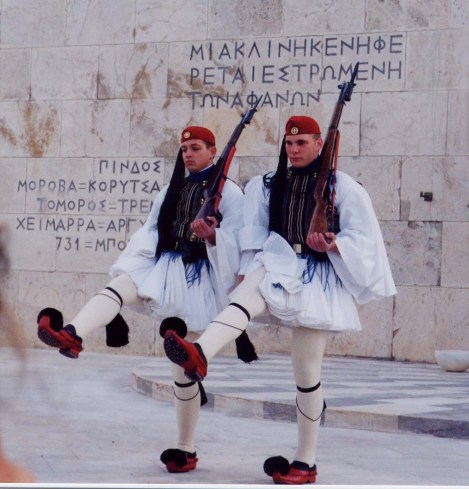
It has always seemed strange to me that the Greeks favored starched white skirts for their male dancers and soldiers. It certainly does not imply any lack of masculinity on their part. As a wartime correspondent, Ernest Hemingway was with the Greek forces invading Turkey in the aftermath of World War One. It was the first time, he wrote, that he had seen “dead men wearing white ballet skirts and upturned shoes with pompoms on them.” Below is a photo of Greek Evzone soldiers on guard duty:

Greek Evzone Troops

Greek Evzone Troops

Don’t let the “ballet skirts” fool you. Although it has not always been well led, the Greek Evzones have always been a formidable fighting force.


The Dance Goes On

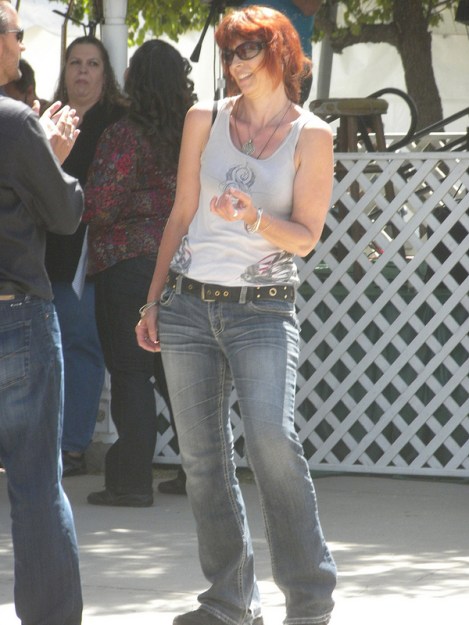
Dancing Aphrodite

Dancing Aphrodite

Today was the Valley Greek Festival in Northridge. Martine and I went to St. Nicholas Greek Orthodox Church at Balboa & Plummer and sampled some of the Greek cuisine (very limited in my case, but still most excellent). Also, I watched some of the folk dancing to the live band—I think its name was Olympia.

The young lady in the photograph above seems to be at all the local Greek festivals. It is a joy to watch her dance: Her moves are incredible. Over the years I have been attending these festivals, perhaps as many as eight or ten years, I have nicknamed her Aphrodite. Never having spoken to her, I do not know her real name; but she is poetry in motion, a regular Terpsichore.

We also took the tour of the church for the umpteenth time. There is something about the Orthodox church that appeals to me. If I were to become an active Christian, I might well switch my allegiance from the Church of Rome to the Church of Hellas. (For one thing, the whole child molestation epidemic among the Catholic clergy has repulsed me, even though I know that only a minority of the priests are guilty.)

The next big Greek festival in the area is in Torrance the weekend after I get back from Iceland in July., followed by the L.A. Greek Fest at Saint Sophia Cathedral in downtown Los Angeles early in September. The dance goes on …