No Skin in the Game

UCLA Students Protesting Israel’s Actions in Gaza

What with all the campus protests of Israel’s attacks on the Palestinians of Gaza, I am reminded of Hamlet watching the murderous King Claudius tear up at ancient Greek tragedy:

What’s Hecuba to him or he to Hecuba
That he should weep for her? What would he do
Had he the motive and the cue for passion
That I have? He would drown the stage with tears
And cleave the general ear with horrid speech,
Make mad the guilty and appall the free,
Confound the ignorant, and amaze indeed
The very faculties of eyes and ears. Yet I,
A dull and muddy-mettled rascal, peak
Like John-a-dreams, unpregnant of my cause,
And can say nothing—no, not for a king,
Upon whose property and most dear life
A damned defeat was made. Am I a coward?
Who calls me “villain”? Breaks my pate across?
Plucks off my beard and blows it in my face?
Tweaks me by the nose? Gives me the lie i’ th’ throat
As deep as to the lungs? Who does me this?

I am somewhat amused by all the campus protests. It’s not at all like the anti-Vietnam War protests of the 1960s, because American college students, for the most part, have nothing to gain or lose by doing so. In all likelihood, they will not be drafted and shipped off to Rafah to confront the Israeli Defense Forces in Gaza.

No doubt, Bibi Netanyahu is a villain, as are the West Bank settlers depriving the Palestinians of their land. But then, there’s plenty of villainy to spread around, when one considers the horrors of Hamas’s October 7 attack on innocent Israeli citizens.

Have there been any campus protests on behalf of the Rohingya? the Chechens? the Ukrainians? Granted, the United States supplies Israel with arms, but we are not participating in or even encouraging what looks like genocide to me. It does not look to me as if the protesting students had any skin in the game.

Perhaps the protests erupted because it’s spring, and “dull and muddy-mettled rascals” like to kick up a row from time to time.

The Revenger’s Tragedy

Illustration from Thomas Kyd’s Play The Spanish Tragedy (1587)

I have just re-read William Shakespeare’s Hamlet in honor of the Bard’s 455th birthday. Although it has been several decades since my last approach to the play, I was surprised how familiar the language was. Apparently, over the years such expressions as “the dead vast and middle of the night” and “I am but mad north-north-west—when the wind is southerly I know a hawk from a handsaw” have become part of my speech and writing.

This time, however, a new thought struck: The play is not just about Hamlet’s dilatoriness in revenging the death of his father by his uncle (who thereupon married his mother, the queen). It is also about the difficulty of straightforward revenge. And that despite the fact that revenge plays were a popular genre. Even Shakespeare, early in his career, came out with Titus Andronicus (ca 1590), in which there is rape, murder, cannibalism, and oodles of blood. Then, in 1606 came Thomas Middleton’s The Revenger’s Tragedy.

In Hamlet, however, Shakespeare shows that the road to revenge can be rocky. The last scene in Act V begins with the Prince telling his friend Horatio:

Sir, in my heart there was a kind of fighting
That would not let me sleep. Methought I lay
Worse than the mutinies in the bilboes. Rashly,
And prais’d be rashness for it,—let us know,
Our indiscretion sometime serves us well,
When our deep plots do pall; and that should teach us
There’s a divinity that shapes our ends,
Rough-hew them how we will.

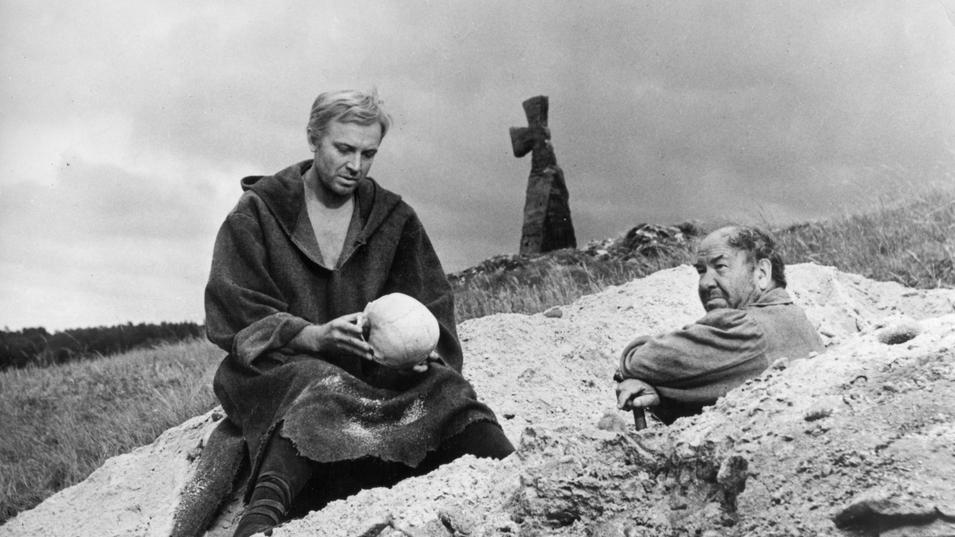
The Graveyard Scene from Grigory Kozintsev’s Russian Film of Hamlet (1964)

This realization on Hamlet’s part after his many hesitations earlier on shows that he has learned a lesson from all his agonizing:

HORATIO.
If your mind dislike anything, obey it. I will forestall their repair hither, and say you are not fit.

HAMLET.
Not a whit, we defy augury. There’s a special providence in the fall of a sparrow. If it be now, ’tis not to come; if it be not to come, it will be now; if it be not now, yet it will come. The readiness is all. Since no man has aught of what he leaves, what is’t to leave betimes?

I wonder how many discoveries await me on re-reading Shakespeare’s plays. I think perhaps it’s worth the effort to make the effort.


His 455th Birthday

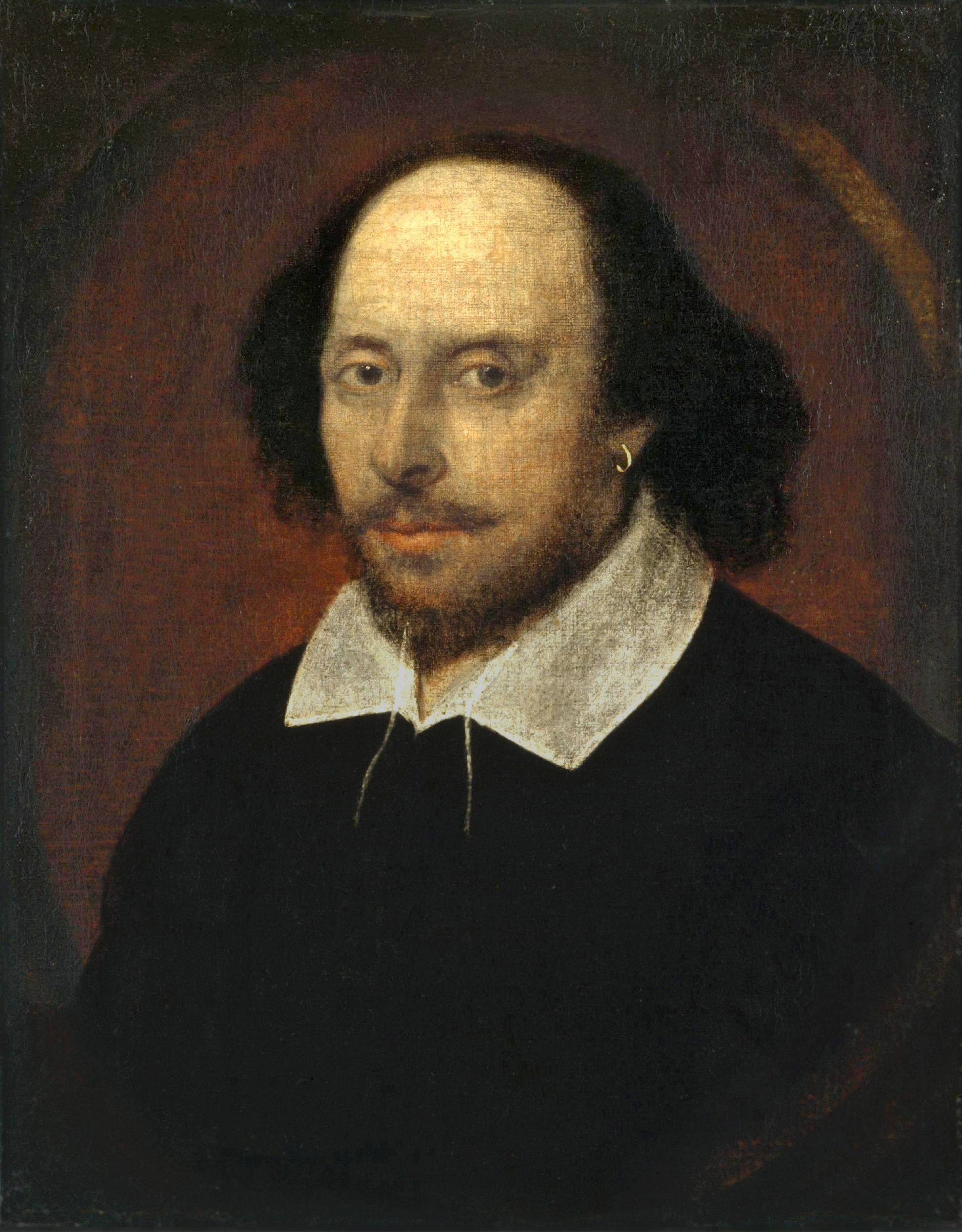
Portrait of William Shakespeare (1564-1616)

Today is the 455th anniversary of the birth of dramatist William Shakespeare. To honor his birthday, I picked up my old Penguin edition of Hamlet and started to re-read it for the nth time. It has been a couple of decades since my last reading. I was shocked to the extent that the Bard’s language had become so familiar to me that I almost regarded it as my own. From Act I alone, I had adopted into my own language such expressions as:

Before my God, I might not this believe
Without the sensible and true avouch
Of mine own eyes. (I,i,56-58)

A little more than kin, and less than kind! (I,ii,65)

’A was a ma, take him for all in all,
I shall not look upon his like again. (I,ii,187-188)

In the dead waste and middle of the night. II,ii,198)

I do not set my life at a pin’s fee (I,iv,65)

Something is rotten in the state of Denmark. (I,iv,90)

There are more things in heaven and earth, Horatio,
Than are dreamt of in your philosophy. (I,v,166-167)

The time is out of joint. O cursèd spite
That ever was I born to set it right! (I,v,188-189)

If these short quotes are familiar to you, it is because they have become a part of our language. Shakespeare actually changed the way we think about things. Within the next day or so, I want to write about how Hamlet changed forever the straightforward revenge tragedy that was such a part of Elizabethan and Jacobean dramaturgy.