Post-Production Blues: Major Dundee

Scene from Major Dundee (1965)

Hollywood is full of stories of battles between the director and the producers. One of the most tragic occurred between Sam Peckinpah and the money men behind Major Dundee. It was only Peckinpah’s third outing as a director of feature films, and he was given a budget of $4.5 million to shoot the film in Mexico. The original director’s cut came in at 4 hours and 38 minutes, and several million dollars over budget. Producer Jerry Bresler promptly denied the director any decision in the post-production process.

He had the film edited down to 123 minutes, which was the version I originally saw at a downtown L.A. theater around 1970. Today, I watched a 136 minute version, which calls itself “The Extended Version,” though is still a bit rough around the edges.

Director Sam Peckinpah

It is a pity that men of no artistic ability like Bresler have such an ability to mar a major work of art. Even with all its jagged edges, Major Dundee is a captivating film. Set in the final years of the Civil War, it tells of a Union officer (Charlton Heston) stationed to New Mexico Territory putting together a unit to revenge a massacre of men, women, and children by Apaches led by one Sierra Chariba. With few regulars on hand at Fort Benlin, he recruits a squad of black Buffalo Soldiers, a few cowboys and outlaws and the usual reprobates, and a group of Confederate prisoners led by Captain Benjamin Tyreen (Richard Harris). When the Apaches cross the Rio Grande into Mexico, Dundee and his men follow them and come into conflict with French troops which then controlled Mexico under the Emperor Maximilian.

Peckinpah always had a special feeling for Mexico. During the shooting of Major Dundee, he fell in love with one of his actresses, Begoña Palacios, and married her. Shown below is a Mexican fan magazine of the period with her picture on the cover.

Begoña Palacios

I will never forget when I saw the rough cut of Peckinpah’s The Wild Bunch (1969) at Warner Brothers Studios. There was a scene of Bill Holden and his men leaving a Mexican village that seemed to go forever. There is a similar scene in Major Dundee, where Charlton Heston captures a small French garrison and finds that the villages does not have enough food to survive. He immediately orders that two of his mules be butchered. There is a long fiesta scene. When Heston and his men leave, the whole village comes out to see him off.

I rather like the special feeling that the director had for Mexico. It gives his films set there a certain glow. It is a pity that Peckinpah died at the age of 59 in 1984. He had indulged in booze and drugs, and they greatly weakened him at a time when he still had a lot to give as one of the greatest artists in the genre of the American Western.
 

Peg Entwistle and the Hollywood Sign

Scene of Many Hollywood Legends

Scene of Many Hollywood Legends

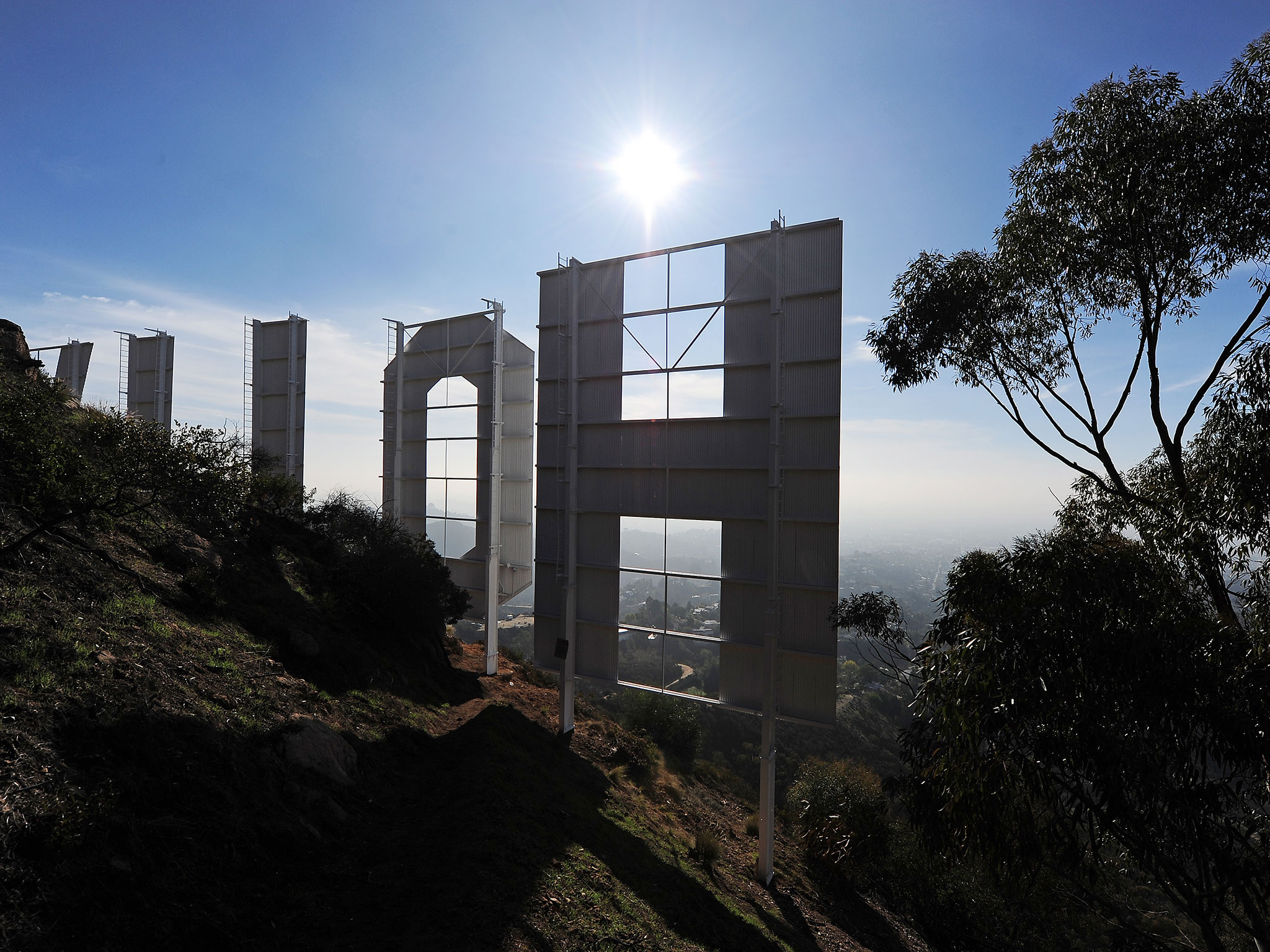
It stands near the top of Mount Lee in the Hollywood Hills. Originally, the sign read “Hollywoodland”—erected using telephone poles and tin to advertise the housing development below. Eventually, the sign was shortened to “Hollywood” and came to signify something altogether different.

I first heard about the story from Dory Previn, who wrote a song called “Mary C. Brown and the Hollywood Sign” way back in the 1970s. You can hear her singing it in this YouTube video.  It is about a movie starlet who grew disenchanted with the dream factory ending her life by jumping off the letter “H” of the Hollywood sign and dying on the slope below of multiple fractures of the pelvis. She died on September 18, 1932.

It really happened, but not to Mary C. Brown. I guess Millicent Lilian “Peg” Entwistle doesn’t scan as well in a song lyric. Peg was a cute blonde Welsh actress with blue eyes. While acting on the stage in New York, she married Robert Keith in 1927. For a short time, she was the stepmother of the man who grew up to be actor Brian Keith.

By coincidence, Brian Keith also committed suicide.

Starlet Peg Entwistle

Starlet Peg Entwistle

During her time in Hollywood, Peg acted in only one film that was ever released: Thirteen Women (1932). I would like to be able to say that it was a success, but it wasn’t, even though it starred Myrna Loy and Irene Dunne.


Walk Like an Egyptian

Part of the Painted Facade of Grauman’s Egyptian Theater in Hollywood

Part of the Painted Facade of Grauman’s Egyptian Theater in Hollywood

If it’s Labor Day weekend, it’s also time for the 52nd Annual Cinecon Classic Film Festival. So Martine and I invaded Hollywood, parked our chariot at Loew’s Hollywood Hotel, and proceeded to view several newly restored films at Grauman’s Egyptian Theater. These included:

  • An episode of a hokey old serial called Jungle Mystery.
  • Three Laurel & Hardy rareties, including Berth Marks and Come Clean.
  • A silent comedy called More Pay—Less Work from 1926.
  • A Columbia film released during World War Two which uniquely accuses the Nazis of atrocities against the Jews: None Shall Escape (1944) starring a radiant Marsha Hunt and directed by Andre de Toth.

Cinecon has thinned out a bit since last year. President Robert S. Birchard, having served in that capacity since 1998, died of a heart attack in May. Many such as my late friends Norman Witty and Lee Sanders had also passed on. Every year, there are more canes and more geriatric ailments in evidence. The pity of it is that Cinecon has difficulties recruiting younger members, who would consider the restored 1920s and 1930s films as ancient history. The organization would have to move more into the 1950s-1970s to get the attention of Generation Xers, not to mention Millennials.

The Hollywood Walk of Fame

The Hollywood Walk of Fame

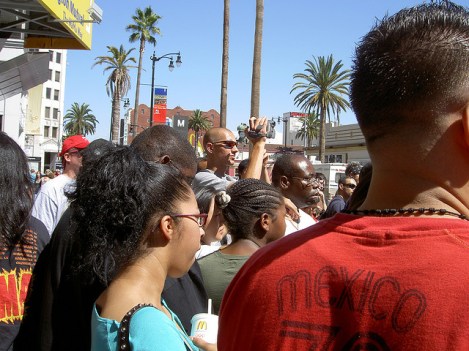
Hollywood itself was filled with young tourists of the tattooed and pierced variety who sashayed up and down the street shooting pictures of the commemorative stars on the sidewalk with their cell phones. On holiday weekends, the Boulevard is a big-time crowd scene, with scores of tour buses taking them to see homes of the rich and famous—or whatever it is they show them. Whenever they accost me for a tour, I offer to give it myself, saying “Hey, I live in this dump!”


The Man Who Gave Us the Tingler

He Made Being Scared Fun

He Made Being Scared Fun

Last Saturday, Martine and I visited one of the three places worth seeing in Hollywood, namely the Hollywood Heritage Museum, which is almost in the shadow of he Hollywood Bowl off Highland Avenue. (The other two places worth seeing are the Egyptian Theater, especially during Cinecon, and the Los Angeles Fire Department Historical Society’s museum on Cahuenga.)

It is not the museum I want to talk about right now—though I’ll get to it later—but an exhibit I saw there honoring that great showman of horror, William Castle, director of such classics as Macabre (1958), The House on Haunted Hill (1959), The Tingler (1959), 13 Ghosts (1960), Mr. Sardonicus (1961), and Homicidal (1961). Although he was active since the early 1940s, it is during this relatively short period in the 1950s and 1960s that he almost pre-empted the horror genre.

Could This Be the Original Prop for The Tingler?

Could This Be the Original Prop for The Tingler?

What make Castle famous at the time was that he were his publicity gimmicks. When he released Macabre, he had to mortgage his house, so he came up with some hilarious ideas to promote the picture, such as giving every customer a certificate for a $1,000 life insurance policy from Lloyds of London in case they should die of fright during the film. He stationed nurses in the lobbies and had hearses parked outside the theaters.

My favorite of his films was The Tingler, filmed in “Percepto.” According to Wikipedia:

The title character is a creature that attaches itself to the human spinal cord. It is activated by fright, and can only be destroyed by screaming. Castle purchased military surplus air-plane wing de-icers (consisting of vibrating motors) and had a crew travel from theatre to theatre attaching them to the underside of some of the seats (in that era, a movie did not necessarily open on the same night nationwide). In the finale, one of the creatures supposedly gets loose in the movie theatre itself. The buzzers were activated as the film’s star, Vincent Price, warned the audience to “scream—scream for your lives!” Some sources incorrectly state the seats were wired to give electrical jolts. Filmmaker and Castle fan John Waters recounted in Spine Tingler! how, as a youngster, he would search for a seat that had been wired in order to enjoy the full effect.

Well, he wasn’t the only one. Several years ago, the Alex Film Society in Glendale not only showed The Tingler, but claimed that some of the seats were “wired.” I was disappointed to see that the wiring was nothing more than some aluminum foil attached to the underside of some of the seats.

It didn’t matter. Martine and I loved the film anyhow, and we loved Castle’s gimmicks. Okay, maybe we were too sophisticated to be taken in by them, but we loved the idea that he made the horror picture not only scary, but funny.

I don’t know if Castle was a “great” director, but I still enjoy seeing his films.

In the Land of the Tattooed Monkeys

Labor Day Weekend in Hollyweird

Labor Day Weekend in Hollyweird

All the tourists who (1) watch too much television; (2) don’t know much about Southern California; and (3) are decorated all over with piercings and tattoos usually end up on Hollywood Boulevard. Labor Day Weekend is particularly crowded, as crowds stop and take pictures of “tweakers” dressed up as Darth Vader, Spider Man, Wonder Woman and other superheroes and superheroines. Or they take pictures of the thousands of star-shaped plaques embedded into the sidewalks honoring key entertainment figures. Or they just take pictures of each other. (The star commemorating Marilyn Monroe in front of Ripley’s “Believe-It-Or-Not” museum is always a mob scene.)

Yesterday evening, Martine and I found a short cut to get us around the crowd pressing around what was once Grauman’s Chinese Theater (and now called the TCL Chinese Theater). Out of the Loew’s Hollywood Hotel (formerly called the Hollywood Renaissance Hotel), we walked past the entrance to the Dolby Theater (formerly the Eastman Kodak Theater) to a tour bus station on Orange Avenue. That saved us at least 15 minutes on the way to Roubo’s Russian and Armenian Restaurant. Of course, all the re-branding made my head spin.

Especially on holiday weekends such as this, it is impossible to go more than a hundred feet without being solicited by tour bus operators. I always tell them that, as a long-time resident, I am better qualified to offer them a tour.

In fact, at any given time around Labor Day, about 30-40% of all vehicles on the boulevard are tour buses.

The movies at Cinecon made it all worthwhile, though it is something of a gauntlet going between the Egyptian Theater, where the films are screened, to the Loew’s Hollywood Hotel, where the dealers’s booths are set up, or to any restaurant serving halfway decent food.


More Morose Delectation

Bessie Love (1898-1986)

Bessie Love (1898-1986)

Once again it is Labor Day Weekend in the United States, and Martine and I have celebrated by seeing loads of films and seeing old friends at Cinecon 49 in Hollywood. Among the pictures we saw were:

  • The Holy Terror (1937) with Jane Withers
  • A Blonde’s Revenge (1926) with Ruth Taylor
  • The Good Bad Man (1926) with Douglas Fairbanks Sr and Bessie Love, directed by Allan Dwan
  • Transient Lady (1935) with Frances Drake
  • Their First Execution (1913) by Mack Sennett
  • Suddenly It’s Spring (1947) with Paulette Goddard and Fred MacMurray

Once again, I was impressed how beautiful many of the young actresses were almost a hundred years ago. Bessie Love in The Good Bad Man wasn’t much of an actress, but her beauty was heartbreaking.

Ruth Taylor (1905-1984)

Ruth Taylor (1905-1984)

Then there was Ruth Taylor with a small role in the Ben Turpin two-reeler A Blonde’s Revenge. It’s difficult to believe that she was the mother of Buck Henry.

Tomorrow, I’ll have to go in to work to help our computer consultant set up a new file server and seven workstations. But then, on Monday, Martine and I return to Hollywood and Cinecon for more movies.


Best American Films By Year, Part Three

Poster for The Wild Bunch (1969)

Poster for The Wild Bunch (1969)

This is the final installment of my series on The Best American Films By Year series, from 1915 to 1980. Why do I stop with 1980? Essentially, I think that by then, most of the great American directors were either not working or had passed on. As in the other postings, I begin with the choice of my friend Lee Sanders, who has seen far more films than I have.

Lee’s list stops at 1977. The choices for 1978-1980 are all my own.

When there is a second choice, it’s my selection when I have either not seen Lee’s choice or have my own preference. My choices are shown in red.

1961 – Two Rode Together (John Ford)
1962 – The Man Who Shot Liberty Valance (John Ford)
1963 – The Birds (Alfred Hitchcock)
1964 – Marnie (Alfred Hitchcock)
1965 – Red Line 7000 (Howard Hawks); Inside Daisy Clover (Robert Mulligan)
1966 – Seven Women (John Ford)
1967 – El Dorado (Howard Hawks)
1968 – The Legend of Lylah Clare (Robert Aldrich)
1969 – Once Upon a Time in the West (Sergio Leone); The Wild Bunch (Sam Peckinpah)
1970 – On a Clear Day You Can See Forever (Vincente Minnelli); Patton (Franklin Schaeffner)

1971 – The Grissom Gang (Robert Aldrich); They Might Be Giants (Anthony Harvey)
1972 – Travels With My Aunt (George Cukor); The Godfather (Francis Ford Coppola)
1973 – American Graffiti (George Lucas)
1974 – The Tamarind Seed (Blake Edwards); Godfather II (Francis Ford Coppola)
1975 – Night Moves (Arthur Penn); The Man Who Would Be King (John Huston)
1976 – A Matter of Time (Vincente Minnelli); Taxi Driver (Martin Scorsese)
1977 – Twilight’s Last Gleaming (Robert Aldrich); 3 Women (Robert Altman)
1978 – Days of Heaven (Terrence Malick)
1979 – Apocalypse Now (Francis Ford Coppola)
1980 – Popeye (Robert Altman)

And that’s how the American Cinema ended, not with a bang but a whimper….

Best American Films By Year, Part Two

John Wayne in The Searchers

In this posting, I continue my list of “The Best American Films By Year” covering the period 1915 to 1977. What I am going from is a list produced by my friend Lee Sanders, with whom I am in substantial agreement. When there are two films for a particular year and the second one is in red, the second one is because I disagree with Lee’s choice (which you will find is not too often). Below is the continuation of the list from 1941 to 1960:

1941 – How Green Was My Valley (John Ford)
1942 – The Magnificent Ambersons (Orson Welles); Casablanca (Michael Curtiz) – Lee actually had both films tied; I prefer the second
1943 – Air Force (Howard Hawks)
1944 – Meet Me in St. Louis (Vincente Minnelli)
1945 – They Were Expendable (John Ford)
1946 – My Darling Clementine (John Ford); The Big Sleep (Howard Hawks) – Lee had both films tied, a decision with which I agree.
1947 – Pursued (Raoul Walsh); Out of the Past (Jacques Tourneur)
1948 – Letter from an Unknown Woman (Max Ophuls)
1949 – Caught (Max Ophuls); She Wore a Yellow Ribbon (John Ford)
1950 – Rio Grande (John Ford)

1951 – On Dangerous Ground (Nicholas Ray); Strangers on a Train (Alfred Hitchcock)
1952 – The Quiet Man (John Ford)
1953 – The Bandwagon (Vincente Minnelli)
1954 – The Sun Shines Bright (John Ford)
1955 – Rebel Without a Cause (Nicholas Ray)
1956 – The Searchers (John Ford)
1957 – Written on the Wind (Douglas Sirk)
1958 – Vertigo (Alfred Hitchcock)
1959 – Rio Bravo (Howard Hawks)
1960 – Home from the Hill (Vincente Minnelli); Psycho (Alfred Hitchcock)

When I conclude this list, we will look at American films of the 1960s and 1970s (up to 1977, and I will bring the list up to 1980 with my own choices).


Best American Films By Year, Part One

Lobby Card for Josef Von Sternberg’s The Scarlet Empress (1934)

One day, my friend Lee Sanders and I started chatting about our favorite American films. From a capacious bag full of various literature, Lee whipped out a list of “The Best American Films of the Year,” spanning the years 1915 through 1977.  Now, for the most part, Lee and I see eye-to-eye. Where we don’t, I propose my own alternative. Where two films are listed for a particular year, the first one is Lee’s; the second, mine:

1915 – The Birth of a Nation (D. W. Griffith)
1916 – Intolerance (D. W. Griffith)
1917 – Straight Shooting (John Ford)
1918 – The Whispering Chorus (Cecil B. DeMille); Shoulder Arms (Charles Chaplin)
1919 – Broken Blossoms (D. W. Griffith)
1920 – Way Down East (D. W. Griffith); The Last of the Mohicans (Maurice Tourneur)

1921 – Dream Street (D. W. Griffith); The Kid (Charles Chaplin)
1922 – Robin Hood (Allan Dwan)
1923 – The White Rose  (D. W. Griffith); Our Hospitality (Buster Keaton)
1924 – He Who Gets Slapped (Victor Seastrom)
1925 – Seven Chances (Buster Keaton)
1926 – The General (Buster Keaton)
1927 – Sunrise (F. W. Murnau)
1928 – The Docks of New York (Josef Von Sternberg)
1929 – Lady of the Pavements (D. W. Griffith); The Love Parade (Ernst Lubitsch)

1931 – Dishonored (Josef Von Sternberg)
1932 – Trouble in Paradise (Ernst Lubitsch)
1933 – Design for Living (Ernst Lubitsch)
1934 – The Scarlet Empress (Josef Von Sternberg)
1935 – Barbary Coast (Howard Hawks); The Devil Is a Woman (Josef Von Sternberg)
1936 – The Road to Glory (Howard Hawks)
1937 – Make Way for Tomorrow (Leo McCarey)
1938 – Bringing Up Baby (Howard Hawks)
1939 – Stagecoach (John Ford)
1940 – His Girl Friday (Howard Hawks)

That’s all for the first installment. My differences with Lee in the above listings relate more to his love of D. W. Griffith’s later melodramas. I will continue in a week or so with the remainder of the list.

Any comments? We old film freaks used to call this activity “trading bubble gum cards.”

Morose Delectation

Mack Sennett Bathing Beauties

Certain stylistic differences separate us from our ancestors; but every once in a while, we can see people from eighty or a hundred years ago as if they were alive today. That was brought home to me at Cinecon today, when I saw a rare reel of Mack Sennett Bathing Beauties outtakes shot at nearby Venice Beach.

The scene was that the director had the girls run into the ocean. Evidently, the water was too cold for them, and they pleaded with the director off-screen to let them get used to the cold. Suddenly, the outlandish bathing costumes of a century ago and the stupid ringlets that the girls curled their hair into didn’t matter any more. In every other way, the scene could have been shot yesterday; and the girls were cute and rather appealing.

On Saturday morning, I saw a 1930 Fox Movietone newsreel of a stage rehearsal of a troupe of chorus girls entitled Backstage on Broadway. Again, once you looked past the inevitable blonde ringlets, the girls were incredibly beautiful, with gams that most of today’s women would kill for.

It is sad to think that virtually all of these girls are now dead. We snicker at minor details that divide their time from ours, and which place a spurious distance between us and them. No doubt their slang was outrageously different; and their everyday beliefs were probably more puritanical (though that’s hard to know for sure). In the Mack Sennett film, the bathing beauties were probably seen as brazen women, and the very large and appreciative male crowd along the Boardwalk lent credence to that that guess.

One of the poster dealers at the Cinecon show had a nude frontal body shot of the lovely Louise Brooks, whose dark bangs make her sexy even today. But, alas, she was found dead in her house from a heart attack after years of suffering from emphysema and arthritis. Mabel Normand, the most famous of Mack Sennett’s Bathing Beauties, died of tuberculosis in a sanatorium in 1930.

I suppose it’s dangerous to fall in love with ghosts. And yet the Lloyd E. Rigler Theater of the Egyptian Theater was filled with aging film fans, some of them in wheelchairs, whose eyes lit up at memories of their youth and of the women who made their lives seem worthwhile. Now they themselves are slowly vanishing into the past. New generations will take their place with dreams of tattooed and pierced young women in the outlandish costumes of Hollywood nightclubs.

Just remember: The outlandishness doesn’t count. They’re just people like us.