Morose Delectation

Mack Sennett Bathing Beauties

Certain stylistic differences separate us from our ancestors; but every once in a while, we can see people from eighty or a hundred years ago as if they were alive today. That was brought home to me at Cinecon today, when I saw a rare reel of Mack Sennett Bathing Beauties outtakes shot at nearby Venice Beach.

The scene was that the director had the girls run into the ocean. Evidently, the water was too cold for them, and they pleaded with the director off-screen to let them get used to the cold. Suddenly, the outlandish bathing costumes of a century ago and the stupid ringlets that the girls curled their hair into didn’t matter any more. In every other way, the scene could have been shot yesterday; and the girls were cute and rather appealing.

On Saturday morning, I saw a 1930 Fox Movietone newsreel of a stage rehearsal of a troupe of chorus girls entitled Backstage on Broadway. Again, once you looked past the inevitable blonde ringlets, the girls were incredibly beautiful, with gams that most of today’s women would kill for.

It is sad to think that virtually all of these girls are now dead. We snicker at minor details that divide their time from ours, and which place a spurious distance between us and them. No doubt their slang was outrageously different; and their everyday beliefs were probably more puritanical (though that’s hard to know for sure). In the Mack Sennett film, the bathing beauties were probably seen as brazen women, and the very large and appreciative male crowd along the Boardwalk lent credence to that that guess.

One of the poster dealers at the Cinecon show had a nude frontal body shot of the lovely Louise Brooks, whose dark bangs make her sexy even today. But, alas, she was found dead in her house from a heart attack after years of suffering from emphysema and arthritis. Mabel Normand, the most famous of Mack Sennett’s Bathing Beauties, died of tuberculosis in a sanatorium in 1930.

I suppose it’s dangerous to fall in love with ghosts. And yet the Lloyd E. Rigler Theater of the Egyptian Theater was filled with aging film fans, some of them in wheelchairs, whose eyes lit up at memories of their youth and of the women who made their lives seem worthwhile. Now they themselves are slowly vanishing into the past. New generations will take their place with dreams of tattooed and pierced young women in the outlandish costumes of Hollywood nightclubs.

Just remember: The outlandishness doesn’t count. They’re just people like us.
On the Boulevard

On Hollywood Boulevard Near Grauman’s Chinese Theater

I have spent two days at the Cinecon show in Hollywood so far this week. Because the films playing tonight don’t interest me, and because tomorrow, we’ll be here for fourteen hours, we decided to leave early today and on Sunday. I had to do that to retain Martine’s good will so that we could see a rare print of John Ford’s Upstream (1927) ending around 10:30 pm.

In the meantime, the short walk (two and a half blocks) between the Egyptian Theater and the Loew’s Hollywood Hotel where the film memorabilia vendors (and Martine) are working and where our car is parked, is as wild and woolly as ever. Tattooed monkeys and brainless girls wearing next to nothing seem to predominate. There are endless tours of Hollywood surrounded by teams of touts who try to funnel tourists into the buses. everal times a day, I have to tell them I’m not interested because “I live in this sh*thole.”

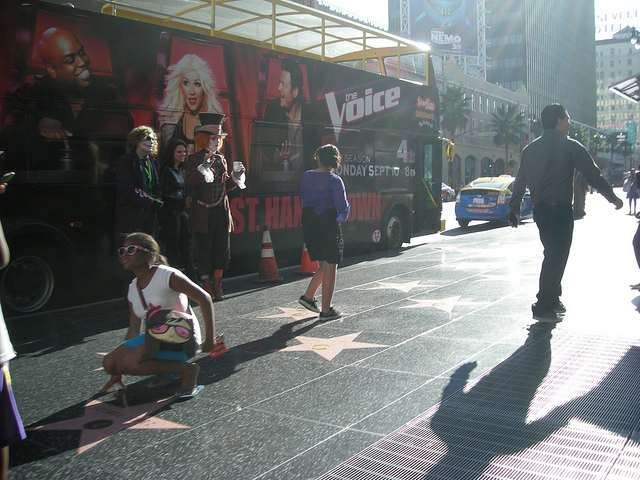
The scene above is of Zoo Central in front of the Hollywood & Highland Center next to Grauman’s Chinese Theater. You see one girl at the left being photographed by one of the stars on the Hollywood Walk of Fame. Behind her is one of the tour buses, accompanied by someone dressed as Johnny Depp in some recent movie whose title slips my mind.

I have been seeing some great films at the Egyptian, however, especially today. I sat through Robert Florey’s Dangerous to Know (1938) with the lovely Anna May Wong and Akim Tamiroff; Madge Kennedy in Dollars and Sense (1920); W. S. Hart in Wild Bill Hickock (1923); and John Blystone’s Gentle Julia (1936) with Marsha Hunt and Jane Withers, both of whom were in the audience as guests.

Last night, Martine and I saw Erle C. Kenton’s Always a Bridesmaid (1943) with the Andrews Sisters. A special treat was a film clip of the famed Nicholas Brothers dance duo, with two granddaughters of Fayard Nicholas tap dancing in synch with what was on the screen.

So, on the whole, it’s a mixed blessing: Great films in a particularly nutty place.

Hollyweird Again

On the Boulevard in Hollywood

I will be taking a break from posting to this weblog over the next few days. Every year during Labor Day Weekend, Martine and I have been attending the Cinecon show in Hollywood. While Martine helps my an old friend of mine sell movie memorabilia at Loew’s Hotel at Hollywood and Highland, I will be spending most of my time at the Egyptian Theater watching somewhere between fifteen and twenty old movies that, for the most part, have not been available to the public since they were first released.

Many of the titles will be silent with organ accompaniment, with most of the others dating from the early sound era. Typically, there are a few outliers whose originals were on nitrate film stock that has been transferred to safety film and cleaned up in the process. Nitrate stock is a fire hazard, and virtually all films before 1948 or so were shot on it. (I recall seeing the studio version of Alfred Hitchcock’s 1948 production of Rope go up in flames at a USC screening years ago.) Some more recent films had serious problems with fading color which film technicians have been able to restore to their almost original color quality.

For more information about Cinecon 48, visit their website for background information, a summary of films being screened, and the screening schedule.

As much as I like old films,spending time in Hollywood will be a drag. Labor Day Weekend almost always brings with it a heat wave.Add to that the problem of finding a decent restaurant on the Boulevard, where most of the eateries are oriented to downmarket tourists who come to stare at the stars’ names on the Hollywood Walk of Fame. Or to the even more downmarket residents of Hollywood, consisting in teenage runaways, low-rent hipsters, prostitutes of multiple genders, and the homeless.

It has always amused me that tourists who have failed to do their research come to Hollywood expecting to see celebrities in what has evolved over the decades into a rather ugly slum. The only hope I see for Hollywood is that public transportation improvements, especially with the Red Line, have made it profitable for developers to try to do something to gentrify the place a bit.

You Can’t Win Them All

Cityscape of JUST IMAGINE in the distant future: 1980

Some films are better known for stills than for the films themselves. One of them is Fox’s Just Imagine (1930), a science fiction musical set in the distant future year of 1980. Today, Martine and I attended a screening at the American Cinemathèque’s Aero Theater in Santa Monica. The event was to honor the late art director Stephen Goosson (1889-1973), who was responsible for designing such pictures as Lost Horizons, Meet John Doe, It Happened One Night, and Mr. Deeds Goes to Town. (Yes, all the above were directed by Frank Capra at Columbia Pictures.)

Just Imagine, however, was directed by the less talented David Butler. Except for Goosson’s outstanding design work, the film was corny to the max. In fact, Martine walked out of the picture about three quarters through because she couldn’t stand it any more. I gamely sat through all of it and cringed through El Brendel’s vaudeville-style comedy routines. Although  Brendel received top billing, he was a major drag on the picture.

Late next week, I will be attending Cinecon 48 in Hollywood and sitting through upwards of fifteen films from the silent era and the early days of sound, with a few outliers that were more recently made. This was, for me, a foretaste of the film orgy to come.