Scarebabes

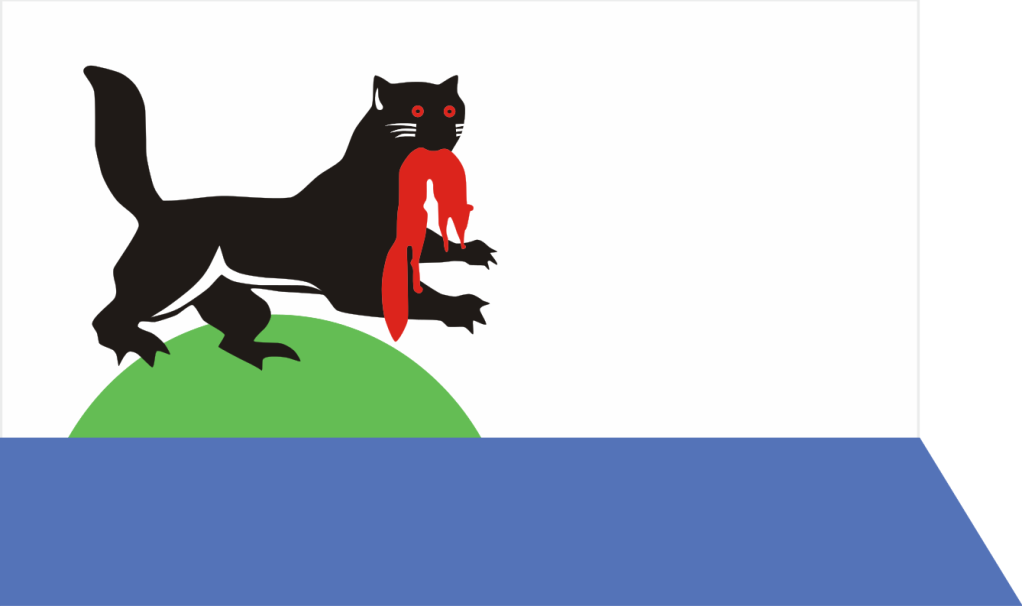
The Scary Flag of Irkutsk Oblast in Siberia

This post is about the things that scared me as a child. In it, I go back as far as I can in my memory banks, back to before I was two years old. There are three things that scared me around that age.

First and foremost was … would you believe … toilet training. We were living in the Hungarian Buckeye Road neighborhood of Cleveland, and my great grandmother was living with us. She was born in Felcsut (pronounced FEL-choot) in the province of Fehérmegye (don’t even TRY to pronounce that one) sometime around 1880. She was old school. Not only that, she didn’t particularly like me at that time because I was the son of that fuszóru Tóth (cock-nosed Slovak) who was my father. (She was later to love my brother me and me, but never my father.) Therefore, she was fairly brutal about my toilet training.

I remember my nightmares at the time. I was seated on the toilet and the walls of the bathroom would close in on me with the roaring sound of a steam locomotive. That occurred fairly regularly as I recall.

As an infant in the crib, I had a boogeyman which I couldn’t exactly describe, only that I knew him as the Lobogó (LOH-boh-goh), which is one of the Hungarian words for flag. It’s odd, because I wasn’t afraid of flags as such, just that word that sounded so sinister to me. My Mom would kid me that there was never any danger from the Lobogó.

Finally, I remember a series of nightmares I had in which I was being chased by a lion. My Mom and Dad must have taken me to the zoo, because how would I know about the existence of lions. This was at least two years before I ever saw a television set. It could have been in a fairy tale that my mother told me. She would make up wonderful stories about a fairy princess (tündérleány) in the dark forest (sötét erdő). A lion must have wandered into one of her tales.

The image above, which is the flag of Irkutsk Oblast in Siberia, combines the dread Lobogó (flag) with my lion nightmares. I particularly like the red eyes.

Sorry for all the Hungarian words, but at the time I didn’t know a word of English, or even that the English language existed.

Tim Conway and Me

Carol Burnett with Tim Conway

Although I hail from Cleveland, Ohio, I am not a big fan of what I and many of my friends call “The Mistake on the Lake.” There I one Clevelander I have always admired. No, not Halle Berry, though I find her incredibly beautiful. And not Paul Newman, who I admit was a talented film actor.

My choice is Tim Conway, who, although born eleven years earlier than me, had a childhood that curiously paralleled my own. Just as I was born to a family that spoke only Hungarian in the home, Tim spoke only Romanian. (Funny, he doesn’t look Romanian—but he was born Toma Conway to an Irish father and a Romanian mother, Sophia, who bore the Romanian equivalent to my mother’s Hungarian name, Zsófi.)

Like my mother, Sophia was born in the United States but taken to be raised in Europe. Like my Slovak father Elek, Daniel Conway adopted his wife’s language in the family circle. Thus, when Tim first attended school, he spoke mostly Romanian, just as I spoke only Magyar.

The parallels stop there. Toma had his name changed to Tim when he started in show business, as there was already a well-known British actor named Tom Conway. Whether playing in McHale’s Navy or The Carol Burnett Show, Tim Conway was one of the funniest men on television. I still watch The Carol Burnett Show on MeTV up to six times a week. Great stuff!

The Long Retreat

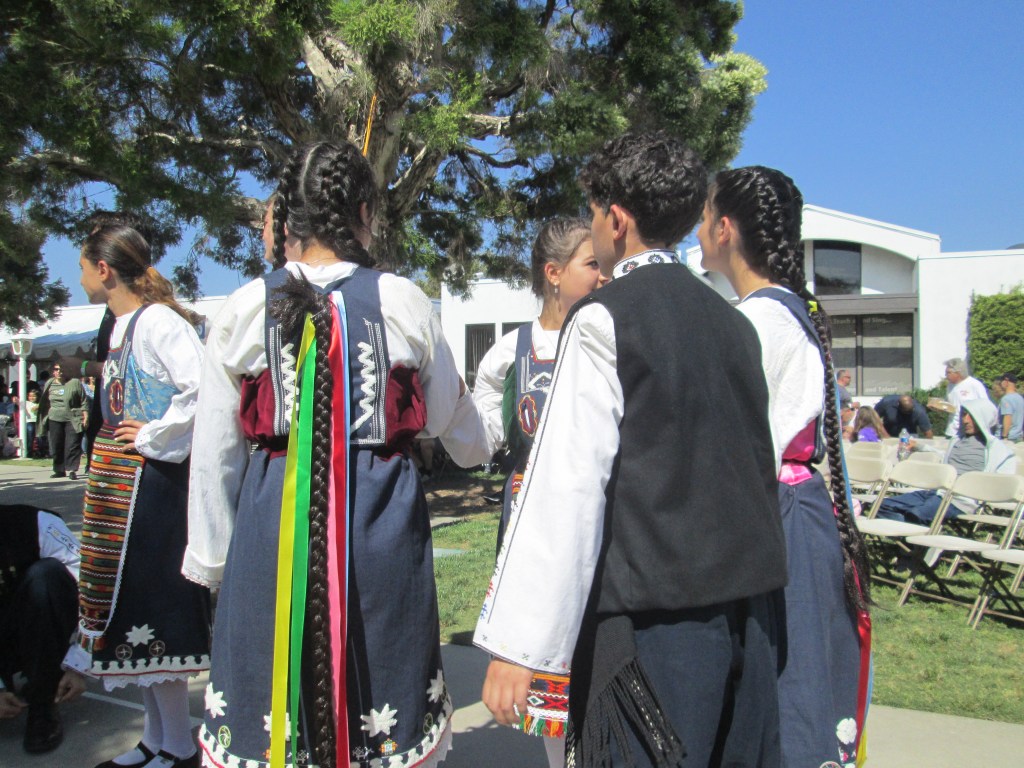
Middle School Greek Dancers at St Nicholas Greek Orthodox Church

I remember a time when most foreign-born Americans were of European ethnicity. My father, Elek Paris, was born in what is now the Republic of Slovakia; and my mother, who was actually born in Ohio, was taken to Hungary to be raised by her grandparents. For the first five or six years of my life, I thought that Hungarian was the language of the United States.

What inevitably happens has happened. The children of European-born immigrants see their parents’ culture, religion, and language as something quaint which they are being reluctantly marshaled into accepting. The three-year Covid-19 lockdown has brought this tendency into sharper focus.

Yesterday, Martine and I attended the annual Greek Festival at St Nicholas in Northridge for the first time since 2019. Sure enough, the tours of the church were more perfunctory; the calamari was more breading than squid; and there were fewer people able to do the traditional dance steps. I noticed much the same at the two Hungarian festivals we attended this month. Only the Grace Hungarian Reform Church in Reseda had anything like the same quality of food and entertainment as before the lockdown.

Our neighbors downstairs are refugees from Putin’s Ukrainian invasion. I notice that their two little daughters are addressing their mother in English instead of Ukrainian.

When I first came to Los Angeles, there were at least half a dozen Hungarian restaurants. Now there are none. If I want real Hungarian food, I’ll either have to cook it myself or visit my brother more often. (He’s a far better cook than I am.)

If Martine and I expect to find more authentic ethnic events, we will have to concentrate on the Asian and Latin American ethnic events, as they have arrived in this country more recently.

Magyar Blood

Folk Dancers from the Kárpátok Troupe at Grace Hungarian Reformed Church

For the first time since the Covid lockdown began, Martine and I were able to attend a church festival, in this case the Hungarian festival at Grace Hungarian Reformed Church in Reseda. I was raised on Hungarian food, and Martine, although French, prefers Hungarian food to the cuisine of her native land.

So we chowed down on stuffed cabbage and krémes (Hungarian style cheesecake) and watched a program of folk dancing. Plus I had the opportunity of practicing my rusty Hungarian. Although it is my native language, my vocabulary and grammar are atrocious. Yet my pronunciation is still pretty accurate. As I’ve mentioned before, I speak a rural Fehérmegye dialect dating back to the 1930s. This is what we spoke at home in Cleveland.

Still and all, I want to stay close to my Magyar roots as much as possible. I see it as an escape hatch when I get too disgusted with my fellow Americans. I like to stay current with Hungarian literature, even though I have to rely on translations into English, of which there are few.

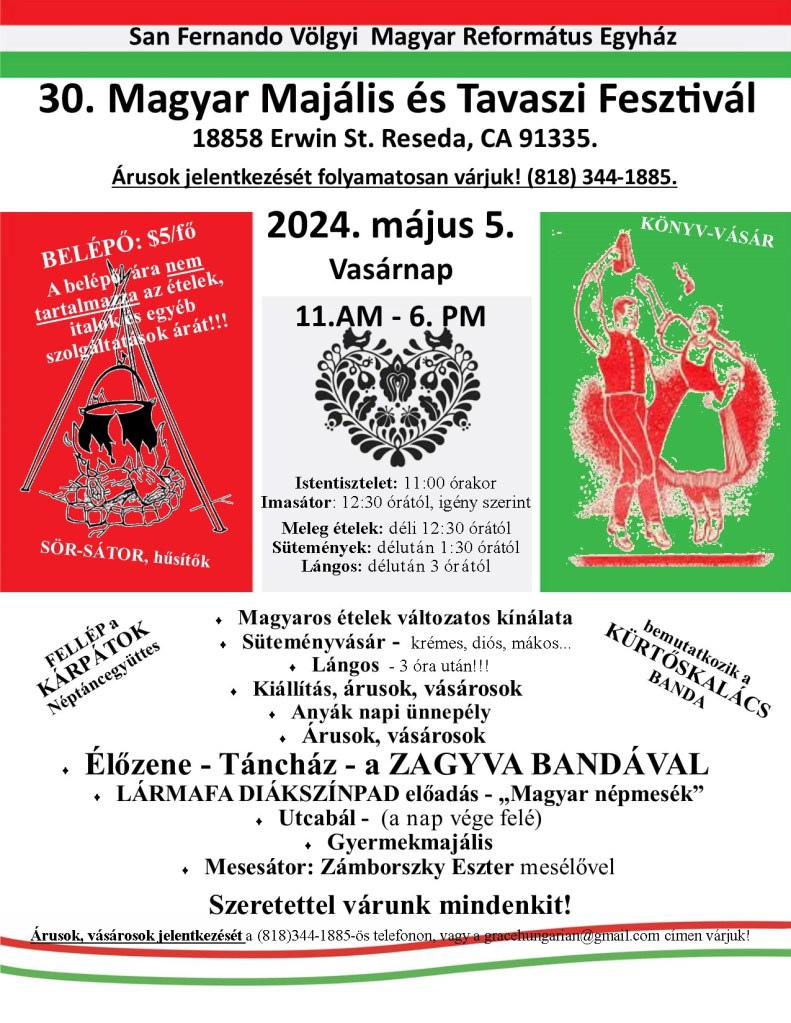
Below is the announcement for the festival we attended today:

Not a single word is in English, and yet I understood most of it. And what I didn’t understand, I looked up.

Martine and I have been attending this church’s spring festivals for most of the last eleven or twelve years. Great fun!

Where the Streets Have No Name

David Hockney’s “Pearblossom Highway, 11-18 April 1986, #2”

This the way I remember it: the way it was decades ago. Yesterday, Martine and I took a road trip to Littlerock, California. Why? We were looking for smoked Hungarian sausage (füstölt kolbász) which was no longer available from our usual source, as the Alpine Village Market in Torrance was no more. I had a distant memory of the Valley Hungarian Sausage & Meat Company in Littlerock, where I had purchased some good kolbász years ago, when my mother was still alive. Then I heard from my brother Dan of a place called Tibor’s that sold kolbász somewhere in the Antelope Valley.

So I took a chance and drove along California 14 (the Antelope Valley Freeway) with its vanishing lanes past the Vasquez Rocks where Captain Kirk battled the reptilian Gorn on Cestus III, past the Red Rover Mine Road and Acton, until we got yo California 138, the Pearblossom Highway, which runs from the 14 all the way to the I-15 at Victorville.

“Where did all those people come from?” I wondered as I saw all the suburban developments that have sprung up in what is now called Canyon Country. I continued asking the same question as I saw how the Pearblossom Highway was no longer “Where the Streets Have No Name,” as Bono and the U2 sang.

Well, the Streets Now Have Names

On the way to Tibor’s, we stopped at Charlie Brown Farms—also in Littlerock—to have lunch and browse around. We quickly realized several characteristics common to the people who now lived in the area:

  1. Everyone was at least thirty pounds overweight, even the kiddies
  2. If they had any discretionary income, it was spent at the local tattoo parlor
  3. To a man, woman, and child, they looked liked bad ass wannabes

We located Tibor’s easily: It was the same as the old Valley Hungarian Sausage & Meat Company. Unfortunately, it was not well stocked. When asked for füstölt kolbász, they said they didn’t have any in stock. That’s kind of like finding no tortillas in a Mexican food store or pasta in an Italian deli. We bought some other kolbász, which turned out to be good. But it was an awfully long drive for slim pickings.

Still, it got Martine out of the house, and she enjoyed the drive to an area she had never seen before. And the California poppies along the road were like golden explosions of faerie light.

The End of the Beginning

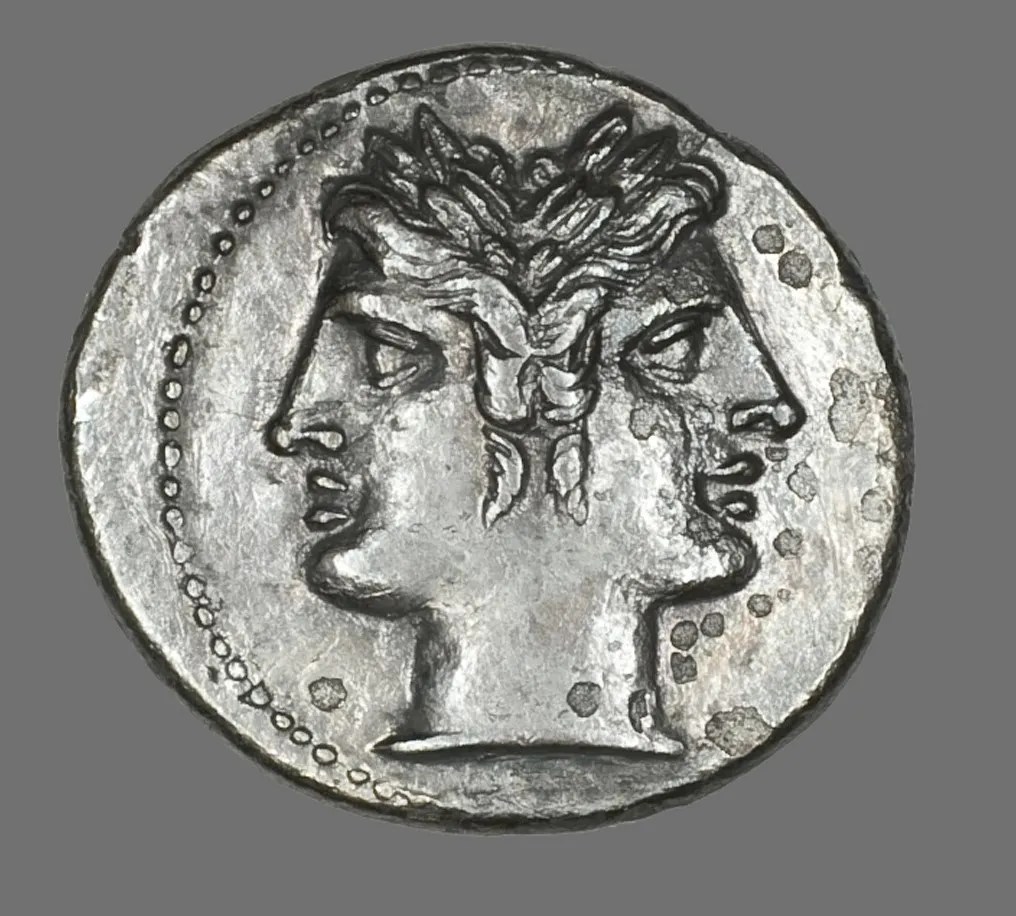
My Janus-Faced January Reading Program

As I wrote in my post dated January 1 of this year, I like to devote a whole month out of each year reading authors I have never read before. As this is the last day of my Januarius Project for January 2023, I thought I’d report on the authors I have discovered.

I have read eleven books this month. Six of them turned out to be excellent:

  • Thomas Hodgkin. Barbarian Invasions of the Roman Empire. I. The Visigothic Invasion. The first of eight volumes and 5,000 pages on the Barbarian Invasions. Excellent scholarship and exciting even!
  • Magda Szabo. The Door. A superb Hungarian novel about a writer and her domineering housekeeper.
  • Laszló F. Földényi. Melancholy. Another Hungarian author dealing with the history of melancholy in Western literature and civilization. Not an easy book to read, but worth the effort.
  • Lawrence Ferlinghetti. Writing Across the Landscape. Travel Journals 1960-2010. It’s always fascinating to see other places from a poet’s perspective.
  • Lucretius. The Nature of Things. An ancient Roman poet describes the science of his day—in verse. Reading Lucretius tells me we may have advanced in some respects, but not all.
  • Juan Rulfo. The Plain in Flames. Why have I not heard of this Mexican author before? Like John Webster, he could see the skull beneath the skin; and his short stories are powerful and gemlike.

The remaining five were merely really good:

  • Vilmos Kondor. Budapest Noir. A top-notch mystery set in the Budapest of the 1930s, on the track of a young woman’s murder.
  • Han Kang. The Vegetarian. A young woman goes from vegetarianism to pushing the envelope of what is human. The author is Korean.
  • Don Carpenter. Hard Rain Falling. A noir crime novel about a pool shark whose life goes from bad to worse. The beginning is particularly powerful.
  • Yu Miri. Tokyo Ueno Station. The author is a Japanese woman of Korean ancestry. A powerful look at urban homelessness in Tokyo.
  • Horacio Quiroga. 7 Best Short Stories. One for the kiddies. A Uruguayan author writes stories about the Argentinian jungle that are reminiscent of Kipling’s The Jungle Book.

I can see myself reading other works by Hodgkin, Szabo, Ferlinghetti, and Rulfo in the year to come.

At Sea in 1949

Boats and Fish Seen By Me at the Age of Four

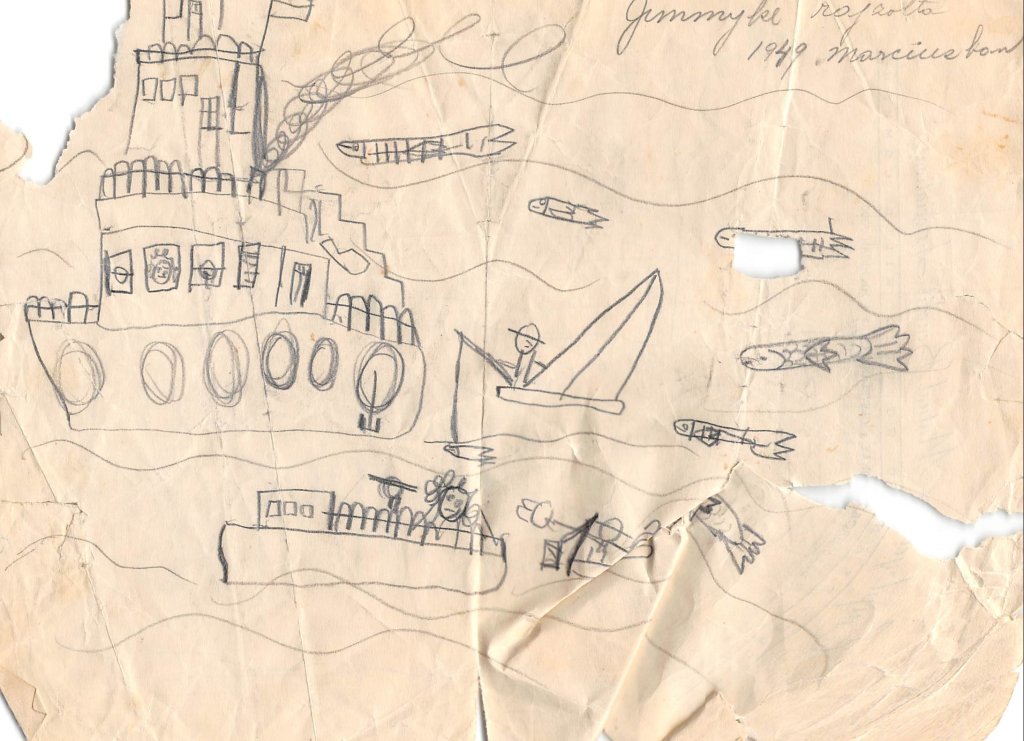
It’s in execrable shape—but then, so am I—but here is a pencil drawing I made at the age of four. It is inscribed by my mother in Hungarian “Jimmy drew this in March 1949.” It displays an attention to detail surprising for a little boy who did not have access to television and who did not know a word of English. All I had were the stories my mother told me. Interestingly, she made them up herself most of the time. A lot of them involved fairy princesses and dark forests.

Then, too, there were the stories she read to me from library books. We would go together to the public library near Harvey Rice School (where I would go for kindergarten and half of first grade) and pick them out, mostly based on the pictures in them. My mother knew English: she was born in Cleveland, but taken back to Hungary to be raised. She would meticulously translate the selected stories from English to my little-boy Magyar tongue. (Magyar means Hungarian in the Hungarian language.)

At the time, we were living at 2814 East 120th Street in the Buckeye Road Hungarian neighborhood of Cleveland. For several blocks around, one could be born, live, and die without knowing a word of English. Not any more, of course. Eventually all the Hungarians moved out and it became a black ghetto. We moved out, too, in 1951, shortly after my brother was born.

The Januarius Budapest Trifecta

Having finished my jaunt to the decaying Roman Empire during the Visigothic invasions, I decided to read three books in a row written by Hungarian authors:

  • Vilmos Kondor’s Budapest Noir (2008), a first novel about a murder on the streets of Budapest.
  • Magda Szabo’s The Door (1987), a novel about the relationship between two women, a writer and a peasant.
  • Laszló F. Földényi’s Melancholy (1984), a history of melancholy through the ages.

As we begin 2023, I find the farther I get from my own Hungarian roots, the more at loose ends I feel. There is a figure in Greek mythology called Antaeus, about whom Wikipedia writes:

Antaeus would challenge all passers-by to wrestling matches and remained invincible as long as he remained in contact with his mother, the earth. As Greek wrestling, like its modern equivalent, typically attempted to force opponents to the ground, he always won, killing his opponents. He built a temple to his father using their skulls. Antaeus fought Heracles as he was on his way to the Garden of Hesperides as his 11th Labour. Heracles realized that he could not beat Antaeus by throwing or pinning him. Instead, he held him aloft and then crushed him to death in a bear hug.

Returning to my Hungarian roots is like Antaeus renewing himself by touching the earth. (If, however, I run into Heracles, I will pointedly avoid wrestling with him.)

So far, I am on schedule with my Januarius reading program.

Howdy Doody and Harvey Rice

This is a repost from March 30, 2013.

That’s me on a tricycle, sometime around 1950. We were living at 2814 East 120th Street off Buckeye Road in Cleveland. The whole place was filthy with Hungarians. There were so many, in fact, that I did not know the English language existed until two things happened: First, we got a television set late in 1949, and I started watching the Howdy Doody show at 5 pm every day, just after Kate Smith closed her show by singing “When the Moon Comes Over the Mountain.” (It took me a while to understand what Howdy and Buffalo Bob Smith were saying.)

Secondly, I started kindergarten at Harvey Rice School on East 116th Street in January of 1950. My parents thought that, living as we did in a Hungarian neighborhood, the public school teachers would speak Hungarian. Nothing doing! Mrs. Idell sent me home with a note pinned to my shirt that asked, “What language is this child speaking?” As if she didn’t know!

That last factor decided my Mom that we had to leave our little Hungarian womb on the East Side and move to the suburbs. Gone forever would be the Reverend Csutoros and the First Hungarian Reformed Church; the Regent and Moreland movie theaters; Kardos’s Butcher Shop with its delicious Hungarian sausages; the College Inn, where my Dad would take me for French Fries; and the Boulevard Lanes where my Dad bowled and I kept score.

It was a cohesive little world, but my parents ate the apple from the Tree of Knowledge when they decided to raise me as a Hungarian. You know what? I’m grateful that they did. I made my adjustment to English (and I’m still making it), but my heart belongs to the Magyar Puszta.

A Hyphenated American

Although I was born in the United States, I prefer to think of myself as a hyphenated American, specifically a Hungarian-American. My native language is Magyar (Hungarian). I did not speak any amount of English until I was six or seven years old. Something happens when you grow up as a bi-lingual person: You find yourself not quite so committed to the land of your birth.

Let me be more direct: I find myself intensely disliking the political and religious beliefs of approximately half of our population, such as the young idiots in the above photo. At present, I am not likely to fly on any American air carriers because most of their passengers are Americans, and I don’t want to be involved in any violence in the air because some yahoo refuses to wear a mask as required by law. I feel safer on a foreign carrier.

When some stranger addresses me in public, I invariably reply to them in Hungarian. The last instance was on a commuter train on which two African-Americans were arguing about Covid-19, and one of them solicited my opinion. I politely told them, in Magyar, that I didn’t (really: wouldn’t) speak their language.

I typically do not celebrate national holidays because I find them more productive of stress than of enjoyment, particularly Christmas, which has evolved into some sort of national potlatch ritual.

Perhaps these responses of mine are the result of a growing lack of faith in my fellow Americans. Particularly white males, though the Republican Party has given us some really monstrous travesties of women.

Does that mean I am withdrawing in any way? Not really. I vote in every election. And I try to remain close to my friends. I’ll stick to being a Hungarian-American, even though the American side of things is going to hell in a hand basket.