
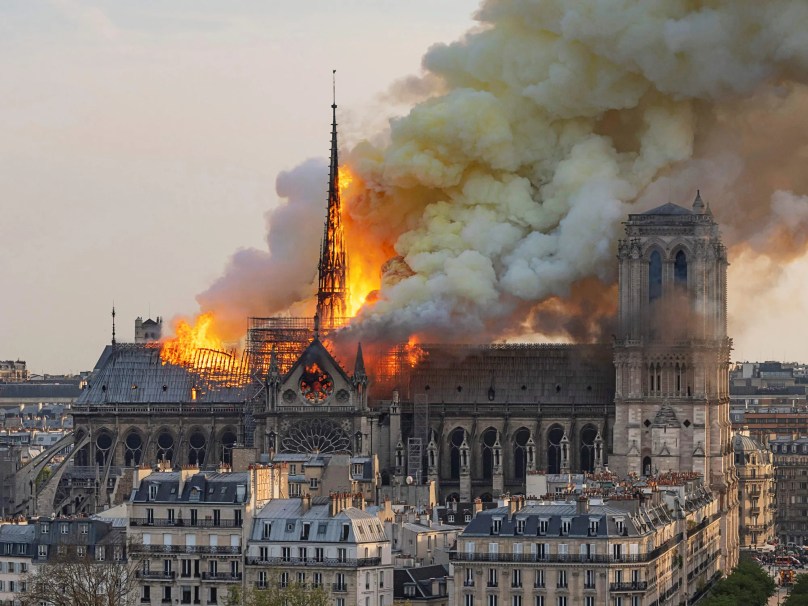
Notre Dame Cathedral in Flames 2019
This morning at the L.A. Central Library, I was reading Mario Vargas Llosa’s novel of sexual obsession entitled The Bad Girl, published in 2006. In it, he discusses a visit to Notre Dame Cathedral in Paris years before the 2019 fire that destroyed the cathedral’s roof. This passage made me think that it is dangerous to talk about anything that is man-made as permanent—with the possible exception of the pyramids at Giza in Egypt. Even though the damage has been repaired for now, nothing (in Vargas Llosa’s words) really is guaranteed to “escape the ususry of time.”
I tried to distract her and took her to look at the cathedral, a sight that never failed to overwhelm me even after all the years I had been in Paris. And that night more than at other times. A faint light, with a slightly pink aura. bathed the stones of Notre Dame. The large mass seemed light because of the perfect symmetry of its parts, delicately balanced and sustained so that nothing was disordered or disarranged. History and the sifted light changed the façade with allusions and resonances, images and references. There were many tourists taking pictures. Was this same cathedral the setting for so many centuries of French history, the inspiration for the novel by Victor Hugo that excited me so when I read it as a boy, in Miraflores, in my Aunt Alberta’s house? It was the same one and a different one that had accrued more recent mythologies and events. Extraordinarily beautiful, it transmitted an impression of stability and permanence, of having escaped the usury of time.


You must be logged in to post a comment.