
Our Salvation Lies in Robots?

Some of the Food Offerings at India Sweets & Spices

About once a week on the average, I drop in for a quick lunch at India Sweets & Spices in Culver City. The vegetarian curries are tasty and not overly expensive, and one does not have a order a meal too big to finish.

As I entered the store, I was greeted by a garrulous retiree who was sitting at one of the outside tables. As is my custom, I answered him politely, but in the 1930s Hungarian rural dialect which I adopt when trying to avoid a chatty individual.

He took the hint quickly while I passed inside to order a samosa and lentil fritter. When I came out with my food, I had to sit at a table within earshot of him. He was regaling one of his captives with an encomium on robots and how they were going to replace surgeons. Someone looking at my face at that point would have guessed that I had just smelled something foul.

You can’t talk about robots without talking about computer algorithms. And I was a person who had just spent an hour explaining to my pharmaceutical mail order firm—three times—that I am not Hispanic (marque dos) before getting to speak to a human being. If most companies cannot reasonably handle automated phone attendants, why would I submit to a computer algorithm with my body for surgery?

Fortunately I was able to finish my vegetarian snack quickly and vanish from sight before hooting derisively.

Jains: The Most Gentle People

Detail, Pilgrimage to a Jain Shrine c. 1850

Compared to the Jains of India, the Quakers and other pietists seem positively warlike. I am currently reading William Dalrymple’s Nine Lives: In Search of the Sacred in Modern India (2009). In it, a Jain adept describes her initiation:

[W]e were led back onto the stage, and told our new names. I was no longer Rekha; for the first time in my life I was addressed as Prasannamati Mataji…. Then we were both lectured by our guruji. He told us clearly what was expected of us: never again to use a vehicle [to avoid crushing insects], to take food only once a day, not to use Western medicine, to abstain from emotion, never to hurt any living creature. He told us we must not react to attacks, must not beg, must not cry, must not complain, must not demand, must not feel superiority, must learn not to be disturbed by illusory things. He told us we must be the lions that kill the elephant of sexual desire. He told us we must cultivate a revulsion for the world, and a deep desire for release and salvation. And he told us all the different kinds of difficulties we should be prepared to bear: hunger, thirst, cold, heat, mosquitoes. He warned us that none of this would be easy.

As they would walk along, Jains would sweep a peacock feather fan in front of them lest they inadvertently took the life of any creature, regardless how small. During the wet monsoon season, they stayed indoors because the omnipresent puddles were teeming with microscopic life.

Dalrymple’s source, a Jain nun called Prasannamati, blamed herself for being closely attached for twenty years to another Jain nun until the latter died of tuberculosis and malaria. Toward the end, the friend gradually cut down on her intake of food until she in effect died of starvation. Although she was only 38 years old and still healthy, Prasannamati was in the beginning stages of the same kind of starvation suicide, called sallekhana.

As Prasannamati said to her questioner, “Sallekhana is the aim of all Jain [monks or nuns]. First you give up your home, then your possessions. Finally you give up your body.”

A Great Writer from India

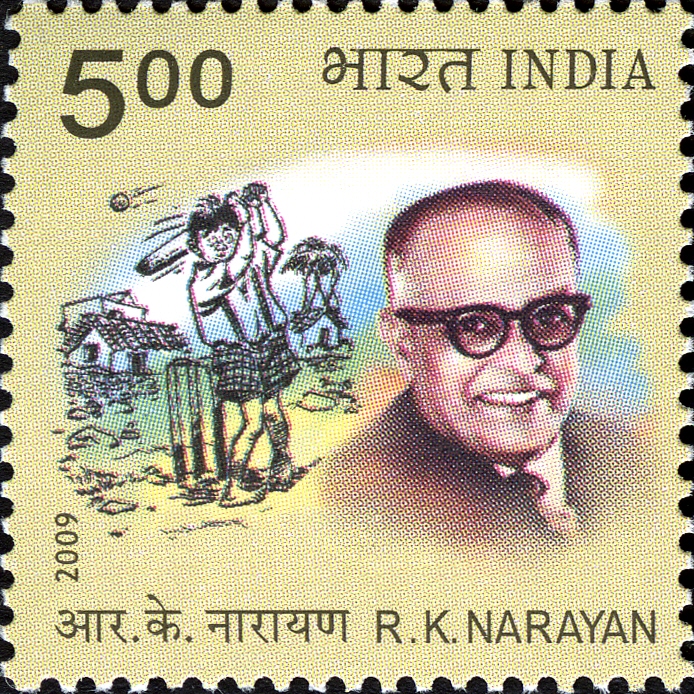
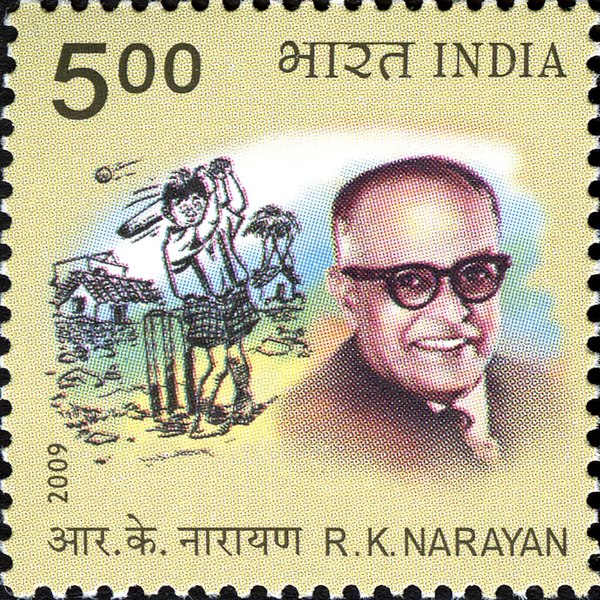
2009 Stamp Honoring R. K. Narayan (1906-2001)

The above stamp was issued to honor the 103rd anniversary of the birth of India’s greatest writer of fiction: Rasipuram Krishnaswami Iyer Narayanaswami, better known as R. K. Narayan. Interestingly, he wrote most of his fiction in English. And it was Graham Greene whose influence led to the publication of his first four books.

I have just finished reading his short-story collection entitled Malgudi Days (1942), in which every one of the 30-odd stories competed with all the others for Best in Show. Over the years, I have also read a number of other titles—all of which I loved—including:

  • Swami and Friends (1935) which includes the cricket scene shown on the illustrated stamp above
  • The Bachelor of Arts (1937)
  • The Financial Expert (1952)
  • The Guide (1959)
  • The Vendor of Sweets (1967)
  • A Tiger for Malgudi (1983)
  • Under the Banyan Tree and Other Stories (1985)

Narayan’s fiction is mostly set in a mythical South Indian city called Malgudi. Once you start reading his work, it will seem like home to you.

Vidyādhara

A Vidyādhara Couple

I am currently reading a book of Kashmiri tales that go back a thousand years or more. The book is Somadeva’s Tales from the Kathāsaritsāgara, written around AD 1050, but retelling from an earlier source. To understand the quote below, you must realize that Vidyādharas are celestial beings very much like angels—but angels who can mate with humans without losing their supernatural abilities.

The tale in question is called “Alaṅkāravatī,” which tells the tale of the promiscuous Anaṅgaprabhā, who has just jilted her lover, King Harivara:

When Harivara found out that Anaṅgaprabhā had left, he wanted to die of grief. But the minister Sumantra consoled him and said, “Why don’t you understand this? Think it over yourself. Anaṅgaprabhā left her husband, who had obtained the powers of a vidyādhara by means of a [magical] sword, the moment she saw you. Why would a woman like that stay with you? She has left for something trivial because she does not desire the good, like someone who is enamored of a blade of grass believing it to be a heap of jewels. She has definitely gone with the dancing teacher for he is nowhere to be seen and I heard they were in the dance hall together in the morning. Since you know all this, why are you so attached to her? A promiscuous woman is like the sunset which has a moment of glory every evening.”

Yamaraja

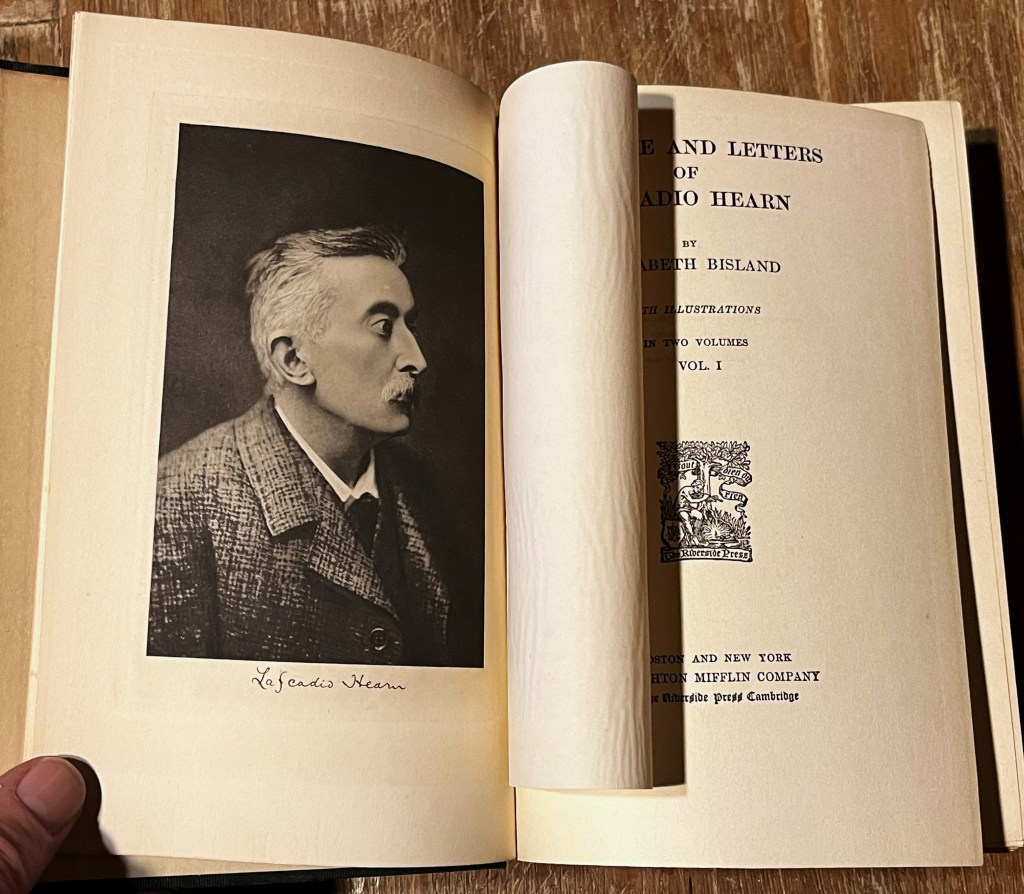
He Always Hid His Damaged Left Eye When Being Photographed

Lafcadio Hearn (1850-1904) was a true exotic. Born in Lefkada, Greece, he came to the United States and published several charming works of folklore, of which his Stray Leaves from Strange Literature (1884) was one title. And then he went to Japan, married a local woman, and published his best known works. These were collections of Japanese folktales in English. Masaki Kobayashi’s gorgeous color horror film anthology, Kwaidan (1964), was based on three of Hearn’s tales. Hearn changed his name to Koizumi Yakumo. Today he is revered by the Japanese for his works.

The following excerpt is from Stray Leaves from Strange Literature from the tale of “Yamaraja,” about a Brahmin who attempts to visit the Hindu god of the dead, who is called Yamaraja, to plead to bring his dead son back to life. It is this god who speaks:

“Verily thou hast not been fitted to seek the supreme wisdom, seeing that in the winter of thine age thou dost still mourn by reason of a delusion. For the stars die in their courses, the heavens wither as leaves, the worlds vanish as the smoke of incense. Lives are as flower-petals opening to fade; the works of man as verses written upon water. He who hath reached supreme wisdom mourneth existence only…. Yet, that thou mayst be enlightened, we will even advise thee. The kingdom of Yama thou mayst not visit, for no man may tread the way with mortal feet. But many hundred leagues toward the setting of the sun, there is a valley, with a city shining in the midst thereof. There no man dwells, but the gods only, when they incarnate themselves to live upon earth. And upon the eighth day of each month Yamaraja visits them, and thou mayst see him. Yet beware of failing a moment to practice the ceremonies, to recite the Mantras, lest a strange evil befall thee! …Depart now from us, that we may reenter into contemplation!”

Tagore’s Garden

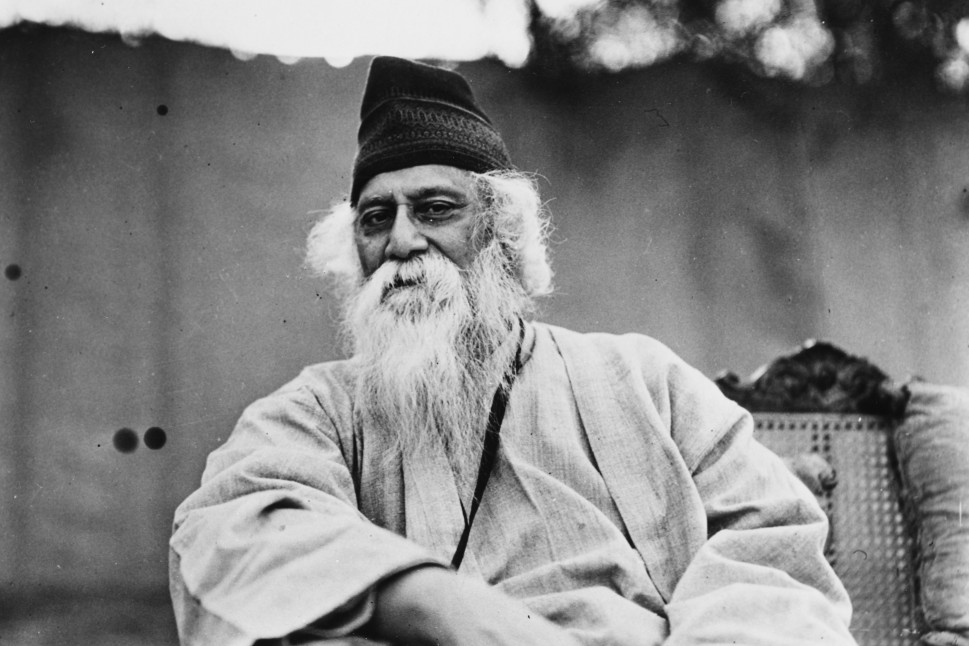
Indian Writer Rabindranath Tagore (1861-1941)

An early winner of the Nobel Prize in Literature in 1913, Rabindranath Tagore is almost forgotten today. How is that so? He was a prolific writer of poetry, prose, plays, novels, and songs. He was offered a knighthood by the British, but turned it down. He did not live to see the creation of a free India, but he led a rich and full life. Here is a short excerpt from his poetry:

The Gardener 85

Who are you, reader, reading my poems an hundred years hence?
I cannot send you one single flower from this wealth of the spring, one single streak of 
     gold from yonder clouds.
Open your doors and look abroad.

From your blossoming garden gather fragrant memories of the vanished flowers of an
     hundred years before.
In the joy of your heart may you feel the living joy that sang one spring morning, sending its glad voice across an hundred years. 

Manageable Chaos

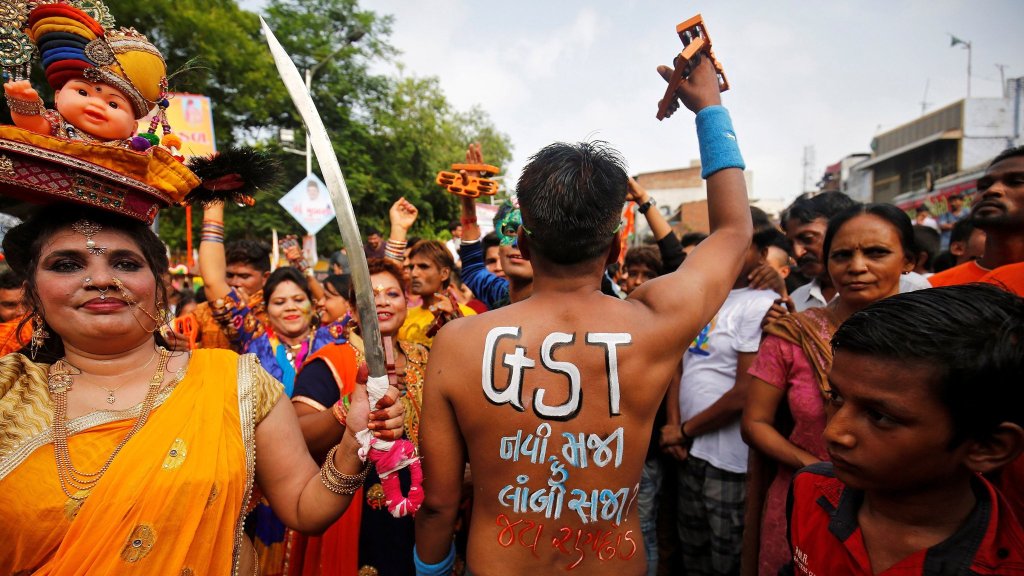
A Hindu devotee shows his painted back with a message stating “GST (Global Service Tax) – A new boon or a lasting burden?” ahead of the rollout of the new tax in India, during the annual Rath Yatra, or chariot procession, in Ahmedabad, India 2017. REUTERS/Amit Dave

According to sociologist Ashis Nandy, writing in 1990:

In India the choice could never be between chaos and stability, but between manageable and unmanageable chaos, between humane and inhuman anarchy, and between tolerable and intolerable disorder.

I am currently reading V. S. Naipaul’s book India: A Million Mutinies Now (1991). It is the last of the late author’s three books on India. The others are An Area of Darkness (1964) and India: A Wounded Civilization (1977). Born in Trinidad of Indian ancestry, Vidia Naipaul was a British citizen who kept trying to understand the land of his forebears.

India is a land of multiple languages, multiple religions, multiple political factions, multiple ethnicities. In a word it is a land of multiple multiplicities. And it is becoming ever more centrifugal as time goes on. Hardly a day passes without news of massacres, rapes, terrorism, and murders directed at the other guy.

V S Naipaul (1932-2018)

In trying to understand India, Naipaul has helped all of us see more clearly what is an increasingly shattered society, yet one that manages to soldier on despite everything. I, who am so despairing of the split between the Trumpists and everyone else in the United States, am truly amazed that India is able to manage its own chaos so well. For now, anyway.

Paper Tiger?

Soldiers of People’s Liberation Army (PLA) march in formation during the military parade marking the 70th founding anniversary of People’s Republic of China, on its National Day in Beijing, China October 1, 2019. REUTERS/Thomas Peter

It is fashionable in the United States to overestimate the Chinese as an international aggressor. Since its involvement in Korea some seventy years ago, China’s Peoples’ Liberation Army (PLA) has not acquitted itself particularly well:

  1. In 1962, there was a border dispute with India which did not involve air or naval forces, in which the three PLA regiments occupied an area in the Himalayas known as Aksai Chin.
  2. In 1967, China attempted to invade Sikkim, just east of Nepal, but were driven back by Indian troops.
  3. In 1979, China invaded North Viet Nam (which was allied with Russia) and lost heavily to battle-hardened Viet troops under Võ Nguyên Giáp.
  4. Recently, China has occupied various uninhabited rocks in the South China Sea, which are in danger of being inundated by tsunamis common in the area due to volcanic activity.

It has been much more common for the PLA to be involved in the suppression of minority populations in south and western China.

So although the PLA on paper is powerful, it has no real history of success in battle. Although I am not in favor of pooh-poohing them as a threat, I think we tend to go too far in the opposite direction.

I must admit, however, that the PLA wins hands down on the parade ground.

English Lit—East

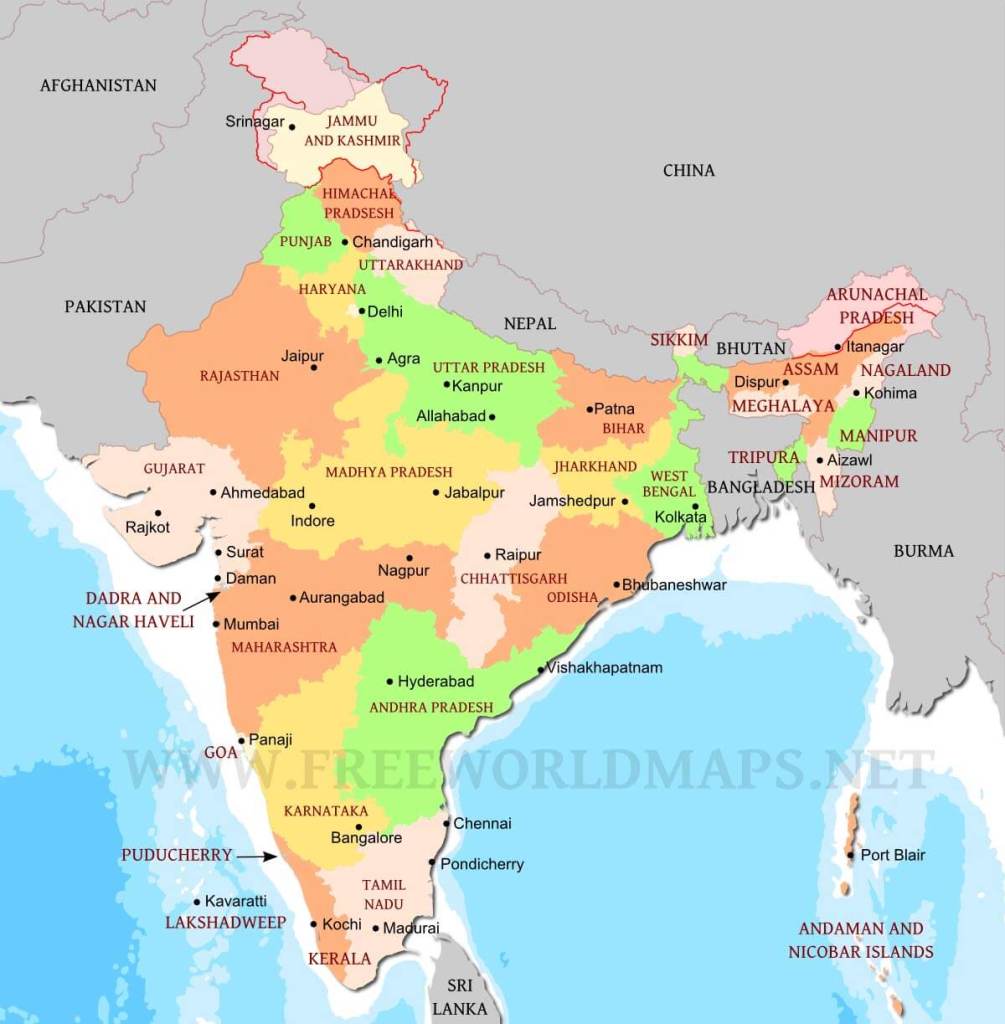
Many people are unaware of the fact that some of the best English literature of the last hundred years or so comes from India. The subcontinent has some 22 officially recognized languages and dialects spoken within its borders. Most people know about Hindi, but what about Assamese, Bengali, Bodo, Dogri, Gujarati, Kannada, Kashmiri, Konkani, Maithili, Malayalam, Marathi, Meitel, Nepali, Odia, Punjabi, Sanskrit, Santali, Sindhi, Tamil, Telugu, and Urdu? Actually, what binds all the various peoples of India together is, believe it or not, the English language, a holdover from British colonial days.

In this post, I will mention two writers whom I have read over the years with great pleasure. First, there is Rasipuram Krishnaswami Iyer Narayanaswami, better known as R K Narayan (1906-2001).

Narayan was brought to the attention of the English-speaking world by none other than Graham Greene. Like William Faulkner with his Yoknapatawpha County, Narayan created a fictional town in Tamil Nadhu called Malgudi and wrote numerous novels and short stories about the people who live there. My favorites among his novels are Swami and Friends (1935), The Financial Expert (1952), The Guide (1958), The Man-Eater of Malgudi (1961), and The Vendor of Sweets (1967).

Another excellent Indian writer writing in English is Anita Desai (born 1937), who currently teaches at MIT in Cambridge, Massachusetts.

Several times, Desai has been shortlisted for the Booker Prize. Among my favorites of her novels are Clear Light of Day (1980), Baumgartner’s Bombay (1988), Fasting Feasting (1999), and The Artist of Disappearance (2011).

There are others I can name, but I have not read as many works by them as I have from Narayan and Desai. If you are interested in the many worlds of India, I heartily recommend that you give them a try.

Cherrapunji

Photo by Manish Jaishree of the Wettest Place on Earth

Here I am, reading about massive rainstorms in India circa 1990 while living iat the edge of a desert—and one in an increasing cycle of drought. I imagine, someone in Cherrapunji, India, might have dreams of living in a dry country in which, for all intents and purposes, there is no rainfall for six months of the year.

For your information, Cherrapunji is considered the wettest place on earth. It holds the record for the most rainfall in a calendar month and in a year: it received 9,300 millimeters (370 inches; 30.5 feet) in July 1861 and 26,461 millimeters (1,041.8 inches; 86.814 feet) between 1 August 1860 and 31 July 1861. in Alexander Frater’s book Chasing the Monsoon, the author talks of a friend of his father experiencing rainfall for several consecutive days in which between 30 and 40 inches of precipitation fell.

I miss rain. In Los Angeles, we only had one day of persistent rain in the last twelve months. There have been numerous instances of what I call a dirty drizzle, in which the windshield of my car is muddy as the result of an insufficient drizzle. To form a raindrop, there must be a bit of dust in every drop. But when not enough rain falls to operate the windshield wiper, then the dust predominates.

California and the American Southwest looks to be one of the big losers in climate change. The Colorado River is drying up, the Sierra snowpack is insufficient to fill the reservoirs the state needs, and horrible wildfires are destroying our forests.

There is not too much one can do about it except wait it out. Climate change has happened before. Up until the 13th century, Greenland was actually a fairly prosperous place, but then a little ice age set in and the colonists appear to have vanished from the pages of history. The town of Garðar was actually a bishopric, but nothing remains of its past glory.

Actually, I wouldn’t mind another “little ice age,” but who knows what will happen in the years to come?