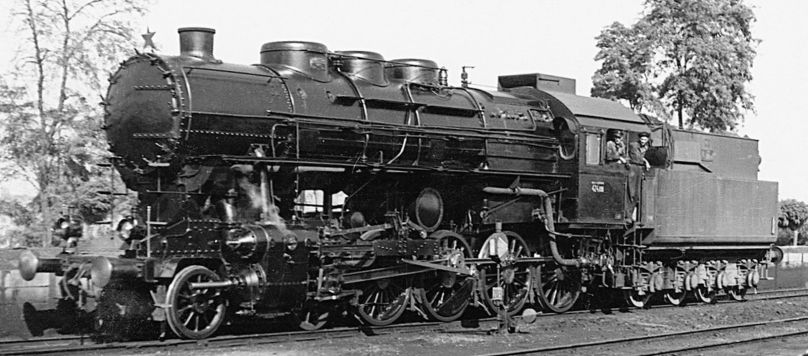
Hungarian State Railways (MÁV) 4-2-4 Steam Locomotive
In Lászlo Krasznahorkai’s great 1989 novel The Melancholy of Resistance, a scheduled train that never shows up throws waiting passengers into a tizzy. A Hungarian novelist, Krasznahorkai is the winner of the Nobel Prize for Literature (2025), the International Booker Prize, and numerous other international literary accolades. Here is a selection from the first page of George Szirtés’s excellent translation of the novel.
To tell the truth, none of this really surprised anyone any more since rail travel, like everything else, was subject to the prevailing conditions: all normal expectations went by the board and one’s daily habits were disrupted by a sense of ever-spreading all-consuming chaos which rendered the future unpredictable, the past unrecallable and ordinary life so haphazard that people simply assumed that whatever could be imagined might come to pass, that if there were only one door in a building it would no longer open, that wheat would grow head downwards into the earth not out of it, and that, since one could only note the symptoms of disintegration, the reasons for it remaining unfathomable and inconceivable, there was nothing anyone could do except to get a tenacious grip on anything that was still tangible; which is precisely what people at the village station continued to do when, in hope of taking possession of the essentially limited seating to which they were entitled*, they stormed the carriage doors, which being frozen up proved very difficult to open.
- Earlier in the paragraph: “[T]he only two serviceable old wooden-seated coaches maintained for just such an ‘emergency’ were coupled to an obsolete and unreliable 424, used only as a last resort.”



You must be logged in to post a comment.