Tacos de Cordero

Dining at the Market in Izamal

Yesterday’s post made me look back fondly to my 2020 trip to Yucatán. I made the acquaintance of a tour guide who helped me find medical care for some really bad blisters from too much walking the streets of Mérida. He recommended a nice jipijapa straw hat, which I bought because I was grateful for his help.

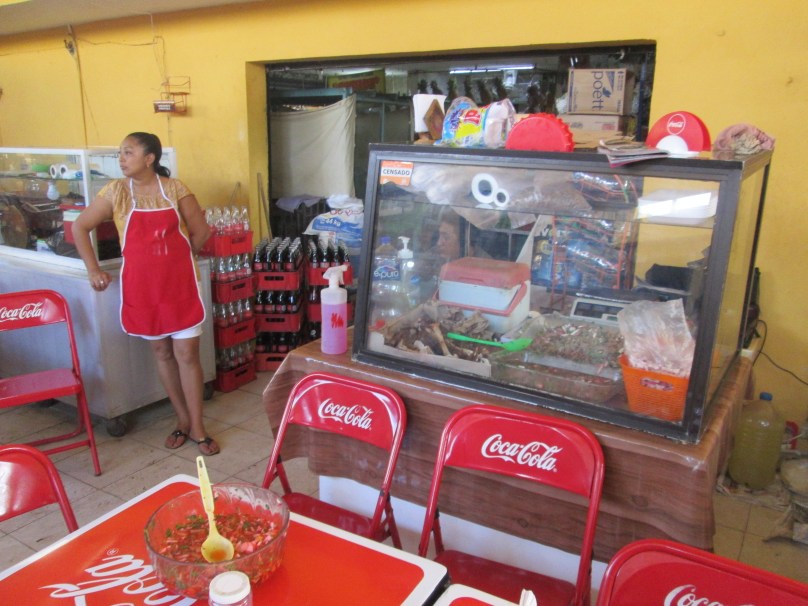
He lived in Izamal, which is an hour drive from the city. We got to talking about food. His favorite restaurant in Izamal was the city market, especially a stall which sold tacos de cordero, or lamb tacos.

Since I was planning to visit Izamal in any case, I noted down the info he gave me. Because my blister was healing slowly, I arranged for a taxi to drive me to Izamal, where I stayed at the Gardenhotel Macan Ché Bed & Breakfast. As soon as I dumped my bags, I walked to the city market and had two lamb tacos at the place recommended by my friend in Mérida (shown in the photo above). They were delicious—and very reasonably priced.

Izamal is known for its multiplicity of Maya ruins, especially Kinich Kakmó. More famous is the Convento de San Antonio de Padua, a huge yellow structure which combined a church, a monastery, and a fortification. Pope John Paul II visited there in August 1993.

After seeing the sites, my blister was healed; and I was able to take the Oriente bus back to Mérida.
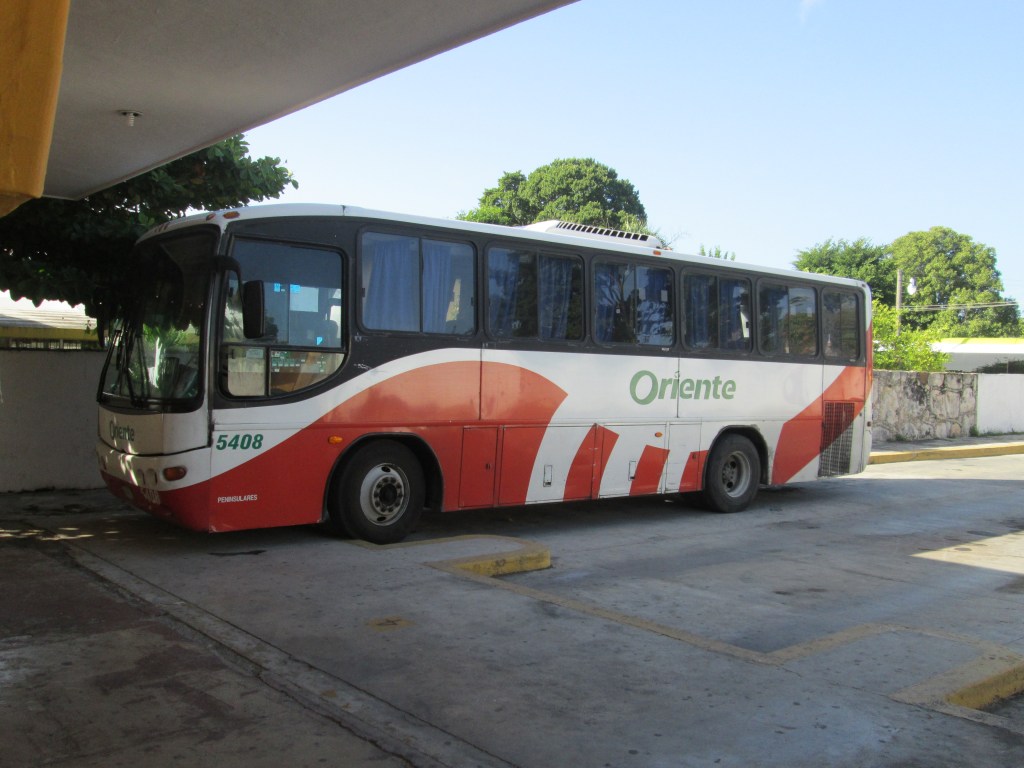
The Oriente Bus from Izamal to Mérida

I was surprised to find that intercity bus travel in Yucatán had improved markedly since my last visit. Even the second class buses looked new and were air-conditioned. In 1980 or thereabouts, I remembered riding a Unión de Camionéros de Yucatán bus from Uxmal to Campeche with broken windows, busted seats, and no air conditioning.
Boat People

Oh, Those Evil Mexicans!

For this post to make any sense, you’ll need to know the exchange rate between the U.S. dollar and the Mexican peso around the time of my trip. When I was there, the peso ran around 17.5 to the dollar, or about 6¢ each.

There is not much love lost between cruise ship passengers and Mexicans. (In fact, there is not much love lost between cruise ship passengers and me, for that matter.) They tend to be retirees whose idea of paradise is to rot on some beach somewhere. They know next to nothing about the countries they visit. In fact, they don’t know the language; their wallets are stuffed with dollars; and they basically listen to what their handlers tell them.

I was in Izamal when for a brief moment, I was mistaken for a boat person. I hand just seen the Church of San Antonio de Padua and wanted to get back to my room. There was a taxi tout next to the Centro bus station who said a taxi would cost 100 pesos for the five-block ride. I glared at him, said that was demasiado caro (“too expensive”), and hoofed it back to my room, which I would have done in the first place if I weren’t recovering from a nasty blister on my right big toe. The tout looked surprised: These boat Gringos weren’t supposed to know any Spanish, and certainly wouldn’t know that the in-town taxi rate in Izamal was only 25 pesos.

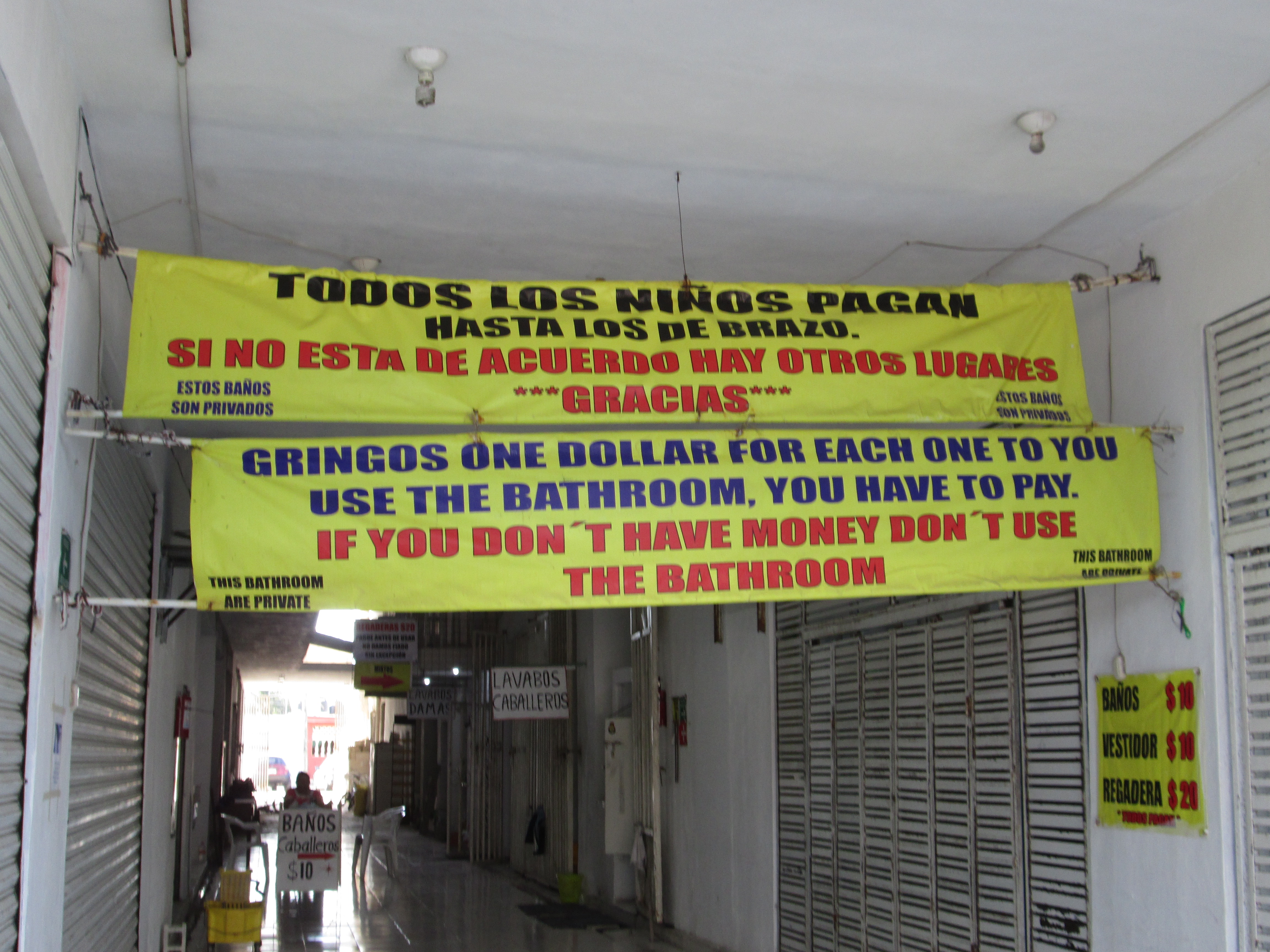
Cut to Progreso, which has two or more cruise ships call each week. The malécon fills up with American cruise ship zombies, who quite naturally have to relieve themselves from time to time. There are bathrooms (sanitarios) in the alleys off the malécon, costing 5 or 10 pesos each. The equivalent price in dollars is 30-60¢, but U.S. coins cannot be exchanged for pesos in Mexico, so the bathroom is charging $1.00 to Gringos. (The sign on the right side of the above photo sets the price in Mexican currency for a bathroom visit to be 10 pesos.)

Finally, also in Progreso, I saw a scene that annoyed me to no end. I purchased a one-way ticket to Mérida for 21 pesos. At the same time, a tout was selling round trip tickets to Mérida for $10.00 each, about four times what I paid. The boat people were grabbing them up as if they were a bargain. Several, seeing that I spoke Spanish while looking like a Gringo, came up to ask me questions. I smiled and answered them … in Hungarian. I have no intention of being a cavaliere servente to a bunch of brain-dead Yanqui tourists.

The Yellow City

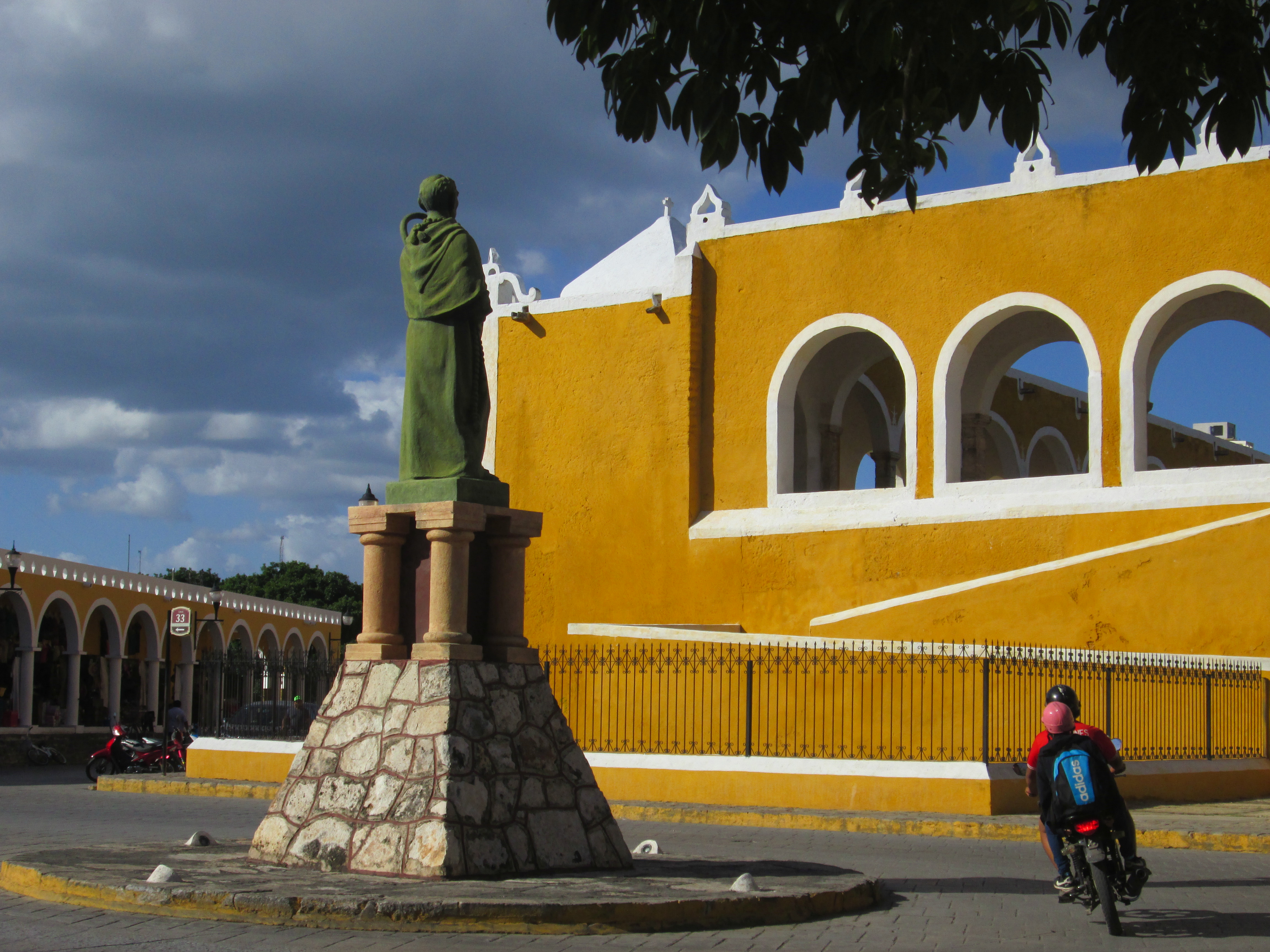
Statue of Diego de Landa Facing the Church of San Antonio de Padua

On my recent trip to Yucatán, I enjoyed staying in smaller towns such as Izamal, each of which seems to have some unique claim to fame. In the case of Izamal, it was the deep yellow color that characterized most of the structures in town. There are a number of reasons for this, but I like the story my guide to the Church of San Antonio de Padua told me: “It’s the color of corn—and we Maya believe that man was created from corn.”

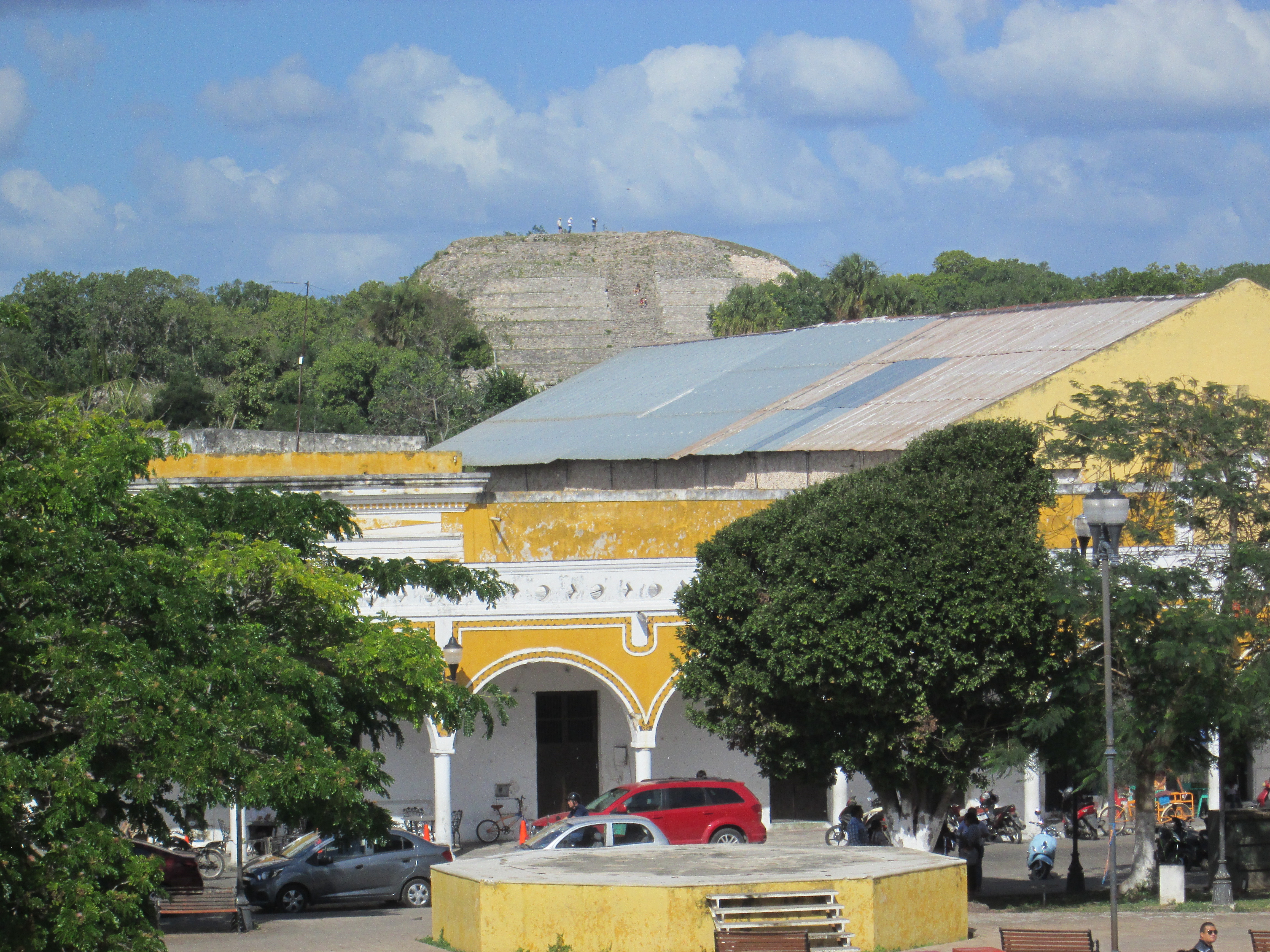
Visible throughout the town are the ruins of ancient Maya structures, particularly the Pyramid of Kinich Kakmo, which is visible from the church:

The Pyramid of Kinich Kakmo Seen from the Church

The church at Izamal is notable for the large size of its footprint, supposedly the second biggest in all of Christendom after St. Peter’s in Rome—and also for two church figures associated with the town. The first is the Franciscan Diego de Landa who is both infamous and famous: the former because as Bishop of Yucatán, he ordered the burning of all the Maya codices as heretical, the latter for writing a book which attempted to atone for his crime by writing Relación de las cosas de Yucatán, which helped scholars of our times understand how to read Maya glyphs.

The other figure who stepped into Izamal’s history is Pope John Paul II, who, during his travels, visited Izamal in August 1993 and served Mass there to a crowd numbering in the tens of thousands. According to an article in the Los Angeles Times:

About 3,000 representatives of indigenous groups of the Americas gathered here to meet with the Pope at a 16th-Century Franciscan sanctuary erected atop a Mayan temple to the sun god. By the Vatican’s count, there are 52 million native peoples in Latin America–26 million in Mexico alone.

“Unfortunately, it must be noted that the richness of your cultures has not been duly appreciated. Neither have their rights been respected as peoples and as communities,” John Paul said. “Sin has also cast its shadow on America in the destruction of not a few of your artistic and cultural creations, and in the violence of which you have so often been the object.”

In a 28-minute speech under a merciless tropical sun that wilted his retinue, John Paul singled out some of those communities by name: Guarani, Quechua, Aymara, Nahuatl, Mixtec. And some farther north as well: Apache, Inuit.

The Church of San Antonio de Padua

I spent only one night in Izamal, though I could have spent several days. At the local mercado, a certain Señor Gordo sold two venison tacos with a cold Coke for a grand total of 25 Pesos, about $1.25.