
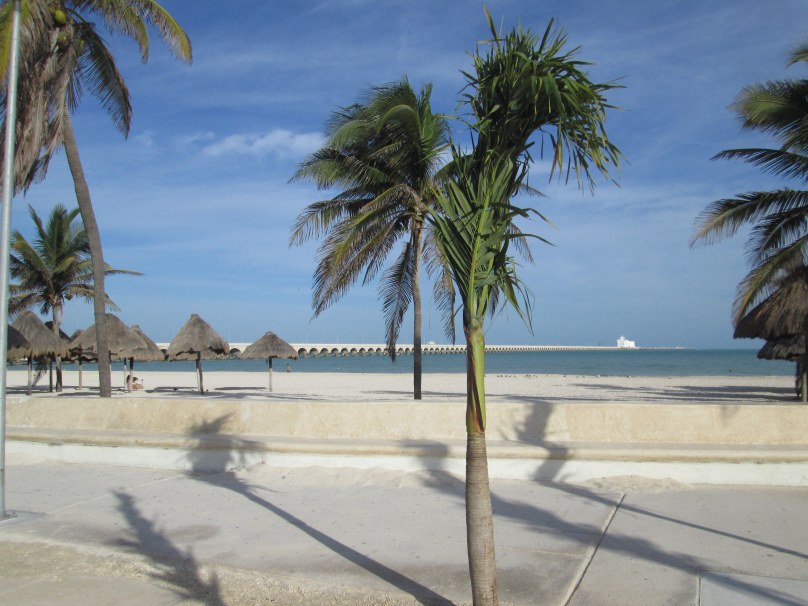
Tropical Paradise?

The Beach at Progreso, Yucatán

We have become accustomed to thinking of tropical beaches as some sort of paradise. When I first came to Southern California, I thought that way too. I used to go to the beach at Santa Monica which was within walking distance of the ocean. I would take a book with me and unroll my towel by Lifeguard Station #12. When it got too hot, I would run into the water and allow myself to be buffeted by the waves. I never learned to body surf, so sometimes I got tumbled around a bit.

Generally, I stayed for only an hour or two to avoid getting sunburned. As I was by myself, there was no one to spread suntan lotion on my back. After a few years, I would go to the beach only before the crowds showed up, around nine in the morning. Then I stopped going altogether.

Why? I really wasn’t that interested in frolicking in the water. Reading on the sand wasn’t that comfortable because it was usually too bright. I wound up falling asleep on my towel and waking up with a sunburn.

The upshot is that, although I visited a number of beach destinations in Mexico, such as Cozumel, Progreso, Mazatlán, Cabo San Lucas, and Puerto Vallarta, it wasn’t the beach that interested me. Frankly, I enjoyed the culture and cuisine more. I could get more reading done in my hotel room than on the beach, where there were vendors, sand flies, broken glass, and discarded plastic straws.

Maybe I’m a bit of a stick in the mud, but my last beach experience was typical. It was January 2000. Covid 19 was just beginning to be noticed. After visiting a number of Maya ruins (Izamál, Uxmal, Kabah, Labna, Sayil, Xlápak, Edzna, Ek Balam, and Dzibilchaltún), I decided to spend a few days in Progreso. Now Progreso is no Caribbean resort: It’s on the Gulf of Mexico and is the seaport for Mérida. The beachgoers were more likely to be locals escaping the heat inland.

The water is more green than blue, and the waves tend to be smallish. As I wandered along the beach, the vendors who set up places in the shade approached me and asked if I wanted a beach umbrella. I shook my head and said I desired sombre (shade) and not sol (sun). Instead, I found a bench in deep shade under the long pier pictured above, which extends 4 miles (6.5 km) out to sea. There, I sat back and read Paul Theroux’s Figures in a Landscape for a couple of hours until it was time for me to find some filete de huachinángo al mojo de ajo. That’s red snapper sautéed in a garlic sauce.
Boat People

Oh, Those Evil Mexicans!

For this post to make any sense, you’ll need to know the exchange rate between the U.S. dollar and the Mexican peso around the time of my trip. When I was there, the peso ran around 17.5 to the dollar, or about 6¢ each.

There is not much love lost between cruise ship passengers and Mexicans. (In fact, there is not much love lost between cruise ship passengers and me, for that matter.) They tend to be retirees whose idea of paradise is to rot on some beach somewhere. They know next to nothing about the countries they visit. In fact, they don’t know the language; their wallets are stuffed with dollars; and they basically listen to what their handlers tell them.

I was in Izamal when for a brief moment, I was mistaken for a boat person. I hand just seen the Church of San Antonio de Padua and wanted to get back to my room. There was a taxi tout next to the Centro bus station who said a taxi would cost 100 pesos for the five-block ride. I glared at him, said that was demasiado caro (“too expensive”), and hoofed it back to my room, which I would have done in the first place if I weren’t recovering from a nasty blister on my right big toe. The tout looked surprised: These boat Gringos weren’t supposed to know any Spanish, and certainly wouldn’t know that the in-town taxi rate in Izamal was only 25 pesos.

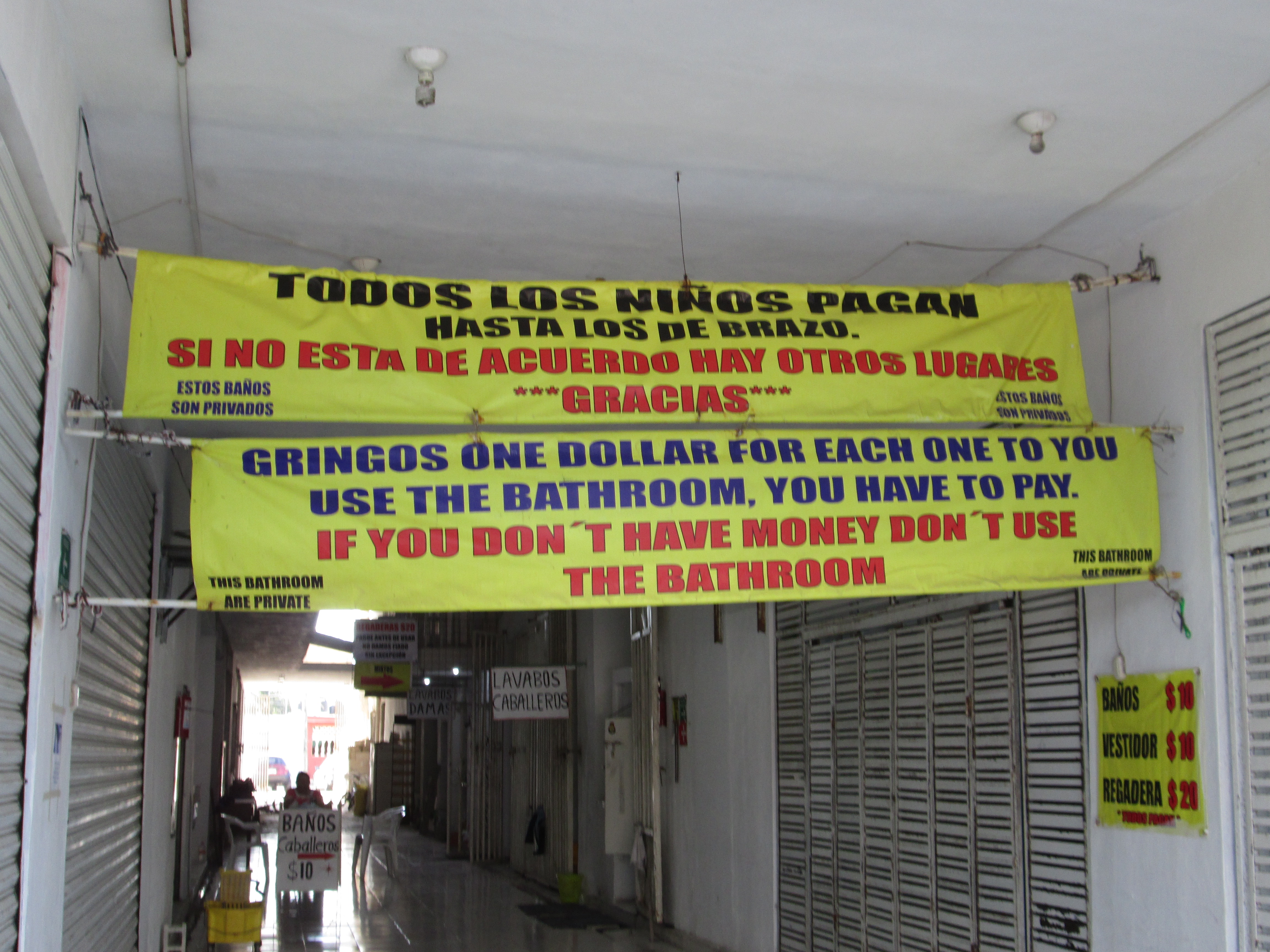
Cut to Progreso, which has two or more cruise ships call each week. The malécon fills up with American cruise ship zombies, who quite naturally have to relieve themselves from time to time. There are bathrooms (sanitarios) in the alleys off the malécon, costing 5 or 10 pesos each. The equivalent price in dollars is 30-60¢, but U.S. coins cannot be exchanged for pesos in Mexico, so the bathroom is charging $1.00 to Gringos. (The sign on the right side of the above photo sets the price in Mexican currency for a bathroom visit to be 10 pesos.)

Finally, also in Progreso, I saw a scene that annoyed me to no end. I purchased a one-way ticket to Mérida for 21 pesos. At the same time, a tout was selling round trip tickets to Mérida for $10.00 each, about four times what I paid. The boat people were grabbing them up as if they were a bargain. Several, seeing that I spoke Spanish while looking like a Gringo, came up to ask me questions. I smiled and answered them … in Hungarian. I have no intention of being a cavaliere servente to a bunch of brain-dead Yanqui tourists.

Progreso

The Beach at Progreso, Complete with 4-Mile-Long Pier

Although I’m not much of a beach person, I decided to end my vacation in Mexico with three days at the Gulf port of Progreso, essentially doing nothing. Well, that’s not exactly true, because on one of those days I hired a taxi to take me to the Maya ruins at Dzibilchaltún (about which more in a later post). I spent my days looking for a nice shady place to read while escaping the heat, and my evenings relaxing in air-conditioned comfort at the Playa Linda Hotel, which was right on the beach.

Progreso is an odd town. When a cruise ship docks at the 4-mile-long pier, the town is overrun with retired American passengers looking for places to eat and things to do. On days when no cruise ship is socked, many places choose not to open at all: Only a few restaurants right near the centralized Calle 80 can be depended upon to welcome diners. There are no museums in Progreso, no really old churches; but there is a nice market with some interesting cheap dining places.

Good Cheap Eats at the Local Market

I had been to Progreso twice before, but only on day trips from nearby Mérida (about 25 miles south, or 43 km). What I remember most vividly were the fish dinners I had there. Now, on my third—and longer—visit, I can say that the fish is indeed wonderful. I remember a place of ceviche de pulpo, raw octopus marinated in lime juice and served with onions, tomatoes, and cilantro. The lime juice in effect “cooks” the octopus. On my last day in Yucatán, I had a ceviche de pescado (with fish this time) at the Marlin Azul in Mérida.

From the Beach Looking Down Calle 80 (with Lighthouse)

One final note: Why is the local pier 4 miles long? Apparently, the Gulf of Mexico is too shallow for shipping at lesser distances. If I were a more of a beach person, I would have waded out into the water to check it out—but alas, I never even so much as got my feet wet.