Holding the Gods to Account

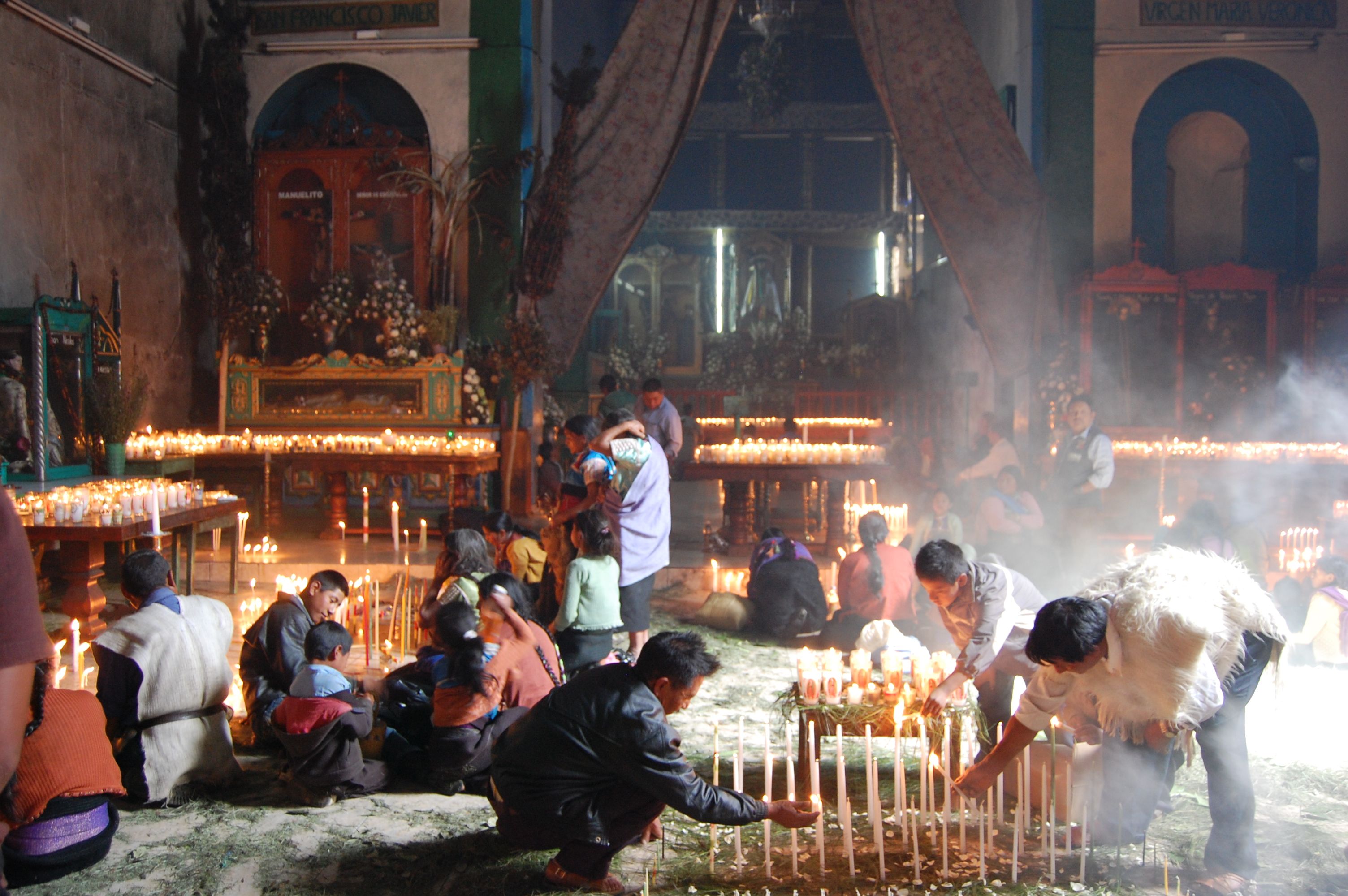
A Rare (and Forbidden) Interior Shot of the Chamula Religious Observances

My brother and I visited the Tzotzil village of San Juan Chamula in 1979. We stood in the back of a stake truck from San Cristóbal de las Casas along with dozens of Chamulas. In the village, we requested permission to visit the church, which was at one time Catholic until the Tzotzil threw the priests out and took over the churches for their own syncretic observances. In the alcalde’s office, we had to sign a promise that we would not take any photographs inside under pain of the severest punishment. (During the 1980s, at least European tourist was killed by an angry mob for just such a transgression).

I found the following description in Paul Theroux’s On the Plain of Snakes: A Mexican Journey, which I have just finished reading:

On the way to Oventic I stopped at the town of Chamula, famous for its weird church observances, where the interior of the basilica of San Juan Bautista was ablaze with flames. Worshipers crouched on the floor arranging candles, fifty or a hundred in symmetrical patterns, then lighting them and, in the candlelight, drinking Coca-Cola and ritually burping—eructation believed to be salutary—and splashing libations of Coke on the church floor, which was covered with sand.

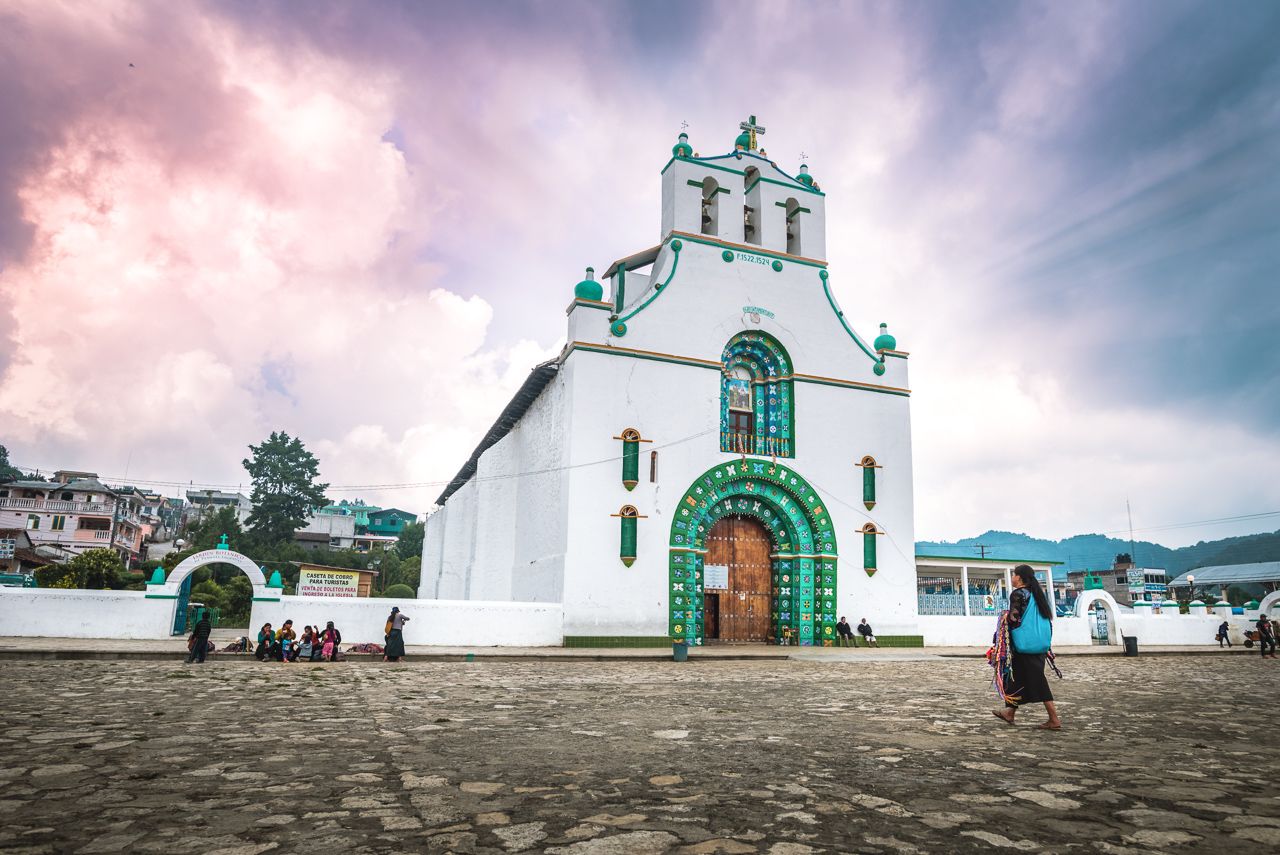
The Church at San Juan Chamula

There were no pews, there were no priests, there was no Mass or formal service. It was a gathering of curanderos—medicine men—and those wishing to be cured. Other solemn groups were chanting, passing hens’ eggs around the the faces and bodies of prayerful pilgrims in a limpia—a purification—or holding a squawking chicken near a kneeling devotee, and a moment later the chicken’s neck was wrung, and the softened, drooping carcase placed near the candles.

As I watched, a man approached me holding a bottle and a glass. He said, “Mezcal,” and poured me a slug and offered it. I drank it, blinked away the dazzle in my eyes, thanked him, and kept looking.

It was a fusion of pre-Hispanic traditions and Christian dogma, the result an observance involving a mass of candles, throttled chickens, and soda pop. (But sheep are sacred, never harmed or eaten: the town of Chamula is full of grazing sheep.) Added to these rituals was a chance for retribution, because if the chosen saint did not grant the supplicant’s wish, the deity could be punished, just as the Zapotecs and mayans punished their gods and saints, lashing their images with whips. In this church, the statues of saints, which had been ceremonially draped, with an uttered prayer, could be stripped of their robe if the prayer was not answered.

Check out the above YouTube video, which gives a you a feeling of life in this Tzotzil village.

Different

Columbus Discovered a Whole New World

As we approach Columbus Day (October 12), it is useful to note that there few monuments to him in most of the New World. Just as there are few monuments to Hernan Cortés or Francisco Pizarro. It would be sort of like Jews creating monuments to Heinrich Himmler or Adolph Eichmann. Since most Gringos are of European ancestry, we have a hard time seeing the world from the eyes of the Caribs who first saw Columbus on San Salvador on October 12, 1492. Oh, by the way, there are no more Caribs. They all died off from the diseases the conquerors brought with them or the subsequent enslavement by their new masters.

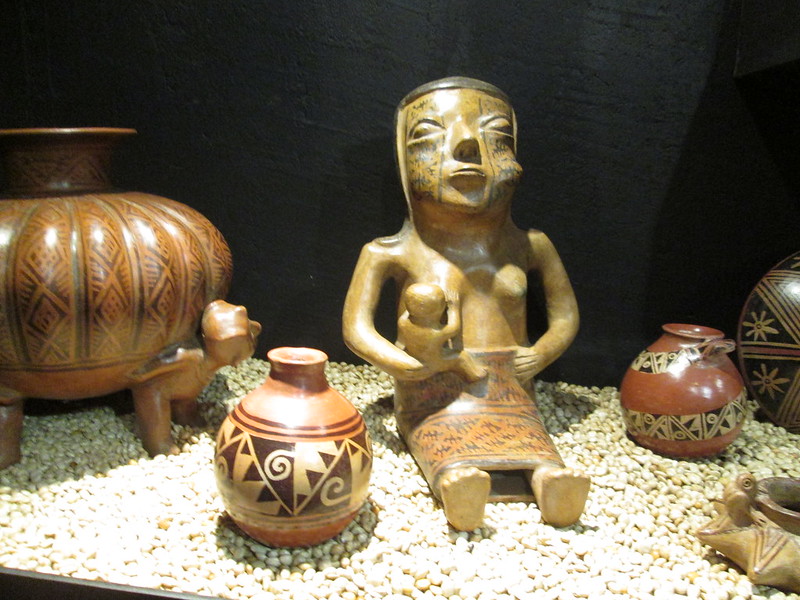
The above image from Quito’s Mindalae Museum has a distinctively non European air about it. Pre-Columbian art, in general, looks odd to Gringos, unless they have developed the fine art of seeing the world through the eyes of other peoples. This is something even our President hasn’t done, inasmuch as he sees Mexican and Central American refugees as rapists. (Talk about the pot calling the kettle black!)

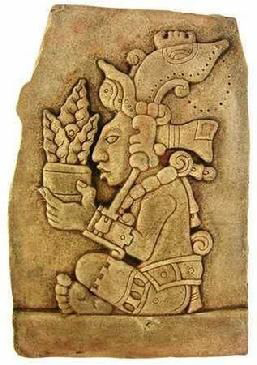
Nowhere is the difference between our culture and theirs more prominent than on the subject of religion. Below, for instance, is an image of the Maya maize god, Hun Hunahpu:

The Maya Maize God

The gods of the Maya pantheon at times appear to partake of the characteristics of lizards, alligators, monkeys, and other creatures—quite different from the Judaeo-Christian and Islamic Deity.

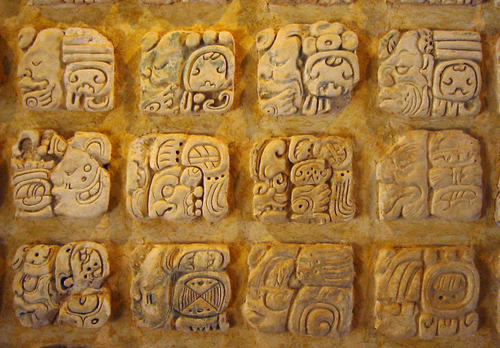
Different as they were from us, the Maya developed a calendar that, even after over a thousand years, is more accurate than our own. They had writing, which, though resembling monsters more than characters in the Greek and Roman alphabets, still enabled them to write their history.

Mayan Glyphs

Even though the cultures of the Old World have proven so dominant, we are only now discovering that the Maya had their own strengths. Although the Aztecs and Inca are no longer active cultures, there are still six million Maya speaking some thirty dialects of the Mayan tongue. The old Mayan glyphs may no longer be in use, but there is still an active Maya culture—actually, a number of them.


War All the Time

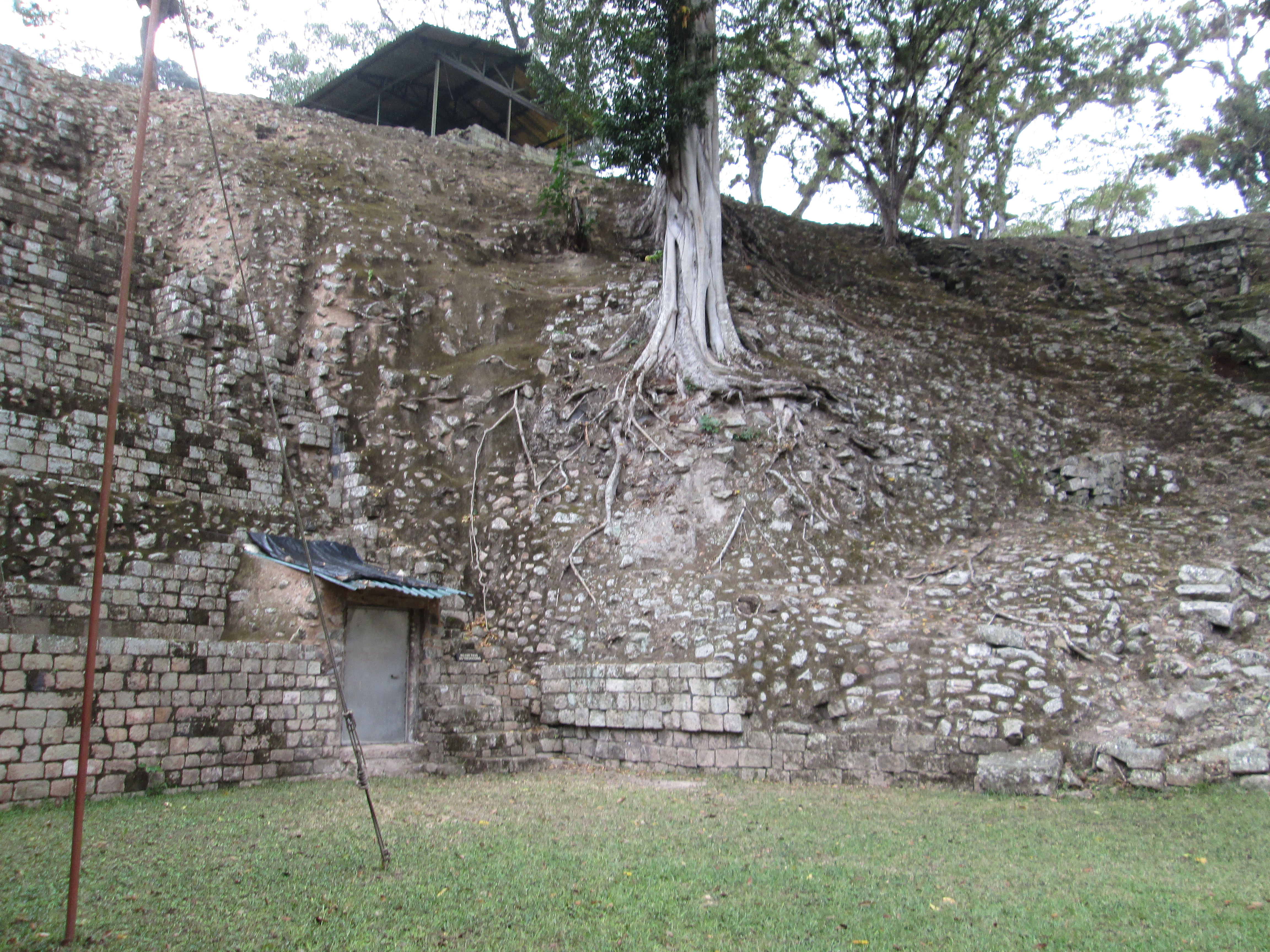
Ball Court at Maya Ruins in Copán, Honduras

I have just finished reading Maya Cosmos: Three Thousand Years on the Shaman’s Path by David Freidel, Linda Schele, and Joy Parker. It was not an easy book to read, and it was a bit on the speculative side, but it brought forth a highly original interpretation of the fall of Classical Maya Civilization (approximately AD 250-800):

In their own way, the Maya thus acknowledged the terrible truth of war as statecraft: the authority of a small number of people over the many who must suffer and die in combat. But unlike our leaders, Maya rulers themselves went to war with the men they sent; and Maya kings and their noble vassals put not only their bodies but also their souls in jeopardy every time they clashed. It is no exaggeration to say that they lived for those moments of truth, those trials of the strength of their spirits. Every major political activity in their lives—the dedication of every public text, image, and building of royal and community importance—required the capture and sacrifice of rival peers. Only in this way could the proper rituals of sanctification be fulfilled, the gods nourished, and the portals of communication opened between the human and the divine.

When the Maya stopped inhabiting their ceremonial centers around AD 800, it wasn’t because they had disappeared: They found that there was too high a price to pay to maintain the god/kings in their position of rule. My personal belief was that certainly was one of the reasons why the Classical Civilization fell, but not the only reason

Macaw Markers from the Copán Ball Court

Intimately connected with the endless wars were a serious of gladiatorial combats in the form of … a ball game. Ball courts were scattered throughout Mesoamerica. At times, the games were friendly and/or ceremonial, but often they were played with the god/kings and nobles of other cities. The losing side was sacrificed to the gods. During the game, the ball could not be hit by the hands or feet: Only the thigh or hip could be used. The ball, made of rubber, was bounced against the sides of the ball court—but at no time was it allowed to touch the ground. If it did, game over—and lost.

Many a Maya god/king was sacrificed in this way, including the great 18 Rabbit of Copán, who was sacrificed at Quiriguá, which was a much smaller Maya polity.


The Talking Stones of Yaxuna

The Mayan Glyph Stairway at Copán

The Maya believe that certain inanimate objects, such as stone glyphs and statues had souls. The following excerpt, entitled “The Talking Stones,” comes from Maya Cosmos: Three Thousand Years on the Shaman’s Path by archeologists David Freidel, Linda Schele, and Joy Parker:

When I read Paul Sullivan’s book [Unfinished Conversations: Mayas and Foreigners Between Two Wars] it helped me understand something I had witnessed among the village people of Yaxuna who worked with me on the nearby ancient city. When excavation first began, the villagers were deeply concerned that we might try to remove stones, especially carved stones, from the ruins. I had difficulty understanding their anxiety. I explained to them that sometimes artifacts had to be removed for analysis, but that they would be returned faithfully when safe storage could be built for them. The matter was of such importance to the villagers that finally Don Pablo, the local shaman, took it personally  upon himself to ensure that no carved stones be removed from the site. There were some strained moments when the archeologists of the Mexican government insisted that carved stones be taken to safekeeping and the Yaxuna people insisted that they stay; but the tensions were finally resolved. The stones of Yaxuna are still there, under the watchful eyes of the villagers, and now I know why the matter loomed so large: such stones are likely k’an che’, seats of supernaturals.

I had one other encounter with Don Pablo and talking stones. One day in the summer of 1989, after he had done some work on the camp kitchen, I found a clear glass marble in the area. Thinking it belonged to Don Pablo and was one of his saso’ob, the “lights” he used when focusing spiritual forces, I took it next door to him that evening. He took the marble and inspected it carefully.

“Yes,” he said finally, “this is a stone of light.”

Then he smiled, “However, it won’t speak until it has been soaked in maize gruel, sak-a’, and then it will speak only Maya.”

Why Latin America?

There Is a Reason Why I Keep Going Back There

My first vacation on my own—at the age of thirty—was to Yucatán. In the intervening years, more than two-thirds of my international vacations have been to Mexico, Central or South America. Originally, my interest was in Pre-Columbian archeology. I still am, but I’ve added post-Columbian (i.e., Christian) archeology to my interests. The two exist side by side in fascinating ways.

Many Latin-American towns have museums of religious statuary and paintings that used to be in churches that are no longer in service. Lima, Peru, for instance has a fascinating museum in the former Archbishop’s palace adjoining the cathedral.

Sacramental Vessels from Lima’s Archbishop’s Palace

American tourists usually go in for all the pre-Columbian sites, but are totally uninterested in the ruins of Catholicism that are evident all over the place. In places like Buenos Aires; Cuenca, Ecuador; Mérida, Mexico; and Antigua, Guatemala there are old churches that are no longer in use, but there are thousands of items of religious art that are fascinating to me. One of the most incredible is the huge monastery of Santa Catalina in Arequipa, Peru, which is like a walled city in its own right.

The Monastery of Santa Catalina in Arequipa, Peru

In the morning that I visited Santa Catalina, I took the two-hour morning tour. Then I went to lunch and had some rocoto relleno (spicy stuffed Peruvian green pepper) in a restaurant behind the cathedral. Then I went back and spent the whole afternoon actually trying to get lost as I wandered through the narrow streets and saw the chapels, nuns’ cells, gardens, kitchens, laundries, and other services that made up the monastery.

Looking back, I think I’d rather see Santa Catalina again than Machu Picchu. In my mind, they are of equivalent interest, but Santa Catalina is much nicer.


Looking South

I Am Looking Forward to My Next Trip to Latin America

It has been not five months since my return from Guatemala, and already I am looking forward to Yucatán and Belize—which is still more than six months in the future.

(Incidentally, I would never refer to it as “the” Yucatán unless I were wearing a pith helmet and those stupid zip-off pants/shorts worn by travelers who fear to venture more than twenty yards from their hotel room without an escort.)

I have been to Yucatán four times in all, the last time with Martine in November 1992. During my visits between 1975 and 1992, I have visited about a dozen Maya archeological sights. Since then, scores more have been developed, including one of the largest at Calakmul in the State of Campeche. In addition, I hope to visit Cobá in Quintana Roo, Ek Balam and Kinich Kakmó in Yucatán, Edzna and several Rio Bec sites to be decided later in Campeche, and Yaxchilan and Bonampak in Chiapas. In addition, I plan to revisit some of the sites I have already seen such as Chichen Itza, Uxmal, and Palenque.

There is something calming about seeing what remains of an ancient civilization—one that had the ability to adapt itself to changing circumstances and survive in the 21st Century.

Yucatec Maya Girls Today

The Maya population is scattered across five Latin American countries: Mexico, Guatemala, Belize, Honduras, and El Salvador. A large number of Maya have found their way to the United States from Guatemala and Honduras, because of dire conditions in their countries of origin, though Maya from Mexico tend not to migrate to the United States. That is despite the long Caste War against the Ladino (Spanish speaking) population that ended only in the early 1900s and the Zapatista Revolt in Chiapas during the 1990s.


The Past Goes Up in Flames

Frederick Catherwood’s Drawing of Maya Ruins at Chichén Itzá

I wanted to write about the Notre Dame de Paris fire yesterday, but I held back. All I could have said at that point is, “What a horrible shame! I am completely aghast!” It needed me to sleep on he news before I was able to put the event in any perspective.

That perspective, as it comes to me now, is that our past is always and everywhere going up in flames, collapsing under the wrecking ball, or being abandoned and overgrown. The City of Los Angeles, for example,  is under the sway of greedy developers who think nothing of bulldozing our history. Much of the history of motion picture production in Hollywood is gone forever, with just a few isolated buildings such as the Chinese and Egyptian Theaters, the Lasky-DeMille Barn, and the Post 43 American Legion Theater standing out from the architectural Kleenex boxes.

Have you ever heard of the seven wonders of the ancient world? They are (or rather were) as follows:

  • The Lighthouse of Alexandria, Egypt
  • The Colossus of Rhodes
  • The Mausoleum of Halicarnassus
  • The Temple of Artemis at Ephesus
  • The Statue of Zeus at Olympia, Greece
  • The Hanging Gardens of Babylon
  • The Great Pyramid at Giza, Egypt

How many of these wonders still exist? Only one, the Great Pyramid. All the others were destroyed by natural disasters and other mishaps over the centuries and millennia. All the great cathedrals of Europe are vulnerable to fires, terrorism, floods, and what have you.

Overgrown Maya Ruins at Copán, Honduras

My visits to Maya ruins in Guatemala and Honduras in January brought home to me in the most vivid way the fragility of the past. I keep thinking of Shelley’s poem “Ozymandias”:

I met a traveller from an antique land,
Who said—“Two vast and trunkless legs of stone
Stand in the desert. . . . Near them, on the sand,
Half sunk a shattered visage lies, whose frown,
And wrinkled lip, and sneer of cold command,
Tell that its sculptor well those passions read
Which yet survive, stamped on these lifeless things,
The hand that mocked them, and the heart that fed;
And on the pedestal, these words appear:
My name is Ozymandias, King of Kings;
Look on my Works, ye Mighty, and despair!
Nothing beside remains. Round the decay
Of that colossal Wreck, boundless and bare
The lone and level sands stretch far away.”

How many other cultural landmarks will disappear during our lifetimes? I have visited Notre Dame twice and marveled at the sheer artistry and magnificence of the place. I hope that the French succeed in reconstructing the interior, the roof, and the spire that were destroyed in the conflagration.

Unfinished Business with the Maya

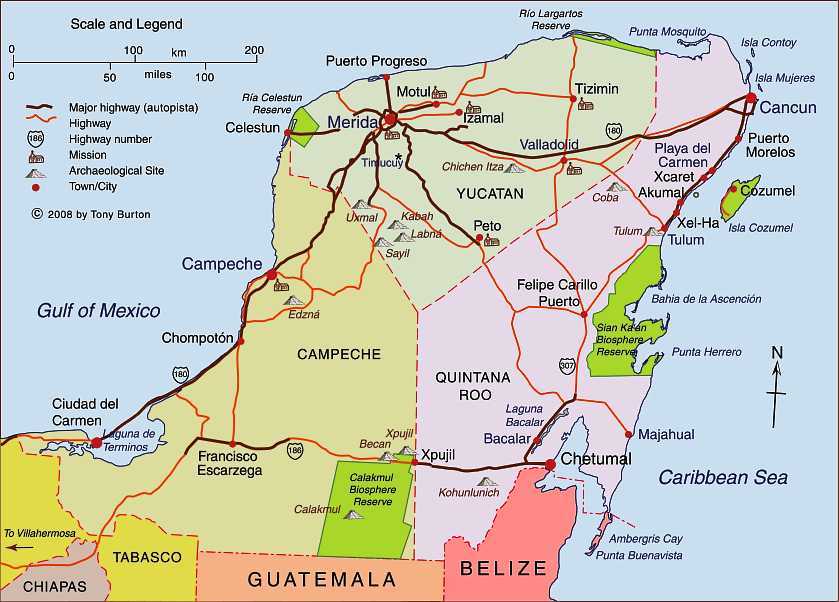
The Three States on the Yucatán Peninsula

I have not been to the Maya parts of Mexico since 1992, when I traveled to the Yucatán Peninsula with Martine and several co-workers at Urban Decision Systems. Now I am thinking of going again. My January trip to Guatemala only whet my appetite for more.

On past trips, I have seen the ruins at Chichén Itzá, Uxmal, Dzibilchaltun, Acanceh, Mayapan, Palenque, Tulum, Kabah, Labna, Sayil, and Xlapak. I would not mind seeing Chichén, Uxmal, and Palenque again, and perhaps even spending a little time at Valladolid and Izamal, which I have not seen. New destinations would include several Maya ruins in the State of Campeche, most notably Calakmul and Edzná, and Bonampak and Yaxchilán in the State Of Chiapas. The latter two can be seen on a tour from Palenque.

The most problematical destination is Calakmul, which may possibly have been the largest Maya city at one time—perhaps even bigger than Tikal in Guatemala. The problem is that the southeastern edge of the State of Campeche has not yet been sufficiently developed for tourism by the Mexican government. I can possibly get a tour from either the city of Campeche or of Chetumal in Quintana Roo.

Maya Structures at Calakmul

There is also the possibility of Cobá in Quintana Roo. I might visit it if I have to go to Chetumal to set up a tour for Calakmul. Otherwise, I would be reluctant to run into the passenger ship mobs that dock at Cancun and the Maya Riviera.

Two cities I would love to re-visit are Mérida in Yucatán and Campeche in the state of the same name. Both are delightful places that positively reek of contemporary Maya culture, with hints of the Mexican mestizo culture and—oddly—an admixture of Lebanese and Syrian, due to the merchant classes that set up there in the 19th Century.


The Copán Ruling Dynasty


Altar L with God/Kings of Copán

When I first began traveling in Maya lands, the Maya did not appear to have a history. Now that so many of their glyphs have been translated, we see that—particularly in the Classic Period between AD 600 and and some point in the 9th century AD, most of the major archeological sites not only had a history, but a rich one as well.

The first event recorded at Copán in Honduras was in 321 BC on Altar I. There was a founder of a dynasty called K’inich Yax K’uk’ Mo’ who ruled between 416 and 437 AD. Then there were two unnamed rulers before K’altuun Hix dedicated a carved step inside the Papagaya Structure around 480 AD. There were two more unnamed rulers before Balam Nehn (524-532 AD) and Wil Ohl K’inich (532-551 AD).  After an unnamed Ruler 9, we have a filled-chronology that takes us all the way to 822 AD:

  • Moon Jaguar (553-578)
  • K’ak’ Chan Yopaat (578-628)
  • Smoke Imix (628-695)
  • Waxaklajuun Ub’aah K’awiil, better known as 18 Rabbit (695-738)
  • K’ak’ Joplaj Chan K’awiil, better known as Smoke Monkey (738-749)
  • K’ak Yipyaj Chan K’awiil better known as Smoke Shell (749-763)
  • Yax Pasaj Chan Yopaat, better known as Yax Pac (763-820)
  • Ukit Took’ (began reign in 822 AD)

It was Ukit Took’, the last known ruler of Copán, who dedicated Altar L, shown above, identifying his predecessors. There are no known dates at Copán after 822 AD.

What happened in 822? The kingship failed for various reasons, as it did around then through most of the adjacent area, for environmental reasons (probably drought), overpopulation, and a change in the form of governance.

As alien as the dynastic names above may seem, the chronology is surer than that of many European dynasties of the period. The calendar was sacred to the Maya, so they were sure to note the exact date that events occurred—and that didn’t even happen in most European countries of the Dark Ages.