The Town of Akranes, Setting for Eva Björg Ægisdottir’s Novels
It’s difficult to think of Iceland as a “scene of the crime” involving murder. The entire nation has a population under 400,000, with approximately half living in or near the capital of Reykjavík. Yet I know of three mystery authors who write about more Icelandic murders than could have occurred within the last half century..
The writers, in the order that I discovered them, are:
Arnaldur Indriðason
Yrsa Siguðardottir (who also writes children’s books)
Eva Björg Ægisdottir
All three are excellent writers. Below are my favorites among their works:
Hypothermia and Reykjavík Nights by Arnaldur Indriðason
Ashes to Dust and My Soul to Take by Yrsa Siguðardottir
Girls Who Lie and Night Shadows by Eva Björg Ægisdottir
These are just some of my favorites, but I haven’t read a single stinker by any of these authors.
When the dog days of summer roll around, I like to look for a good mystery novel, especially if the scene of action is in a steamy place like Florida. Ever since I discovered that I could “check out” up to ten books from the L.A. public library to read on my Amazon Kindle, I have been looking for John D. MacDonald titles. In the last few weeks, I have picked out four titles. To date, I have read eleven of his books.
In many ways, MacDonald reminds me of Georges Simenon, another of my favorites. On one hand, Simenon wrote some 75 novels featuring Inspector Jules Maigret, and hundreds of other of what he calls his romans durs, or “hard” novels. You guessed it: The latter group tend to be much more hard-bitten than the Maigret titles.
In the same way, MacDonald has his score of Travis McGee novels set in Florida and featuring the very sympathetic captain of the Busted Flush, the yacht on board of which he lives. Like Raymond Chandler’s Philip Marlowe, he is a knightly presence in the Southern California darkness. MacDonald’s non-Travis-McGee titles also tend to be a bit tougher sledding, with his detective’s humane presence absent.
I am just now starting to read some of MacDonald’s other fiction, such as Border Town Girl.
She was a gorgeous Texan from Fort Worth who just happened to be perhaps the best woman mystery novelist of all time. Graham Greene called her “The Poet of Apprehension.” Her novels and stories were unusually dark, beginning with her first novel, Strangers on a Train (1950), which was turned into a film by Alfred Hitchcock. Patricia Highsmith (1921-1995) was depressed and preferred relationships with women. Eventually, the depression dragged her down and destroyed her good looks.
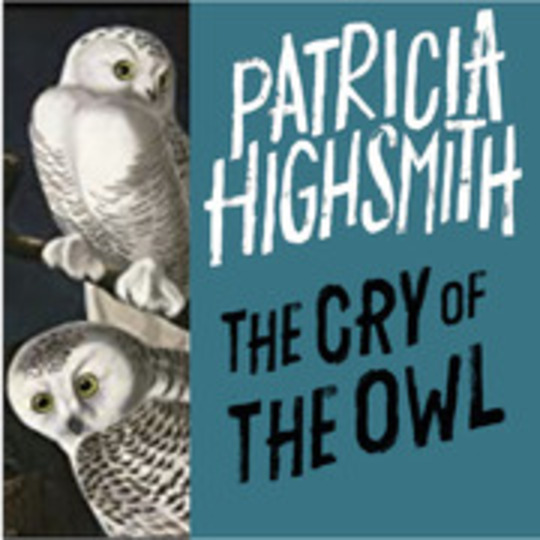
I have just finished reading her novel The Cry of the Owl (1962), one of her darkest novels. Robert, her hero, is a strange kind of asexual Peeping Tom who falls for a young woman by watching her prepare salads and entertain her boyfriend Greg. Things begin to develop dangerously when Jenny, the young woman, ends her relationship with Greg and begins to fall for Robert. There follow two murders, several attempted murders, a suicide, some incredibly sloppy police work, and encounters with the neighbors from hell.
When Greg teams up with Robert’s ex-wife Nickie, they both decide to make life difficult for Robert in every way possible, up to beating him up, wounding him, or killing him.
By the time I finished reading the novel about an hour ago, I began to understand that relationships can go bad at warp speed.
In addition to The Cry of the Owl, I have read the following Highsmith novels and collections, each of which I loved:
The Talented Mr. Ripley (1955)
A Game for the Living (1958)
A Suspension of Mercy (1965) – Released in the U.S. as The Story Teller
A Dog’s Ransom (1972)
Little Tales of Misogyny (1975)
The Black House (1981)
Fortunately, Highsmith was a fairly prolific writer, and I have only just begun to scratch the surface of her work.
On my occasional visits to the few bookstores that remain, I have become conscious that some dealers have split mysteries into two categories:
The traditional hard police procedurals and noir works
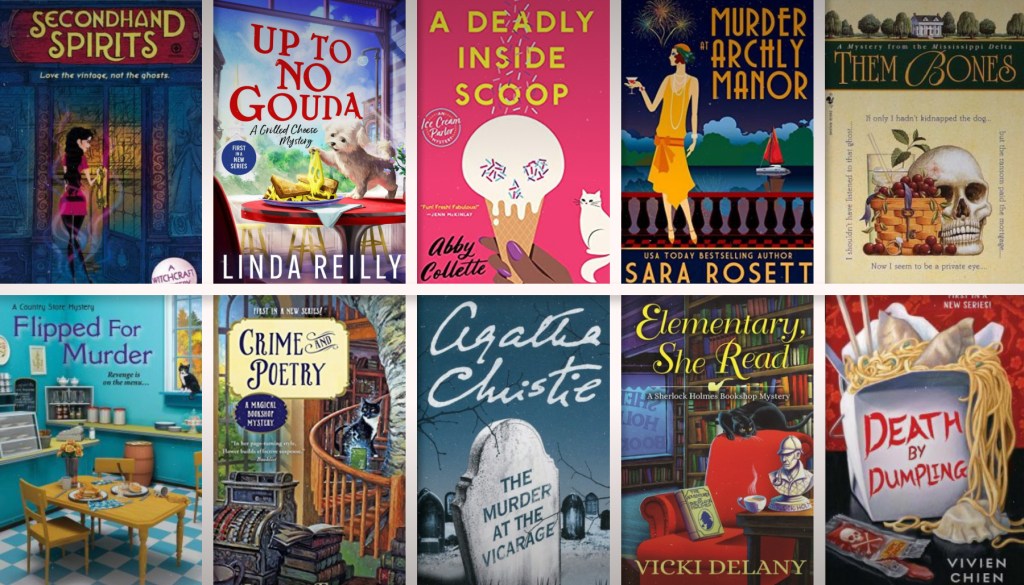
“Cozy mysteries”
What? If they find a cadaver in a “cozy mystery,” does it not smell? Does it look nice rather than ghastly? One thing for sure, it tends to be either British or it imitates British mysteries. I am not implying that all British mysteries are “cozy,” because they aren’t. Take the works of Ian Rankin and P. D. James—which are anything but “cozy.”
I suspect that the sub-genre is meant to appeal mostly to women readers who like tales emphasizing ratiocination (as Poe called it) rather than being exposed to any form of unpleasantness. (Curiously, Dorothy Sayers’s excellent The Unpleasantness at the Bellona Club verges on “cozy” at times.)
Unpleasantness doesn’t bother me. I just finished reading Charles Willeford’s The Way We Die Now with its bloody murder of two Floridian backwoods baddies, and I found it rather soothing in a strange way.
Avoiding all unpleasantness, however, would bother me. I have always felt that whatever we most studiously avoid winds up biting us in the ass.
He is probably most famous for his ghost stories. His Carmilla (1872) was a Lesbian vampire tale that inspired Bram Stoker’s Dracula and was turned into a Roger Vadim film called Blood and Roses (1960). His stories were an unusual mixture of horror, mystery, and historical fiction. After putting it off for decades, I am finally reading his Uncle Silas: A Tale of Bartram-Haugh (1864) and am enjoying immensely.
The title of this post comes from John Keats’s “Ode on a Grecian Urn”:
Thou still unravish'd bride of quietness,
       Thou foster-child of silence and slow time,
Sylvan historian, who canst thus express
       A flowery tale more sweetly than our rhyme:
What leaf-fring'd legend haunts about thy shape
       Of deities or mortals, or of both,
               In Tempe or the dales of Arcady?
       What men or gods are these? What maidens loth?
What mad pursuit? What struggle to escape?
               What pipes and timbrels? What wild ecstasy?
There is something eminently satisfying about reading a long nineteenth century novel. It calls for reserves of patience, but rewards with insights similar to those of the Grecian urn about which Keats writes. That is particularly true of novels from the British Isles, where the prose at times approaches the realm of poetry:
See how a sleepy child will put off the inevitable departure for bed. The little creature’s eyes blink and stare, and it needs constant jogging to prevent his nodding off into the slumber which nature craves. His waking is a pain; he is quite worn out, and peevish, and stupid, and yet he implores a respite, and deprecates repose, and vows he is not sleepy, even to the moment when his mother takes him in her arms, and carries him, in a sweet slumber, to the nursery. So it is with us old children of earth and the great sleep of death, and nature our kind mother. Just so reluctantly we part with consciousness, the picture is, even to the last, so interesting; the bird in the hand, though sick and moulting, so inestimably better than all the brilliant tenants of the bush. We sit up, yawning, and blinking, and stupid, the whole scene swimming before us, and the stories and music humming off into the sound of distant winds and waters. It is not time yet; we are not fatigued; we are good for another hour still, and so protesting against bed, we falter and drop into the dreamless sleep which nature assigns to fatigue and satiety.
I am presently 70% of the way through Uncle Silas and look forward to finishing the book tomorrow, come hell or high water. If you are interested in exploring LeFanu’s work, the following editions were issued by Dover Publications and may still be found from used book dealers (I recommend http://www.abebooks.com):
Best Ghost Stories of J. S. LeFanu
Green Tea and Other Ghost Stories
Ghost Stories and Mysteries
Wylder’s Hand
Uncle Silas: A Tale of Bartram-Haugh
The Wyvern Mystery
It is my opinion that LeFanu is a sadly neglected writer who, over time, will come into his own.
One of the grisliest places I ever visited was the Mexican State of Tabasco, where storms upriver caused floods in Villahermosa. From the banks of the Grijalva, my brother and I saw the carcasses of cows and other livestock come floating past in the fast-flowing muddy waters. The humidity easily stood at 100%, if not more.
We have our swampy regions in the States as well. Take Louisiana, for instance, where the Atchafalaya Basin could become the new course of the Mississippi, if it jumps the Army Corps of Engineers dams to the north.
James Lee Burke, Author of the David Robicheaux Novels
I have just finished reading James Lee Burke’s Sunset Limited, in which David Robicheaux of the New Iberia Police confronts evils that are scarcely to be imagined, let alone experienced.
Years ago, a labor leader named Frank Flynn was murdered by being crucified upside-down with a nail gun on the side of an old barn. His children Cisco and Megan are back in the Bayou Teche area, along with some of the nastiest contract killers ever portrayed in literature. But then, as Dave reminds us, “Evil doesn’t have a zip code.”
The gnarliest of them, one Harpo Scruggs, also has a wicked sense of humor:
“You got a lot of brass,” I said to him.
“Not really. Since I don’t think your bunch [the police] could drink piss out of a boot with the instructions printed on the heel,” [Harpo] replied. He unscrewed the cork in the mescal bottle with a squeak and tipped another shot into his glass.
One thing that characterizes a Dave Robicheaux novel is the tendency of its hero, along with his friend Clete Purcel, a former New Orleans police officer, to confront evil head on, with intensity and frequency.
To date, I have read over ten of Burke’s Robicheaux novels with their brooding atmosphere of Cajun eeriness—and I intend to keep going.
I have been reading occasional mystery novels by James Lee Burke over the years. Having just finished the first novel in the Dave Robicheaux series—Neon Rain (1987)—I now know why I like him so much.
Dave Robicheaux is the hero of most of Burke’s novels. After a traumatic stint in Vietnam, he joins the New Orleans Police Department. He has had a problem with alcoholism and a history with Twelve-Step programs, as well as a distrust of authority. At one point in Neon Rain, he says:
Like many others, I learned a great lesson in Vietnam: Never trust authority. But because I had come to feel that that authority should always be treated as suspect and self-serving.
His pictures of the Southern Louisiana landscape sometimes wax on the poetic:
Clouds of fog swirled off the bayou through the flooded woods as I banged over an old board road that had been cut through the swamp by an oil company. The dead cypresses were wet and black in the gray light, and green lichen grew where the waterline touched the swollen bases of the trunks. The fog was so thick and white in the trees that I could barely see thirty feet ahead of the car. A rotted plank snapped under my wheel and hanged off the oil pan. In the early morning stillness the sound made the herons and egrets rise in a sudden flapping of wings toward the pink light above the treetops. Then to one side of the road, in a scoured-out clearing in the trees, I saw a shack built of Montgomery Ward brick and clapboard, elevated from the muddy ground by cinder blocks and cypress stumps, with a Toyota jeep parked in front.
And:
Somewhere down inside him, he knew that his fear of death by water had always been a foolish one. Death was a rodent that ate its way inch by inch through your entrails, chewed at your liver and stomach, severed tendon from organ, until finally, when you were alone in the dark, it sat gorged and sleek next to your head, its eyes resting, its wet muzzle like a kiss, a promise whispered in the ear.
There is a great deal of violence in the plot as Robicheaux fights his police force and various Federal agencies at the same time as he tracks down a set of murderous thugs, one by one.
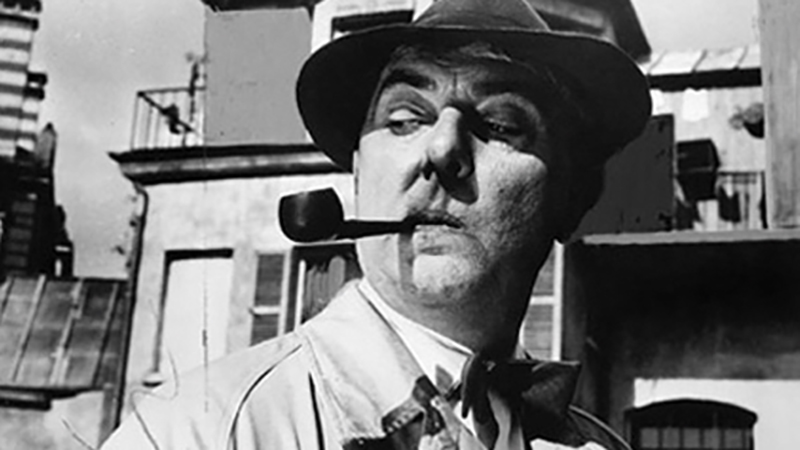
Whenever I am looking for a great crime read, my first choice is usually the late Georges Simenon, the creator of Inspector (later Superintendent) Jules Maigret. Like the author, Maigret always had a pipe in his mouth. I cannot help but think that Simenon thought of himself as his hero, but whenever I visualize the French detective, I have a different image in my mind, that of the film comedian Jacques Tati (1907-1982), Simenon’s near contemporary. (See photo below.)
I have just finished reading The Patience of Maigret [La Patience de Maigret] (1965), the 92nd Maigret in a series extending to 103 titles. Although the ones he wrote in the 1930s were brilliant, there was no noticeable falling-off with the later novels.
Maigret is in many ways the anti-Sherlock-Holmes. His cases are not solved as much through ratiocination as by a fanatical thoroughgoing diligence and its hero’s trust in the picture of the crime that emerges as a result. Near the beginning, Simenon describes Maigret going through his paces: “And yet that was how the Superintendent had succeeded with most of his investigations: climbing stairs, sniffing in the corners, having a chat here and there, and asking apparently futile questions, often spending hours in rather shady bistros.”
Comic Jacques Tati in Monsieur Hulot’s Holiday—The Very Image of the Paris Detective
At another point, he writes: “People had a mania about asking him about his methods. Some of them even thought they could analyse them and he would look at them with bantering curiosity because they knew more about it than he, who usually improvised at the whim of his instinct.”
In The Patience of Maigret, everyone is stumped. In fact, the jewel crimes at the heart of them have been going on for over twenty years, but no one could figure out who was cutting the gemstones out of their settings in order to fence the loot. The answer comes at blinding speed in response to a comment made during a phone call to the former mayor of Douai. When that happens, Maigret corrals the guilty parties and ties everything together with giftwrap for the examining magistrates who will do the heavy lifting for the prosecution.
The words are those of Herman Melville’s Bartleby the Scrivener in his story of the same name. In that story, a clerical worker refuses outright to continue to do his work and pays the price for his obstinacy. In Patricia Highsmith’s A Suspension of Mercy, Bartleby is the last name of writer Sydney Bartleby, a man who is every bit as obtuse as Melville’s scrivener. He is married—not entirely happily—to Alicia Sneezum. They live in the English countryside, with Sydney trying to publish a novel and television scripts, and Alicia trying to paint abstracts. At one point they decide to split up for a while and maybe come together only when they had gotten the ya-yas out of their system.
So Alicia is put on a train at Ipswich, telling her husband to tell people she had gone to stay with her parents. Except, she doesn’t in fact tell her parents anything. In the meantime, Sydney plays with the idea of having his friends and neighbors suspect that he had murdered Alicia. He even rolls up an old carpet, imagining that he had hurled Alicia down a flight of stairs to her death and rolled the body into the carpet. He buries the carpet early one morning in a forest some distance from his cottage.
In the meantime, people keep calling Sydney asking to speak to Alicia. He tells them she is staying with her parents. When they call the parents, and find her not there, the suspicion arises that Sydney has murdered her. A neighbor had seen him struggle to load a heavy rolled carpet into his car.
Enter the police. Sydney leads them to the buried carpet, which they find minus the body of Alicia. That only makes the police more suspicious. They start digging other holes in the area to search for the body. Interestingly, Sydney finds Alicia, with her new inamorata whom she had met at a party, but he doesn’t alert her or, in fact, anybody. So the suspicions continue to mount.
Nasty. Nasty. Nasty. This is clearly a story by Patricia Highsmith, author of Strangers on a Train (1950) and The Talented Mr Ripley (1955). It is delightful how the mutual obstinacy of Sydney and Alicia lead to the police, the press, and the general public to assume the worst. At several points, Bartleby (or Alicia) could have short-circuited all this needless mountain of false news, but, like the original Bartleby, preferred NOT to.
This is without a doubt the most obstinate mystery ever written, and great fun withal.
Maybe the Great American Novel Will Be a Mystery …
Up until fifty or sixty years ago, the great American Novel would have been by someone like Ernest Hemingway, F. Scott Fitzgerald, or William Faulkner. Then something happened. Specifically what happened were writers like Raymond Chandler and Dashiell Hammett, followed by scores of other excellent mystery writers such as Ross Macdonald, James Ellroy, David Goodis, Jim Thompson, Cornell Woolrich, and Elmore Leonard.
I just finished reading Leonard’s Get Shorty, primarily because I loved the 1995 movie directed by Barry Sonnenfeld and starring John Travolta as Chili Palmer, the loan shark from Miami suddenly turned movie producer.
Renee Russo and John Travolta in Get Shorty
Recently, I just finished re-reading most of Raymond Chandler’s novels (except for Playback, which I’ll get to shortly). And I’ve been reading other mysteries and noir novels and enjoying them immensely. I am beginning to think that, years into the future, this will be looked at as a golden age of genre novels.
America’s contribution is mostly in the mystery genre, but there have been great science fiction classics, especially from Philip K. Dick (Do Androids Dream of Electric Sheep?) and Ray Bradbury, Ursula K. LeGuin, and Kurt Vonnegut, to name just a few. I will have to beg off on romance classics because, jeez, I’m a guy and the genre makes me alternatively giggle and puke.
If we eliminated genre novels from consideration, I would probably say that Herman Melville’s Moby Dick was the Great American Novel. But I don’t think we really should cut off the 20th Century American genre novel from a shot at the title.










 Tarnmoor
You must be logged in to post a comment.