L.A. Writers: Tyler Dilts

An Up-and-Coming Police Procedural Mystery Writer

An Up-and-Coming Police Procedural Mystery Writer

Actually Tyler Dilts is more of a Long Beach writer than an L.A. writer. I find that exciting because he writes about an interesting locale about which most people know very little. There have been writers about Beverly Hills and Hollywood before, but both places are way too enshrouded in their own myths. Long Beach is the 36th largest city in the United States, and the 7th largest in the State of California. It is an interesting city in its own right, and it is large and diverse enough to sustain a series of crime novels set within its borders.

To date, there are four novels in the Long Beach homicide series:

  • A King of Infinite Space (2009)
  • The Pain Scale (2012)
  • A Cold and Broken Hallelujah (2014)
  • Come Twilight (2016)

All four feature Long Beach Homicide Detective Danny Beckett and his partner, Jennifer Tanaka. Beckett. In the first novel, Tyler’s wife dies in a car crash on Intersate-5. In the second book, Danny is sidelined with pain in his hand to his shoulder for an entire year, but he manages to go on.

A Cold and Broken Hallelujah was the first Dilts I had read, in Cusco, Peru, of all places. It is about the murder of a homeless man. In an interview with Craig Lancaster, Dilts describes his novel thus:

At the opening of the new novel, Danny’s come to terms with much of what was haunting him in the first two books, but a murder he investigates—a homeless man who is burned to death by a group of teenagers—tests his resolve, especially in mourning his late wife, who also died by burning. Danny’s the kind of detective who carries the weight of the past with him. It’s a quality that is certainly not healthy for him, but it keeps him connected to the victims of the crimes he investigates and allows him to maintain a sense of empathy. He knows that it is his greatest strength as a detective, so he can’t bring himself to let go, even though he’d be healthier and happier if he did.

As for the fourth book, I am reading that now.
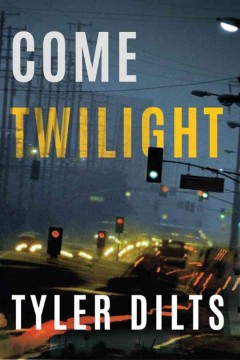
The latest Novel by Dilts

The latest Novel by Dilts

What I like about the Danny Beckett novels is the empathy he feels for the characters with whom he comes into contact. He himself lives a life of occasionally disabling physical pain. Yet he works well with his colleagues in the LBPD and with both witnesses and even suspects. While there is no romance as such between Beckett and his partner Jennifer Tanaka, there is a closeness and mutual consideration that could potentially develop into one.

Tyler Dilts is the son of a Los Angeles County Sheriff’s Department detective. In the Craig Lancaster interview, he continues:

My father was Sheriff’s Deputy for Los Angeles County. He worked in quite a few different capacities—in the county jails, on patrol, as a trainer at the academy, and as a detective. I think I realized that I wouldn’t follow in his footsteps sometime in high school. But I didn’t know what path I would take until I got to college and discovered theatre. I got my BA in Acting and Directing and spent several years working in theatre in LA. I’m a big guy and found myself getting typecast, so a good friend, after hearing me complaining about the fourth time I played Lennie in Of Mice and Men, suggested that I start writing my own plays. That led me back to grad school, this time in English Lit and Creative Writing. In a way, writing about Danny Beckett feels like coming full circle and returning to that desire to follow in my father’s footsteps.

Dilts is still early in his writing career. I look forward to following it with great interest.
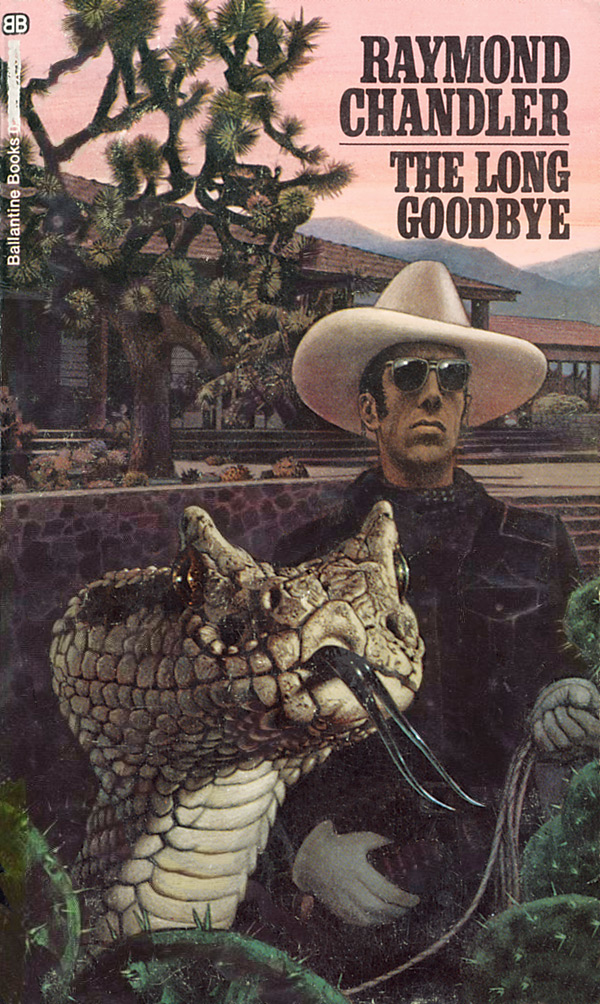


The Long Goodbye


The First Time I Read This Edition

The First Time I Read This Edition

The following is based on my review of Raymond Chandler’s The Long Goodbye for Goodreads.Com:

I had read The Long Goodbye many years ago, and liked it. In the meantime, I have aged—not exactly like a fine wine, but aged nonetheless—and found myself loving Raymond Chandler’s penultimate work. I might even go so far as to say it is his masterpiece, though back then I liked The Big Sleep and Farewell My Lovely more.

This time I detected the raggedness. Chandler’s wife, Cissy, was dying and he felt more vulnerable. This is no tight Agatha Christie thriller than runs like a Swiss clockwork. Not by a long shot. It’s about a nasty, persistent evil that, once you poke it with a stick, keeps coming back to snare you and hurt you. Somehow, Chandler’s detective Marlowe walks the straight and narrow path and comes out alive at the end:

I was as hollow and empty as the spaces between the stars. When I got home I mixed a stiff one and stood by the open window in the living room and sipped it and listened to the groundswell of the traffic on Laurel Canyon Boulevard and looked at the glare of the big angry city hanging over the shoulder of the hills through which the boulevard had been cut. Far off the banshee wail of police or fire sirens rose and fell, never for very long completely silent. Twenty-four hours a day somebody is running, somebody else is trying to catch him. Out there in the night of a thousand crimes people were dying, being maimed, cut by flying glass, crushed against steering wheels or under heavy tires. People were being beaten, robbed, strangled, rape, and murdered. People were hungry, sick, bored, desperate with loneliness or remorse or fear, angry, cruel, feverish, shaken by sobs. A city no worse than others, a city rich and vigorous and full of pride, a city lost and beaten and full of emptiness.

A French Edition of The Long Goodbye

A French Edition of The Long Goodbye

And mind you, this is just the background in which a series of murders and/or suicides take place that call Marlowe’s actions into question and put him in personal peril, such as the time four toughs waylay him in his own house. They included the following:

A man was sitting across the room with his legs crossed and a gun resting sideways on his thigh. He looked rangy and tough and his skin had that dried-out look of people who live in sun-bleached climates. He was wearing a dark brown gabardine-type windbreaker and the zipper was open almost to his waist. He was looking at me and neither his eyes nor the gun moved. He was as calm as an adobe wall in the moonlight.

That last short sentence inspired writer Walter Mosley to begin writing his own series of detective novels featuring Easy Rawlins.

I feel I have not rendered justice to this great novel—probably because it is still working its way through my bloodstream and opening channels in my body that I did not know existed.

Mischa the Penguin

A Lone King Penguin Among Magellanic Penguins on Isla Pajaros

A Lone King Penguin Among Magellanic Penguins on Isla de Pájaros

Serendipity strikes again. I just read an obscure Ukrainian crime story by Andrey Kurkov entitled Death and the Penguin. The narrator is one Viktor Akelseyevich Zolataryov who writes for publication what his editor refers to as obelisks. These are obituary essays written about living people so that, when death comes to them, the newspaper is not caught short for materials to publish quickly. Oddly, though, it seems that all too many of the individuals Andrey memorializes in his deathless prose wind up … dead.

My favorite character is Viktor’s pet and companion, the King Penguin Mischa. When the zoo in Kiev was suffering a financial meltdown, they sold their penguins; and Viktor bought the one he called Mischa.

Mischa is very like the King Penguin at the right in the above picture, which was taken on the Isla de Pájaros on the Beagle Channel in Tierra Del Fuego. The largish penguin took a wrong turn into the Beagle Channel and wound up in a rookery consisting mostly of Magellanic Penguins and some Gentoos. It was obviously very lonely and disappointed. Every once in a while, he would try to mate with one of the Magellanic females, but caused uproars every time he tried.

Viktor’s Mischa shambles around the apartment, looking into the mirror, establishing a kind of hiding place behind some furniture, and displaying all the symptoms of a morose and puzzled disposition occasionally verging on depression. Even while Viktor worries that his writing job is connected with an assassination ring, Mischa slowly keeps getting worse. At the same time, he winds up taking care of Sonya, the daughter of one “Mischa-non-penguin,” who was associated with the editor who hired the writer, and who disappears after leaving money and a pistol. He also hires a teenage girl, the niece of his friend Sergey (who dies mysteriously) as a nanny for Sonya, who lethargically enters into a relationship with him.

I loved Death and the Penguin for its mellow strangeness. For a man surrounded by violent death, to which he may be contributing in some unexplained way, Viktor is relatively cool. Eventually, the situation changes rapidly. Mischa becomes ill and gets a heart transplant; and Viktor, well, let us say he takes action of an unexpected kind.

Victorian Genre Fiction

Sherlock Holmes Was Not the Only Game in Town

Sherlock Holmes Was Not the Only Game in Town

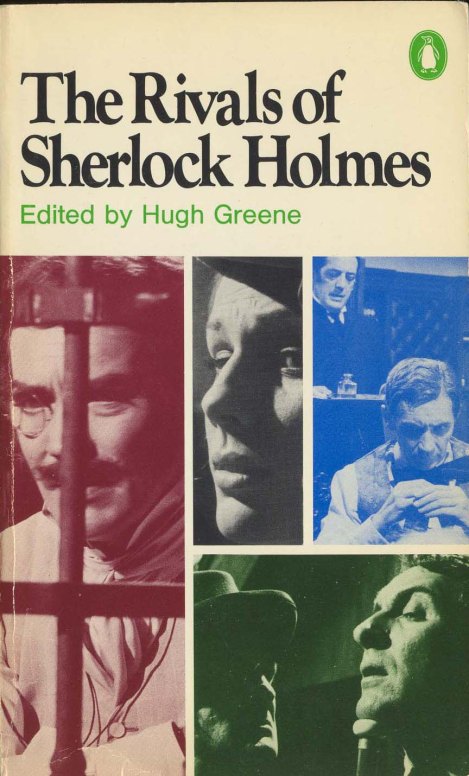
The paperback whose cover is illustrated above first came out in 1972, followed by three other volumes of non-Sherlock detective stories written during the same period. Edited by Hugh Greene, brother of Graham Greene, the books were a revelation to me. I started Reading Richard Austin Freeman’s Dr. Thorndyke stories; Ernest Bramah’s Max Carrados stories (Carrados was blind, and could read the London Times by feeling the elevation of the ink on the paper); the novels and stories of the vastly underrated Arthur Morrison; Jacques Futrelle’s “Thinking Machine” stories (Futrelle died on the Titanic); and Baroness Orczy’s The Old Man in the Corner Stories.

And that was only the beginning! I also noticed that the Victorians and Edwardians wrote excellent horror stories as well, and that many of them were available from Dover Publications, including such luminaries as Algernon Blackwood, M. R. James, Arthur Machen, Mrs. J. H. Riddell, and Wilkie Collins. Now, in the age of the Kindle and other e-books, one could pick up virtually all of Blackwood’s short stories in two “megapacks” for a mere $1.98. There are even two well-known “psychic detectives” investigating hauntings and possessions, namely Algernon Blackwood’s John Silence, the self-styled “psychic doctor,” and William Hope Hodgson’s Max Carnacki, the ghost detective.

The stories are, for the most part, available readily and inexpensively now that their copyright protection expired years ago. It may still be difficult to find some Arthur Morrisons such as the Martin Hewitt detective stories and the stories in The Dorrington Deed-Box.

Even G. K. Chesterton got into the act somewhat later with his Father Brown stories, which are in a slightly different vein, but which owe much to Arthur Conan Doyle and his “rivals.”

A good way to start is to find Hugh Greene’s collections on eBay or Amazon.Com and, if you like them, dig around in used book stores, or, if you are on a budget, Amazon Kindle and its “rivals.”