Chabuca Granda

Songstress Chabuca Granda (1920-1983)

Peruvian Songstress Chabuca Granda (1920-1983)

When I go to another country, I like to have some idea of their most beloved music. Why? Because it tells me a lot about the culture. For Argentina, I listened to the tango songs of the immortal Carlos Gardel, who died in a plane crash in Colombia some eighty years ago. For Iceland, I love listening to Ólafur Arnalds. For Peru, I picked Chabuca Granda, famous for her song “La flor de la canela,”

Born Maria Isabel Granda Larco on September 3, 1920, Chabuca has a number of her songs available on YouTube:

Granda is known for the nostalgic Afro-Peruvian rhythms in her work. It is not that well known that Peru has a fairly substantial black population, especially in the south, from which Chabuca hailed.

To honor her, the Peruvians have set up a large entertainment space called the Alameda Chabuca Granda along the Rimac River and directly behind the Government Palace. She also has a park dedicated to her in the Barranca neighborhood in which she lived.

The Guano Economy

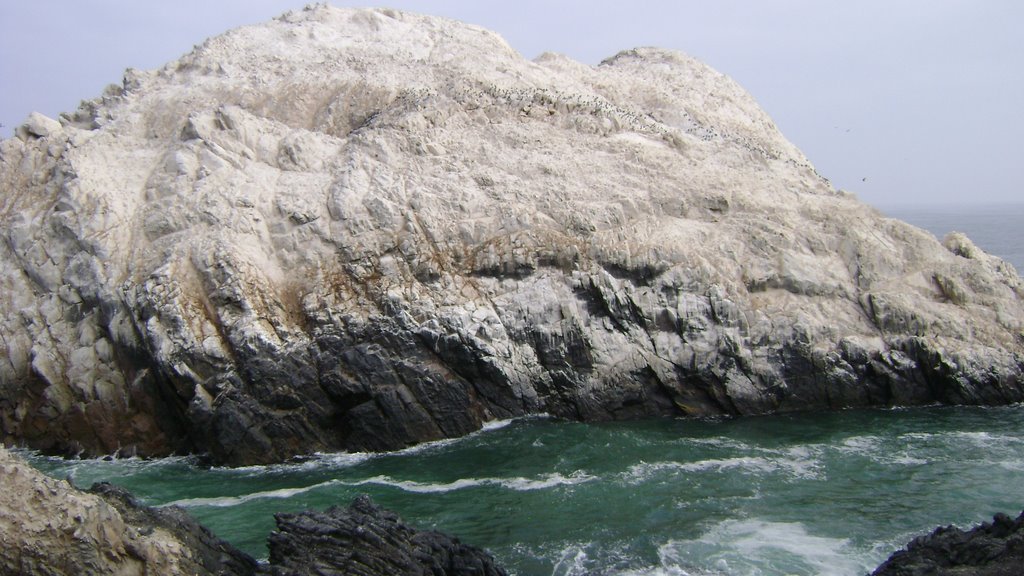
Guano Island Off Peru

Guano Island Off Peru

When Peru finally won its independence from Spain in the 1820s, there was no short quick route to prosperity. Much of South America’s economy was primarily agricultural, based on large haciendas, many of which had just changed hands from Spanish loyalists to officers of the revolution. It took about twenty years before Peru discovered that its primary source of wealth was actually bird sh*t. There were a number of islands off the coast of the Atacama Desert in the south that were covered to a depth of several meters with a centuries’ long accumulation of guano. Europe, which was trying to recover from the ravages of the Napoleonic Wars, needed the fertilizer to insure rich crops.

Mining the guano was no picnic. Peru imported thousands of laborers from China to dig up and bag the guano for shipment to a customer base that was willing to pay top dollar for the … stuff. Native Peruvians did not breathing in the noxious particles, so it was mostly immigrants who worked the islands. For about thirty years, Peru was sh*tting pretty, until it hit the fan. (Had enough of the puns yet?)

After much of the guano was shipped overseas, it was discovered that the Atacama Desert was rich in nitrate fertilizers, which were a good substitute for the organic stuff. At this point, the main actors in the business were Peru, Bolivia (which then had a seacoast), and Chile. Bolivia arbitrarily raised the taxes on mining nitrates. As many of the companies supervising the mines and transporting the fertilizer were Chilean, they demanded tax relief. Bolivia refused, and Peru backed Bolivia.

What Kind of Bird Izzat?

What Kind of Bird Izzat?

In 1879 began the War of the Pacific, with Chile arrayed against both Peru and Bolivia. As Chile had better military leadership and weaponry, it won handily after a number of bloody sea and land battles. The upshot was that Bolivia lost its access to the sea (though they still have admirals for some reason), and Peru lost its State of Tarapacá, including Tacna, Arica, Iquique, and Pisagua. (Eventually Tacna was ceded back to Peru some years later.)

In the end, the British took over the nitrate mining industry, with most of its associated profits. Bolivia suffered the most, as it lost all access to the Atacama Desert. Peru was outraged at having been occupied by Chile, though it fought a fairly successful guerrilla insurgency. Nonetheless, it had suffered a humiliating defeat with repercussions lasting to the present time.

As to the profits from fertilizer mining, they dwindled rapidly; and Peru went from being a wealthy country to being an economic basket case.

For more information, click here for a good illustrated review of the 19th century guano mining industry.


The Cloud-Covered City of the Kings

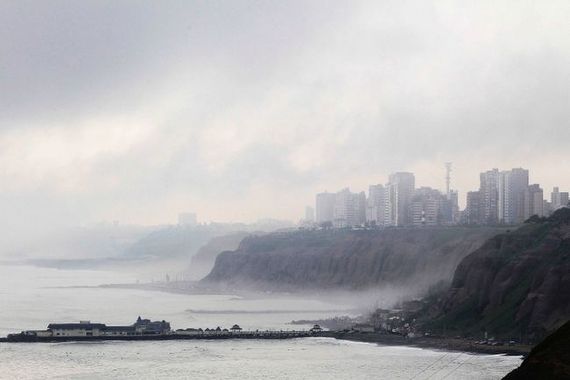
The Garúa Investing the Coastline of Lima

The Garúa Investing the Coastline of Lima

Just because Peru is a few degrees south of the Equator doesn’t mean the sun is always shining. In fact, from June through November, a warm wind interacting with the cold Humboldt current results in a condition around Lima locally referred to as la garúa. As one American expat describes it:

It is more than a fog, less than a rain. It is the heavy mist that sometimes appears in the winter in Lima. The locals call it la garúa, a sea mist caused by warm winds interacting with the cool water of the ocean. It is a condition found usually from June through November along the Peruvian Coast.

Arriving in Lima as I am in September, I will be in the Peruvian equivalent of March (subtract six from the ninth month of the year), which means it will still be winter. That will be fine with me, because I abhor hot weather. I expect Lima will be similar to our spring marine layers in Los Angeles that we usually refer to as “June Gloom.”

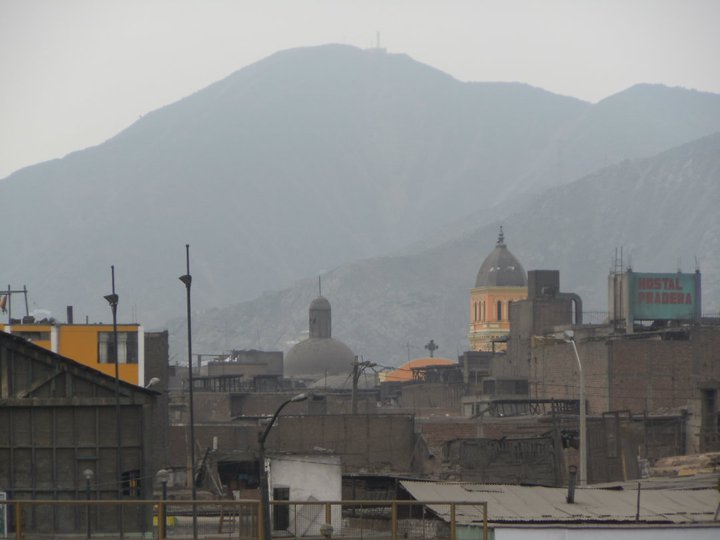
Here is another view, taken from the historic center of the City of Kings:

Foothills of the Andes from Central Lima

Foothills of the Andes from Central Lima

It will be a challenge to me as a photographer to make my scenic views interesting, but it will be fun. Once I leave Lima, I will be in the bright sunny mountains with their spectacular clouds.

Ring of Fire

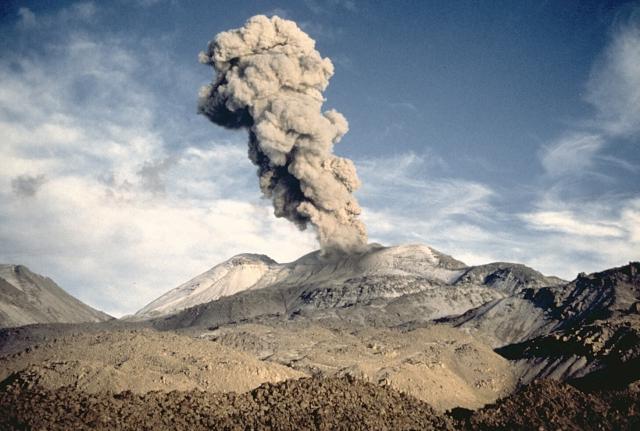
The Volcano Sabancay: Erupting Again

The Volcano Sabancaya: Erupting Again

The Pacific Ring of Fire stretches from Indonesia and the Southwest Pacific in a massive arc around Asia, North America, down to the West Coast of South America. According to Peru This Week, this zone “is the site of 85% of global seismic activity caused by friction between shifting tectonic plates.”

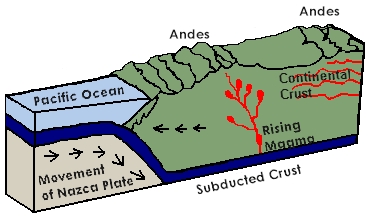
In South America, the culprit is the Nazca Plate, which borders the Pacific side of the continent, and which features a convergent boundary subduction zone and the South American Plate, which action has formed the Andes. Hardly a day passes by when I don’t hear of another earthquake in Peru (usually in the Richter 4.0-5.5 range); and hardly a month passes by without a new volcanic eruption. Today, it is reported that Sabancaya (see above) in the State of Arequipa has begun to spew ash. If it continues, I will probably be there to see it in person next month at this time.

Below is an illustration of how the Nazca Plate (in light brown) subducts the South America Plate (in green), thereby causing all these dire events (and, by the way, over the millennia, causing much of the beauty of the Andes as well):

The Nazca Plate Takes a Dive, Wrinkling the Face of the Earth

The Nazca Plate Takes a Dive, Wrinkling the Face of the Earth

Last year, I visited Iceland, through which runs the boundary between the Eurasian Plate and the North American Plate, resulting in several dozen active volcanoes and frequent earthquakes. In fact, the boundary runs right through the middle of Thingvellir National Park, where it is expanding the size of Iceland (and the park) year by year.

What is it with me and volcanoes? Is it because I live in multiply cross-faulted Southern California with its own history of earthquakes? Maybe in future I should visit Krakatoa and Mount Vesuvius?


Imagining Argentina

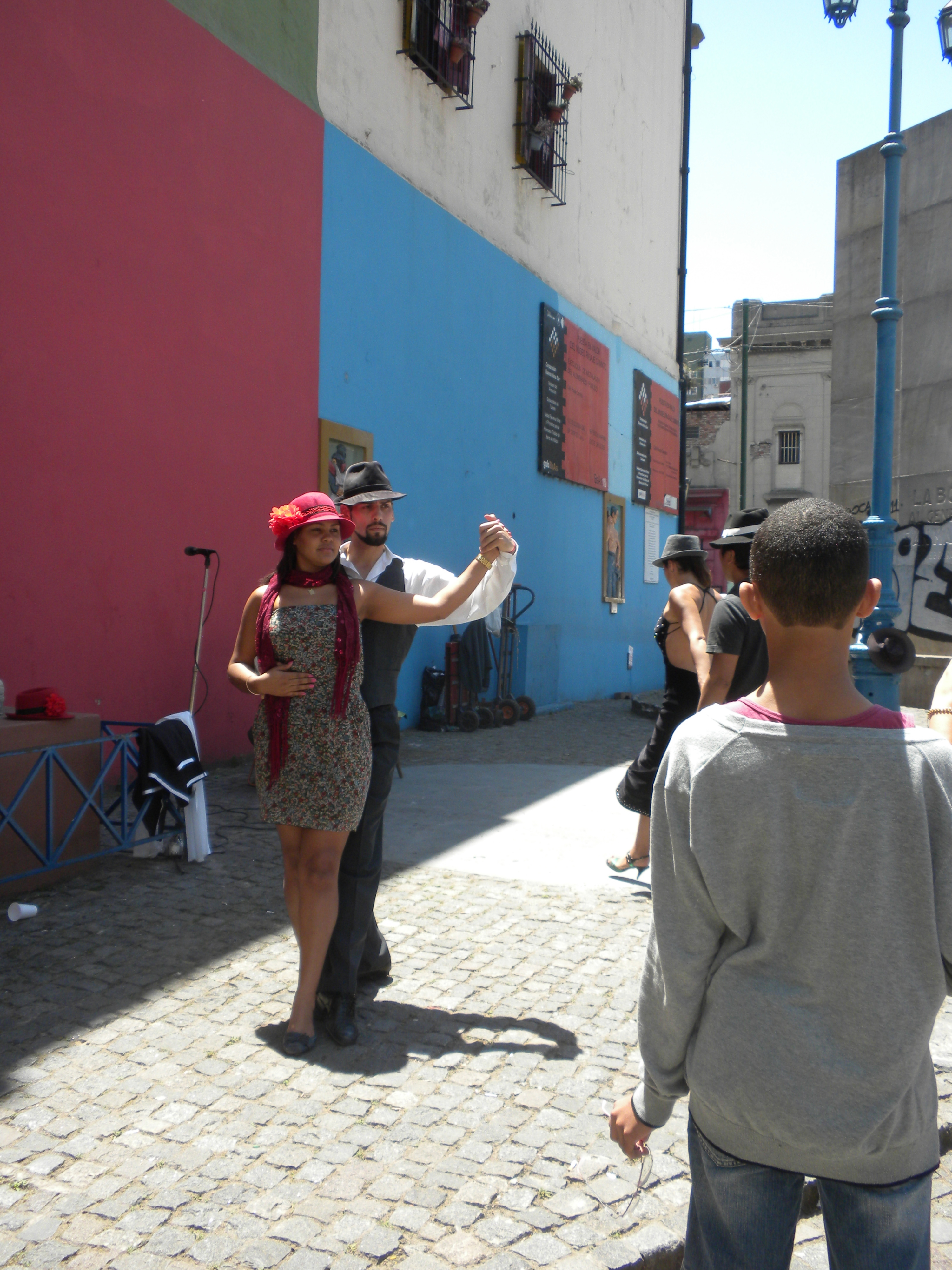
Tango Dancers in La Boca

Tango Dancers in La Boca

Even though I’ll be in Arequipa, Peru, a month from today, I still look back fondly to Argentina, which I visited in 2006 and 2011. In fact, today Martine and I ate dinner at Empanadas Place at Sawtelle and Venice Boulevards in Mar Vista. I had an entraña (skirt steak) sandwich and iced mate cocido, while Martine had two empanadas, one stuffed with spinach and the other chopped beef. It is probably one of our favorite places to eat on L.A.’s West Side; and, according to Martine, the empanadas there were better than what we were served in Argentina. (Of course, the place for empanadas is in Northwest Argentina around Salta and Tucumán.)

In addition to Empanadas Place, there is a very good Argentinean restaurant on Main Street in Culver City: the Grand Casino Bakery & Café. We go there several times a year.

I have come to love drinking yerba mate tea and—very occasionally—sneaking some alfajores cookies filled with dulce de leche. My two visits to the Southern Cone of South America have resulted in a series of cravings I have yet to fill. Although we saw a good part of Patagonia, I have yet to go to Carmen de Patagones, Viedma, San Carlos de Bariloche, and Esquel. (In 2011, there was a major volcanic eruption at Puyehue and Cordon Caulle in the Chilean Andes which covered several whole states of Patagonia with ash—so we went to El Calafate instead to see the glaciers.)

To be sure, when I return from Peru, I will be haunted by my desire for Peruvian food. Fortunately, there are also Peruvian restaurants in L.A.; but I am sure it is but a pale shadow of what I will be eating next month. Plus, I will no doubt miss interacting with the Quechua and Aymara peoples of the Peruvian altiplano.

My Brother Sets Me Straight

Now I Know What I’m Going to See There!

Now I Know What I’m Going to See There in Peru!

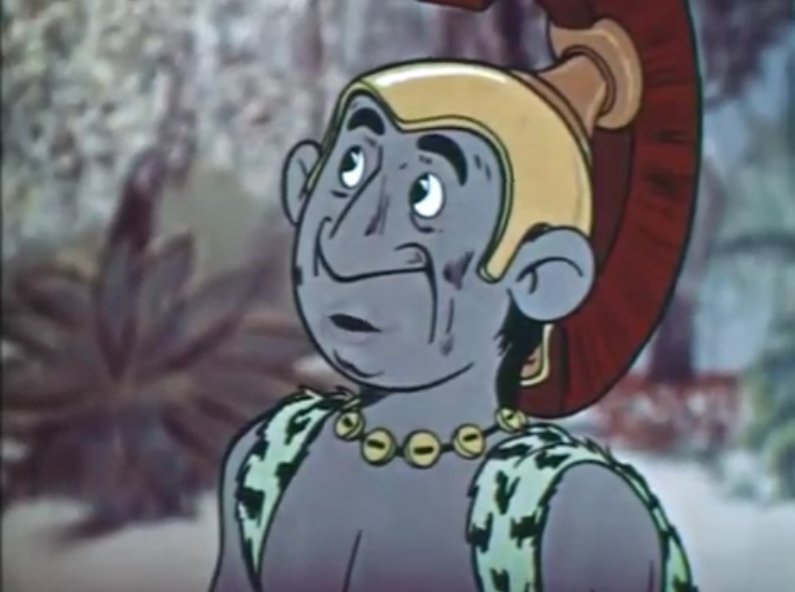
Last night, my brother left the following comment on my status on reading Nigel Davies’s book The Incas on Facebook: “How about The Dinky Incas”? That set me back for a minute. Who in blue blazes were the Dinky Incas? Well, there was only one way to find out: I Googled it. Then it all came back to me. There was an animated television series around 1959-1960 called “Clutch Cargo,” starring a ruggedly good-looking hero with an enormous jaw named Clutch Cargo who flew to strange locales with a small freckle-faced boy named Spinner and a dachshund named Paddlefoot. They engaged in the type of exotic adventures I recall from reading Carl Barks’s Uncle Scrooge comic books.

By the time my brother was of an age to enjoy the limited animation adventures of “Clutch Cargo,” I was already a teenager who was much too sophisticated for that type of stuff. Dan, on the other hand, was eight or nine years old and watched every episode.

Now You, Too, Can Follow Their Adventures

Now You, Too, Can Follow Their Adventures

The series on the “Dinky Incas” was about a missing archaeologist who was on a dig in Peru which resembled, more than anything else, a Mayan pyramid in the jungle. (The real Incas didn’t build pyramids and they preferred the higher-elevation altiplano to the jungles of the Amazon.) Clutch, Spinner, and Paddlefoot run into two unsavory characters who try to do away with them, because, of course, they’re after all the gold and jewels. But Clutch and his sidekicks take care of them right quick, as you can see for yourself if you have twenty minutes to watch the whole series, which is available by clicking here.

Independence Day 1821

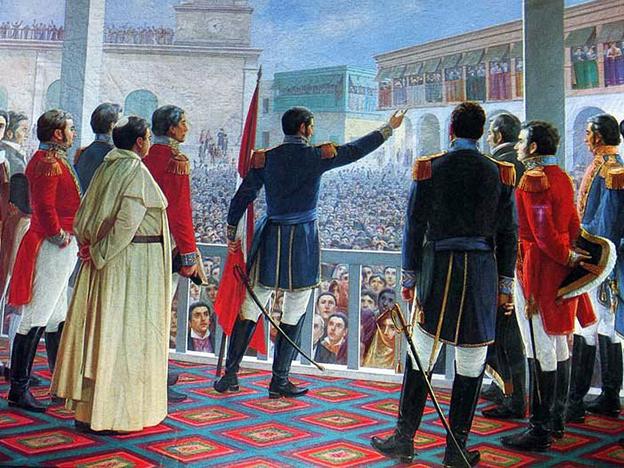
Declaring Independence Was One Thing, But Winning It Another

Declaring Independence Was One Thing, But Winning It Another

Peru is now celebrating the 193rd anniversary of its own Declaration of Independence by José de San Martin in Lima, as shown in the famous painting above by Juan Lepiani. As with our own Declaration of Independence, there was still a lot of fighting to come. Worse still, disunity was rampant. So much so that San Martin left for Europe in disgust and remained there until his death in 1850. Compared to what happened in South America, our own struggle for independence was a cakewalk, thanks largely to Admiral de Grasse and the French navy.

Let me give you a brief timeline. First there were the native peoples of what is now Peru, who were mostly gobbled up by the Inca empire. Then the Spanish came in under Francisco Pizarro, defeated the Incas, and set up a European-based government. All went somewhat smoothly under the Peninsular War of the early 19th century, in which the English, abetted by Spanish guerrillas, drove Napoleon’s French out of the Iberian Peninsula—at the cost of messing up their colonies in the New World. All criollo (native-born white) officials were replaced by new administrators from Spain. So, feeling disenfranchised, the criollos rebelled under Bolivar, San Martin, Sucré, O’Higgins and others. They won, effectively driving the Spanish from South America.

Even to this day, Peru is largely a criollo-run country, even though whites constitute only 15% of the population. Naturally, the 45% who are Amerindians and the 37% who are Mestizo (mixed races) currently feel disenfranchised. Is Peru due for another revolution? In a way, it had one in the 1980s and 1990s under the Shining Path and the MRTA guerrillas, who were defeated in a series of bloody confrontations in which thousands of innocent people were killed.

It is inevitable that the non-whites in power will be replaced by more of the people from the Altiplano and jungle regions as time goes on. There may be other Independence Days to come. Who knows?

After all, there are people who feel the same way in the United States, people who dress in 18th century costumes with tea bags dangling from their hats.

Before the Incas

Yes, There Were Great Civilizations Before the Incas

Yes, There Were Great Civilizations Before the Incas—Witness This Moche Pot

We tend to think that the only advanced Pre-Columbian Civilizations were the latest. For Mexico and Central America, that would mean the Aztecs and Mayas; for Peru, the Incas.

As one who has traveled to Mexico many times to see archaeological sites, I can vouch for the fact that, long before the Aztecs left their mythical homeland of Aztlán, there were other civilizations in Mexico that they replaced, but which they did not necessarily improve upon. The peoples who built Teotihuacan north of Mexico City did it around a hundred years before the Christian era. Then there were the Toltecs, the Totonacs, the Olmecs, and the Huastecs. I have seen remains from these and other Meso-American civilizations over a thirty-year period.

The Mayans are slightly different: They were less a centralized political entity than a people who have been around for thousands of years and lived through both empires and more localized city states and leagues of city states. The last Mayans were conquered by the Spanish at Tayasal in 1697, representing a much thornier military target for the conquistadores than the Aztecs.

The Moche Civilization of Peru

The Moche Civilization of Peru (100-800 AD)

Like the Aztecs, the Incas were fairly late on the scene, first coming to notice around 1438 and being conquered (but not decisively) by Francisco Pizarro a hundred years later. In many ways they were not as advanced as the Aztecs and Mayans inasmuch as they did not have writing—though they appear to have been able to use a writing system of colored knotted cords called quipus for inventories and other business purposes. (In this regard, they were like the ancient Greeks who used Linear A in a similiar way.)

What the Incas had going for them were primarily two things:

  1. They built a great paved road system covering some 25,000 miles. (But since these roads included steps at times, they could be navigated by sure-footed llamas, but not by the Spaniards’ horses).
  2. They were great builders who, in a major earthquake zone, erected structures that are still standing.

Prior to the Incas, there were numerous Peruvian civilizations who bettered the Incas in many respects. The Moches or Mochica of the north were just one example: Their pottery is far more artistic (see above photo) than anything the Inca were able to create. Then, there were the Wari, the Nazca, the Chavin, Tiwanaku, Chincha, Chanka, and Chimu.

My upcoming trip to Peru will include some visits to non-Inca ruins, such as Huaca Pucllana of the indigenous Lima culture and Pachacamac of the Ichma people. If it weren’t for the fact that I’ve never been to Peru before—and I don’t know whether I can go again—I will concentrate mostly on the Inca sites of the Sacred Valley between Cusco and Machu Picchu.


“Mother of Stone and Sperm of Condors”

Pablo Neruda

Pablo Neruda

Chilean poet Pablo Neruda has, in his The Heights of Macchu Picchu, written with exquisite feeling about those Inca forebears who gave all South Americans a metaphor that unites the disparate strains of their pasts. The following is the sixth poem in the sequence:

Then up the ladder of the earth I climbed
through the barbed jungle’s thickets
until I reached you Macchu Picchu.

Tall city of stepped stone,
home at long last of whatever earth
had never hidden in her sleeping clothes.
In you two lineages had run parallel
met where the cradle both of man and light
rocked in a wind of thorns.

Mother of stone and sperm of condors.

High reef of the human dawn.

Spade buried in primordial sand.

This was the habitation, this is the site:
here the fat grains of maize grew high
to fall again like red hail.

The fleece of the vicuña was carded here
to clothe men’s loves in gold, their tombs and mothers,
the king, the prayers, the warriors.

Up here men’s feet found rest at night
near eagles’ talons in the high
meat-stuffed eyries. And in the dawn
with thunder steps they trod the thinning mists,
touching the earth and stones that they might recognize
that touch come night, come death.

Neruda’s Macchu Picchu

Neruda’s Macchu Picchu

I gaze at clothes and hands,
traces of water in the booming cistern,
a wall burnished by the touch of a face
that witnessed with my eyes the earth’s carpet of tapers,
oiled with my hands the vanished wood:
for everything, apparel, skin, pots, words,
wine, loaves, has disappeared,
fallen to earth.

And the air came in with lemon blossom fingers
to touch those sleeping faces:
a thousand years of air, months, weeks of air,
blue wind and iron cordilleras—
these came with gentle footstep hurricanes
cleansing the lonely precinct of the stone.

For some reason, Neruda always spelled the ruins “Macchu Picchu” rather than “Machu Picchu,” as it is called today. That’s okay. He’s a poet and can call the place whatever he wants. For all intents and purposes, it’s his creation.


Bad Taxi!

Beware of Unregulated Taxis

Beware of Unregulated Taxis

In many countries, taxicabs are unregulated. There are no meters. What is worse, many of them are looking for victims to rob, rape, or kidnap. According to the PeruNews website:

In the taxi robbery, a driver takes you to where his accomplices are waiting and then stops, sometimes pretending to stall the engine or run out of fuel. Then, you get mugged or kidnapped. Nice.

Many of the cabs used in these crimes have just been stolen, so don’t get into a vehicle with e.g. a broken window. You can reduce the chances by taking a cab from a company that you call up.

On the street, one cab is as good as another. The fact that it’s yellow, has a phone number written on it, is parked by the cinema rather than being driving past when you flag it down, a driver with official-looking ID; none of these means a safe taxi.

Many of the worst instances take place from Lima’s Jorge Chavez International Airport. Of course you can get a better deal if you walk past the legitimate (and more costly) taxi stands in the airport’s international arrivals area, but you can also get driven to ATMs and requested under duress to drain your bank account with the maximum permissible withdrawals.

That’s one of the reasons it’s a good idea to have a cellphone in Peru. This way, you can get a list of legitimate taxi companies from your guidebook and call for pickup. So what if it costs a few soles more! Your security is worth something, no?

Another problem, even with legitimate taxis, are thieves that break windows and grab the passengers’ bags. Make sure your luggage is securely locked in the trunk, and keep any bags with you on the floor and between your legs. You might even want to get a strap that attaches them to your legs. I plan to do that, even though I am taking a Taxi Verde or a Mitsui Remisse from the airport.

In one sense, Peru is a dangerous place. In another—wherever you are in the world—you have to keep your eyes open and be ready.