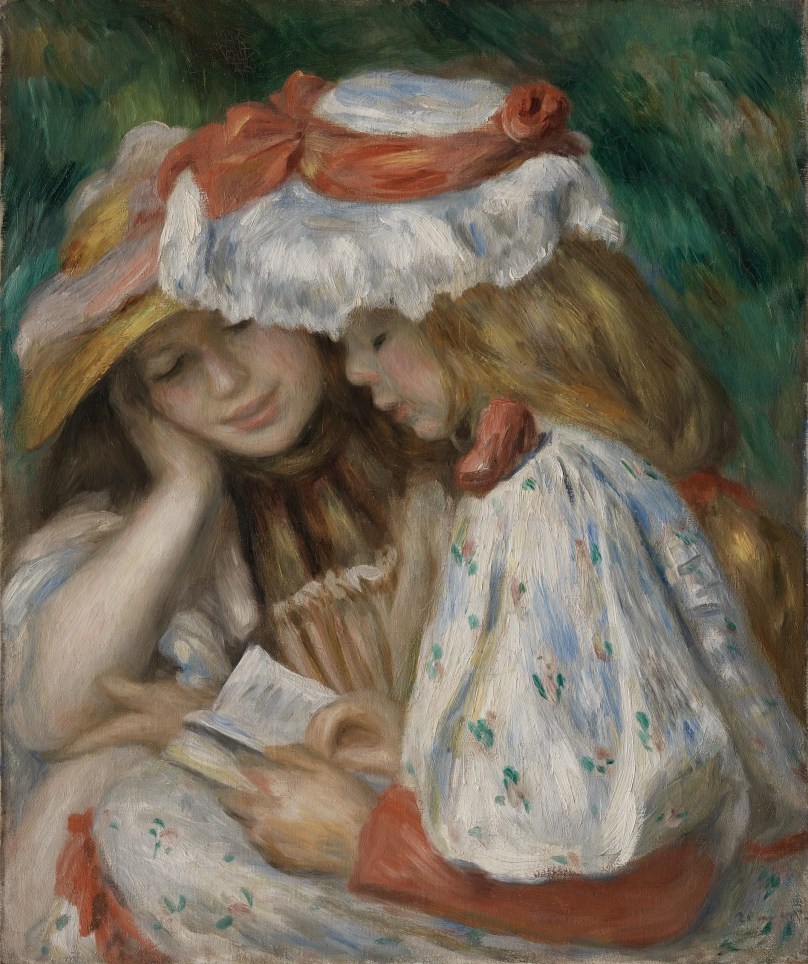
Two Girls Reading

Pierre-Auguste Renoir, Two Girls Reading, c. 1890-1891, Los Angeles County Museum of Art, Frances and Armand Hammer Purchase Fund, photo © Museum Associates/

There are two reasons why I am not particularly fond of the Los Angeles County Museum of Art (LACMA). Years ago, I signed up as a member. The museum cashed my membership check but then proceeded to pretend that I had never joined. Secondly, I am not enamored of most modern art; and I think the museum has extensive dubious holdings in that area.

When I did go to visit LACMA, I fell in love with a painting by Pierre-Auguste Renoir entitled “Two Girls Reading.” I have always thought of it as one of the must successful paintings of the whole French Impressionism movement

Many a time, I would stand for upwards of a half hour admiring the painting. I have always loved Renoir and have fond memories of visiting a major Renoir exhibition at the Museum of Fine Arts in Boston over forty years ago.

The other section of LACMA that I liked were the ancient Indian, Tibetan, and Chinese religious art.

Since the museum has gone on a major development kick with new buildings and prohibitive admission fees, I have not seen fit to go back and visit. I liked the old buildings better than the new ones and feel that the people in charge are empire building.

Renoir in the Waiting Room

Auguste Renoir’s “Bal du Moulin de la Galette” (1876)

There I was, waiting for a full hour beyond my appointment time at my physician’s office. Going through my mind was the question “What should I write about for my blog tonight?” Hanging in the waiting room were two reproductions of paintings by Pierre Auguste Renoir, one of which was “Bal du Moulin de la Galette.”

The thought suddenly came to me that no other artist depicted women so radiantly. In the above painting, it seems that there is a soft spotlight on every woman’s face. The men do not quite receive the same treatment. That tendency is even more pronounced in “La Promenade” at the Getty Center in Los Angeles:

Auguste Renoir’s “La Promenade” (1870)

The following is from an earlier post about the painter from December 2, 2021:

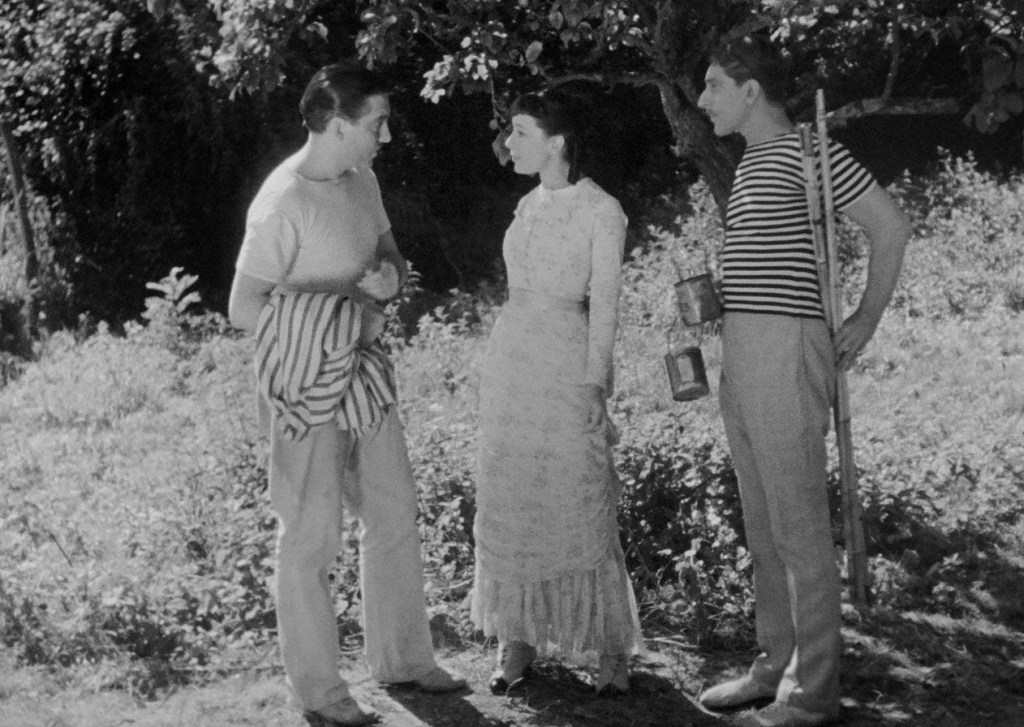
What I find truly amazing is that much of the same sensibility was passed on to his son, Jean, who became one of the great motion picture directors. There are times when the viewer feels that the father could have directed the same scene in the same way…..

Some of the same feeling is in his earlier The Rules of the Game (1939), which is set in the present day. The men in the film all fly around the Marquise de la Chesnaye (played by Nora Gregor) like moths circling a flame.

Of course, Jean Renoir was very conscious of his father’s work, appearing in several of the paintings. He also wrote a beautiful biography of him called Renoir, My Father, which is available in a New York Review edition and is well worth reading.

Although I was in my doctor’s waiting room for a long time, my mind kept flitting back to the father and son whose paintings and films have influenced me so much.

Like Father, Like Son

The illustration above is of Pierre-Auguste Renoir’s La Promenade, painted in 1870, and on display at the Getty Center in Los Angeles. I have always been partial to Renoir’s paintings, particularly when they have these luminous portraits of women. In the painting, the man’s face is in shadow; he is reduced to a polite gesture of leading his lady on. The young woman, on the other hand, lights up the canvas.

What I find truly amazing is that much of the same sensibility was passed on to his son, Jean, who became one of the great motion picture directors. There are times when the viewer feels that the father could have directed the same scene in the same way.

Above is a still from A Day in the Country (1946), which is set in the same period and shows us a picnic in the woods—with the same feeling of the radiance of the female character. Some of the same feeling is in his earlier The Rules of the Game (1939), which is set in the present day. The men in the film all fly around the Marquise de la Chesnaye (played by Nora Gregor) like moths circling a flame.

Of course, Jean Renoir was very conscious of his father’s work, appearing in several of the paintings. He also wrote a beautiful biography of him called Renoir, My Father, which is available in a New York Review edition and is well worth reading.