The Decline and Fall of the American Meal

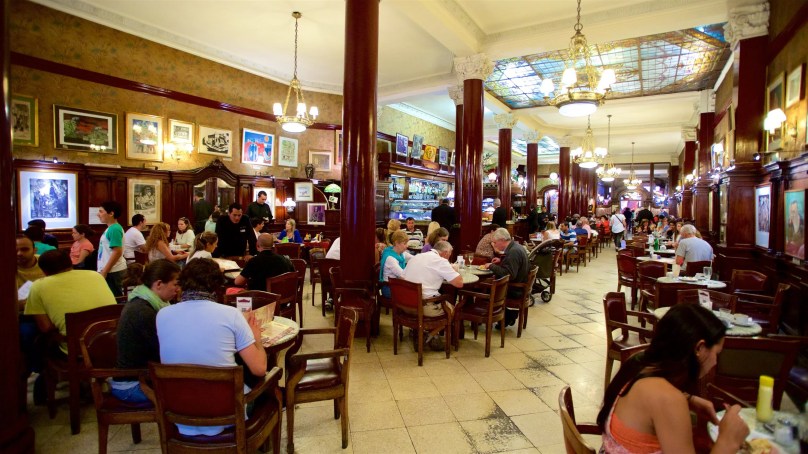
Last night, Martine and I had dinner at a restaurant in Glendale that we have loved for twenty-five years. As soon as we walked in, we noticed some ominous signs. The waitstaff were all young, they were wearing bright new T-shirts imprinted with the name of the restaurant, and there was a brand new illuminated sign. Most seriously, the old owner was not there.

For the first time ever, both Martine and I left the restaurant feeling slightly ill. I almost didn’t make it back to my parked car. And it was lucky that there was a large Mobil gas station at the corner of Brand and Chevy Chase in Glendale, where I was able to dispose of some of the intestinal irritants.

Mind you, I can understand why restaurants are dropping like flies. It is no fun to own or work at a restaurant, especially after the Covid-19 lockdowns. And increasingly, there is more microwaving than cooking taking place in the kitchen—by people who don’t know much about food safety.

Not only in restaurants, but across the board the quality of the American meal has declined precipitously. Even supermarkets are moving away from serving customers who do their own cooking. Recently, I have had problems finding basic food items such as barley or peanut oil. What there is no lack of are frozen meals that taste like cardboard and various “helper” mixes for people afraid to make anything from scratch.

Increasingly, the foods that people eat at home or in restaurants are deficient in nutrition and flavor.

One thing that particularly bothers me is the disappearance of ethnic restaurants as the next generation takes charge. When I first came to Los Angeles, there were loads of great Italian, French, Hungarian, Greek, and other ethnic restaurants. And there were even good cheeseburgers that didn’t look like a 300-pound guy named Rufus sat on them.

Restaurant Confidential

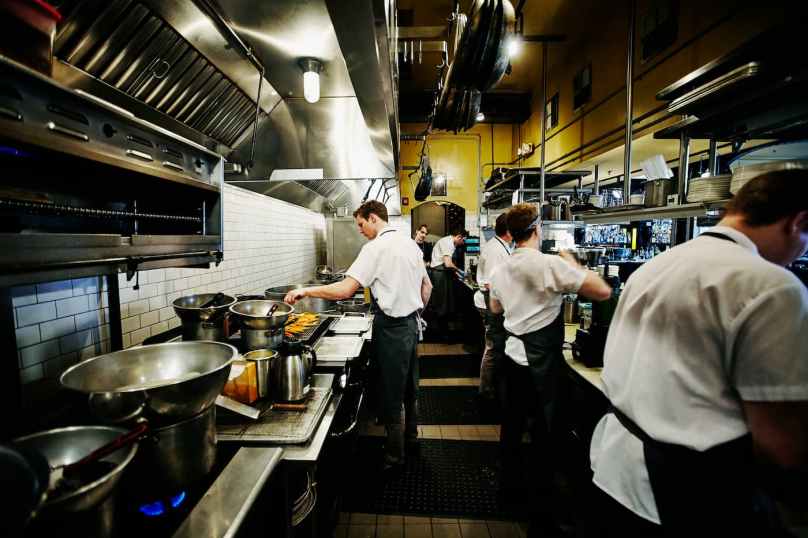
Restaurant Kitchen

Shortly after we survived the Covid-19 onslaught, I noticed that many of my favorite restaurants were shutting their doors. There was Papa Cristo’s Greek restaurant at Pico and Normandie near downtown L.A.; the Original Pantry at 9th and Figueroa, which was closed only a single day over the last century but is no more; and Jerry’s Deli, once a thriving chain.

Come to think of it, I am always surprised that restaurant stay open. I cannot imagine a less rewarding job than being the owner, manager, or supervising chef at a restaurant. The hours are long, your hands get scarred and burnt; you don’t make much money; and there are stringent health and sanitation requirements.

I have been reading Anthony Bourdain’s book Kitchen Confidential, which tells of one chef’s experiences in the New York and Provincetown, MA restaurant scenes. At one point, he writes:

To want to own a restaurant can be a strange and terrible affliction. What causes such a destructive urge in so many otherwise sensible people? Why would anyone who has worked hard, saved money, often been successful in other fields, want to pump their hard-earned cah down a hole that statistically at least will almost surely prove dry? Why venture into an industry with enormous fixed expenses (rent, electricity, gas, water, linen, maintenance, insurance, license fees, trash removal, etc.), with a notoriously transient and unstable workforce, and highly perishable inventory of assets?

Especially with the current occupant of the White House, who has it in for kitchen and agricultural workers, who traditionally tend to be illegal immigrants. As the owner of hotel restaurants at his glitzy Trump properties, who is going to work in his restaurant kitchens? Then, too, all this uncertainty over tariffs is going to hit hard at food items that are typically imported, such as winter fruits, avocados, and seafood. But then, we are entering a period of seat-of-the-pants decisions made without weighing the consequences.

Perhaps all that will be left are the “factory” restaurants like McDonalds and Burger King. That would certainly slash my restaurant expenses.

Two Auto Museums Bite the Dust

Martine Sitting in a Classic Corvette

I was dismayed to find that two superb auto museums closed down in 2024. In both cases, the museums grew out of personal car collections. When the museum founders passed on to that garage in the sky, both museums started to run into hard times.

The first was the Mullin Automotive Museum in Oxnard with its Bugattis and Art Deco paintings and furniture which closed in February 2024.

Hitting closer to home was the closure in October of the Zimmerman Automobile Driving Museum in El Segundo. There was a time when we visited the museum every few weeks. Martine loved it because they concentrated on American cars and because they allowed visitors to sit behind the wheel. She was particularly fond of a classic Corvette illustrated above.

There is an excellent article in Hemmings.Com about the Zimmerman Museum’s frantic attempts to raise cash after Stanley Zimmerman died in 2020. The article contains some excellent photos of the museum’s holdings.

Museums based on private collections have a high mortality rate. They are like restaurants, which, especially after the Covid-19 lockdown, are dropping like flies.

Escaping Thayer

It’s now called the Class of 1953 Commons, but when I was attending Dartmouth College between 1962 and 1966, it was called Thayer Hall. All students were required to eat there, which for me was a disaster. The meat was like slabs of granite, accompanied by bland potatoes and overcooked vegetables.

Supposedly it has improved since the days when Miss Jeanette Gill (who was reputed to be a retired marine) ruled the dining hall with an iron spatula. But then there were troops of dogs fighting for table scraps. When we saw the truck from the Precinct Pig Farm parked outside of Thayer, we were wondering whether they were picking up to slop the hogs or delivering to slop the students.

When I returned to Cleveland for Christmas vacation in December 1962, I managed to get a doctor’s note excusing me from eating at Thayer because it was making me sick. Which it was.

That left the handful of restaurants in Hanover, New Hampshire for me to explore. Probably my favorite was Lou’s Restaurant, owned by Louis Bressett, who, once every blue moon, served a devilish good spaghetti with meatballs. There was the usually reliable College Inn, and always the possibility of a splurge at the Hanover Inn.

I also enjoyed a local restaurant called Minichiello’s. Let me quote a 2015 post:

One of the places I ate was Minichiello’s: They had good pizza and were friendly. The only problem was they thought I was such a nice boy. You must remember that when I was a college senior, I looked as if I were still twelve; and I was subject to bullying by the local high schoolers until they saw I was carrying a college ID. So there I was, munching away at my pizza, when they introduce their daughter to me. She was very cute in a bad girl sort of way, and here her parents were holding me up as an example she should follow—instead of those bad boys who worked at the local garage.

God knows, if it weren’t for the fact that I was seriously ill with a pituitary tumor and, as a result, had not yet physically reached the age of puberty, I would much rather be doing with her those things her parents feared she was doing with the bad boys.

So for the rest of my college career, I avoided Thayer Hall. Where food is concerned, there’s a lot to be said for the privilege of being able to choose.

Museo Larco

This is the scanned image of my ticket to the Museo Larco in Lima, Peru. It was the first tourist sight I visited in Lima back in 2015—and it was an eye-opener. Founded in 1926, it was dedicated to the northern coastal cultures of Peru, of which there were many. We tend to think, “Peru … Yeah, that’s the Incas.” Except that the Incas were 15th century latecomers, and some of the earlier cultures were more advanced than they were.

Besides the Incas, there were the Moche, the Wari, the Chimu, the Chavin, the Paracas, the Nazca, the Chachapoyas, and many others.

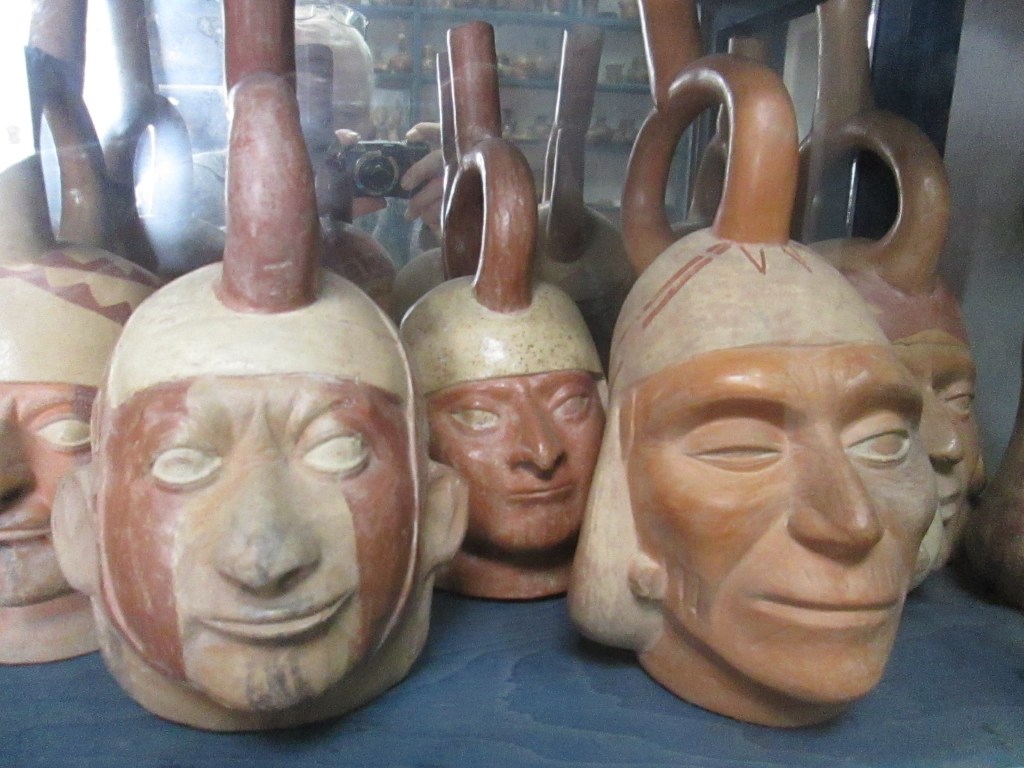
There were scores of these Moche heads at the museum. Like the famous terra cotta warriors at Xian in China, all had distinctive facial features as if they were based on particular individuals.

In addition there were elaborate textiles dating back centuries and still in excellent condition. There were even a few quipus, collections of knotted cords that were used for accounting purposes. None of these peoples appear to have had a written language like the Maya or Aztecs.

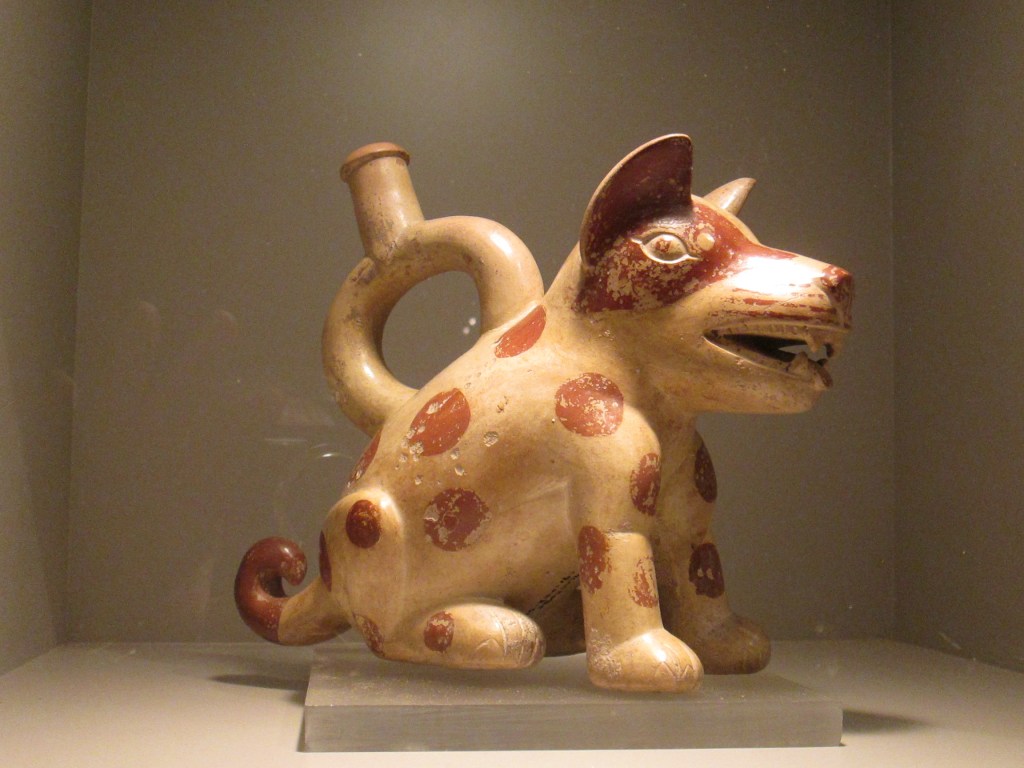
In common with many of the early Mexican cultures, the Moche had cute pottery fashioned in the shape of animals, such as the above dog.

One great thing about many museums in Latin America is that they frequently had adjoining cafés with excellent meals. The Museo Larco was no exception.

If you should find your way to Peru after they horrible Covid infestation, remember that there are a whole lot more to see than just the ruins of Machu Picchu. I could have spent several weeks in Lima without exhausting the list of places I wanted to see, such as the Police Museum in Callao.

Baby Steps

Los Angeles Central Library at 5th and Flower Streets

Today I took the train in to Downtown Los Angeles (or DTLA, as it is also known) to return some library books and pick up the next batch. For the first time in almost a year and a quarter, I was able to enter the library, hand my returns to a human being, and pick up the next batch. The last time, I had to call on my cell phone and have a librarian come out with the bagged books I had put on hold.

Now the ground floor of the library is open. This includes the book check-in and check-out and the international languages department—oh, and the restrooms. For any other books, I still have to put them on hold using the library’s website.

With my books in hand, I took the Dash Bus B to Chinatown and looked for a promising Chinese restaurant that was open to indoor dining. My old standby, the Hong Kong Barbecue, was still take-out only; but I found a good option in the Hop Woo Chinese Seafood Restaurant, just a few doors down, where I had rock cod in black bean sauce.

On the way back to Union Station, I bought my usual small bag of limes from an elderly woman (only $1 for about eight limes). As the weather grows warmer, I am addicted to fresh-squeezed lime juice with a slight splash of tequila.

I still had to wear a face mask on the train and the bus, resulting in fogged-up glasses, but I am encouraged that sometime soon we will be able to dispense with them. My second Pfizer Covid-19 vaccination was two months ago, so I am hopeful that the worst is past.

Carvaganza

A Perfect Car for the Road in Los Angeles

This weekend, a number of museums opened up for Covid-weary Angelenos, among whom are Martine and me. First we ate—indoors—at Du-Par’s Restaurant at the Original Farmers’ Market at 3rd and Fairfax. Then we breezed down Fairfax to the Petersen Automotive Museum at the corner of Fairfax and Wilshire.

Unfortunately, the current exhibits were more oriented toward the bearded and tattooed grundgerati. The museum’s former emphasis on the history of the automobile has been replaced by racing cars, including Maseratis, Lamborghinis, and others. In addition, there were a number of fantasy cars such as the monster above, which was designed for some movie which I likely never saw.

A Lamborghini Racing Car for the Cash-Non-Challenged

Still and all, it was nice to go eat out at a restaurant and visit a museum—quite a change from the previous twelve months. The Petersen was packed to overflowing with visitors who had no idea what social distancing was and why it is still essential. On the plus side, the wearing of masks was de rigeur.

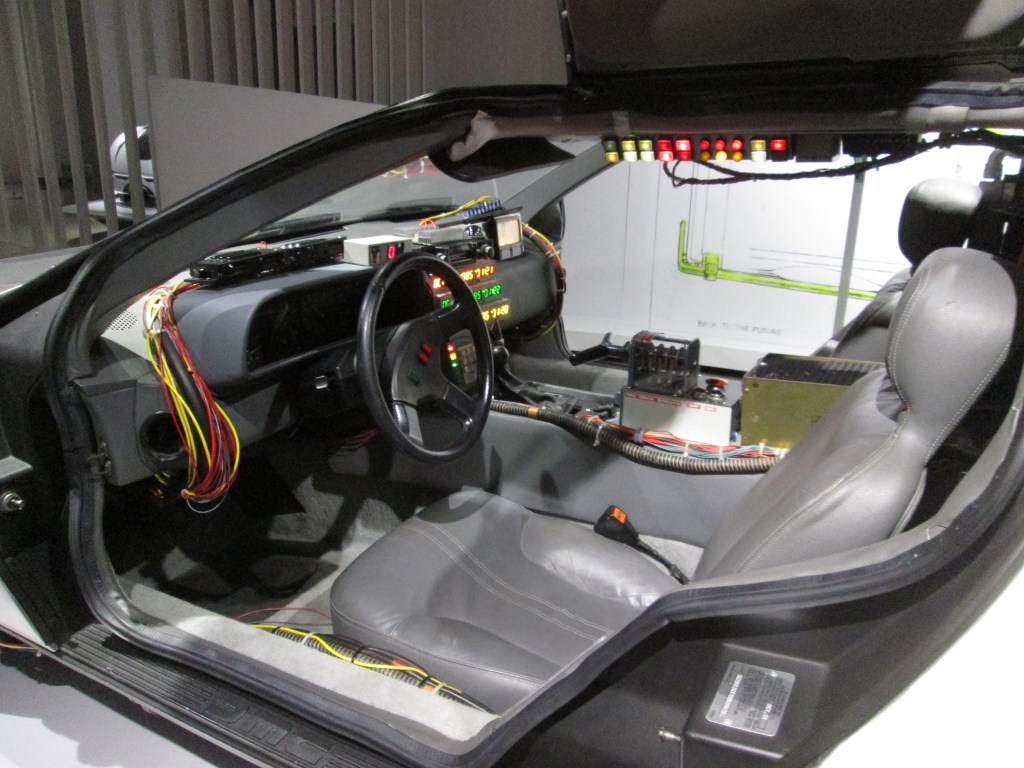
Finally, here is a peak of the dashboard of the original Back to the Future car:

Dash and Front Seat of the Original Back to the Future Car

Plague Diary 20: More Books and Films

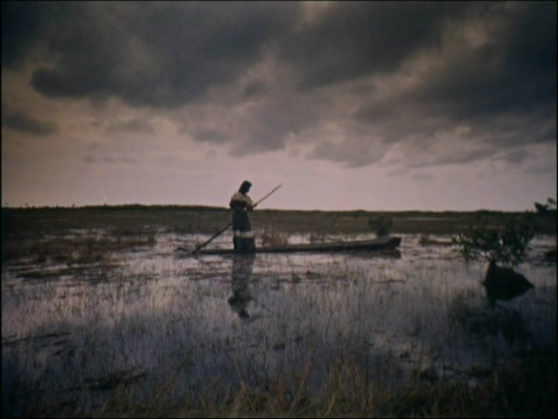
Christopher Plummer in Nicholas Ray’s Wind Across the Everglades

It was yet another day in quarantine (I am not keeping count). I started by making hot chocolate with the premium chocolate I had purchased in Mexico during my vacation. When produced in a double boiler the chocolate comes out perfect every time.

Then I decided to take a walk to the mailbox on Barry, about a mile east of here, to return a Netflix DVD of two Japanese samurai films I had seen over the previous two days. (I will write more about them in a future post.) I also wanted to stop in at the local Target store, but I had forgotten to bring my face mask with me—something I do about half the time. I notice a lot of people wear face masks all the time. They remind me of people who sleep alone with condoms draped over their jewels.

I returned to eat lunch with Martine. Mine was a couple of Chinese beef buns accompanied by frozen peach slices. While Martine went for her afternoon walk, I watched Nicholas Ray’s Wind Across the Everglades (1958) starring Burl Ives and Christopher Plummer. There were some beautiful shots of the Everglades and its bird life, and some highly dubious plotting, even if Budd Schulberg wrote the script.

Martine had wanted us to order Japanese from the Aki Restaurant on Santa Monica Blvd, so I phoned in an order and picked it up. It was a tasty reminder of when we used to eat our weekend meals in restaurants.

After dinner, I began reading Anthony Marra’s A Constellation of Vital Phenomena (2013), set during the Chechen wars. It looked like a good read.

Which brings me near to the end of another day. I will watch another episode of “Deep Space 9” and hit the sack.


Plague Diary 4: The Empanadas Run

Our Local Empanada Take-Out Restaurant

Near the corner of Sawtelle and Venice is our local Argentinian take-out restaurant, called Empanadas Place. I have been to Argentina three times, and I find that Empanadas Place has tastier empanadas than the South American versions. I decided to pick up a bunch of them for Martine, myself, and my elderly Mexican neighbor Luis, who is particularly fond of the place.

So I drove down there and placed my order. The tables for the sit-down part of the restaurant were all in storage, except for one for people waiting for take-out. I had a nice chat with the owner, an Argentinian of Italian ancestry (like about 75% of all Argentinians). Because his business had always been heavily oriented toward take-out, his business did not seem to be suffering from the forced closure of all sit-down restaurants. Unlike most Americans, he did not see his business as a path to riches: He was quite happy to make a small living selling delicious empanadas to the residents of Culver City and West Los Angeles.

For myself, I got four items: an Arabe (lemon-flavored ground beef and onions), spicy beef with cheese, spinach, and potatoes with cheese. I ate two of them for lunch, saving the remainder for tomorrow. Luis was pleased with his empanadas. (I think I will try to do an occasional take-out run at least once a week for the duration of the plague.

A Selection of Goodies from Empanadas Place

In addition to the featured items, Empanadas Place also sells a selection of Argentinian groceries, such as yerba mate tea, dolce de leche, and cookies known as alfajores. You can also get sandwiches and salads, as well as a refreshing glass of iced yerba mate tea.


Yucatán Yummies

La Chaya Maya in Mérida

One of the best parts of my recent trip to Mexico was the general high quality of the meals I ate. Following is a brief survey of some of the highlights:

Mérida. My favorite restaurant in Mérida was La Chaya Maya on Calle 55 near Parque Santa Lucia. In all, I ate there five times. The specialty there is Yucatec Maya food, such as papadzules, salbutes, panuchos, and the excellent sopa de lima. It was there that I discovered chaya, or tree spinach, which when mixed with fruit juice makes an incredibly refreshing drink.

Martine vividly remembers sopa de lima from her trip with me to Yucatán in 1992. La Chaya Maya’s sopa de lima was the best, with its shredded chicken and tart local limes.

Honorable mention goes to Marlin Azul on Calle 62, where I had a memorable ceviche de pescado for just a few dollars.

Santa Elena is a small town between the ruins of Uxmal and Kabah. The Pickled Onion is a B&B run by a British and Canadian expat by the name of Valerie Pickles. Although she no longer does the cooking, the breakfasts at her place were memorable, but the poc chuc (a Maya pork dish) I had one evening was superb. I treated my Maya guide to the Puuc Hill ruins to a meal there, and he was so enthusiastic that he wanted to bring his family there.

A Few Miles South of Champotón is a restaurant on the Gulf of Mexico shore where I had the best seafood lunch of my life: It was a filete de pescado a la Veracruzána (filet of fish with a sauce of tomatoes, onions, and olives) at a restaurant whose name had the word Tortuga in it. I only wish I remembered the exact name. I liked my lunch there so much that I kept ordering the same dish elsewhere, but it never was quite so good elsewhere.

Campeche. I ate twice at Marganzo near the Plaza Independencia in Campeche. The seafood was great, particularly a botana (freebie extra dish) of octopus ceviche, which was incredibly fresh and tender.

The only bad meal I had in Mexico was also in Campeche, at a Chinese steam table buffet called the Restaurante Shanghai where all the dishes were tepid.