
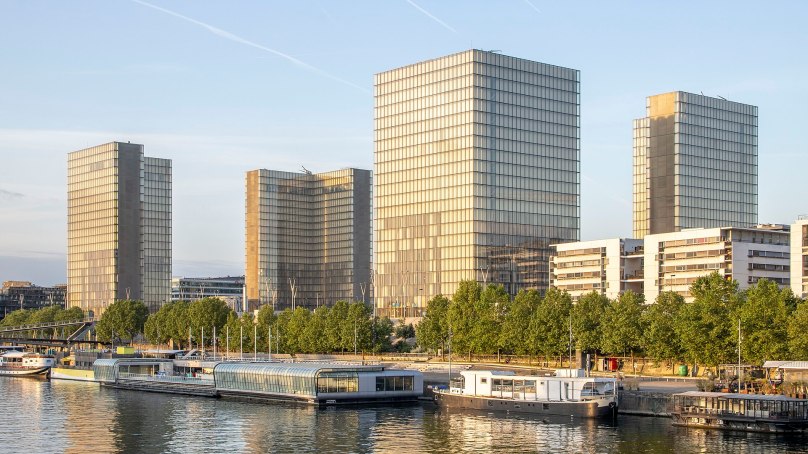
The Bibliothèque Nationale in Paris
One of the treasures in my recent reading is W G. Sebald’s Austerlitz, in which the haunted main character, Jacques Austerlitz, attempts to track down his parents who were lost to him in the War. At one point, he visits the Bibliothèque Nationale in Paris. Alas, he remains “oppressed by the vague sense that he did not belong in this city either, or indeed anywhere else in the world.” I was on the top floor of Los Angeles’s Central Library when, fittingly, I read this beautiful passage.
As for himself, Austerlitz continued his story after a long pause, during my first stay in Paris, and indeed later in my life as well, I tried not to let anything distract me from my studies. In the week I went daily to the Bibliothèque Nationale in the rue Richelieu, and usually remained in my place there until evening, in silent solidarity with the many others immersed in their intellectual labors, losing myself in the small print of the footnotes to the works I was reading, in the books I found mentioned in those notes, then in the footnotes to those books in their own turn, and so escaping from factual, scholarly accounts to the strangest details, in a kind of continual regression expressed in the form of my own marginal remarks and glosses, which increasingly diverged into the most varied and impenetrable of ramifications. My neighbor was usually an elderly gentleman with carefully trimmed hair and sleeve protectors, who had been working for decades on an encyclopedia of church history, a project which had now reached the letter K, so that it was obvious he would never be able to complete it. … Some years later, said Austerlitz, when I was watching a short black and white film about the Bibliothèque Nationale and saw messages racing by pneumatic post from the reading room to the stacks, along what might be described as the library’s nervous system, it struck me that the scholars, together with the whole apparatus of the library, formed an immensely complex and constantly evolving creature which had to be fed with myriads of words, in order to bring forth myriads of words in its own turn.
Shades of Jorge Luis Borges’s story, “The Library of Babel”!


You must be logged in to post a comment.