Beauty and Melancholia

Mabel Normand

Mabel Normand

I have found a definition of the Beautiful, of my own conception of the Beautiful. It is something intense and sad, something a little vague, leaving scope for conjecture. I am ready, if you will, to apply my ideas to a sentient object, to that object, for example, which Society finds the most interesting of all, a woman’s face. A beautiful and seductive head, a woman’s head, I mean, makes one dream, but in a confused fashion, at once of pleasure and of sadness; conveys an idea of melancholy, of lassitude, even of satiety—a contradictory impression, of an ardour, that is to say, and a desire for life together with a bitterness which flows back upon them as if from a sense of deprivation and hopelessness. Mystery and regret are also characteristics of the Beautiful.

A beautiful male head has no need to convey, to the eyes of a man, at any rate—though perhaps to those of a woman—this impression of voluptuousness which, in a woman’s face, is a provocation all the more attractive the more the face is generally melancholy. But this head will also suggest ardours and passions—spiritual longings—ambitions darkly repressed—powers turned to bitterness through lack of employment—traces, sometimes, of a revengeful coldness., … sometimes, also—and this is one of the most interesting characteristics of Beauty—of mystery, and last of all (let me admit the exact point to which I am a modern in my aesthetics) of Unhappiness. I do not pretend that Joy cannot associate with Beauty, but I will maintain that that Joy is one of her most vulgar adornments, while Melancholy may be called an illustrious spouse—so much so that I can scarcely conceive (is my brain a witch’s mirror?) a type of Beauty which has nothing to do with Sorrow. In pursuit of—others might say obsessed by—these ideas, it may be supposed that I have difficulty in not concluding that the most perfect type of manly beauty is Satan—as Milton saw him.—Charles Beaudelaire, Intimate Journals (trans. by Christopher Isherwood)


Does It Pay To Take a Chance?

KFC in Keflavik

KFC in Keflavik

During my recent visit to Iceland, I saw a number of American fast food chains represented, including KFC (see above photograph), Subway, Quizno’s, and several others—but, curiously, no hamburger chains. McDonald’s was there, but is gone now. I guess they couldn’t make a go of it.

As I would avoid most of these chains at home, I didn’t care to patronize them on my vacation either. Mostly, I looked for fish dishes, which were always fresh and delicious. Once I had a hamburger on the main drag in Isafjördur at Hamraborg and found it by no means inferior to  American burgers. In fact, I thought the béchamel sauce was a nice touch.

Not all of Hamraborg’s offerings looked quite so appetizing:

A Local Specialty I Decided Not to Try

A Local Specialty I Decided Not to Try

It looked as if it were loaded with sugar anyhow.

As in California, the type of restaurants I preferred were one-of-a-kind. At Háholt in Mossfellsbær, for example, I had a long wait; so I passed by the KFC and Subway and found a delightful little place near the local Bonus Supermarket:

I Was Probably the First American To Eat Here

I Was Probably the First American To Eat Here

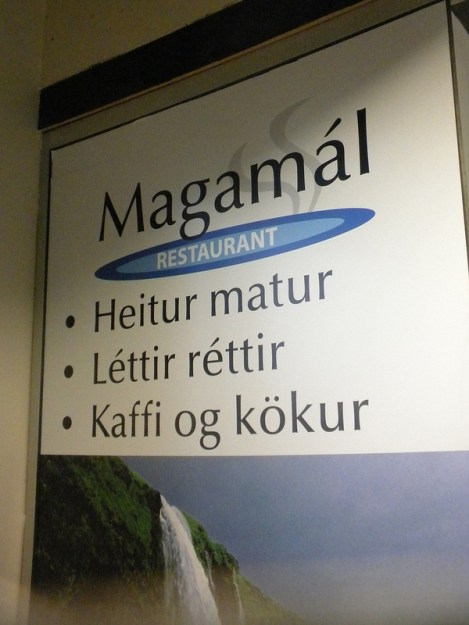
Now the sign doesn’t really tell you very much, does it? (I know the last line refers to coffee and cakes, however.) But I talked to the owner as he moved some tables and chairs outside and I decided to eat there. I had some great soup and a delicious piece of codfish with fresh vegetables. The owner was a bit of a health nut, and that fit in perfectly with my dietary restrictions. That was probably my best lunch in Iceland. I told the owner I was delighted not to have to eat at Subway or KFC, which were the only other choices within walking range.

Sometimes it pays to take a chance.


Not Just About Rocks

Zion National Park

Zion National Park

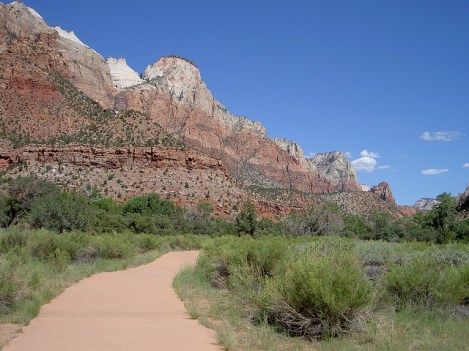
Geology is one of those subjects I would like to know much more about. Although I took the subject in college during late Ordovician times, it was all dictated by synclines, geosynclines, and anticlines, which I never quite understood—nor did the geologists who promulgated the notion.

Living as I do in the American Southwest, where the rocks are not covered by all that dirt, geology is something that seems more immediate. All the more so when the earth shakes as the tectonic plates are slowly marching on their pre-ordained paths to their next destination.

Geology is the history of what lies under our feet. It’s not just the study of rocks—though I can see where that could be interesting—but the study of long, slow processes that are changing the face of the earth. I saw some of those processes in action at Vatnajökull Glacier in Iceland, which has retreated hundreds of meters since the 1930s, when a road around the whole of the country was a laughable ides. Even now, the road across the black sands drained by the glacier is only a temporary expedient.

But then we are all temporary. If we want to see how small we are, we could make a study of the stars. But why go that far? The earth under our feet can be just as bizarre and alien. We talk about global warming as if it had never occurred before. It is just as likely that the currents of the oceans will reverse, bringing cold weather southward; and the glaciers may just start to re-form. We just don’t know.

I just finished reading John McPhee’s book In Suspect Terrain, about the forces that formed the eastern part of the United States, mostly the Appalachian Mountains. Plate tectonics explains some things, but as one geologist remarked, “While geologists argue, the rocks just sit there. And sometimes they seem to smile.”

This and the other titles in McPhee’s geological tetralogy, are good books to read if you want to puncture a few misconceptions.

Puffin Safari

Never Did I Think It Would Be So Difficult

Never Did I Think It Would Be So Difficult

On one hand, I saw literally thousand of puffins. On the other hand, I had no idea they were such agile little buggers. They hang out along the tops of cliffs, where they create burrows in the topsoil to serve as nests. If you try to approach them, there is a good chance the soil will collapse into one of their burrows, sending you catapulting over the edge.

Icelanders eat puffins. They catch them by dangling on a rope from the top of the cliff and catching the puffins with a net that looks something like a lacrosse stick. But I was not interested in eating any puffins—although I had the chance—because, well, I started to admire these clownfaced little birds.

The above photo, and the cropped and heavily manipulated photo below is taken from the above picture, just so that you can get a close-up view of a real live wild puffin (Fratercula arctica).

Close-Up from the Top Photo

Close-Up from the Top Photo

All in all, I saw puffins on Lundey Island in Faxaflói Bay, on the Westman Islands (by the thousands), and on Vigur Island on Isafjarðardjúp fjord. The above photo was taken on Vigur, where the wind and rain kept the puffins from venturing into its teeth. The pictures were taken with the maximum telephoto setting on my Nikon CoolPix s630. I had to work fast, because the puffins would dart around quickly, and it took several seconds between pictures for my camera to reset.

It’s not like Argentina, where Martine and I paid a visit to several hundred thousand Magellanic penguins, who just stood by quizzically wondering whether we were good to eat, or what. That enabled me to get lots of close-ups, because they weren’t exactly flying off.

Because Martine was not with me on this trip, I wanted to at least get some good puffin pictures to show her. We had looked for puffins in Scotland in 1998, but we were too early. I looked for them in Heimaey in 2001, but I was too late.

I guess the puffins, in the end, were easier to photograph than moose. They weren’t quite so shy, they were around in great abundance—but you had to act fast.

Politics As It Should Be

Outgoing Icelandic Prime Minister Johanna Sigurdardottir

Outgoing Icelandic Prime Minister Johanna Sigurdardottir

There is a delightful little video on YouTube about the recent change of government in Iceland. Although I didn’t understand a word of it, I loved the spirit of the whole thing. Instead of doing the kind of mean-spirited things that characterize American politics, the Icelanders had a little fun with it. In particular, do not miss the bomb-detecting robot in the Prime Minister’s Office Building! (That’s the two-story 18th century building shown in the video, also worn as a hat at the beginning.)

By the way, outgoing PM Johanna Sigurdardottir was probably the first lesbian head of state who was in a same-sex marriage.

The Guardian

A Job for All Time

A Job for All Time

On my first day in Reykjavik on June 20, I had a challenge: To stay awake until it was time to go to bed on Greenwich Mean Time.The problem is, I started the day on Pacific Daylight Time, which added seven hours to the usual twenty-four.

By the way, there is no Daylight Savings Time in Iceland because—duh!—it’s the Land of the Midnight Sun, and it remains light at all hours.

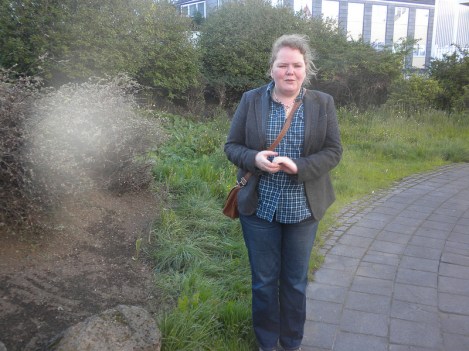
One way I managed this was to take GoEcco’s Haunted Walk of Reykjavik. From my readings in the Medieval Sagas, I was already interested in Icelandic ghosts, so it was a natural for me. I was fortunate that the walk was given by a historian familiar with the Sagas (shown below).

Say, Isn’t That a Ghost on the Left?

Say, Isn’t That a Ghost on the Left?

One of the places we visited was Fossvogur Cemetery near the University. Our guide told us an interesting story about an old Icelandic custom:

Icelandic folk beliefs hold that the first person to be buried in a cemetery will be its ’guardian’ and that the body will not rot but serve to watch over those arriving later.  In Fossvogur the ‘guardian’ is Gunnar Hinriksson, a weaver, buried there on 2nd September 1932.

The tombstone of the cemetery guardian contains the image of a lit oil lamp as shown in the top photograph. Now, not everyone wanted their loved ones to serve as the guardian of the cemetery for all time; and, in fact, a number of people who died prior to 1932 were buried there.

Fossvogur is one of two cemeteries I visited in Iceland. The other was on Heimaey in the Westman Islands. I remembered videos of the 1973 eruption of the volcano Eldfell that showed a fall of ash and lava that covered the cemetery to a depth of several feet. It was cleaned up and is now in immaculate condition.

Iceland Is for Foodies

Fish is Number One in Iceland

Fish is Number One in Iceland

Fishing exports account for some 40% of Iceland’s export income and employs some 7% of the workforce. I remember riding a bus from Háholt In Mossfellsbær to Borgarnes with the first mate of a fishing trawler, who explained that he would be off for several weeks because of the rigid quota system employed by the fisheries. As soon as it was possible to go to sea without the danger of exceeding the quota, they would set sail.

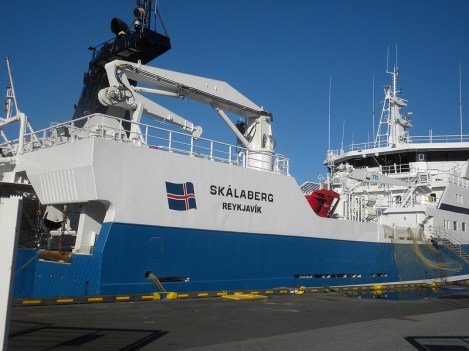
Needless to say, I ate a lot of fish in Iceland, sometimes as often as twice a day. In addition to Icelandic cod, my favorite, there was ling cod, sea wolf, salt-water catfish, langoustines, mussels, shrimp, halibut, haddock, monkfish, and probably half a dozen other varieties. Since the vast majority of the population lives within sight of the North Atlantic, I could look out the window while I was eating fish and see the trawlers and other fishing vessels (such as the one above) parked in the harbor waiting for their next outing.

Unlike the United States, where seafood is usually the priciest item on the menu, in Iceland, it is usually the cheapest.

Many people don’t know this, but some fifty years ago, Iceland fought a “cod war” with the United Kingdom. It was the first country to declare an extended territorial limit, mainly to protect its fisheries from British fishing boats. Nets were cut by the Icelandic Coast Guard, and a British frigate once threaten to ram the offending ship. Fortunately, the two NATO nations avoided a shooting war.

In the end, the Brits lost, and the British fishing industry is now but a shadow of what it once was. Now all countries, including the United States and Britain, have extended territorial limits. One interesting result is the possibility that Iceland could become an oil-producing country. There is an possible oil field within the territorial limits called the Dragon Zone which Iceland and Norway are thinking of sharing, much to the dismay of the Chinese and Russians, who would like to exploit the resources for themselves.

Street Grunting

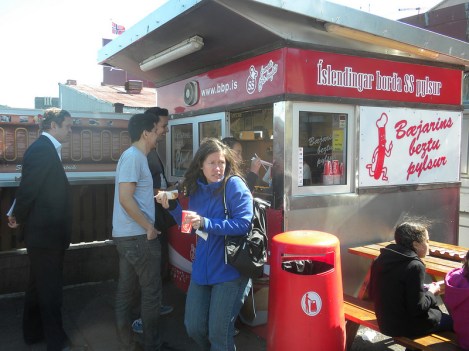
One would not think that Iceland would be a good place for what A People’s Guide to Mexico called “street grunting.” Tucked away near the old port is an 80-year-old hot dog stand called Bæjarin’s Beztu (roughly translated as “the best in town”).

They Sell Only Two Things: Pylsur and Soda

They Sell Only Two Things: Pylsur and Soda

Icelandic hot dogs are called pylsur. They are made with a combination of meats, including lamb, and are served in hot dog buns with ketchup, sweet mustard, fried onions, and remoulade, which includes mayonnaise and relish.

Generations of Reykjavík residents have made their way to Bjarin’s Beztu for a quick and relative cheap snack.

If you are in the boonies, not to worry: You can get decent pylsur at gast station roadhouses throughout the island. Also available are pizza, burgers, and fish and franskum (chips).

Skyr

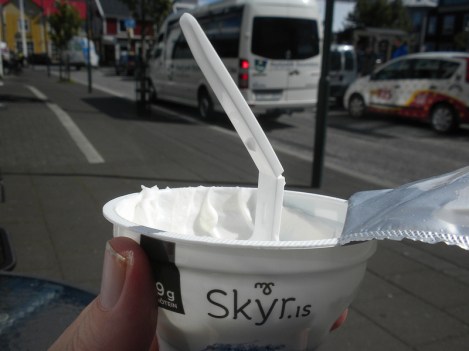
Finally, there is one Icelandic dairy product that is widely available to which I became addicted, and that is skyr. While similar to yogurt, it is much creamier and richer in texture. Made with pasteurized skim milk, it can be found virtually everywhere, either plain or in various fruit flavors.

Plain Skyr. Yum!

Plain Skyr. Yum!

The above picture was taken by me on my first day in Iceland. I went into a downtown market and purchased the above tub of the ambrosial treat. You can find out more by going to the manufacturer’s website.

I don’t think I lost any weight during my recent trip, but I did have a lot of tasty and, for the most part, healthy food.

“A Heart-Breaking Shop”

Bookstore Window

Bookstore Window

But what were even gold and silver, precious stones and clockwork, to the bookshops, whence a pleasant smell of paper freshly pressed came issuing forth, awakening instant recollections of some new grammar had at school, long time ago, with “Master Pinch, Grove House Academy,” inscribed in faultless writing on the fly-leaf! That whiff of russia leather, too, and all those rows on rows of volumes, neatly ranged within—what happiness did they suggest! And in the window were the spick-and-span new works from London, with the title-pages, and sometimes even the first page of the first chapter, laid wide open; tempting unwary men to begin to read the book, and then, in the impossibility of turning over, to rush blindly in, and buy it! Here too were the dainty frontispiece and trim vignette, pointing like hand-posts on the outskirts of great cities, to the rich stock of incident beyond; and store of books, with many a grave portrait and time-honored name, whose matter he knew well, and would have given mines to have, in any form, upon the narrow shelf beside his bed at Mr Pecksniff’s. What a heart-breaking shop it was!—Charles Dickens, Martin Chuzzlewit

The Greatest Show on Earth

Ringmaster Andre McClain of the Ringling Bros Barnum & Bailey Circus

Ringmaster Andre McClain of the Ringling Brothers Circus

When I returned from Iceland, I noticed that Martine had printed out a couple of sheets about the latest show of the Ringling Bros. and Barnum & Bailey Circus. Since she had been waiting patiently for my return, suffering from an obscure nerve disorder (apparently still not officially diagnosed as fibromyalgia) that has robbed her of sleep and caused a steady level of back pain, I thought it would be a good idea to take her out on Saturday afternoon to see the show.

It was playing at the Staples Center downtown, which Martine had never seen; so I reserved a couple of VIP seats and hopped on the bus to go downtown. (A Santa Monica #10 freeway flyer bus straight downtown picks up only a block from our apartment, and it is far more convenient than hassling the downtown parking scene.)

I had seen several circuses in Cleveland while I was growing up, both the Ringling Brothers and the Grotto Circuses. In Los Angeles, I had seen Circus Vargas twice. Even in Mexico, I had seen small local circuses in Zacatecas and San Cristobal de las Casas. The latter was a family affair which I saw with my brother Dan in 1979. The 15-year-old aerialist also sold popcorn. Having taken a shine to Dan, she sat several rows behind him and tried to get his attention by tossing popcorn at him.

Ringling Brothers is several thousand times bigger then the Circulo del Sureste in San Cristobal, but it was all the same sort of fun. Instead of an adolescent boy rolling around in broken glass and Mamacita balancing furniture on her chest, we had a tiger tamer from Chile that had me on the edge of my seat. There was also an all-African-American unicycle team that played basketball, a young lady shot out of a cannon, a parade of elephants, various high wire acts, and a husband/wife pair of clowns from Russia who were outstandingly funny.

Outside the Staples Center were scores of protestors claiming that the animals in the show were being tortured to perform. Yes, true to some extent, but so were the humans; and no one was protesting about that.

The only sour note was that my cell phone holster fell apart, and I lost my cheap cell phone. I’ll make a few calls to lost and found today, but I’m not exactly disconsolate about the whole thing. I never answered my cell phone anyhow unless I was expecting a particular call.

Diamonds on Black Velvet

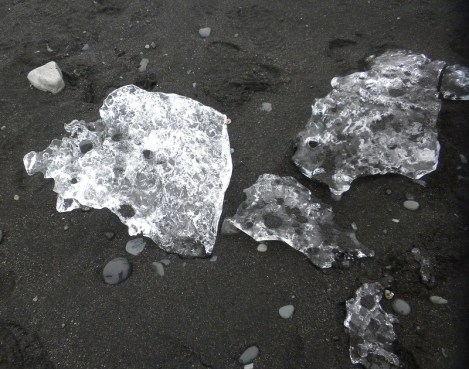
The Volcanic Sands of Breidamerkursandur with Chunks of Glacial Ice

The Volcanic Sands of Breidamerkursandur with Chunks of Glacial Ice

It’s just on the other side of the road from the Jokulsarlon glacial lagoon, one of Iceland’s primo tourist destinations. But for every one hundred backpackers milling around the lagoon, only two or three walk over to where the lagoon debouches into the North Atlantic. There you will find miles of black sand dotted with the remnants of icebergs. The effect is like looking at diamonds on a black velvet background.

I first heard about Breidamerkursandur (“Sands of the Broad Boundaries”) and Skeidararsandur (“Sands of the Open Spaces”) in Katharine Scherman’s excellent 1976 book Daughter of Fire: A Portrait of Iceland. There are very few places in the world where one can find miles and miles of black volcanic sand. I am told that Sicily, around Mount Etna, is another such place.

Years ago, my French friend Alain entertained a cousin from the old country who complained about the sands of Santa Monica being tan-colored, rather than pure white like the beaches with which he was familiar. The reason for the difference was not that our sand was dirty, but rather that it was formed by the ocean beating for millenia against sandstone rather than limestone. Certain volcanic rocks just happen to produce sand that is jet black, as at the beach at Breidamerkursandur.