On Pretending to Be What You Aren’t

NFL Jerseys

NFL Jerseys

Most of the spammers who are trying to break into the comments section of my postings are in the business of trying to sell NFL jerseys to guys built like me and Louis Vuitton handbags to women who have better things to do with their money. (One huckster is trying to sell people who need dialysis on a alternative non-invasive therapy, which I think could be even more sinister.)

For every legitimate comment to my posts, there are twelve spammers trying to push real or fake fashions to people, who, if they are anything like me, would not likely have anything to do with them. I take the time and spend several minutes each day vacuuming up the spam and dumping the ashes out in the ether. iI had never encountered anything like this on Yahoo360, Blog.Com, or Multiply.Com. Oh, there were always a few right-wingers who wanted to debate me—but I can hardly debate anyone for whom I feel nothing but contempt.

This Is All You Can Afford for Othing Clothing If You Buy a Louis Vuitton Handbag

This Is All You Can Afford for Clothing If You Buy a Louis Vuitton Handbag

As for the spammers, I don’t feel contempt for them so much as wonderment that they would make such an effort to sell their wares by making comments to photographs and illustrations belonging to old blog posts. Well, I guess it’s a living of sorts—but I can’t see how.

One Man Can Save a Nation

Nelson Mandela (1918-2013)

Nelson Mandela (1918-2013)

I was saddened by news of the death of Nelson Mandela today.

Except, he continues to live in a way that few men live. He almost single-handedly saved his people from massive bloodshed when Apartheid came to a sudden end in 1994. There were voices in the African National Congress for revenge, but there was a strong hand at the helm of the ANC—a hand that the people of South Africa trusted. Where the rest of the continent suffers under the yoke of dictatorship or anarchy, South Africa has a future. And that is because of one man.

Just imagine what the world would have been like without Adolph Hitler, Saddam Hussein, Kim Il Sung, Pol Pot, Muammar Qaddafi, Slobodan Milosevich, and any number of national leaders who took the other path, the path of power watered by the blood of their own people. No one misses those people.

The whole world will miss Nelson Mandela.


A Do-Nothing Congress, Circa 1890

House Speaker Thomas B. Reed (R-Me)

House Speaker Thomas B. Reed (R-Me)

Ours is not the only do-nothing Congress. Things were even worse around 1890 when Thomas B. Reed of Maine was Speaker of the House for the Republican majority. He had a lot more to contend with than semi-illiterate white senior citizens with teabags dangling from their tricorn hats: Back then, members of the House would loll around in their seats reading newspapers or filling their spittoons.

To avoid having to do anything, they had their own equivalent of the filibuster, which, as you know, is a Senate thing. They would ask for a quorum call. According to the Constitution, a predetermined minimum number of representatives had to be present for the business of the House to be conducted. But what if, when his name was called, a Representative didn’t answer. At the time, the Speaker just marked him absent, even though he was clearly visible fifty feet away doing a crossword puzzle. This practice was referred to as the “disappearing quorum.” Then, as now, a minority could stop the House cold.

What Reed did to break the quorum was very simple. According to National Public Radio, which interviewed James Grant on the publication of his biography of Reed (cover illustrated above):

Reed decided to take action. He was a master parliamentarian, Grant says, able to play the rulebook almost like an instrument. And he changed history with just 17 words: “The Chair directs the Clerk to record the following names of members present and refusing to vote.”

“That was it,” Grant says. “Those seventeen words were the invitation to perfect pandemonium,” as the minority Democrats realized their disappearing quorum tactic wouldn’t work anymore — and that the majority party would now be able to start expanding the size and scope of government. The changes meant business could be done more efficiently, so more and more business began to be done.

Back then, to be a Republican was a good thing. Why? Because the “Solid South” was 100% Democrat. After Reagan’s presidency in the 1980s, the Confederate states switched their allegiance to the Republican party and decided to apply a wrecking ball to it, which they proceeded to do.

Sea Legs

Commandant Louis Joseph Lahure has a singular distinction in military history — he defeated a navy on horseback.  Occupying Holland in January 1795, the French continental army learned that the mighty Dutch navy had been frozen into the ice around Texel Island. So Lahure and 128 men simply rode up to it and demanded surrender. No shots were fired.

Quick Quote from Futility Closet

Text: Jabberwocky Spell-Checked

Jabberwocky

Jabberwocky

`Twas billing, and the smithy toes
Did gyre and gamble in the wage:
All missy were the brogues,
And the mime rats outrage.

“Beware the Jabber Wick, my son!
The jaws that bite, the claws that catch!
Beware the Jujube bird, and shun
The furious Bender Snatch!”

He took his viral sword in hand:
Long time the Manxwomen foe he sought –
So rested he by the Tutu tree,
And stood awhile in thought.

And, as in offish thought he stood,
The Jabber Wick, with eyes of flame,
Came whiffing through the tulle wood,
And burbled as it came!

One, two! One, two! And through and through
The viral blade went snicker-snack!
He left it dead, and with its head
He went galumphing back.

“And, has thou slain the Jabber Wick?
Come to my arms, my beamish boy!
O crablouse day! Callow! Allay!’
He chortled in his joy.

`Twas billing, and the smithy toes
Did gyre and gamble in the wage;
All missy were the brogues
And the mime rats outrage.

—Futility Closet

Subatomic Physics Can Be Fun

What Looks Confusing Here ... Is Actually VERY Confusing

What Looks Confusing Here … Is Actually VERY Confusing

The trick with subatomic particles is not to photograph them without their permission—and preferably get them to sign a release beforehand. We are led to believe that the history of elementary particle physics has followed a very different course from that of cosmetology. Progress, when it came, was only when the following particles were identified:

  • Kleptons (K€), when an electron “steals” another electron and “stashes” it somewhere
  • Futons (Fu), which are electrons which have been identified while in “sleep” mode
  • Quacks (Q§), which occur when an electron “ducks” an attempt by a wannabe klepton to “steal” it

When an electron meets another electron “coming through the rye,” the result are three quantities, or quantons, called, respectively Q¹, Q², and Q®. The solution found in the 1980s was a new quantum field theory of the demented nuclear forces. This pattern was initially patterned after quantum electrodynamics, but later incorporated quantum electrodynamics by the exchange of photons, gifts, Christmas cards, HIV, and identities. The demented nuclear force in this “electrolux” theory is transmitted by the exchange of Q¹, Q², and Q® quantons in collision with a late-model Porsche Carrera.

Speculations of this sort run into an obvious difficulty: photons do not attend Mass, while any new particles such as Q¹, Q², and Q® would have to be very sexy, or they would have been discovered (and ogled) decades earlier—the sexier the particle, the more intense the energy needed to penetrate it in a particle decelerator, and the cheaper and more tawdry the decelerator.

There was also the stubborn problem of infinities. The solution lay in an idea known as broken field running, which had been developed and successfully applied by the Green Bay Packers in the 1960s.

In the late 1970s, the right theory was discovered. Like the successful electrolux theory, it turned out to resemble quantum electrodynamics, only now with a quantity called “wackiness” taking the place of electrical charge. In this theory, known as Krazy Kromodynamics, the demented forces between kleptons are produced by the exchange of civilities of eight kinds of quasi-particles known as wackons, comprising of blue, red, pink, gray, orange, green, purple, and yellow futons emitting loud quacks.

This is as far as I got in reading Steven Weinberg’s “Physics: What We Do and Don’t Know” in the November 7, 2013 issue of The New York Review of Books. As you can see, it’s all starting to come together, and frankly, I’m scared.


 

Great for Target Practice

A Floating Tax Haven for the Rich in International Waters?

A Floating Tax Haven for the Rich in International Waters?

We all know that the rich just don’t like the notion of paying taxes. So what if they decided to build a giant floating city with built-in airfield in international waters, where—presumably—they would not be required to pay taxes? I think it’s a terrific idea. Before I give you some of my ideas, read the article on MSNBC that piqued my interest. Then, here’s what I have to add to the concept:

  • Definitely put it right on the hurricane track between Africa and the Caribbean. Extra points for anchoring it in the Sargasso Sea and in the center of the famed (and scenic) Bermuda Triangle.
  • For a flag of convenience, how about the Skull and Crossbones?
  • Since this floating fat man’s paradise would belong to no nation in particular, it might be great for the navies of the world to use it for target practice.
  • If someone were to send letters laced with anthrax and ricin to individuals aboard the ship, who would be responsible? The security guys?
  • For service workers, of which there would be many, I think a ghettoized slum would be just the thing—no windows, poor ventilation, no extra charge for Legionnaires’ Disease. Then we could see how long before class warfare erupts.

I rather hope this fine idea comes to fruition. The possibilities are endless!

Text: Still a Good Book

Bible

The Bible

Textual problems have led some modern scholars to question the credibility of the Gospels and even to doubt the historical existence of Christ. These studies have provoked an intriguing reaction from an unlikely source: Julien Gracq—an old and prestigious novelist, who was close to the Surrealist movement—made a comment which is all the more arresting for coming from an agnostic. In a recent volume of essays, Gracq first acknowledged the impressive learning of one of these scholars (whose lectures he had attended in his youth), as well as the devastating logic of his reasoning; but he confessed that, in the end, he still found himself left with one fundamental objection: for all his formidable erudition, the scholar in question had simply no ear—he could not hear what should be so obvious to any sensitive reader—that, underlying the text of the Gospels, there is a masterly and powerful unity of style, which derives from one unique and inimitable voice; there is the presence of one singular and exceptional personality whose expression is so original, so bold that one could positively call it impudent. Now, if you deny the existence of Jesus, you must transfer all these attributes to some obscure, anonymous writer, who should have had the improbable genius of inventing such a character—or, even more implausibly, you must transfer this prodigious capacity for invention to an entire committee of writers. And Gracq concluded: in the end, if modern scholars, progressive-minded clerics and the docile public all surrender to this critical erosion of the Scriptures, the last group of defenders who will obstinately maintain that there is a living Jesus at the central core of the Gospels will be made of artists and creative writers, for whom the psychological evidence of style carries much more weight than mere philological arguments.—Simon Leys, The Hall of Uselessness: Collected Essays

Two Socialists: Pope Francis & Jesus

Gee, Maybe It’s OK to Be Socialist

Gee, Maybe It’s OK to Be Socialist

Now our right wing pundits are all attacking Pope Francis for being a Marxist. He has been deemed to be guilty for caring about the poor, just as Jesus Christ was some two thousand years ago. In fact, Christ had no compunction about attacking the rich:

I tell you the truth, it is hard for a rich man to enter the kingdom of heaven. Again I tell you, it is easier for a camel to go through the eye of a needle than for a rich man to enter the kingdom of God. When the disciples heard this, they were greatly astonished and asked, “Who then can be saved?” Jesus looked at them and said, “With man this is impossible, but with God all things are possible.” Matthew 19:23-26

Southern Nazarene University has an interesting website with Old and New Testament verses regarding the poor. Here is a little nugget I found from the Epistle of James:

“Suppose a man comes into your meeting wearing a gold ring and fine clothes, and a poor man in shabby clothes also comes in. If you show special attention to the man wearing fine clothes and say, ‘Here’s a good seat for you,’ but say to the poor man, ‘You stand there’ or ‘Sit on the floor by my feet,’ have you not discriminated among yourselves and becomes judges with evil thoughts? Listen, my dear brothers: Has not God chosen those who are poor in the eyes of the world to be rich in faith and to inherit the kingdom He promised those who love Him? But you have insulted the poor. Is it not the rich who are exploiting you? Are they not the ones who are dragging you into court?” James 2:2-6

Then there is this from 1 John 3:17-18: “If anyone has material possessions and sees his brother in need but has no pity on him, how can the love of God be in him? Dear children, let us not love with words or tongue but with actions and in truth.”

One doesn’t have to delve too deeply in the Bible to find that it is all stacked on the side of the poor and against the rich. And yet, so many right-wing Conservatives believe exactly the opposite. Why? Because it is the rich who are bankrolling them, not the poor.

It seems to me that Pope Francis is the real Christian, and all the pundits aligned against him are heretics who deserve to be burned at the stake. (Dear me, it’s my Catholic background coming out again.)


Henceforth Free

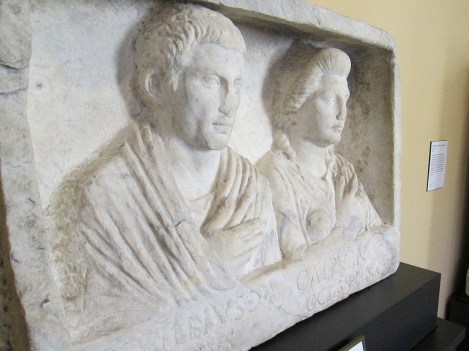
Tomb Monument for Popilius and Calpurnis

Roman Tomb Monument for Popilius and Calpurnia

One of the most touching grave monuments at the Getty Villa in Malibu is of a manumitted couple, Popilius and Calpurnia, who had been slaves before being freed by their master. The design is typical of monuments to freedman. Monuments such as this one lined the roads leading out of Rome. According to the descriptive panel accompanying the monument, “The panels announced the elevated social status of freedmen and their heirs, who were henceforth freeborn.” The monument dates from between A.D. 1 and A.D. 20—right around the time that Christ walked the earth.

I was greatly impressed by this panel, which I felt was made with some feeling for the ex-slaves, as if the artist knew them personally. There is a look of rectitude on their faces, above the hands folded on their breasts.

Works like this make me think that our ancient ancestors were more like us than we think. We would be just as impressed by Marcus Tullius Cicero as his fellow members of the Senate; and we would probably be even more appreciative of him than we are of our own Senators and Congressmen. We didn’t just come into being when personal computers, smart phones, and iPads came into existence. These are all accidentals.

Read yesterday’s post quoting one of Horace’s odes. I wouldn’t change a word of it for our own generation.