Scofflaws

I Have Nothing But Problems with These Guys

I Have Nothing But Problems with These Guys

There is a problem with always holding the high moral ground. It means that everyone else is one of the damned.

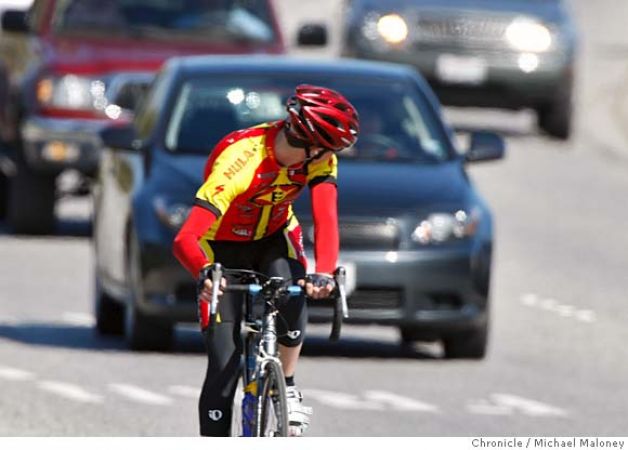
I live and work close to the UCLA campus with its population of 29,000 students, many of whom travel back and forth from home on their bicycles. In this part of Los Angeles, there are a limited number of east/west roads suitable for cyclists. It is dispiriting for me as a motorist to have to deal with the attitudes of cyclists who do not feel that they have to follow traffic signals and stop signs, and who could suddenly morph from vehicular traffic to pedestrian traffic and crossing at crosswalks and scaring the Bejeezus out of little old ladies with their shopping carts.

There are two types of cyclists: the ones who are law abiding and those who insist on showing their contemptuous attitude. Usually this second group wears expensive brightly-colored racing designs and fancy helmets. These scofflaws treat automobile drivers as pond scum. A few weeks ago, I made a right turn going eastbound while a westbound cyclist made a left turn into my lane without any hint of a turning signal. He chased me down for almost a mile just so that he could verbally abuse me. He said that he was not required to signal a turn. (They don’t appear to be required to follow any laws.)

That’s why, today, as I exited the parking lot of the main Santa Monica Library, my heart was cheered by seeing a police officer cite a group of cyclists who had violated some law. When I told her about this, Martine was incredulous: She had never a cyclist stopped by the police. She is furious with cyclists who zigzag back and forth from the street to the sidewalk and brush by pedestrians.

I Would Like to Have Been Him, Part 2

Patrick Lee Fermor (1915-2011)

Sir Patrick Leigh Fermor (1915-2011)

A long time ago—certainly before I moved my blog to WordPress—I wrote about Sir Richard Francis Burton, how I would like to have lived his life.(I’ll look it up for you and re-post it sometime in the next week or two.) The other person whom I admire so much that I would like to have been him is Sir Patrick Michael Leigh Fermor. Both were knighted; both were world travelers; both had superb intellects; and both were superb writers.

At the age of eighteen, Fermor decided to walk the length of Europe, starting from Holland and ending up in Constantinople. Most of his trip was covered by two volumes he wrote years after the fact: A Time of Gifts (1977), covering from Holland to the Hungarian Border, and Between the Woods and the Water (1986), covering Hungary and Romania. When he died in 2011 at the ripe old age of 96, he will still working on the third volume. I was heartbroken at the loss, feeling I would never find out how his trip ended.

Thanks to his good friends Artemis Cooper and Colin Thubron—himself no mean travel writer—the third volume has finally come out. It bears the title The Broken Road: From the Iron Gates to Mount Athos (2013). Fortunately, enough of the text is pure Fermor, which is quite a complement. Take this passage, for example, describing Romanian Orthodox art:

I was fascinated, and slightly obsessed, by these voivodes and boyars as they appeared in frescoes on the walls of the monasteries they were always piously founding — crowned and bearded figures holding up a miniature painted facsimile of the church itself, with their princesses upholding its other corner, each with a line of brocaded, kneeling sons and daughters receding in hierarchical pyramids behind them. Still more fascinating, later portraits,hanging in the houses of their descendants—some by unknown local artists who travelled through the principalities early in the nineteenth century—showed great boyars of the princely divans, men who bore phenomenal titles, most of them of Byzantine origin, some of them Slav: Great Bans of Craiova, Domnitzas, Bayzadeas, Grant Logothetes, hospodars, swordbearers and cupbearers, all dressed in amazing robes with enormous globular headdresses or high fur hats with diamond-clasped plumes, festooned with necklaces, and jewel-crusted dagger hilts.

What a whiff of Eastern Christianity is in this passage from pages 183-184! It is typical of Fermor’s obscurely beautiful lists that can pop up anywhere in the text.

As if his travel and writing were not enough, Paddy Fermor was a legitimate war hero. During the Nazi occupation of Crete, as a member of the Special Operations Executive (SOE), he helped organize the Greek resistance and carried off the German commandant, General Heinrich Kreipe, over several mountain ranges to a waiting British submarine. At one point, the captive Kreipe was so impressed by the scenery, that he quoted some lines by Horace in Latin. Fermor finished the quote, also in Latin, at which the astonished Kreipe could only mutter, “Ah, so!” Fermor commented that both he and Kreipe had “drunk at the same fountains” of learning.

Other books by Fermor include the following titles which I have read:

  • The Violins of Saint-Jacques (1953)
  • A Time to Keep Silence (1957)
  • Mani: Travels in the Southern Peloponnese (1958)
  • Roumeli: Travels in Northern Greece (1966)
  • Three Letters from the Andes (1991)

All are travel books except the first, which is a novel. The only book of his I have not yet read is The Traveller’s Tree (1950), about his sojourn in the Caribbean. Also well worth reading is his wartime colleague W. Stanley Moss’s Ill Met by Moonlight: The Abduction of General Kreipe (1950). Most of Fermor’s books are available in attractive paperback editions from the New York Review of Books.

Breaking News—Floating Debris in Ocean!

... And Still They Go On and On and On

… And Still They Go On and On and On

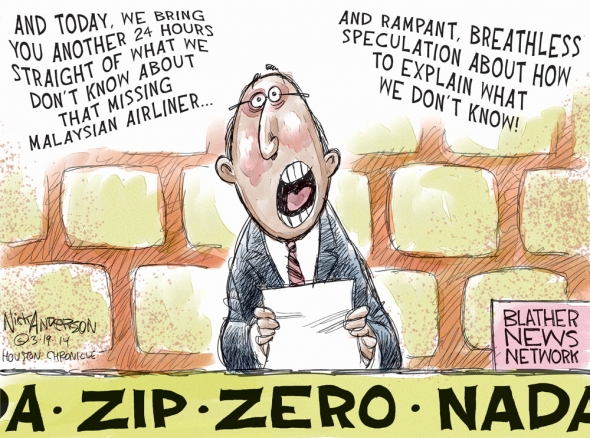
The death of all those passengers and crew on Malaysia Airlines Flight 370 is a legitimate disaster. And trust me, they are all dead. No one’s going to call the news services that they landed safe and sound in Timbuktu, Kathmandu,  or the Rings of Saturn. Something happened, and we won’t know what for some time to come. In the meantime, we are bombarded by the media noise machine which is using the event to sell us soap. By the time we find out what happened, there’ll be a different news orgy: Perhaps another Kaylee, or another Scott Peterson, or another Michael Jackson. It almost doesn’t matter. To re-use the name of a bygone, late-lamented series, TV News is the ultimate Short Attention Span Theater.

You may want to resolve not to watch the news on TV. After all where does it get you? Well, for one thing, floating in the Indian Ocean 1,500 miles southwest of Australia.

“Her Impact Was … Very Slight”

Politkovskaya

Anna Politkovskaya

I would like to say a few words on this subject [of Anna Politkovskaya’s murder]. First of all, I would like to say that no matter who committed this crime and no matter what the motives behind it, it was a horribly cruel crime and it cannot go unpunished. There could have been a number of different motives. This journalist was indeed a fierce critic of the current authorities in Russia. But, as the experts know, and as journalists should realise, I think, her impact on Russian political life was only very slight. She was well known in the media community, in human rights circles and in the West, but her influence on political life within Russia was very minimal. The murder of someone like her, the brutal murder of a woman and mother, was in itself an act directed against our country and against the Russian authorities. This murder deals a far greater blow to the authorities in Russia, and in Chechnya, to which she devoted much of her recent professional work, than did any of her publications. This is very clear to everyone in Russia. But, as I said, no matter what the motives behind the perpetrators’ actions, they are criminals and they must be identified, caught and punished. We will do everything necessary to ensure that this is done.—Vladimir Putin, News Conference in Germany, 2006

Revisiting: Anna Politkovskaya

Anna Politkovskaya: Read Her Books to Understand Today’s Russia

Anna Politkovskaya: Read Her Books to Understand Today’s Russia

This is an article I wrote for the old Yahoo! 360 back in 2008. Currently, I am reading Is Journalism Worth Dying For? Final Dispatches.

I have just had a harrowing experience, having finished reading Anna Politkovskaya’s A Dirty War: A Russian Reporter in Chechnya. We don’t hear much about Chechnya these days: Vladimir Putin has succeeded in muddying the waters by getting us all to regard the entire civilian population of the province as Muslim terrorists. Based on Politkovskaya’s reportage, there are actually four groups of terrorists in Chechnya:

  1. The actual terrorist bands themselves, highly mobile groups widely dispersed in the mountains of Chechnya, Ingushetia, and Daghestan.
  2. The Chechen civilian government under the Russians, which cynically exploits the suffering of the local population for financial gain.
  3. Contract soldiers, the Russian equivalent of Blackwater, which is a force on its own. They maintain pseudo-checkpoints which are simply an excuse for mayhem.
  4. The Russian Army itself, which authorizes local “cleansing” operations, consisting of robbery, torture, rape, and murder without being held responsible to anyone. Also, Russian soldiers themselves are frequently the victims of other units which have a bone to pick with them.

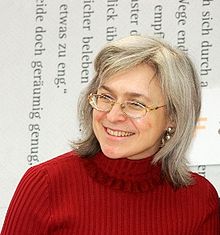
Running through the book are a series of stories about the Grozny Old Peoples’ Home. Most of the sick, elderly tenants are Russians, not Chechens; Russian Orthodox, not Islamic. Yet the residents are treated by all parties as the enemy. Politkovskaya (photograph above) wrote several articles explaining their plight, checking back with them every few months. They had no food or medical care, and were afraid to venture outside for fear of running afoul of armed parties of any description.

The only hospital in bombed-out Grozny had a few volunteer doctors, but no medicines. Such medications as were sent from Moscow were intercepted by the Chechen [pro-Russian] civilian government and sold on the black market.

When there were too many casualties in a Russian army operation, it was not unusual for the wounded to be taken not to a nearby military hospital, but to a more distant civilian hospital where there was no electricity, no medications, and only a skeleton staff. Whether they live or die, they are considered as deserters and therefore do not adversely affect any Russian officer’s military reputation. Many of the wounded soldiers die without identification, leading their families to spend years and a small fortune trying to find out what happened to their sons. (I wonder if this sort of thing was also going on [during the Soviet occupation of] Afghanistan.)

If you leave your apartment in Grozny, be very careful. You might find well-hidden anti-personnel mines at your doorstep or even within the apartment. This is a common cause of death throughout Chechnya.

When Politkovskaya encountered particularly obnoxious politicians or generals, she would publish their cell phone numbers in the Novaya Gazeta, for whom she worked at that time, and urge people to say to their face what they thought of them.

As one could expect, a woman like this makes lots of powerful enemies. On October 7, 2006, the crusading journalist was shot to death in the elevator on the way to her apartment in Moscow. After an “investigation” of sorts, no guilty party was found. Vladimir Putin, who most likely ordered the assassination, points the finger at some unnamed gunman from the West. After all, he says, she had no influence in Russia: Her audience were mostly liberals in Europe and America.

Politkovskaya was a singularly brave journalist and paid the ultimate price for it. Compare them to American journalists who were supinely complicit in the atrocities of the Bush-Cheney administration. No awards for courage there.

He’ll Probably Get Away With It

Vladimir Putin Shows Us He’s a Man’s Man

Vladimir Putin Shows Us He’s a Man’s Man

As far as the Crime of the Crimea is concerned, Vladimir Putin will probably not only get away with it: He’ll come out ahead in the hearts and minds of the Russian voters. He stood up for the poor Russian majority in the Crimea, where they were being harassed by Ukrainian thugs, such as the notorious Svoboda Party skinheads, who are actually part of the government in Kiev.

We are dealing with a part of the world where good guys are few and far between. All the leaders of the Ukraine, including the somewhat cute Yulia Tymoshenko, were corrupt to varying degrees, with the deposed Viktor Yanukovych bidding fair to be the worst. Admittedly, we’re not talking about people who are as bad-ass as Putin himself. (If you want some background about Putin’s crimes, read whatever you can find by Anna Politkovskaya, the Novaya Gazeta reporter who investigated the Chechen War and who Putin had assassinated at the door of her flat.)

If you go back a few years to the Second World War, you will see some strange things happening: there were guerrillas who were simultaneously fighting Hitler and Stalin, and conducting their own pogroms just for fun. (These are the goons who morphed into the Svoboda Party.)

So was it “right” for Russia to annex the Crimea? Strictly speaking, no. But then, the Crimea was a gift to the Ukrainian SSR from Nikita Khrushchev, himself a Ukrainian, some fifty years ago. Before then? It was a part of Russia. Demographically, it’s heavily Russian; so it was perhaps inevitable. But do I think well of Putin for pulling his strong man act? Not really, he is to my mind a contemptible cur, a murderer at arm’s length, and quite possibly a Dick Tracy villain. (But then, that is true of many of our politicians as well, no?)

One final note: Two days of a run-up in the stock markets of Europe and the United States indicates to me that most of the talk about sanctions is pure swamp gas. It would only strengthen Putin.

The Digital Divide

With Every New Technology, There Is a Die-Off

With Every New Technology, There Is a Massive Die-Off

Little by little, I am becoming aware of a tendency in our culture to downplay everything that is before the Internet. Wikipedia and Google are so convenient that we tend to ignore older sources of knowledge. And now that libraries are trashing many of their old books and periodicals and replacing them with computers, there is a real danger that many of the old sources that used to pass for knowledge are slowly disappearing.

For example, I have many books that pre-date the ISBN code. When I read one of them, I have some difficulty describing the book to GoodReads.Com because the likelihood is that there is no reference to the edition I have. And when I try to sell the books on Half.Com (which is owned by eBay), I can’t enter the book because it lacks the ISBN code used to identify the edition. It’s actually keeping me from reading my essays by Sainte-Beuve or many of the hundreds of Oxford World Classics I own in hardbound. Ever since I got in the habit of reviewing everything I read, I tend to hesitate with some of my older editions. Just in front of me, for example,  is a 1926 Alfred A. Knopf edition of Arthur Machen’s The Canning Wonder. I could review the book on Goodreads only if I answer a questionnaire about the edition. If I wanted to sell it on Half.Com, I’d be out of luck.

Most at risk is the history of our civilization based on original archival materials that date back to the Middle Ages. Fortunately, the Europeans are willing to spend the money (in most cases) to protect their history. But what about the Americans? All it would take is for some idiot like Ted Cruz or Rand Paul to sniff at supporting libraries, and millions of words of our country’s history would go by the wayside.

But what about Google Books, you might ask? It is a noble effort, but only a small percentage of old books have been scanned. I collect the works of Sir Richard F. Burton (no relation to the actor). He’s not exactly a popular item, but he is one of the most exciting explorers and travelers of the Nineteenth Century. I can find Burton’s Two Trips to Gorilla Land and the Cataracts of the Congo, but only Volume I has been scanned. The same is true for his Exploration of the Highlands of Brazil. Oh, the books will still be around, but they will be fabulously expensive. (On the other hand, I have been able to find some Burton titles on Gutenberg.Com that I could never afford to buy in print—so the argument cuts both ways.)


It’s Like … Whatever

You’ll Never Guess the Most Frequently Used Word

You’ll Never Guess the Most Frequently Used Word

Today I had to work in an un-air-conditioned high rise on a day when the temperature rose into the 90s. Midway through, I took a break and walked over to the UCLA campus, where I had lunch and hung out in the student bookstore for a while. Along the way (it was one mile in each direction), I heard snippets of a lot of conversations. You’ll never guess what the most frequently used work was. It was, like, like.

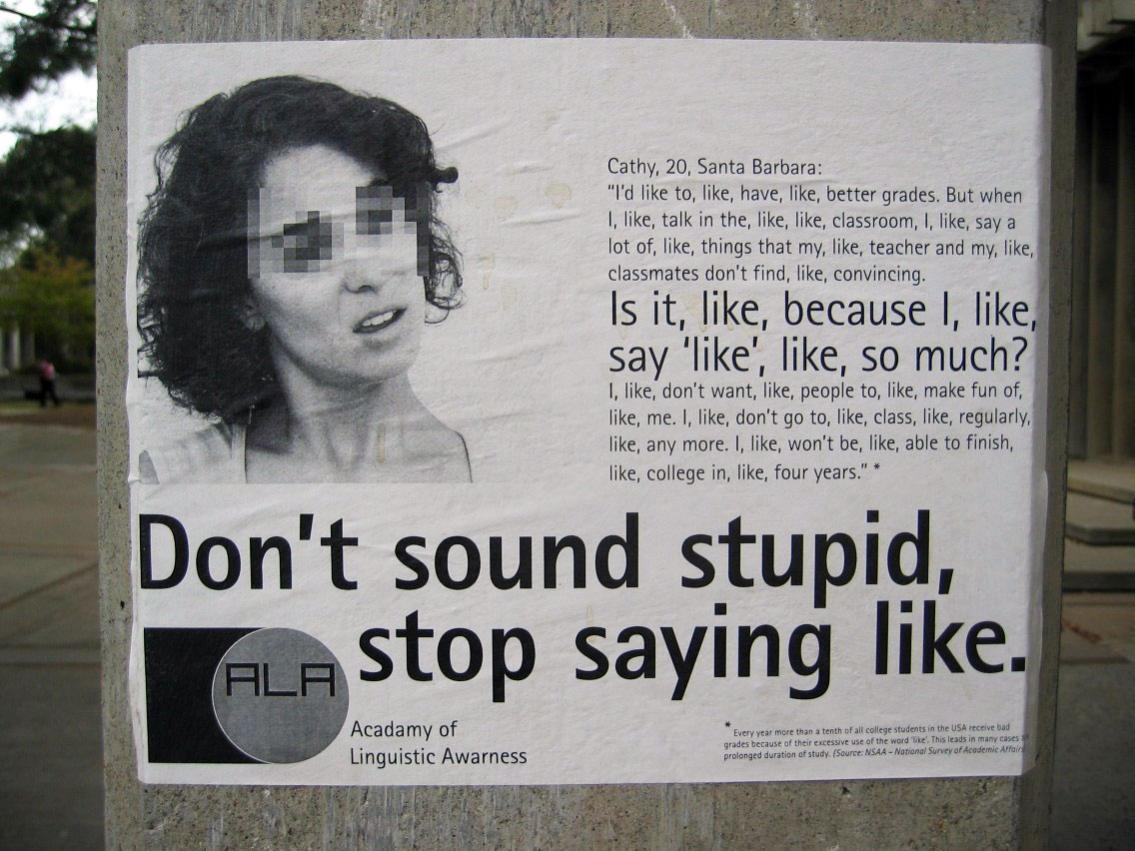
Let’s get Bill O’Reilly involved in this, because it looks as if there is a concerted attack by young women on the verb “to be.” Nothing any more is, it is “like.” It’s much worse than the War on Christmas or the Amphibious Assault on Arbor Day. When was it that young women realized they they weren’t anything in particular, just “like” something. The similes multiply so much that it resembles this at times:

Is Moon Unit Zappa to Blame for All This?

Is Moon Unit Zappa to Blame for All This?

By the way, note the misspelling of the word “Academy” in the lower left of the above illustration. That’s what happens when one starts over-using the word “like.” A certain level of brain rot takes place, and it spreads to other areas. I think it all started with Moon Unit Zappa singing “Valley Girl” back in 1982. Almost overnight, young women adopted the idiom:

Like, OH MY GOD! (Valley Girl)
Like-TOTALLY (Valley Girl)
Encino is like SO BITCHEN (Valley Girl)
There’s like the Galleria (Valley Girl)
And like all these like really great shoe stores
I love going into like clothing stores and stuff
I like to buy the neatest mini-skirts and stufl
It’s like so BITCHEN cuz like everybody’s like
Super-super nice…
It’s like so BITCHEN..,

On Ventura, there she goes
She just bought some bitchen clothes
Tosses her head ’n flips her hair
She got a whole bunch of nothin’ in there.

Yep, it sure sounds like “a whole bunch of nothin’ in there.” Wonder what they sound like in philosophy class trying to discuss something, like, really PROFOUND. Oh, like whatevah!

Bird of Paradise

Bird of Paradise at Los Angeles Arboretum

Strelitzia reginae at Los Angeles Arboretum

Even before I came to Los Angeles for the first time in 1966, I could identify the Bird of Paradise, or Strelitzia reginae. For me, it always represented the exoticism of the tropics. It went with all those palm trees and other flora that one never found in Cleveland or New Hampshire. There is a funny thing about those exotic plants, including the Bird of Paradise. Whereas Eastern plants are more tactile, the palms and flowers in Southern California are not friendly to the touch.

That is especially true of palm trees. When I found out that rats like to live in palm trees, I lost all interest in touching them. As for the Bird of Paradise, which is actually an import from South Africa, where it is called the Crane Flower, it has no inviting scent, nor is it soft and approachable. It’s like many succulents, many of which are interesting looking, but do not reward close scrutiny.

Sometimes I wonder if the people in Los Angeles resemble the local plant life in that regard. We’re all from somewhere else, like the Bird of Paradise, but we’re hard tom get to now. There is a certain feeling of noli me tangere. (Do not touch!)

What Would I Have Done Differently?

Our Embattled President

Our Embattled President

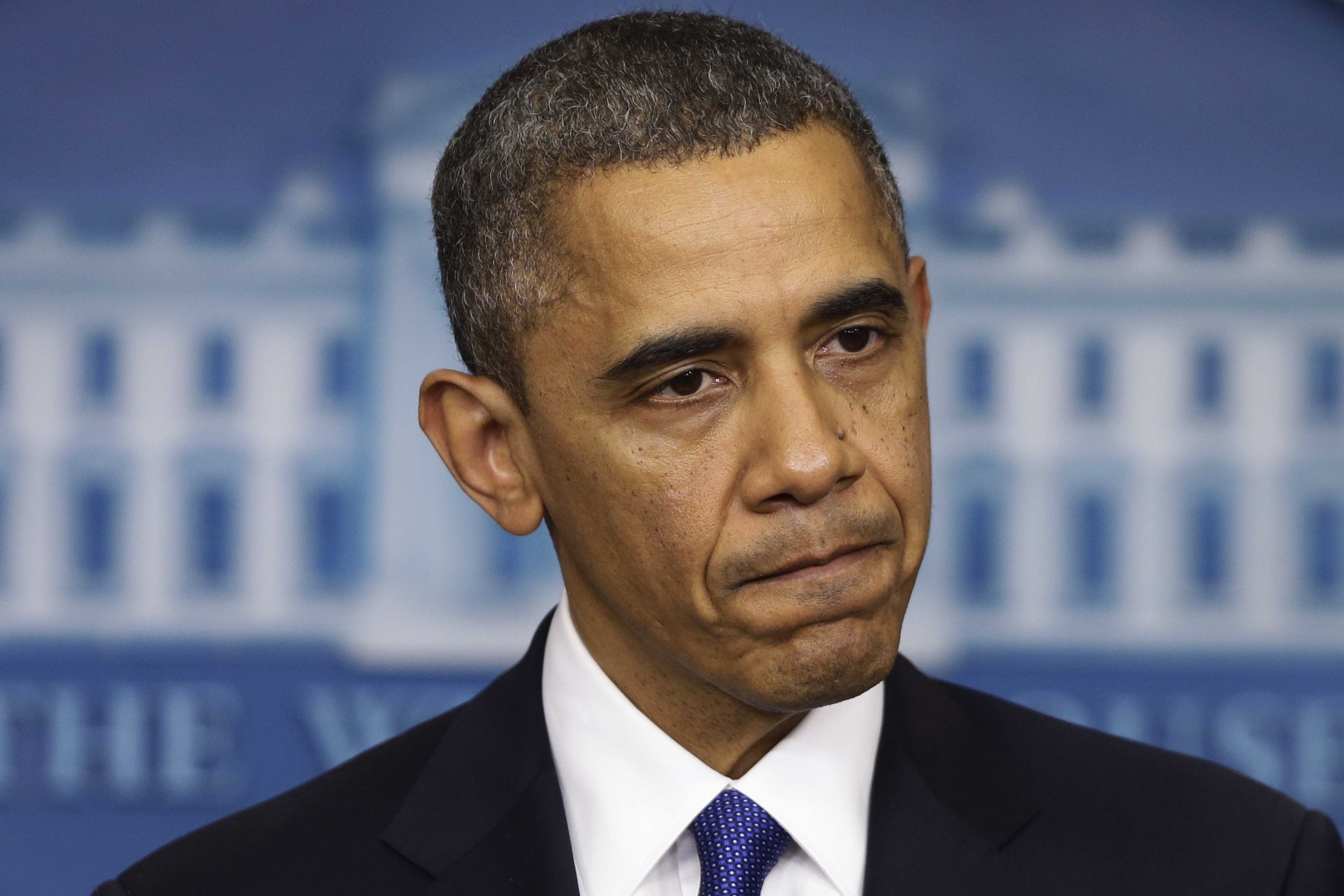
As we approach the end of the Obama presidency, a few thoughts are running through my mind, mostly along the lines of what I would have done differently. I am really not cut out to be a politician: From me. one is more likely to get a smoldering look along the lines of “What’s with you, f*ckwit?” than a glad hand.

The President has made an honest attempt to reach across the aisle to the Republicans and conduct his office for the benefit of all Americans. I would probably have been better known as the leader who invited the Republican leadership to the Oval Office, from which they mysteriously and unaccountably disappeared. Instead of playing golf with John Boehner and Mitch McConnell, I would have introduced those two traitorous obstructionists to a cat-’o-nine-tails and liberally (I use the adverb advisedly) slathered chile habañero onto their wounds. I would be like those ancient Roman leaders who urged certain opposition leaders to depart the political scene by opening their veins in a hot bath, lest they face something a whole lot worse.

Okay, so I’m not a nice guy, especially to people I perceive as having done me dirt. None of this turning the other cheek business. After all, these Evangelical tools don’t follow that rule, so why should I?

Barack Obama was probably too nice, too reasonable to be President. Within those constraints, I think he did a good job at a truly horrible time. Americans are being jerked around big time by a combination of Corporate Fat Cats and a few million Secessionists who just want to blow away anyone who looks at them cross-eyed or won’t let them marry their twelve-year-old cousins.