Attack of the Killer Fungus

Bakersfield in a Windstorm

Bakersfield in a Windstorm

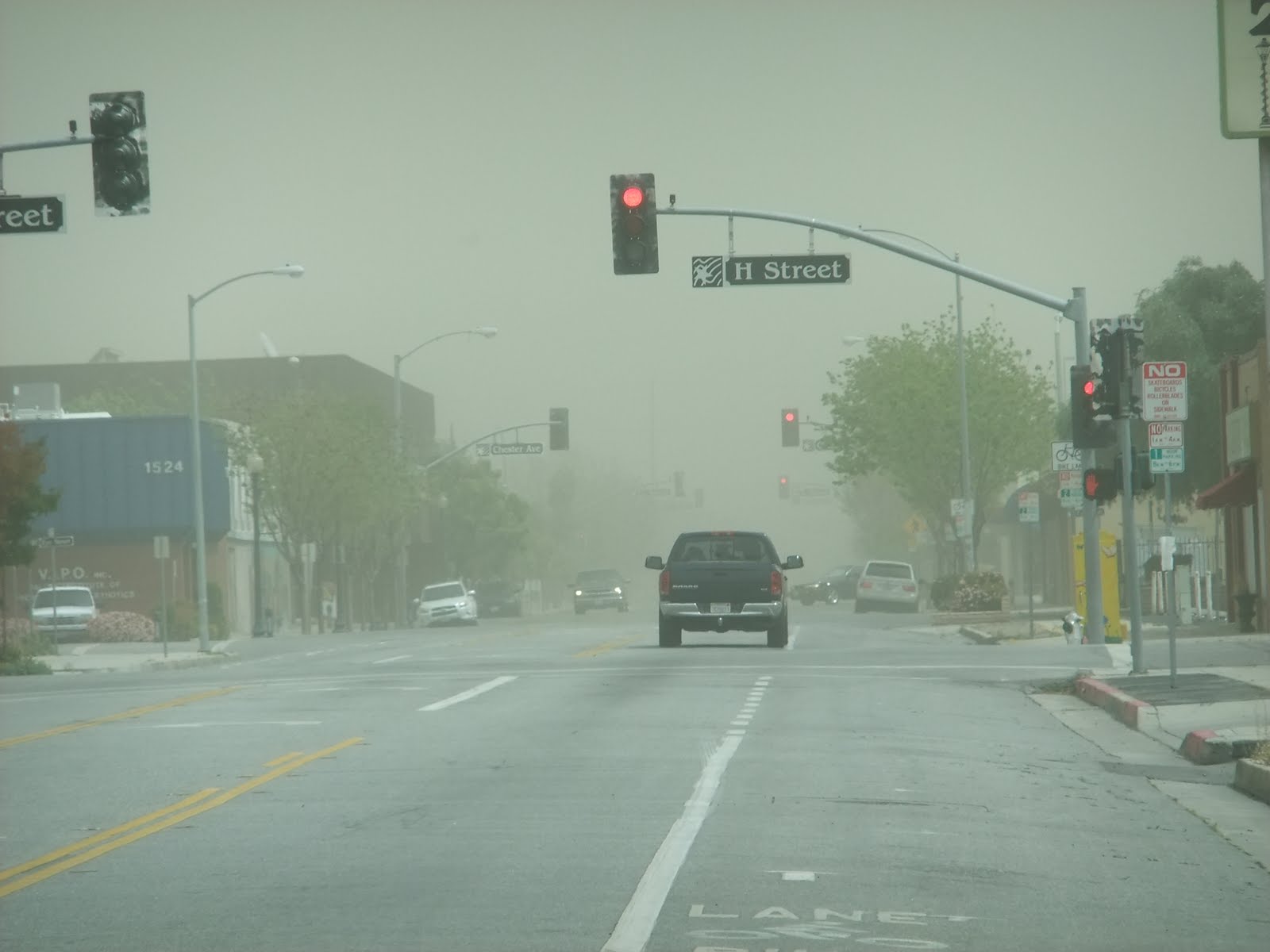
I have always felt that, as long as I’ve lived in the American Southwest, I’ve never wanted to live somewhere that had the word “Valley” in its name. After reading Dana Goodyear’s article entitled “Devil Dust” in the January 20, 2014 issue of The New Yorker, I find that I have better reasons for saying this than ever before. The culprit is a deadly fungus that dwells in the soil called Coccidiotes immitis, which causes a disease for which there is no cure called coccidioidomycosis, better known as Valley Fever:

C. immitis is adapted to lodge deep: its spores are small enough to reach the end of the bronchioles at the bottom of the lungs. We can breathe them in, but we can’t breathe them out. Once in the lung, the spore circles up into a spherule, defined by a chitinous cell wall and filled with a hundred or so baby endospores. When the spherule is sufficiently full, it ruptures, releasing the endospores and stimulating an acute inflammatory response that disrupts blood flow to the tissue and can lead to necrosis. The endospores, each of which will become a new spherule, travel through the blood and lymph systems, allowing the cocci to spread, as one specialist says, “anywhere it wants.” In people with weakened immune systems, cocci can take over.

Unfortunately, cocci, as it’s called, is endemic throughout the desert Southwest, as well as the desert portions of Central and South America. When there is  building, farming, clearing, or drilling activity, it gets stirred up and transported by the hot winds that characterize the deserts of the New World.

From 1998 to 2011, the Centers for Disease Control reported a 1,000% increase in the number of reported cases. The sad thing is that, because the more temperate areas are unaffected, there is less likelihood of a pharmacological solution to the disease. I’m sure that scientists in Europe and the Eastern part of the United States would prefer to find solutions to diseases that are much more widely disseminated.

So consider me a lifelong non-dweller in the valleys of California. I don’t care how cheap the housing is!


A Neglected Poet

Rain as a Subaltern

Rain as a Subaltern

Thomas Hardy is not one of our most widely-read poets. If anything, people are far more familiar with his novels, such as Jude the Obscure, Tess of the D’Urbervilles, and Far from the Madding Crowd. Fortunately, after years of neglect, his poems are coming into their own. The other night, I was reading an essay on the 20th century Russian poet Joseph Brodsky in J. M. Coetzee’s Stranger Shores: Literary Essays 1986-1999, and I came across the following:

[Joseph] Brodsky’s system can best be illustrated from the essay on Thomas Hardy. Brodsky regards Hardy as a neglected major poet, “seldom taught, less read,” particularly in America, cast out by fashion-minded critics into the limbo of “premodernism” (On Grief, pp. 373, 315, 313)

It is certainly true that modern criticism has had little of interest to say about Hardy. Nevertheless, despite what Brodsky says, ordinary readers and (particularly) poets have never deserted him. John Crowe Ransom edited a selection of Hardy’s verse in 1960 [I have a copy]. Hardy dominates Philip Larkin’s widely read Oxford Book of Twentieth-Century English Verse (1973), with 27 pages as opposed to 19 for Yeats, 16 for Auden, a mere 9 for [T. S.] Eliot. Nor did the Modernist avant-garde dismiss Hardy en bloc. Ezra Pound, for instance, tirelessly recommended him to younger poets. “Nobody has taught me anything about writing since Thomas Hardy died,” he remarked in 1934.

Here is my favorite of Hardy’s poems. Picture a man struggling to walk through a rainstorm:

The Subalterns

I

“Poor wanderer,” said the leaden sky,
“I fain would lighten thee,
But there are laws in force on high
Which say it must not be.”

II

–“I would not freeze thee, shorn one,” cried
The North, “knew I but how
To warm my breath, to slack my stride;
But I am ruled as thou.”

III

—“To-morrow I attack thee, wight,”
Said Sickness. “Yet I swear
I bear thy little ark no spite,
But am bid enter there.”

IV

—“Come hither, Son,” I heard Death say;
“I did not will a grave
Should end thy pilgrimage to-day,
But I, too, am a slave!”

V

We smiled upon each other then,
And life to me had less
Of that fell look it wore ere when
They owned their passiveness.

Hardy can be at one and the same time incredibly simple and incredibly deep. At the same time, we have sickness and death acting with compassion against the poor traveler. Who can write such a poem today?

Tarnmoor’s ABCs: Film

Mack Sennett Bathing Beauties

Mack Sennett Bathing Beauties

I was very impressed by Czeslaw Milosz’s book Milosz’s ABC’s. There, in the form of a brief and alphabetically-ordered personal encyclopedia, was the story of the life of a Nobel Prize winning poet, of the people, places, and things that meant the most to him. Because his origins were so far away (Lithuania and Poland) and so long ago (1920s and 1930s), there were relatively few entries that resonated personally with me. Except it was sad to see so many fascinating people who, unknown today, died during the war under unknown circumstances.

This blog entry is my own humble attempt to imitate a writer whom I have read on and off for thirty years without having sated my curiosity. Consequently, over the next few months, you will see a number of postings under the rubric “Tarnmoor’s ABCs” that will attempt to do for my life what Milosz accomplished for his. I don’t guarantee that I will use up all 26 letters of the alphabet, but I’ll do my best.

These Mack Sennett Bathing Beauties are not what you usually think of when you think of the movies, but that was about a hundred years ago. Film has been around for more than a century, and I have been  a film freak for almost half that time. It all started at Dartmouth College, where there were frequent free screenings at Fairbanks Hall. One afternoon in my freshman year, I saw Carl Theodor Dreyer’s Day of Wrath (1943), about witchcraft in seventeenth century Denmark. I was hooked.

Although my original intention was to become a professor of English, somewhere during my second or third year at college, I decided to switch to film. The Hopkins Center had just opened, and there was a large beautiful theater for screening films. The Dartmouth Film Society put on an ambitious year-long Alfred Hitchcock Retrospective, and my career choice began to waver. When, finally, Arthur L. Mayer, the author of Merely Colossal, came to teach a class in film history, my mind was made up.

Dartmouth had a long history of ties with the film industry. Its Baker Library was the home of the Irving Thalberg collection of Hollywood scripts. Graduates included such film luminaries as Joseph Losey, Robert Ryan, Budd Schulberg, David Picker, and Max Youngstein. Even before my senior year, I had decided to do my graduate work in film history and criticism. During the summer of 1965, I went with my parents to New York, mainly to see Haig P. Manoogian, who ran the film department at New York University. Mr. Manoogian was kind enough to see me, but not kind enough to encourage me—although he was a favorite of Martin Scorsese, who went to school there. I guess he was more interested in film production. (That summer, I also saw the New York World’s Fair of 1964-1965.)

That left the University of Southern California (USC) and UCLA. One of my Dartmouth classmates from the Class of 1965 had attended UCLA. When he came up to Dartmouth to visit, he discouraged me about USC, which he said was a slum and Smog Central.

So I came out to Southern California, where I still live. I attended graduate school at UCLA for several years until Professor Howard Suber put the kibosh on my budding career as a film professor. He was a lackadaisical academic who supposedly was working on a shot-by-shot analysis of Citizen Kane and who didn’t much like movies. I was about to write a thesis about the Westerns of John Ford with Robert Epstein as head of my thesis committee, but then Suber replaced him with himself. At that point, I knew I was finished, as there was little love lost between us. Years later, I joined a letter-writing campaign to have his tenure denied, calling him a cross between Mr. Pickwick and Caligula.

Although I’ve always loved film, I had by this time taught myself how to operate and program computers, and I got a job at System Development Corporation in Santa Monica. Curiously, the person I replaced at SDC was a young woman who had been murdered by a UCLA film student. So here I am today, a computer expert at a Westwood accounting firm, still in love with film, though greatly disappointed because all the great filmmakers I idolized are dead, and the quality of films now being produced has fallen markedly.

Tarnmoor’s ABCs: Earthquakes

Earthquake Fissure in Road

Earthquake Fissure in Road

I was very impressed by Czeslaw Milosz’s book Milosz’s ABC’s. There, in the form of a brief and alphabetically-ordered personal encyclopedia, was the story of the life of a Nobel Prize winning poet, of the people, places, and things that meant the most to him. Because his origins were so far away (Lithuania and Poland) and so long ago (1920s and 1930s), there were relatively few entries that resonated personally with me. Except it was sad to see so many fascinating people who, unknown today, died during the war under unknown circumstances.

This blog entry is my own humble attempt to imitate a writer whom I have read on and off for thirty years without having sated my curiosity. Consequently, over the next few months, you will see a number of postings under the rubric “Tarnmoor’s ABCs” that will attempt to do for my life what Milosz accomplished for his. I don’t guarantee that I will use up all 26 letters of the alphabet, but I’ll do my best.

If there is any natural phenomenon that frightens me, I would have to say it is earthquakes. During my years in Southern California, I have lived through two big ones: The Sylmar earthquake on February 9, 1971 (Richter 6.6) and the Northridge earthquake of January 17, 1994 (Richter 6.7).

On Friday, we had a small tremor centered on nearby Marina Del Rey. It was only a 3.2, but I acted as if it were just the start of a much bigger shake. Sitting in my library reading Proust, I dropped the book, jumped clear over the hassock and headed to the hallway just outside my bathroom to brace myself for what (perhaps) was to come. It didn’t. In the meantime, Martine peered around the corner and asked what was wrong. Did she feel the quake? Yes, but it was only a tiny one. But there I was, standing in the doorway with my heart racing, preparing myself for the worst.

The origins of my fear go back to 1994, when I used to sleep on an improvised futon in my living room. It was around 4:30 am when the earth began to shake in the darkness of the pre-dawn hours. Lights flashed whenever a nearby transformer exploded. Things were falling down from the walls and shelves, and some of them even rolled to where I was lying in terror as the sounds and smells and shaking had incapacitated me. What happened immediately after, I don’t recall because I actually lost my memory. All I know was that I was picked up by the police several hours later carrying two gallon jugs of purified water on Santa Monica Boulevard with blood flowing down my right leg.

Little by little, my terror subsided, only to be ramped up again with each aftershock. The damage caused by the quake was substantial: some nearby buildings were askew, and my kitchen had to be cleaned up with a shovel.

Ever since then, I do not go to bed without laying out all my clothes for the next day on a chair between the bedroom and the front door. Walking barefoot on broken glass and crockery is not a pleasant experience. So even now, a small temblor is capable of bringing back the terror, for however short a time.


Odette

Detail of Zipporah from Botticelli’s The Trials of Moses

Detail of Zipporah from Botticelli’s The Trials of Moses

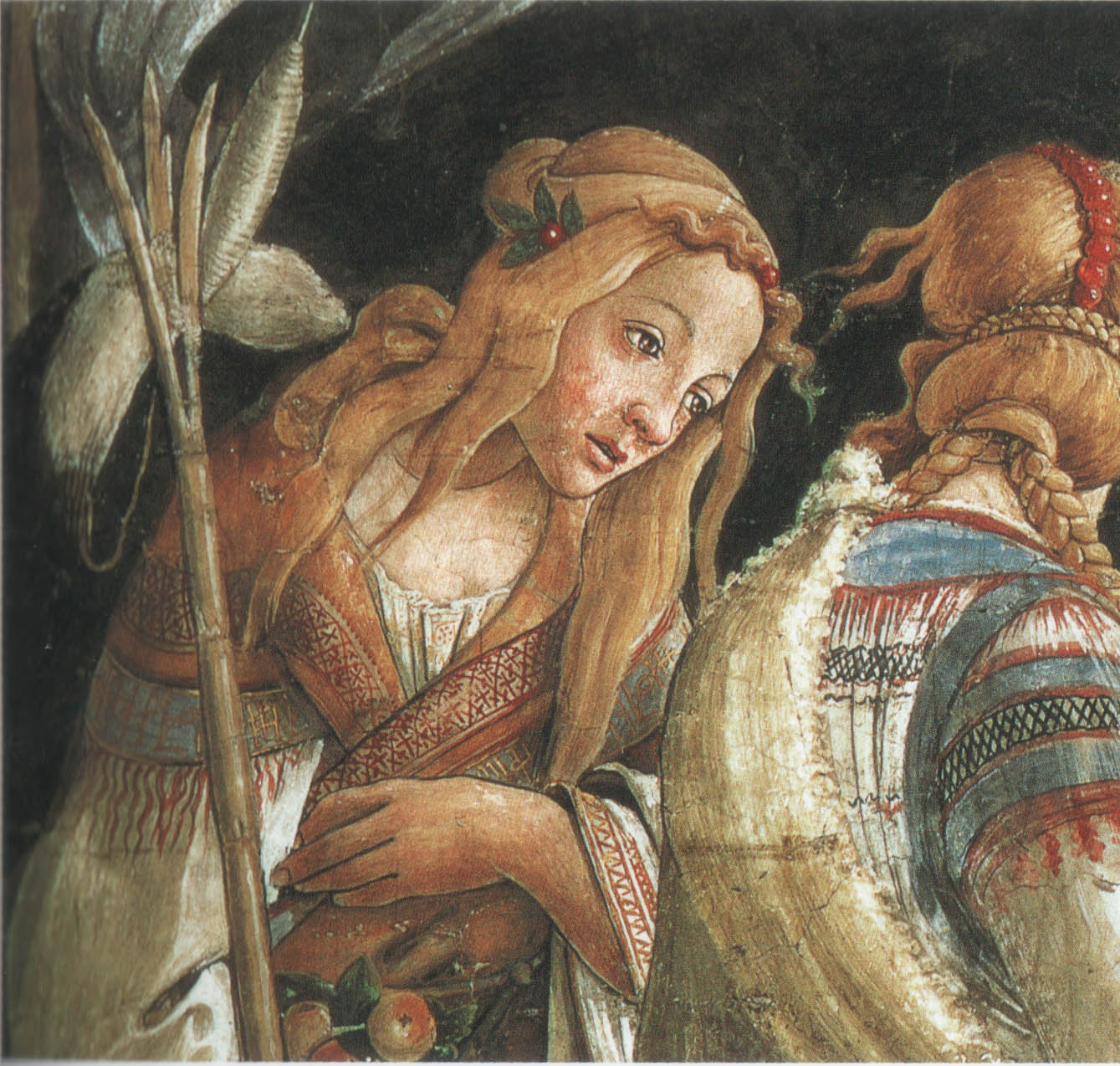
Shown above is a detail from Sandro Botticelli’s painting “The Trials of Moses” depicting Jethro’s daughter Zipporah. It is this image which Marcel Proust used to describe the love of Charles Swann’s life, Odette de Crécy. It was a mammoth undertaking, especially as Proust was gay: He constantly had to translate heterosexual behavior through a homosexual template, which was more familiar to him. (In later volumes, Marcel’s lover Albertine was thus “translated” from his Italian chauffeur, Alfred Agostinelli.) As difficult as it seems to do this, Proust succeeded so well that Swann’s Way is perhaps the greatest work in literature about disappointment in love.

Swann was not immediately taken with Odette:

[S]he had seemed to Swann not without beauty, certainly, but of a type of beauty that that left him indifferent, that aroused no desire in him, even caused him a sort of physical repulsion, one of those women such as everyone has his own, different for each, who are the opposite of the kind our senses crave. Her profile was too pronounced for his taste, her skin too delicate, her cheekbones too prominent, her figures too pinched. Her eyes were lovely, but so large they bent under their own mass, exhausted the rest of her face, and always gave her a look of being in ill health or ill humor.

A few pages later, we see what Swann (and by extension Proust) was doing in crystallizing his feelings toward this young woman::

He placed on his worktable, as if it were a photograph of Odette, a reproduction of Jethro’s daughter. He admired the large eyes, the delicate face, which allowed one to imagine the imperfect skin, the marvelous curls of the hair along the tired cheeks, and adapting what he had found aesthetically beautiful up to then to the idea of a living woman, he translated it into physical attractions which he rejoiced to find united in a creature whom he could possess. The vague feeling of sympathy that draws us toward a masterpiece as we look at it became, now that he knew the fleshly original of Jethro’s daughter, a desire that henceforth compensated for the desire that Odette’s body had not at first inspired in him. When he looked at that Botticelli for a long time, he would think of his own Botticelli, whom he found even more beautiful, and bringing the photograph of Zipporah close to him, he would believe he was clasping Odette against his heart.

Alas, Odette is openly unfaithful to Swann and drives him crazy with envy as the Comte de Forcheville moves in on his woman, while their friends at the Verdurins’ salon conspire against him. In the process, Swann’s life becomes bitter; and he no longer derives any joy from the things that hitherto had sustained him, his friends, his art, and high society. In the end, Swann admits to himself: “To think that I wasted years of my life, that I wanted to die, that I felt my deepest love, for a woman who did not appeal to me, who was not my type!”

Of course, that didn’t keep him from marrying her. But that is another story.

Still a Good Investment?

University Buildings at UCLA

University Buildings at UCLA

Over the years since I graduated from college, I’ve seen the cost of a university education climb to stratospheric levels. At the same time, I’ve seen massive unemployment among college graduates, sometimes even those with a postgraduate education. It forces me to think what I would do different if I had a couple of teenaged children to put through school (though in fact I have no children). Would I still at this date recommend that children go to college to improve their chances for the future?

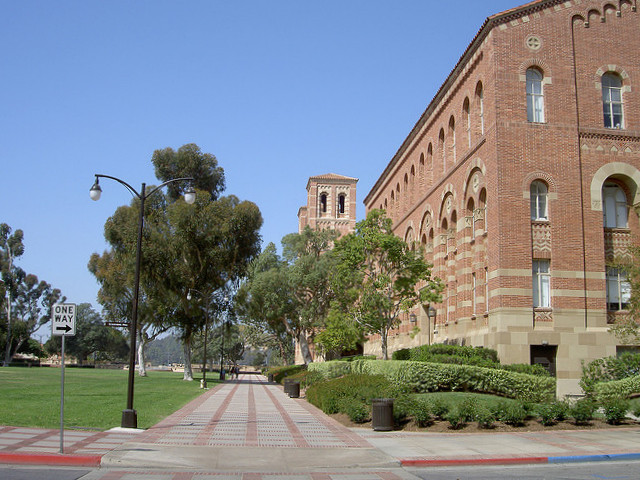
Part of the problem is symbolized by that “One Way” sign in the above photo. It used to be that the object was to get everyone into college: It was a bargain back then. Even if the kids washed out within the first quarter or two, the thinking was that they were given the opportunity.

I went to an Ivy League college for four years—Dartmouth College in Hanover, New Hampshire—whose tuition back in the years 1962-66 was only $1,500 a year. With the dollar as it is today, that would be somewhere between $9,000 (using the CPI) to $27,200 (using the relative share of GDP) in 2012, the most recent year for which this calculation is available. For the academic year 2013-2014, Dartmouth’s tuition is now $45,445. The question I ask is this: Is a Dartmouth education worth twice as much as when I went to school? I think not. It’s still very good, but not at two to five times the cost.

Other related costs have also been skyrocketing. I am particularly incensed by textbooks that run to several hundreds of dollars each. I remember paying something under a hundred dollars for all the textbooks for an entire quarter. Admittedly, textbooks can be gorgeously produced with nice bindings and four-color illustrations, but is that always necessary? I can see where these expensive productions will eventually be replaced by software programs, but even then the temptation will be to charge more than they are worth, even after the production costs for multiple copies have plummeted.

So, what to do? There isn’t much chance that youth between the ages of eighteen and twenty-one will find jobs that at the same time do not require a college education, yet provide a reasonable opportunity for advancement. How does one advance after a job flipping hamburgers or selling tee shirts? A college degree will help, even though it has been devalued over the years. It costs twice as much in real dollars, yet probably isn’t as good as it was when my generation was on campus.

I still urge kids whose intellects are sharp to go to college whenever they can. It doesn’t have to be the best college, but it should be a decent one (and I don’t mean something like the University of Phoenix and its imitators). To get a good job after graduation, some thought has to be put into a good choice of a major. Perhaps it would help to have some kind of certification in certain subjects attesting to a student’s proficiency in, say, writing or mathematics. If instituted, it may even replace the whole notion of a major; and it may help grads with multiple certifications to have different options to choose from when looking for a job.

In 1966, I graduated with a major in English. Then I went on for two years at UCLA in motion picture history and criticism, stopping short of getting my M.A. for mostly political reasons. (The instructor I hated most got himself appointed to head up my thesis committee, upon which I switched over into computer software.) It was a good thing that I had taught myself how to become conversant with computers at Dartmouth, where every student was allowed free time on the Dartmouth Time-Sharing System, the nation’s first. That kind of flexibility to switch among career alternatives is becoming more important than ever.


A Republican Designed by Cubists

Congressman Darrell Issa (R-CA)

Congressman Darrell Issa (R-CA)

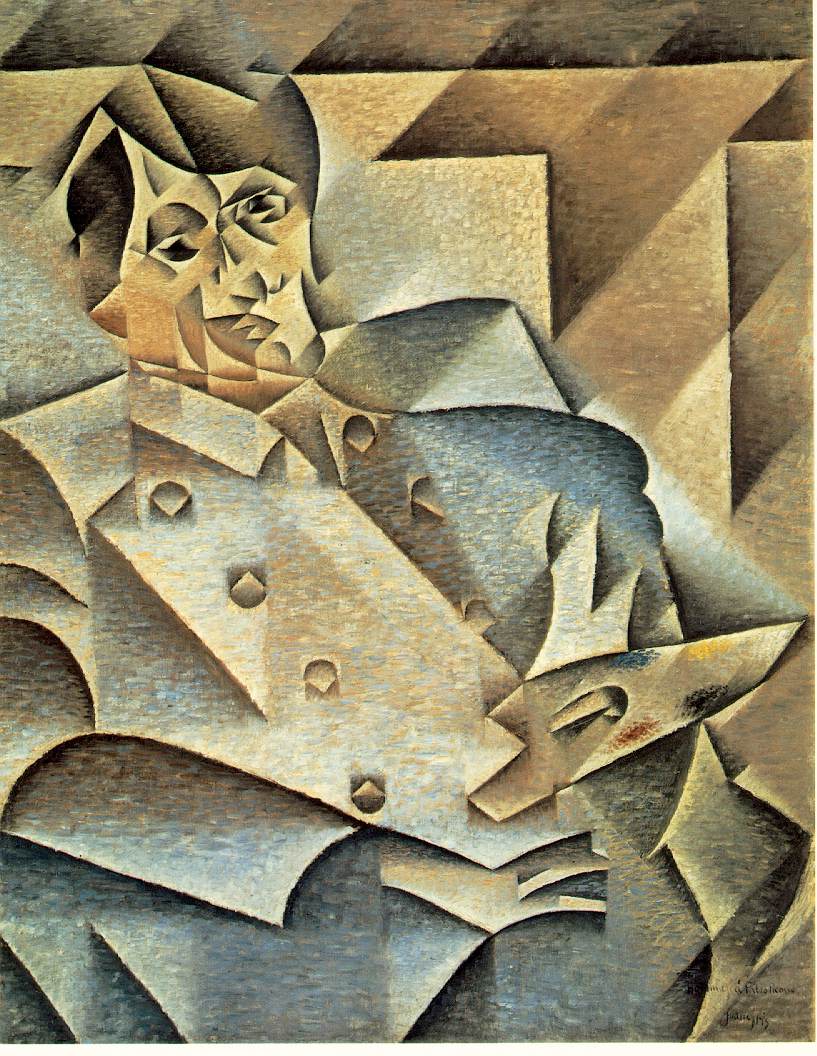
Every time I look at a picture of Troglodyte Republican Congressman Darrell Issa, I think of the cubist paintings of a century or so ago. The lack of symmetry of his facial planes is rather marked; and I cannot help but wonder if it represents some seismic disaster in his brain. His right eyebrow seems to be an inch or more above his left eyebrow. Seems quite appropriate for a rightist, no?

Compare with the portrait by Juan Gris below and you’ll see what I mean:

Portrait by Juan Gris

Portrait by Juan Gris

“A Half-Open Door”

Pieter de Hooch’s The Mother

Pieter de Hooch’s The Mother

In Marcel Proust’s Swann’s Way, Charles Swann uses his knowledge of art and music to convince himself that the love of his life is Odette de Crécy. First, he discovers a musical phrase by the composer Vinteuil which Odette also loves. Then there is the matter of the paintings. Listening to Vinteuil, his mind wanders to the work of a Dutch painter:

He would begin with the sustained violin tremolos that are heard alone for a few measures, occupying the entire foreground, then all of a sudden they seemed to move away and, as in those paintings by Pieter de Hooch, which assume greater depth because of the narrow frame of a half-open door, away in the distance, in a different color, in the velvet of an interposed light, the little phrase would appear, dancing, pastoral, interpolated, episodic, belonging to another world. It rippled past, simple and immortal, distributing here and there the gifts of its grace, with the same ineffable smile….

From my own past, I know well that one makes use of bogus comparisons to crystallize one’s growing love for a young woman. I remember one whose facial expression kept bringing the Latin word claritas to mind. It turned out that, like Swann, I was deceiving myself with someone whose motivations were anything but clear. But, such is life.

I am fascinated by Proust’s references to art and would like to recommend Eric Karpeles’s excellent book, Paintings in Proust, to anyone venturing into In Search of Lost Time.

Re-Orienting Myself to Peru

Spanish Colonial Architecture in Peru

Spanish Colonial Architecture in Lima, Peru

Because I place such a high value on traveling with Martine, I thought nothing last December of ditching my plans in an instant to visit Peru so that we could go to France and Italy. At that point, nothing was firm yet—I planned to go in September or October. (I frequently plan in advance by so many months that all my friends think that I have already gone and returned.) But continuing problems with her back, especially where soft beds are concerned, induced her to cancel the European trip.

There is never any guarantee when staying at strange hotels that your bed will be firm or mushy. Fortunately, I can tolerate a fairly wide range; but Martine’s range of acceptability is much narrower. It’s a pity, because her half-sister Madeleine in St-Lô (near the D-Day Beaches of Normandie)  is ailing and cannot travel herself.

In the meantime, I am resuming my Peru reading program, which consists primarily of:

  • Novels by Mario Vargas Llosa, Peru’s only Nobel Prize winner in literature
  • Novels and poems by other Peruvian literary notables, such as César Vallejo
  • Histories of the Spanish conquest of the Incas
  • Other Peruvian histories on subjects including the War of the Pacific, which Peru lost to Chile in the late 19th century
  • A biography of Simon Bolivar and possibly José de San Martín, the two principal liberators of South America

I don’t know how much I can read before the departure date, which has not  been set yet, but I will do my best.

All this preparation is, for me, a kind of courtesy. I do not believe in visiting another country without knowing enough of its language, culture and history to be conversant with the locals. That has helped me considerably in Argentina and Iceland. Plus, it is a pure pleasure for me to prepare a trip far enough in advance—especially during tax season, when there is little else to forward to. I have little truck with those travelers who believe in being “spontaneous” at the cost of making their fellow Americans look like dunces.

Half Life

How Do I Survive the Rigors of Tax Season?

How Do I Survive the Rigors of Tax Season?

This is not my favorite time of the year. I have to work longer hours in a more stressful atmosphere, and I no longer have the weekends during which to unwind. My life becomes what I refer to as a “half life”—not to be confused with a radioactive isotope.

I still have dinner with Martine every evening, though the dishes I prepare (yes, I am the cook, even at this time of year) are usually simpler. After we eat, however, I disappear into my library and read until it’s time for bed, usually around 10:30 pm. At this time, however, I am more careful about the books I read: I insist on works that absorb and enthrall me. Right now, I am reading Lydia Davis’s masterful translation of Marcel Proust’s Swann’s Way, here called The Way by Swann’s. At my side is a useful volume showing all the many paintings mentioned by Proust: Paintings in Proust by Eric Karpeles.

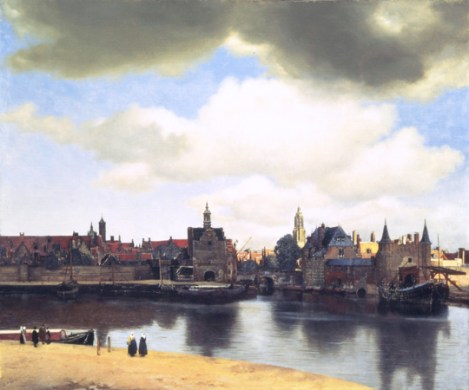
The above painting, Vermeer’s “A View of Delft,” plays a major part in The Captive, the fifth volume in Proust’s In Search of Lost Time. I present it here in its entirety:

The circumstances of his [the writer Bergotte’s] death were as follows. A fairly mild attack of uraemia had led to his being ordered to rest. But, an art critic having written somewhere that in Vermeer’s View of Delft (lent by the Gallery at The Hague for an exhibition of Dutch painting), a picture which he adored and imagined that he knew by heart, a little patch of yellow wall (which he could not remember) was so well painted that it was, if one looked at it by itself, like some priceless specimen of Chinese art, of a beauty that was sufficient in itself, Bergotte ate a few potatoes, left the house, and went to the exhibition. At the first few steps he had to climb, he was overcome by an attack of dizziness. He walked past several pictures and was struck by the aridity and pointlessness of such an artificial kind of art, which was greatly inferior to the sunshine of a windswept Venetian palazzo, or of an ordinary house by the sea. At last he came to the Vermeer which he remembered as more striking, more different from anything else he knew, but in which, thanks to the critic’s article, he noticed for the first time some small figures in blue, that the sand was pink, and, finally, the precious substance of the tiny patch of yellow wall. His dizziness increased; he fixed his gaze, like a child upon a yellow butterfly that it wants to catch, on the precious patch of wall. “That’s how I ought to have written,” he said. “My last books are too dry, I ought to have gone over them with a few layers of colour, made my language precious in itself, like this little patch of yellow wall.” Meanwhile he was not unconscious of the gravity of his condition. In a celestial pair of scales there appeared to him, weighing down one of the pans, his own life, while the other contained the little patch of wall so beautifully painted in yellow. He felt that he had rashly sacrificed the former for the latter. “All the same,” he said to himself, “I shouldn’t like to be the headline news of this exhibition for the evening papers.”

He repeated to himself: “Little patch of yellow wall, with a sloping roof, little patch of yellow wall.” Meanwhile he sank down on to a circular settee whereupon he suddenly ceased to think that his life was in jeopardy and, reverting to his natural optimism, told himself: “It’s nothing, merely a touch of indigestion from those potatoes, which were undercooked.” A fresh attack struck him down; he rolled from the settee to the floor, as visitors and attendants came hurrying to his assistance. He was dead. Dead for ever? Who can say? Certainly, experiments in spiritualism offer us no more proof than the dogmas of religion that the soul survives death. All that we can say is that everything is arranged in this life as though we entered it carrying a burden of obligations contracted in a former life; there is no reason inherent in the conditions of life on this earth that can make us consider ourselves obliged to do good, to be kind and thoughtful, even to be polite, nor for an atheist artist to consider himself obliged to begin over again a score of times a piece of work the admiration aroused by which will matter little to his worm-eaten body, like the patch of yellow wall painted with so much skill and refinement by the artist destined to be for ever unknown and barely identified under the name Vermeer. All these obligations, which have no sanction in our present life, seem to belong to a different world, a world based on kindness, scrupulousness, self-sacrifice, a world entirely different from this one and which we leave in order to be born on this earth, before perhaps returning there to live once again beneath the sway of those unknown laws which we obeyed because we bore their precepts in our hearts, not knowing whose hand had traced them there—those laws to which every profound work of the intellect brings us nearer and which are invisible only—if then!—to fools. So that the idea that Bergotte was not dead for ever is by no means improbable.

They buried him, but all through that night of mourning, in the lighted shop-windows, his books, arranged three by three, kept vigil like angels with outspread wings and seemed, for him who was no more, the symbol of his resurrection.

There have been many scholarly analyses of the little patch of yellow wall mentioned in The Captive, such as the one to be found by clicking here and scrolling down halfway.

The past translations by C. K. Scott-Moncrieff are still widely available, but they suffer from a stiffness and even prissiness that does not encourage new readers. I have many literate friends who have been so put off by the beginning of Swann’s Way that they laid the book aside and deprived themselves of the payoff to be found by sticking it out.

How I intend to survive the rest of this tax season—the most difficult part—is by holding fast to what moves me the most in literature. And Proust is very near the top.