Spare Me the Fame

Why Would Anyone Want My Help in Setting Up a Blog?

Why Would Anyone Want My Help in Setting Up a Blog?

Mine is not a particularly striking looking website, yet each week I get numerous requests for information on how I put it together, together with questions as to whether I would link to their website. The odd thing is that I don’t believe these people, especially since:

  1. Their e-mail address indicates they are in some dubious business, such as selling designer knock-offs.
  2. Instead of referring to a recent posting, they seem to be linking to my media file, especially to photographs from postings of several months ago.
  3. They never say anything that would indicate they actually read what I write—never any link to any actual content.

You never see these requests because I erase over 99% of the entries identified by WordPress’s Akamai (means “smart” in Hawaiian pidgin) Spam filtering system, and that’s where these usually end up.

Another group of pseudo-comments wants to see me get a lot more hits and to be at the top of Google searches. Why? Obviously, I’m not into blogging for the fame. If thousands of people daily visited Tarnmoor, my life would turn to crap: Imagine having to filter through hundreds of comments.

If you found this site because it was on page ten of a Google search, and you like what I do, you are most welcome. If you want to tell the world what a great blogger I am, I would think you would be doing me a disservice. If I have to spend all my time tending to this site, I would just as soon give it up.

In fact, I like to write. I like to use the process to think things through. And I like interacting with my friends. So don’t offer any suggestions how I could crud up this site by using clickbait the way that Weather.Com and most news websites do. There’s no clickbait here, and no advertising. If you like what I write, well and good. If not, there are other places you can go.

You Don’t Say … Please!

William Macy as the Car Salesman in Fargo

William H. Macy as the Car Salesman in Fargo

Whenever I hear one of the following words or phrases, I cringe. If you’re using them to try to sell me, you can see a “NO SALE!” pop up on my eyelids. They appear here in alphabetic order, together with a few comments:

  1. alright – Not really a word, so stop it all ready!
  2. amazeballs – Any expression invented by Perez Hilton deserves to be consigned to the nether regions, dunked in gasoline, and lit.
  3. bipolar – Usually this just means moody. The earth is bipolar, but I don’t know any people who are.
  4. embolden – This was a favorite Dubya term. Everything anyone did that he didn’t like would end up “emboldening” the terrorists. As if the terrorists, by their very nature, would accept anything as a setback! (They know all about spin.)
  5. give 110% – I would like to make that the income tax rate for people using this phrase.
  6. going forward – How about “from now on”? Is that too plain for you?
  7. irregardless – Try “regardless” instead. It doesn’t make you look like an idiot.
  8. let’s touch base – I don’t let salesmen touch my base or anything thereunto appertaining.
  9. like – If you’re not using this in a simile as a preposition, you’ll sound like a Valley Girl. (There, I used it in a simile.)
  10. LOL – Usually means you’re trying too hard. A simple smirk will usually do.
  11. OMG – Again with the Valley Girls?
  12. pwn – What’s this? A Welsh vowel? And the “p” is pronounced “o”? Give me a break!
  13. synergy – A word used in conjunction with mergers and acquisitions which means, in short, “It makes us look good for fifteen minutes, anyway.”
  14. 24/7 – You can contact us by phone at any time, but you will never get any degree of satisfaction from us! Myself, I’m an 8/5 person.

Do any of you have any terms to add to the list?


A True Life Adventure? Not Really!

Lemmings Committing Suicide En Masse

Lemmings Committing Suicide En Masse

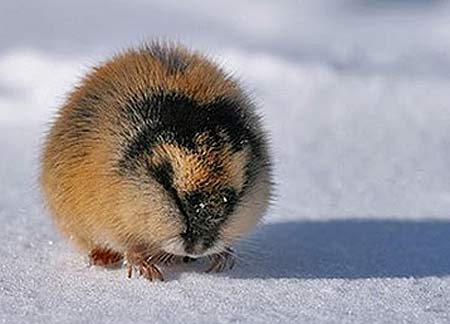
We have all heard of the mass suicide of cute little Arctic lemmings, but has anyone ever seen it? You have if you’ve seen the Walt Disney True Life Adventure called White Wilderness (1958), directed by James Algar. And the reason you’ve seen it is because the filmmakers faked it. According to the Alaska Fish & Wildlife News in September 2003:

According to a 1983 investigation by Canadian Broadcasting Corporation producer Brian Vallee, the lemming scenes were faked. The lemmings supposedly committing mass suicide by leaping into the ocean were actually thrown off a cliff by the Disney filmmakers. The epic “lemming migration” was staged using careful editing, tight camera angles and a few dozen lemmings running on snow covered lazy-Susan style turntable.

“White Wilderness” was filmed in Alberta, Canada, a landlocked province, and not on location in lemmings’ natural habitat. There are about 20 lemming species found in the circumpolar north—but evidently not in that area of Alberta. So the Disney people bought lemmings from Inuit children a couple provinces away in Manitoba and staged the whole sequence.

In the lemming segment, the little rodents assemble for a mass migration, scamper across the tundra and ford a tiny stream as narrator Winston Hibbler explains that, “A kind of compulsion seizes each tiny rodent and, carried along by an unreasoning hysteria, each falls into step for a march that will take them to a strange destiny.”

That destiny is to jump into the ocean. As they approach the “sea,” (actually a river—more tight cropping) Hibbler continues, “They’ve become victims of an obsession—a one-track thought: Move on! Move on!”

The “pack of lemmings” reaches the final precipice. “This is the last chance to turn back,” Hibbler states. “Yet over they go, casting themselves out bodily into space.”

Faking documentaries is nothing new to the film industry. In the famous early documentary Nanook of the North (1922), filmmaker Robert J. Flaherty had to teach his Eskimos how to build an igloo. And the women who were supposedly the star’s wives were actually Flaherty’s common-law wives, who happened to be Inuit. So much for verisimilitude!

An Actual Lemming. Cute, Huh?

An Actual Lemming. Cute, Huh?


Blake’s Milton

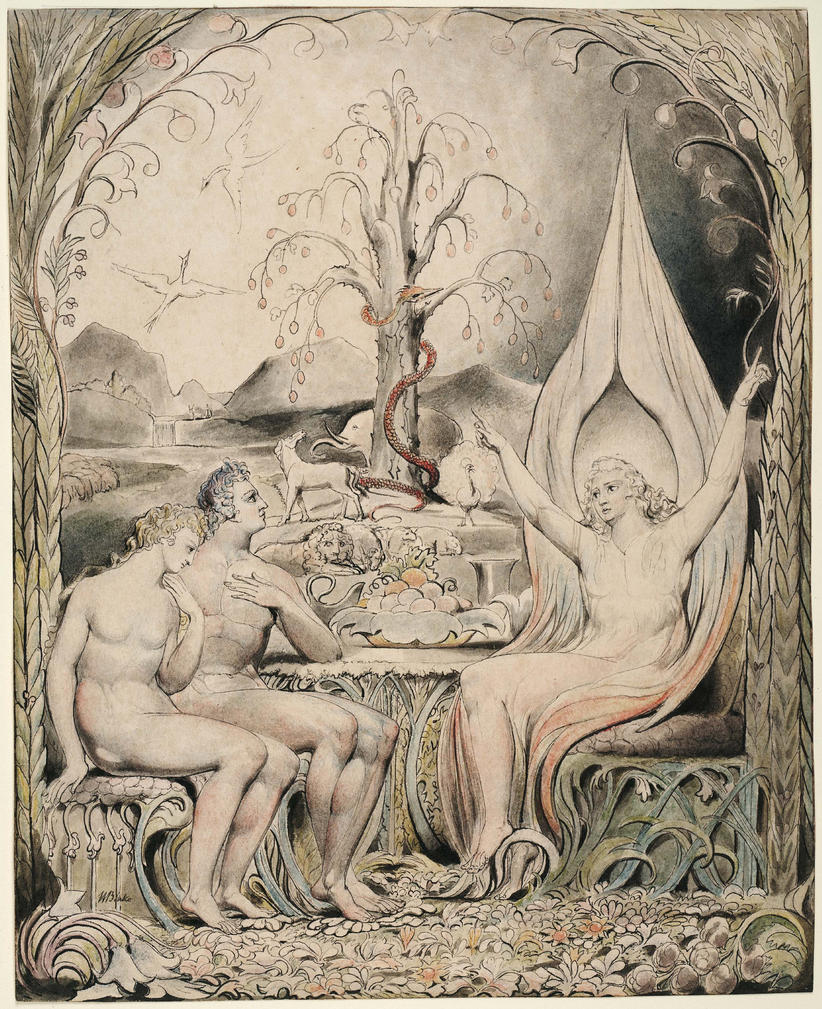
The Expulsion of Satan and His Angels from Heaven

The Expulsion of Satan and His Angels from Heaven

William Blake was not only a great poet, but he was also a great artist. When I was younger, I used to think that his art was a bit clunky—until I started reading his poetry. Then I saw that both the poetry and the art were all of a piece: they were like flames from a mind and heart on fire.

It was in his greatest poem, “The Marriage of Heaven & Hell,” that William Blake wrote this line:

The reason Milton wrote in fetters when he wrote of Angels and God, and at liberty when of Devils and Hell, is because he was a true Poet, and of the Devil’s party without knowing it.

Certainly, Book I of Paradise Lost shows a Satan who is unrepentant and verging on the magnificent:

What though the field be lost?
All is not lost; the unconquerable Will,
And study of revenge, immortal hate,
And courage never to submit or yield:
And what is else not to be overcome?
That Glory never shall his wrath or might
Extort from me.

At the same time, Milton’s God is also splendid. When he hears that Satan is loose on Earth, he foresees what is to come and sends the Archangel Raphael to explain to Adam and Eve the story of the fall of Satan and his angel followers. Blake illustrates the scene thus:

Note the Snake Wrapped Around the Tree of the Knowledge of Good and Evil in the Background

Note the Snake Wrapped Around the Tree of the Knowledge of Good and Evil in the Background

In actuality, Milton has Eve fall into a sleep while Raphael talks with Adam.

Blake’s Eden is strangely desert-like, whereas Milton gives us a verdant creation in which Adam and Eve are early agronomists who take care of the plants as part of their daily tasks. No matter, Blake is an artist in his own right and has no compunctions about creating his own Paradise Lost in pictures.


Dysinventions

I Wish Touchscreen Keyboards Could Be Uninvented

I Wish Touchscreen Keyboards Could Be Uninvented

There are wonderful inventions that make things easy for people. Then there are what I call dysinventions, or bad inventions, that while seeming to advance technology actually represent a step backward. One prominent example is the touchscreen keyboard. I could see the thought forming in the inventor’s mind: “Why not get rid of the clunky keyboard and just have people hit letters on a keyboard that appears on the screen?”

Well now, that’s just ducky for texting, twittering, and other forms of second-tier communications; but I could not enter this blog on such a quasi-keyboard. Let’s take yesterday’s blog, for example. I would have to type the name of the Icelandic volcano Eyjafjallajökull without the umlaut over the “o”. Eyjafjallajokull would probably look okay to most people, but it is wrong to me; and I insist on absolute correctness. To get the letter, I hit Alt-0246 on my keyboard. To get the em dash in the third paragraph, I type Alt-0151 instead of the double hyphen (“- -”) using the old typewriter convention.

I feel bad enough that there are some Eastern European diacritical marks I can’t use, such as an anacrusis or the Hungarian double-acute-accent over the “o” and “u” to indicate an extended vowel sound. In time, I will figure this out. But not on one of those touchscreen keyboards. I can imagine it would be gruelling just to type an average paragraph shifting between upper and lower case letters and numbers, let alone diacritical marks.

If I can’t make it look as if it were typeset, I would just as soon forget the whole thing. It just wouldn’t be me.

And that is why I don’t travel with an iPad or similar “crippled computer.”

I Have This Thing About Volcanoes

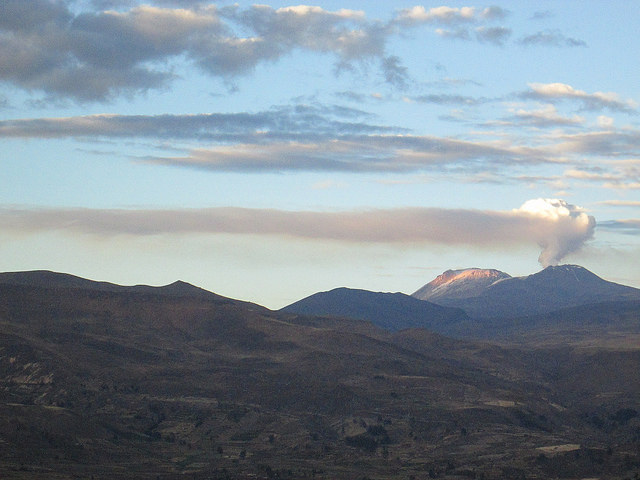
The Volcano Sabancaya in Eruption, seen from Colca Canyon

The Peruvian Volcano Sabancaya in Eruption, seen from Colca Canyon

I can tell you the day and time when it first started. It was at 6:00:41 am PST on February 9, 1971, when the earth started shaking. I held on to my mattress for dear life, even as it was sliding onto the bedroom floor from the massive jolts. The noise was deafening with all those structures shaking, and all the kitchen cabinets being emptied onto the floor. I had just lived through the Sylmar Quake in which 58 people lost their lives.

It was then that I realized we as a species were not exactly in control. Man inhabited a thin crust which was criss-crossed by earthquake faults and floating atop oceans of magma waiting to break out at points along the globe and cover our puny undertakings with layers of lava and ash. And there I was, right on the famed Ring of Fire, in a state with hundreds of faults and not a few volcanoes.

Since then, I have been to Iceland to see Hekla and Eyjafjallajökull, which at various points in history—the latter in 2010—caused havoc worldwide. And now, even as I write, it is Bárðarbunga which continues spewing lava after several weeks.

In September, I saw two volcanoes in Peru’s State of Arequipa spewing ash: Sabancaya and Ubinas. Both are highly active and may continue erupting for some time.

Our lives on this earth are incredibly fragile. I am most impressed by earthquakes and volcanoes, but there are other terrestrial and atmospheric events that can cut our short lives even shorter. That’s not even to mention microscopic bacteria and viruses, slips and falls, tree branches crashing down on our heads, automobile accidents, or any number of causes. Life is magnificent even when it is at its most destructive. Enjoy it while you can!


“Where Words Fail…”


At Its Best, This Is What Music Does

At Its Best, This Is What Music Does

It was Hans Christian Andersen who wrote, “Where words fail, music speaks.”

Tonight, Martine and I attended the Torrance Civic Chorale’s annual Christmas concert. It was beautiful. Conductor David Burks enabled me to step outside my usual noisily conflicted self and into an ethereal place, one of joy and celebration.

I’m not going to try to talk about what music does for me, because how it acts on me is outside the world of words. I could tell you what kind of music I like the most, but I could not even begin to describe the mechanism by which my emotions are directly manipulated.

I regularly listen to KUSC-FM in Los Angeles, which plays classical music pretty much all day. When musicologist and KUSC announcer Jim Svejda—a man who for decades has influenced my taste in music—talks about music or interviews a musician, I wish he would shut up. I’ve even told the station that when phoning in my annual donation: “Please keep Jim Svejda on, but tell him not to talk so much.”

It’s not what Svejda says that influences me: It is his choices in the music he plays.

Over the years, I have been most moved by Gustave Mahler, Jean Sibelius, and Anton Bruckner. Last night, I read Vladimir Sorokin’s Day of the Oprichnik while listening to Bruckner’s Third Symphony. It was nothing short of sublime. Now that I have much of my favorite music on an MP3 player, I feel liberated. High in the Andes, I listened to Sibelius and Tchaikovsky and felt they were writing music about what I was seeing with my eyes even as I was seeing it..


Tarnmoor’s ABCs: Newspapers

Take a Good Look While They’re Still There

Take a Good Look While They’re Still There

I was so very impressed by Czeslaw Milosz’s book Milosz’s ABC’s. There, in the form of a brief and alphabetically-ordered personal encyclopedia, was the story of the life of a Nobel Prize winning poet, of the people, places, and things that meant the most to him. Because his origins were so far away (Lithuania and Poland) and so long ago (1920s and 1930s), there were relatively few entries that resonated personally with me. Except it was sad to see so many fascinating people who, unknown today, died during the war under unknown circumstances.

My own ABCs consist of places I have loved (Iceland), things I feared (Earthquakes), writers I have admired (Chesterton, Balzac, Proust, and Borges); things associated with my past life (Cleveland and Dartmouth College), people who have influenced me (John F. Kennedy), and things I love to do (Automobiles and Books). This blog entry is my own humble attempt to imitate a writer whom I have read on and off for thirty years without having sated my curiosity. Consequently, over the months to come, you will see a number of postings under the heading “Tarnmoor’s ABCs” that will attempt to do for my life what Milosz accomplished for his. To see my other entries under this category, hit the tag below marked “ABCs”. I don’t guarantee that I will use up all 26 letters of the alphabet, but I’ll do my best. Today the letter is “N” for Newspapers.

I know that newspapers are in trouble, especially in this country. Still, I cannot imagine beginning my day without reading the Los Angeles Times with my breakfast. (It used to be the Herald Examiner, but that died almost exactly twenty-five years ago.) I scan the front page, the California section, the business section, and—most especially—the comics.

The comics have always given me a good feel for the way people really look at life. It’s the most “popular” section of the paper, and it cuts across age boundaries and even socioeconomic boundaries. I know I could see many of the comics on individual websites, but not easily while I am drinking my tea and munching my cheese and crackers. This morning it would not have been possible at all because I think my Uninterrupted Power Supply unit crashed overnight. Despite a fearsome rainstorm, however, my paper was still leaning on my doorstep.

There are parts of my newspaper I don’t read, including the sports page and many opinions of columnists and pundits. I’m down on pundits in general. It’s kind of pathetic that these people, who get paid for being experts, are often so ignorant and opinionated. As for sports, I have no allegiance to these highly-paid mercenaries from L.A. and elsewhere.

Will American newspapers eventually disappear? I wish I knew. In the meantime, I will continue to read the Times.


Fifth Graders Against Communism

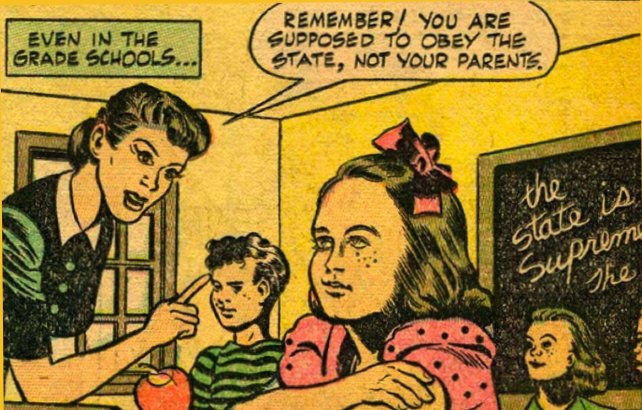
Back in Fifth Grade, We Knew All About the Red Menace

Back in Fifth Grade, We Knew All About the Red Menace

When I was a grade school student at St. Henry’s in Cleveland, we received a weekly newsletter reporting on the news of the world. Most particularly, we learned how the Communists who had recently taken over Eastern Europe were persecuting Catholics and suppressing the God-given rights of the people. At no time were we ever told that Hungary and several other of the Russian satellites fought on the German side in World War Two. And now the communists were threatening us! Several times a year, we had to do drills instructing us what to do in case of a nuclear attack. If you don’t already know, this 1951 video will explain it all to you:
 

(Those school desks were marvelous at protecting students from radiation and falling debris.)

At home, several times a year my mother put together bundles of used clothing she got from church sales to send to our friends and relatives in Hungary. After she’d accumulated about twenty or thirty pounds, she would wrap them in sturdy white cloth and write the address directly on the cloth with indelible ink. Then off it would go. With luck, the jackbooted thugs that worked for the Budapest Post Office would let selected items be delivered to the addressees. The rest, of course, was a perquisite for Communist Party apparatchiks.

Things came to a head during the Hungarian Revolution in 1956. When, after a few days of freedom, the Russian tanks rolled into Hungary and re-established Soviet rule, our family was appalled. Naturally we did what we could to help some of the refugees that made it across the line before the axe fell. (As it turned out, they were not nice people. How could that be? After all, they were Hungarians.)

And Now America Was Threatened, Too

And Now America Was Threatened, Too


Somehow, we made it through those dangerous years. We listened to the Civil Defense alarms that sounded a test on Fridays at noon. And we tuned in to Conelrad at 640 and 1240 on our radio dial. There was so much else, too, bad we licked Communism in the end. Or did we?

Beatniks Then and Now

Fifty Years Before the Opera Came the Novel

A Full Fifty Years Before the Opera Came the Novel

A hundred years before Jack Kerouac, Allen Ginsberg, and the Beat Generation came into being, there were the “original” Bohemians—although, possibly, one could make a case for tracing them all the way back to François Villon in the 15th Century—popularized by Henri Murget in Scènes de la Vie de Bohème (or Bohemians of the Latin Quarter). We are probably much more familiar with the operas based on this popular novel of the 1840s, including Giacomo Puccini’s La Bohème. Ruggiero Leoncavallo also wrote an operatic version, and the Broadway musical Rent is loosely based on  Murger’s novel of 1846-1847.

The big difference between the Beats and Murget’s Bohemians is that, while the Beats were more heavily into booze and drugs, the Parisian artists and artistes of the 1840s were more into surviving. The whole picture of the starving young artist really came into fruition around then. We see pieces of it in Honoré de Balzac’s Illusions Perdues (Lost Illusions) and some of his other works, but it was Murger who popularized it, while graciously acknowledging Balzac’s contribution.

In Murget’s novel, there were four main heroes: Rodolphe, Marcel, Colline, and Schaunard, along with their mistresses, especially Mimi and Musette. What distinguishes Murget from Balzac is that he is nowhere near as dark. His Bohemian artists are impoverished, but generous and good-hearted. Although it has a “where are the snows of yesteryear” (itself a quote from Villon) sadness to it, we do not feel there is any evil present, except perhaps in the landlords who persist on asking for rent. As Marcel cynically says at one point toward the end:

It is no longer possible for us to continue to live much longer on the outskirts of society—on the outskirts of life almost—under the penalty of justifying the contempt felt for us, and of despising ourselves. For, after all, is it a life we lead? And are not the independence, the freedom of mannerism of which we boast so loudly, very mediocre advantages? True liberty consists of being able to dispense with the aid of others, and to exist by oneself, and have we got to that? No, the first scoundrel, whose name we would not bear for five minutes, avenges himself for our jests, and becomes our lord and master the day on which we borrow from him five francs, which he lends us after having made us dispense the worth of a hundred and fifty in ruses or in humiliations. For my part, I have had enough of it. Poetry does not alone exist in disorderly living, touch-and-go happiness, loves that last as long as a bedroom candle, more or less eccentric revolts against those prejudices which will eternally rule the world, for it is easier to upset a dynasty than a custom, however ridiculous it may be. It is not enough to wear a summer coat in December to have talent; one can be a real poet or artist whilst going about well shod and eating three meals a day. Whatever one may say, and whatever one may do, if one wants to attain anything one must always take the commonplace way.

Unfortunately, not many people today read Murger. It is interesting, however, to trace an idea back to its origins; and Murger makes for pleasant reading. You can find a free English translation on Gutenberg.Com.