A Philosophical Conundrum

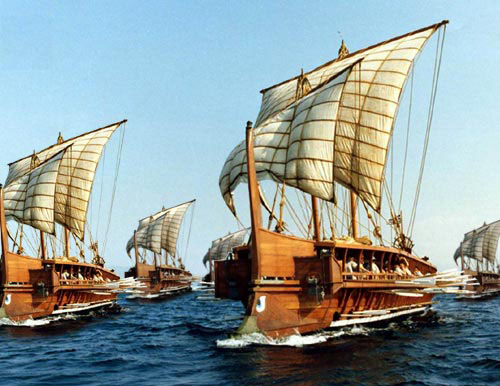
It’s Called “The Ship of Theseus”

It’s Called “The Ship of Theseus”

I got this puzzle from The Futility Closet, which I have decided to add to my links:

Suppose we have a complete wooden ship, and one day we replace one of its wooden planks with an aluminum one. Most people would agree that the ship survives this operation; that is to say, its identity remains unchanged. But suppose that we then replace a second plank, and then a third, until our wooden ship is made entirely of aluminum. Is this the same ship that we started with? If not, when did it change?

Thomas Hobbes adds a wrinkle: Suppose that, as we did all this refurbishing, someone had gathered up all the discarded wooden planks and used them to assemble a second ship. What are we to make of this? “This, without doubt, had also been the same numerical ship with that which was at the beginning; and so there would have been two ships numerically the same, which is absurd.”

And philosopher Roderick Chisholm adds another: “Let us suppose that the captain of the original ship had solemnly taken the vow that, if his ship were ever to go down, he would go down with it. What, now, if the two ships collide at sea and he sees them start to sink together? Where does his duty lie — with the aluminum ship or with the reassembled wooden ship?”


Tributes: Maya Angelou (1928-2014)

The Young Poetess Half a Lifetime Ago

The Young Poetess Half a Lifetime Ago

Losing a poet is a serious thing. They tend not to get replaced often enough with others who are as good. Or maybe we have gotten too used to their voices to hear newer voices emerging from the mass.

I was saddened to hear of Maya Angelou’s death this morning. She had been in poor health and slipped away from us quietly. Fortunately, her voice remains behind to remind us of what we are missing. Such as these brief lines entitled “Awaking in New York”:

Curtains forcing their will
against the wind,
children sleep,
exchanging dreams with
seraphim. The city
drags itself awake on
subway straps; and
I, an alarm, awake as a
rumor of war,
lie stretching into dawn,
unasked and unheeded.

I love that image of children sleeping while exchanging dreams with seraphim.

To one interviewer who asked in 1984 about how she wrote her poems, Miss Angelou had a quick retort:

I also wear a hat or a very tightly pulled head tie when I write. I suppose I hope by doing that I will keep my brains from seeping out of my scalp and running in great gray blobs down my neck, into my ears, and over my face.

Maybe that’s what I should do when I write these blogs!


Tarnmoor’s ABCs: Jorge Luis Borges

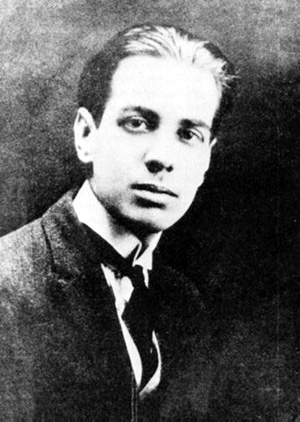
Jorge Luis Borges in 1921

Jorge Luis Borges in 1921

I was so very impressed by Czeslaw Milosz’s book Milosz’s ABC’s. There, in the form of a brief and alphabetically-ordered personal encyclopedia, was the story of the life of a Nobel Prize winning poet, of the people, places, and things that meant the most to him. Because his origins were so far away (Lithuania and Poland) and so long ago (1920s and 1930s), there were relatively few entries that resonated personally with me. Except it was sad to see so many fascinating people who, unknown today, died during the war under unknown circumstances.

My own ABCs consist of places I have loved (Iceland), things I feared (Earthquakes), writers I have admired (G. K. Chesterton and Honoré de Balzac); things associated with my past life (Cleveland and Dartmouth College), and things I love to do (Automobiles and Books). This blog entry is my own humble attempt to imitate a writer whom I have read on and off for thirty years without having sated my curiosity. Consequently, over the months to come, you will see a number of postings under the heading “Tarnmoor’s ABCs” that will attempt to do for my life what Milosz accomplished for his. To see my other entries under this category, hit the tag below marked “ABCs”.I don’t guarantee that I will use up all 26 letters of the alphabet, but I’ll do my best. Today, we’re at the letter “J,” for Jorge Luis Borges.

Ever since I first learned about Jorge Luis Borges (1899-1986), I have been hooked. By now, I have read just about everything that has been translated into English, sometimes two or three times. He has guided my reading for over forty years: Without him, I would never have discovered Iceland or the works of G. K. Chesterton. Without him, I would never have gone to Argentina twice, once in 2006 and once in 2011. His City of Buenos Aires has become one of the ineluctable geographies of my dreams.

Of his works, I recommend most highly Labyrinths, Ficciones, Other Inquisitions, and, of course, his magnificent poetry. Below, from the recent Penguin anthology entitled Poems of the Night, I have excerpted one poem entitled “Sleep” as translated by Stephen Kessler:

SLEEP

The night assigns us its magic
task. To unravel the universe,
the infinite ramifications
of effects and causes, all lost
in that bottomless vertigo, time.
Tonight the night wants you to forget
your name, your elders and your blood,
every human word and every tear,
what you would have learned from staying awake,
the illusory point of the geometricians,
the line, the plane, the cube, the pyramid,
the cylinder, the sphere, the sea, the waves,
your cheek on the pillow, the coolness
of the fresh sheets, the Caesars and Shakespeare
and the hardest thing of all, what you love.
Oddly enough, a pill can
erase the cosmos and erect chaos.

Most people who know of Borges know only that he was blind. For the last half of his life, he was a kind of Teiresias. That’s why I wanted to reproduce above a photograph of the poet in his twenties. The other thing many people know is that he was singled out by the Swedish Academy to be passed over for the Nobel Prize for Literature, primarily because one member of the selection committee disagreed with his politics. This was supposedly because he accepted an award from Chilean dictator General Augusto Pinochet Ugarte. I do not care a fig if Borges’s politics are to the right of mine: All that counts is that he has had a benign, lasting, and ever growing influence on the person I have become.

Television IS News?

Look What’s Popping Up on TV News Websites?

Look What’s Popping Up on TV News Websites?

It was bound to happen sooner or later. Now that the same corporations that own television news also own popular television series.One can’t look at CNN.com or NBCNews.com without running into articles about the latest developments in “Man Men,” “Breaking Bad,” or even the dwindling “American Idol.” That never used to happen before. Even Salon.Com, which insofar as I know, is unaffiliated with any entertainment producers, is heavily interlarded with references to popular shows.

Since I have deliberately abandoned television programming over ten years ago, all these references in the news mean nothing to me. They end up as descriptions of cultural phenomena that are meaningless to me. In no case do I ever become interested enough to see what all the hoopla is about. I think the last time I tried was a few years ago when I rented the first season of “The Sopranos” from Netflix. I thought it was all right, but not good enough to maintain my interest.

Instead of television series, it would be interesting to see more news articles about books. That occasionally happens on Salon.Com, but almost never on the mainstream media websites. Oh, well, you can always come here and look at what I am reading. You are bound to encounter quite a few books. I have made a commitment to Goodreads.Com to read 106 books this year. So far, I am 16 books ahead on my goal. Maybe I should alert CNN?

Aldous Huxley Foresees the Future

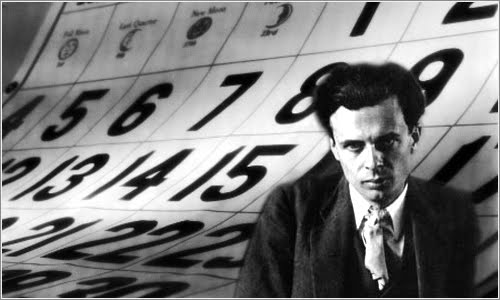
The Young Aldous Huxley

The Young Aldous Huxley

The Twentieth Century gave us two dystopias to consider: George Orwell’s 1984 and Aldous Huxley’s Brave New World. It is interesting to note, years after the fact, whose vision is closer to the reality. My vote goes to Aldous Huxley, as does the writer of this website, which compares the two point by point using comics to make their point.

In 1949, right after 1984 came out, Huxley wrote a letter to Orwell in which he doubts the latter’s vision would ever come true:

The philosophy of the ruling minority in Nineteen Eighty-Four is a sadism which has been carried to its logical conclusion by going beyond sex and denying it.

Whether in actual fact the policy of the boot-on-the-face can go on indefinitely seems doubtful.

My own belief is that the ruling oligarchy will find less arduous and wasteful ways of governing and of satisfying its lust for power, and these ways will resemble those which I described in Brave New World.
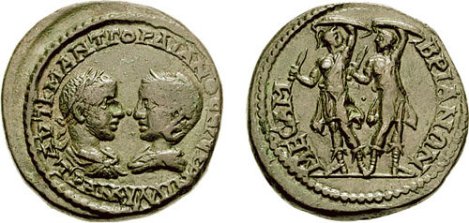
Corybantic Dancers on Reverse of Coin

Corybantic Dancers on Reverse of Greek Coin

Last night, I saw a DVD containing what my friend Lee Sanders claims is the only filmed interview with Huxley, shortly before his death in 1963. Considering the extent to which Huxley has been one of my gurus over the last half century, it is no surprise that I found it fascinating. During the interview, Huxley repeatedly made the point that our own intellectualism was over-rigorous. He brings up the point that the Ancient Greeks needed the frenzied Corybantic Dances to maintain their lives on an even keel.

He also quoted two related poems by William Wordsworth entitled “Expostulation and Reply” and “The Tables Turned.” The the former, a visitor, thought to be Hazlitt, remonstrates with the poet, who appears to be sitting and doing nothing:

‘The eye—it cannot choose but see;
We cannot bid the ear be still;
Our bodies feel, where’er they be,
Against or with our will.

’Nor less I deem that there are Powers
Which of themselves our minds impress;
That we can feed this mind of ours
In a wise passiveness.

’Think you, ’mid all this mighty sum
Of things for ever speaking,
That nothing of itself will come,
But we must still be seeking?

’—Then ask not wherefore, here, alone,
Conversing as I may,
I sit upon this old grey stone,
And dream my time away.’

In “The Tables Turned,” Wordsworth goes on the offensive:

Sweet is the lore which Nature brings;
Our meddling intellect
Mis-shapes the beauteous forms of things:—
We murder to dissect.

Enough of Science and of Art;
Close up those barren leaves;
Come forth, and bring with you a heart
That watches and receives.

Significantly, Huxley wrote a novel entitled Those Barren Leaves (1925), which I have not yet read.

Whether we fling our clothes off and engage in wild corybantic dances, or we sit still and let the world communicate with us in its own time, we are in the process sharpening and shaping our minds using all of our faculties, rather than just a few.


Indiana Jones in the Flesh

Hiram Bingham III and Indiana Jones

Hiram Bingham III and Indiana Jones

Yes, Virginia, there was a real Indiana Jones. He was the son of a Protestant missionary in Hawaii, who was in turn the son of a Protestant missionary in Hawaii. In fact, if you’ve read James Michener’s Hawaii, his grandpappy was Abner Hale. Hiram Bingham III (1875-1956) had too much of the spirit of wanderlust to be tied down to a clerical life. He was an explorer, aviator, and eventually Governor of Connecticut and U.S. Senator from Connecticut during his long and active life.

He came to my attention as the self-proclaimed discoverer of the ruins of Machu Picchu in Peru, which I hope to visit later this year. He came upon the ruins in 1911, thinking he was the first—even though they appeared on an 1874 map. No matter. Even if he was wrong, Bingham did a great job publicizing the ruins using his association with Yale University and the National Geographic Society. Among other things, he wrote an excellent book entitled Lost City of the Incas: The Story of Machu Picchu and Its Builders in 1948. (He also wrote several other books, including Inca Land: Explorations in the Highlands of Peru and The Ruins of Choqquequirau, among others.)

If he weren’t such a good writer, I might not have forgiven Bingham for being so wrong. Not only was he the first white man at Machu Picchu: He thought he had discovered Old Vilcabamba, the last hideout of the Incas as they fled the Conquistadores. In reality, the last four Inca rulers were based in the jungle at a place called Espiritu Pampa. Curiously, Bingham had been there (see photo below), but thought the place was far too tropical for his beloved Incas.

Bingham (Upper Right) and Peruvian Assistant at Espiritu Pampa (1911)

Bingham (Upper Right) and Peruvian Assistant at Espiritu Pampa (1911)

It is almost pathetic to read Bingham’s forcing the issue regarding his misidentification. He practically ordered furnishings for the rooms from Macy’s to prove his point:

One day we located the burial place of the High Priestess or Mama-cuna, the Lady Superior of the convent, the person chiefly responsible for the training of the Chosen Women. It was a very sightly location on a rock-sheltered terrace on the slopes of Machu Picchu Mountain, about a thousand feet above the highest part of the ruins. The terrace was about forty feet long above some agricultural terraces and connected with the highest by two flights of stairs. It was almost completely overhung by an immense bowlder which looked like a peaked crag of the grey granite mountain. The flat-faced projecting portion of the bowlder was at least fifty feet high. The terrace was constructed largely of rock and gravel. Sheltered from the fierce noonday heat of the sun, it offered an ideal resting place for the Mother Superior.

Yes, but what kind of tea did she drink?

I might be a little hard on the guy, with all his palaver about Chosen Women and Virgins of the Sun. Remember, the Incas had no writing, so Bingham filled his discovery from his own imagination. Mother Superior my Aunt Fanny!


The New Normal

Transitioning to—What?

Transitioning to—What?

As Zadie Smith writes in The New York Review of Books in an April 3, 2014 article entitled “Elegy for a Country’s Seasons”:

Sing an elegy for the washed away! For the cycles of life, for the saltwater marshes, the houses, the humans—whole islands of humans. Going, going, gone!

There is little doubt that our earth is changing, such that the next generation may not recognize the patterns that make for our own daily existence. Glaciers will be all but gone. Tornadoes, polar vortexes, hurricanes, typhoons, and giant storm cells will cover new parts of the globe. I for one will not say authoritatively that we are at fault or that we can prevent or even mitigate it, but I will try to do my part as if we can.

I do not profess to understand the psyche of climate change deniers. Suffice it to say that they will change their minds soon or die wrapped in a veil of profoundest ignorance. This actually has nothing to do with politics: It’s about the Earth, Our Mother. She’s entering a menopausal phase that will affect virtually everyone on the planet.

Zadie Smith continues:

Oh, what have we done! It’s a biblical question, and we do not seem to be able to pull ourselves out of its familiar—essentially religious—cycle of shame, denial, and self-flagellation. That is why (I shall tell my granddaughter) the apocalyptic scenarios did not help—the terrible truth is that we had a profound, historical attraction to apocalypse. In the end, the only thing that could create the necessary traction in our minds was the intimate loss of the things we loved.

Have we as a species ever turned our back on a powerful new technology? I can think of only a single example: When 16th Century Portuguese traders tried to sell the Japanese rifles, the Samurai opted to stick instead with their swords. Their whole military culture was predicated on the blade and their knowledge of how to wield it.

Maybe we should have stuck with the horse.


“Stupidity of the Vilest Kind”

Dick Cheney

Dick Cheney

You are wedded to stupidity, my fine friend, of the vilest kind; you are impeached of this by your own words, out of your own mouth; and this, it seems, is why you dash into politics before you have been educated. And you are not alone in this plight, but you share it with most of those who manage our city’s affairs… Plato: Alcibiades

Intihuatana

The Inca Had No Writing, Just Knots, Called Quipu

The Inca Had No Writing, Just Knots, Called Quipus

I spent many vacations between 1975 and 1992 visiting archaeological sites in Mexico. These included not only Mayan and Aztec, but also Totonac, Toltec, Zapotec, Mixtec, Olmec, and whatever peoples built the ruins at Teotihuacán. As a result, I developed a feeling for the strengths and weaknesses of these Meso-American peoples. This year I plan to visit Peru and acquaint myself with the Incas and the various peoples who preceded them in the Andes.

So far my researches have turned up some interesting results. First of all, the Incas had no writing—as such. Instead, they used colored threads of llama, alpaca, or cotton with knots tied into the various strands called quipus. We know which knots stood for the various digits in their base-10 numbering system, but have no idea how they managed to convey any kind of qualitative content, such as “Look out for that Lord Manco: He’s trying to pull a fast one on you.”

In contrast, the Mayans had a hieroglyphic language which is just now being understood, as well as a vigesimal (base-20) numbering system which is relatively easy to understand.

Whereas the peoples of Mexico had no animals they could use to either ride or carry or pull weights—remember: they did not have the wheel!—the Incas developed their own draft animals by breeding guanacos into llamas, alpacas, and vicuñas. Llamas could not bear human riders, but they could bear up to one hundred pounds of weight on their backs; and, unlike horses, they were comfortable about climbing stairs at high altitude. When fighting the conquistadores, the Inca learned to set up ambushes at places where one of their mountain roads turned into stairs. As the horses bunched up afraid to take the stairs, the Incas atop the ridge line would tumble huge rocks down upon their enemy.

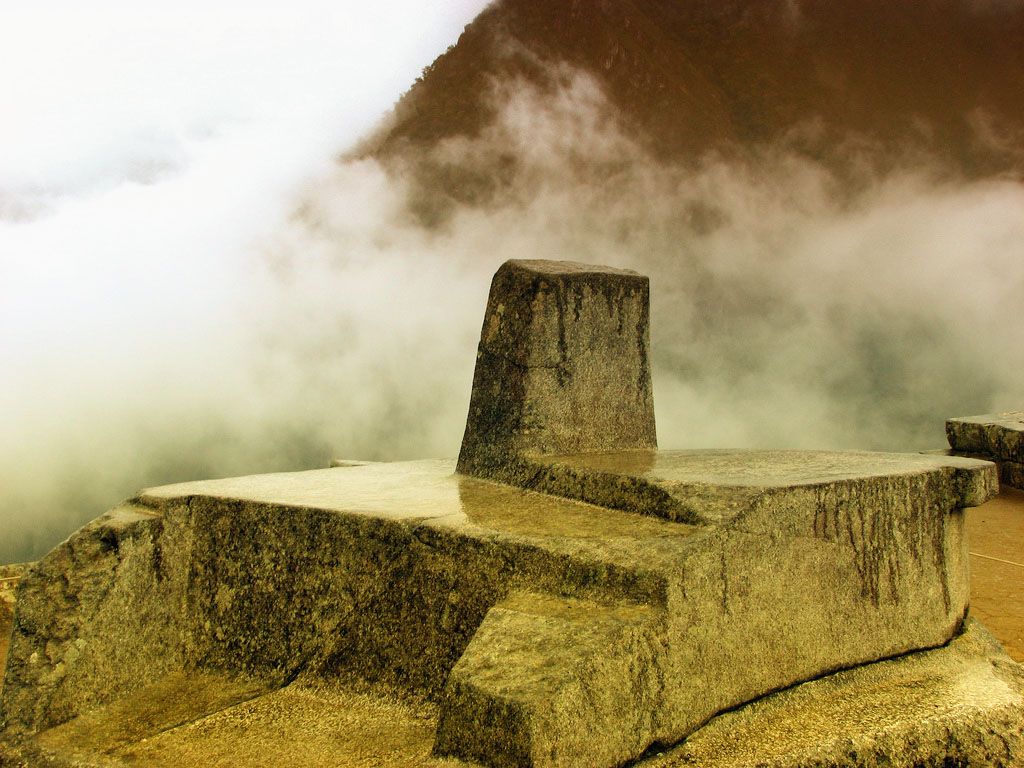
An Intihuatana, or “Hitching Post of the Sun” at Machu Picchu

An Intihuatana, or “Hitching Post of the Sun” at Machu Picchu

Who were more advanced, the Incas or the Pre-Columbian peoples of Mexico? My feeling is that they were both remarkable. Where the Mayans excelled in writing, the Incas were great architects and built thousands of miles of roads—many of which exist to this day despite all the earthquakes that have occurred since they were built.

A good example of Inca ingenuity are the Intihuatanas, or “Hitching Posts of the Sun,” that are found at various sites, such as at Pisac and Machu Picchu. An Intihuatana was a stone that was carefully cut so that the Inca savants could note when the sun was approaching a solstice. An excellent discussion of the stone at Machu Picchu, together with angles and measurements, appears in a scholarly article by Dieter B. Hermann, which was translated into English and appears on the net as an Acrobat PDF file. The stone at Pisac was heavily damaged when a camera crane fell on it during the filming of a beer commercial in 2000. The Inca ruins can survive earthquakes, frosts, and thaws for whole centuries … but apparently not wayward humans.


A Forgotten War

Chinese Troops in the Sino-Vietnamese War of 1979

Chinese Troops in the Sino-Vietnamese War of 1979

Once the U.S. abandoned Saigon to the Viet Cong in 1975, we seem to have lost all interest in Southeast Asia. There was, however, a lot happening. The Pol Pot regime in Cambodia, which was supported by the Chinese, was engaged in genocide on a massive scale. Also, we must not forget at that time that the Sino-Soviet conflict was at its height: The Russian-Chinese border fairly bristled with guns and military units. At the time, the Hanoi government had a military alliance with the Soviet Union. When Vietnam invaded Cambodia and deposed the Khmer Rouge, China decided to punish its neighbor to the south.

On February 17, 1979, somewhere between 200,000 and 600,000 troops of the Peoples’ Liberation Army (PLA) invaded North Vietnam and occupied the all territory for approximately twenty miles south of the border. It appears that China either wanted to test the alliance with Russia or divert the crack Viet military units engaged in Cambodia—or both, or neither. A number of reasons have been adduced for this incursion, and China wasn’t owning up to its motivation for so doing. Vietnam met the attack by the 1st and 2nd military regions—essentially militia—under the command of Dam Quang Trung and Vu Lap. The number engaged of the Vietnamese forces was a fraction of the Chinese force, but it inflicted heavy casualties on the PLA, and suffered heavy casualties in return. (The numbers vary depending on whether one is following Chinese or Vietnamese statistics.)

Newsweek Cover in Feb 1979

Newsweek Cover on March 5, 1979

When I heard that, after thirty-five years of relative peace, the Chinese are once again testing the resolve of the Vietnamese by drilling an oil well off the Paracel Islands in the South China Sea, which are claimed by both nations, my antennae started to tingle. Tiny uninhabited islands are big news these days, mainly because they extend the territories claimed by adjoining land powers. Claiming a tiny rock can extend one’s territorial waters by literally thousands of square miles. And both China and Vietnam need all the oil they can get.

The Vietnamese responded by rioting and attacking Chinese within their borders, along with the businesses they ran. China has been chartering flights to evacuate its nationals from Vietnam.

Although the PLA is huge, it is largely untested in battle. The Sino-Vietnamese War of 1979 was probably the largest military conflict it faced in the last half century—and it did not fare too well faced with a smaller number of Vietnamese militia. At that time, one must remember that the Vietnamese had been at war ever since the end of World War Two and, as a people, were probably as battle-hardened as one could be.

It would be interesting to see whether China is willing, once again, to test Vietnam’s resolve.