Vilcabamba

Vilcabamba a.k.a. Espiritu Pampa

When Hiram Bingham III first laid eyes on the spectacular ruins of Machu Picchu in Peru’s Andes, he had been looking for the last capital of the Incas who had rebelled against the Spanish conquistadores. It was a place called Vilcabamba. Curiously, he had actually discovered the ruins of Vilcabamba a few weeks later at a place called Espiritu Pampa, but rejected it as the last Inca stronghold.

Why? Let Bingham explain in his own words, quoted in Kim MacQuarrie’s The Last Days of the Incas (New York: Simon & Schuster, 2009). The American explorer found it hard to believe that

the [Inca] priests and Virgins of the Sun … who fled from cold Cuzco with Manco … would have cared to live in the hot valley of Espiritu Pampa. The difference in climate is as great as that between Scotland and Egypt. They [the Incas] would not have found in Espiritu Pampa the food which they liked. Furthermore, they could have found the seclusion and safety which they craved just as well in several other parts of the province, particularly at Machu Picchu, together with a cool, bracing climate and food stuffs more nearly resembling those to which they were accustomed.

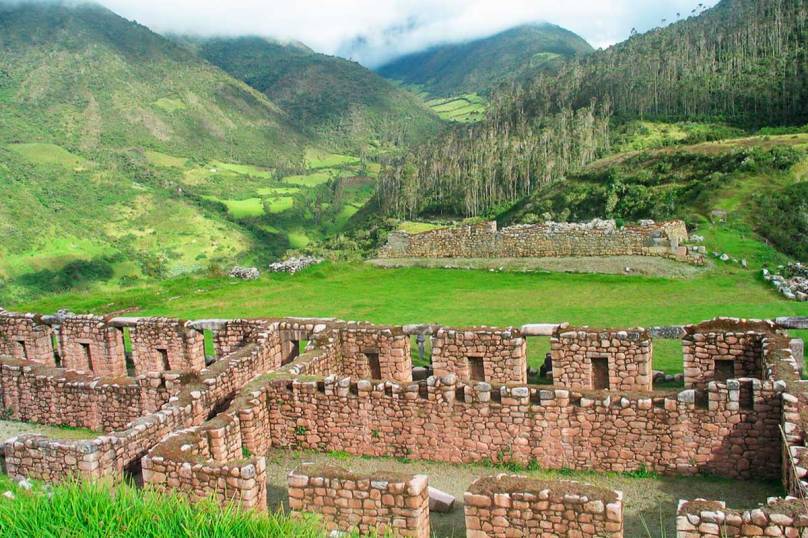
Essentially, Espiritu Pampa was too yucky. (Note that in the above photo, a considerable amount of tropical foliage has been cleared.) Too yucky for the Inca and too yucky for the … the … Virgins of the Sun?!

Who in blue blazes were the Virgins of the Sun?

According to Wikipedia’s AI overlord: “The Aclla (Quechua for ‘Chosen Women’), often called ‘Virgins of the Sun’ or ‘Wives of the Inca,’ were young women in the Inca Empire chosen around age 10 for their beauty and purity. Sequestered in convents called Acllahuasi, they lived a cloistered, nun-like existence, specializing in weaving, brewing, and religious duties under the supervision of Mama Cuna.”

Well, I could see why a lonely American professor, scion of two generations of New England missionaries, would become entranced by the idea of Virgins of the Sun. Might as well junk everything that several generations of Spanish sources wrote on the subject of Vilcabamba and declare Machu Picchu to be the site of the Inca city It’s a nicer chunk of real estate and could more easily be promoted as the next Disneyland.

Curiously, none of those old Spanish documents ever mentioned Machu Picchu, however gorgeous it looks compared to Manco Inca’s hidey-hole in the jungle, far from the Spanish who had massacred so many of his people.

Indiana Jones in the Flesh

Hiram Bingham III and Indiana Jones

Hiram Bingham III and Indiana Jones

Yes, Virginia, there was a real Indiana Jones. He was the son of a Protestant missionary in Hawaii, who was in turn the son of a Protestant missionary in Hawaii. In fact, if you’ve read James Michener’s Hawaii, his grandpappy was Abner Hale. Hiram Bingham III (1875-1956) had too much of the spirit of wanderlust to be tied down to a clerical life. He was an explorer, aviator, and eventually Governor of Connecticut and U.S. Senator from Connecticut during his long and active life.

He came to my attention as the self-proclaimed discoverer of the ruins of Machu Picchu in Peru, which I hope to visit later this year. He came upon the ruins in 1911, thinking he was the first—even though they appeared on an 1874 map. No matter. Even if he was wrong, Bingham did a great job publicizing the ruins using his association with Yale University and the National Geographic Society. Among other things, he wrote an excellent book entitled Lost City of the Incas: The Story of Machu Picchu and Its Builders in 1948. (He also wrote several other books, including Inca Land: Explorations in the Highlands of Peru and The Ruins of Choqquequirau, among others.)

If he weren’t such a good writer, I might not have forgiven Bingham for being so wrong. Not only was he the first white man at Machu Picchu: He thought he had discovered Old Vilcabamba, the last hideout of the Incas as they fled the Conquistadores. In reality, the last four Inca rulers were based in the jungle at a place called Espiritu Pampa. Curiously, Bingham had been there (see photo below), but thought the place was far too tropical for his beloved Incas.

Bingham (Upper Right) and Peruvian Assistant at Espiritu Pampa (1911)

Bingham (Upper Right) and Peruvian Assistant at Espiritu Pampa (1911)

It is almost pathetic to read Bingham’s forcing the issue regarding his misidentification. He practically ordered furnishings for the rooms from Macy’s to prove his point:

One day we located the burial place of the High Priestess or Mama-cuna, the Lady Superior of the convent, the person chiefly responsible for the training of the Chosen Women. It was a very sightly location on a rock-sheltered terrace on the slopes of Machu Picchu Mountain, about a thousand feet above the highest part of the ruins. The terrace was about forty feet long above some agricultural terraces and connected with the highest by two flights of stairs. It was almost completely overhung by an immense bowlder which looked like a peaked crag of the grey granite mountain. The flat-faced projecting portion of the bowlder was at least fifty feet high. The terrace was constructed largely of rock and gravel. Sheltered from the fierce noonday heat of the sun, it offered an ideal resting place for the Mother Superior.

Yes, but what kind of tea did she drink?

I might be a little hard on the guy, with all his palaver about Chosen Women and Virgins of the Sun. Remember, the Incas had no writing, so Bingham filled his discovery from his own imagination. Mother Superior my Aunt Fanny!