Ytinerary: Iguazu Falls

Rainbow Over the Falls

Rainbow Over the Falls

My doctor suggested I see it, my niece suggested I see it, my friends suggested I see it; so I decided to add Iguazu Falls to my itinerary. It is considered by some to be the most spectacular waterfalls on earth. It lies at a point where the borders of three countries meet: Argentina, Brazil, and Paraguay. About 20% of the falls are on Brazilian territory, and 80% on Argentinian territory. Nearby Paraguay gets 0%. To see the best long-distance view, I have to pay the $140 visa reciprocity fee to Brazil, even if I just sneak across the border for an hour or two. (I have already paid the Argentinian fee in 2011, which is good for ten years.)

I plan to spend two nights at Puerto Iguazu on the Argentinian side. To get there from Buenos Aires, I plan to take a Via Bariloche bus with their tutto letto service with 180º degree reclining bed/seats. The trip takes upwards of eighteen hours, though I get the chance to see a lot of countryside. On the way back, I will take a plane—carefully avoiding Aerolineas Argentinas to the maximum extent possible. (We had horrendous luck with them back in 2011.)

Whether I will spend $140 to see the Brazilian side of the falls for a few hours is still a moot point. My doctor said it’s worth it, but a lot of tourists have written that once you get close up to the Garganta del Diablo (the Devil’s Throat), everything else is secondary.

As I have written earlier, I have avoided the falls on earlier trips because of my hatred of mosquitoes. I will take a 100% DEET insect repellent with me and avoid spending too much time in the jungle areas around dusk. Instead, I will read a book in air conditioned comfort.


American Pharoah, Knig, and Impuror

Send for the Royal Orthographer!

Quick, Send for the Royal Orthographer!

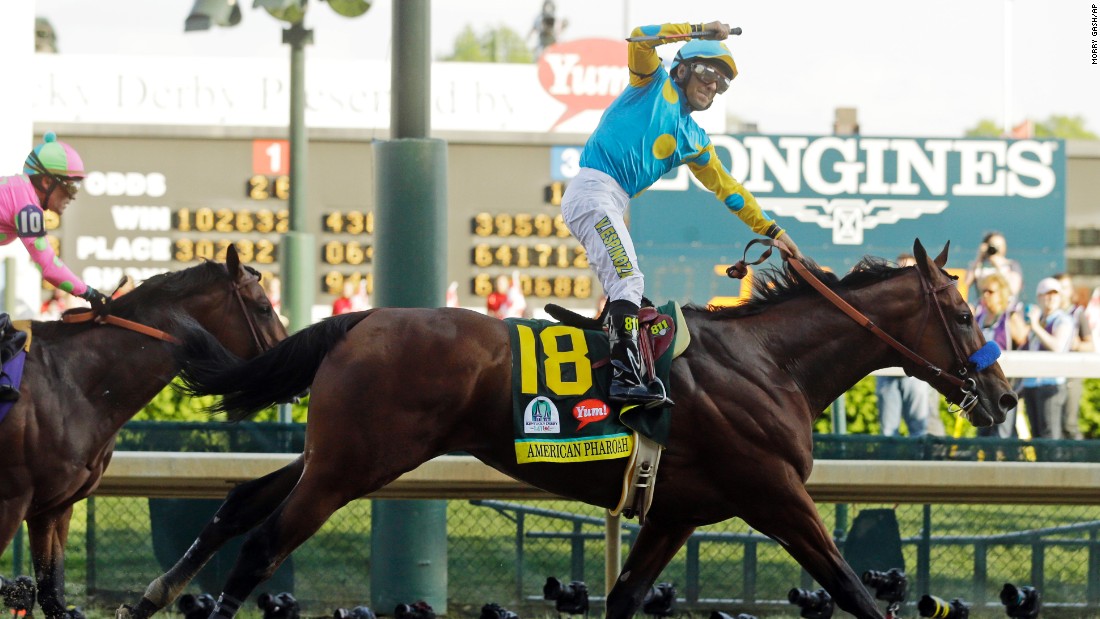
It ain’t the horse’s fault. It’s just that where sports is concerned, speling is opshunal. I mean, by putting the word “American” in front, you can get away with darn near everything. It refers not just to a country or a people, but to a state of mind in which you’re free to put letters however. Ah, friedom, isn’t it wonderful?


Sliced Off at the Knees

The Weather Stops at El Border

The Weather Stops at El Border?

On many counts (almost too numerous to mention) the news is a partial and usually misleading travesty. Take the weather, as represented by this morning’s precipitation map off the Weather Channel’s weather.com. We are approaching the time of year when our weather comes not from the west or north, but from Mexico.

Even as I write this, Hurricane Bianca is threatening the State of Baja California Sur. What does that mean for Southern California? It means that we get the northern edge of whatever monsoonal weather is hitting Northwest Mexico. Stray clouds, winds, and precipitation do occasionally sneak across the fence at the border and make their way to El Ciudad de Los Angeles.

So what use is it to us when we get a weather report that ignores everything south of the line? No, the earth does not change color at that point, and the weather does move around by laws that do not respect national boundaries.

Over the next few weeks, we expect humid weather with possible light showers—not sufficient to rain on our parade or affect the drought in any significant way. But it nonetheless is a factor we should not ignore.

Cartoneros and the Tren Blanco

The Recyclers Come Out at Night ...

The Recyclers Come Out at Night …

There are always two sides to the coin. The other day, I wrote a post about Buenos Aires that perhaps gilded the lily overmuch. I have to keep reminding myself that one can easily love someone, something, or someplace that is far from perfect. Take Los Angeles, for example, from which my cousin Peggy from Cleveland fled because, as she said, she couldn’t find anyone who spoke English. (I don’t think she tried very hard.)  Many of my friends from other parts of the country do not hold Southern California in high regard, especially if they haven’t given the place a chance to work its way into their bones, the way it has with me.

So back to Buenos Aires. As with many huge cities, there is a lot of poverty lurking behind the picturesque façades. In Argentina, these usually take the form of what are sardonically called villas miserias (“misery villas”) due to the habit of calling the areas surrounding the urban core with names beginning with Villa, such as Villa Lugano, Villa Lynch, Villa Crespo, and the spectacularly awful Villa 31 (see below) adjoining the posh neighborhood of Retiro. This used to be the docks area for the Port of Buenos Aires, before they moved east.

Villa 31 with the Microcentro in the Background

Villa 31 with the Microcentro in the Background

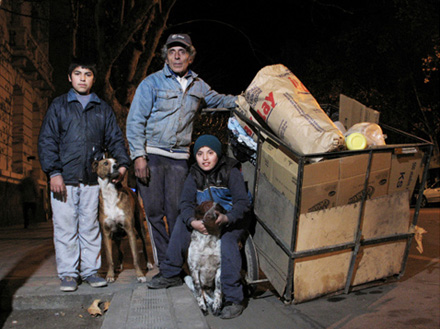
After dark, the streets of Buenos Aires fill up with cartoneros, whole families with large carts who go through the garbage for cardboard and other recyclable items for which they can earn a few pesos. After the economic crisis of 2001, the government wisely has begun to recognize them and even facilitated their scavenging by creating the tren blanco, or “white train,” to bring them from the villas miserias, where they live, to the center of the city. These trains consist of old rolling stock with the seats removed (to allow for carts to loaded) and sometimes even without lighting.

Aboard the Tren Blanco

Aboard the Tren Blanco

I have seen the cartoneros at work the few times I wondered the streets of the city at night. For the most part, they are diligent and friendly as they go about their work; but there were stories at the Posada del Sol youth hostel about backpacks and wallets that were stolen. Fortunately, I escaped being mugged.

Again, there are parts of Los Angeles about which I would say the same thing. Except here, there is a higher chance of violence and rape accompanying the mugging.

The Royal Society for Putting Things on Top of Other Things

Alberta Branch

Alberta Branch

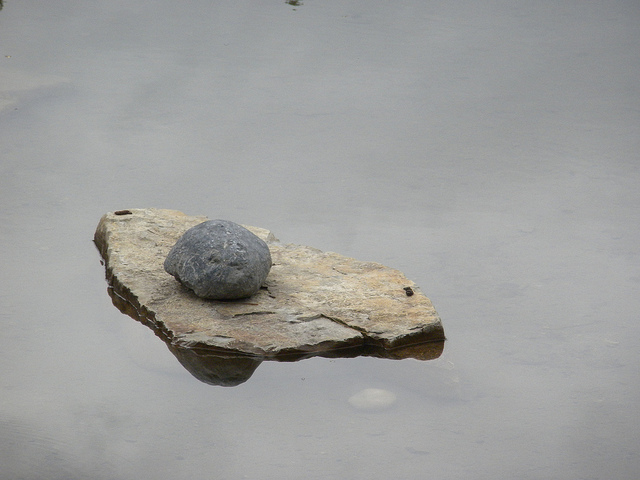
One of my favorite Monty Python sketches was about the Royal Society for Putting Things on Top of Other Things, chaired by the late lamented Graham Chapman. (To see the sketch, click here.) Above, we see the local Alberta branch’s work at Johnson Lake, just northeast of Banff Townsite.

The question I ask myself is the following: Is there any way that round rock could have gotten onto the flat rock on its own? If so, how so? And is there any way of measuring exactly when it happened? And if the above is a natural formation, would that not altogether vitiate the work of the Society for Putting Things on Top of Other Things? These are all hard questions which either must be addressed, or entirely scouted.


Tarnmoor’s ABCs: Xul Solar

Surreal Cities ...

Surreal Cities …

All the blog posts in this series are based on Czeslaw Milosz’s book Milosz’s ABC’s. There, in the form of a brief and alphabetically-ordered personal encyclopedia, was the story of the life of a Nobel Prize winning poet, of the people, places, and things that meant the most to him.

My own ABCs consist of places I have loved (Iceland, Patagonia, Quebec, Scotland), things I feared (Earthquakes), writers I have admired (Chesterton, Balzac, Proust, Borges, and Shakespeare); locales associated with my past life (Cleveland, Dartmouth College, and UCLA), people who have influenced me (John F. Kennedy), foods I love (Olives and Tea), and things I love to do (Automobiles and Books). This blog entry is my own humble attempt to imitate a writer whom I have read on and off for thirty years without having sated my curiosity. Consequently, over the next couple of weeks (there are now only two letters left in the alphabet: Y and Z), you will see a number of postings under the heading “Tarnmoor’s ABCs” that will attempt to do for my life what Milosz accomplished for his. To see my other entries under this category, hit the tag below marked “ABCs”. Today is X for—no, not X-Ray—but Xul Solar.

I generally do not like modern art, but I have a strange affinity for many surreal artists like Salvador Dalí, Giorgio di Chirico, and Xul Solar.

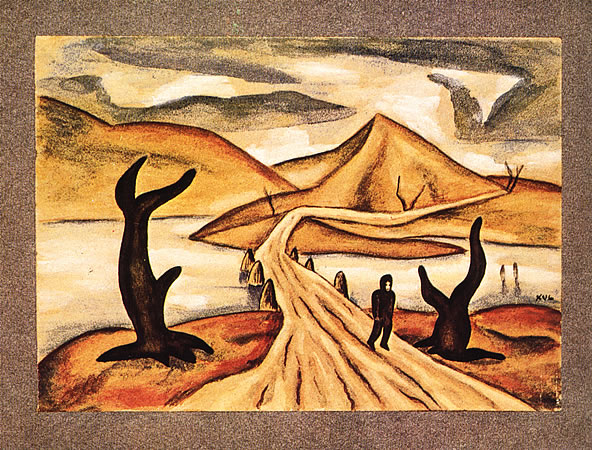
In March of last year, I already wrote a post about the Latvian-Argentinean painter, whose real name is Oscar Agustín Alejandro Schulz Solari, but since that “X” is a difficult letter to account for in any alphabetical scheme such as this one, and because I plan to visit his museum in Buenos Aires in November, I decided to write more about his work, which is filled with strange cities and desolate landscapes populated with strolling characters of a vaguely human appearance.

“Paisaje Bunti”

“Paisaje Bunti”

As I wrote in my previous post, it was Jorge Luis Borges who turned me on to his work. As he wrote on one occasion, “His paintings are documents of the unearthly world, of the metaphysical world in which the gods take the forms of imagination, dreams. Passionate architecture, happy colors, many circumstantial details, labyrinths, homunculi and angels unforgettably define this delicate and monumental art.” Soon after he wrote those words, Borges lost his eyesight and was unable to enjoy any paintings, save what visual fragments remained in his memory.

Below is Xul Solar’s take on a cathedral:

“Cathedral”

“Cathedral”

My hotel in Buenos Aires will be within walking distance of the Xul Solar Museum, which is situated at Laprida 1212, a short walk down Pueyrredón from Recoleta. You can visit the museum’s website and view a nice selection of his paintings done over some fifty years. Never mind that the text is in Spanish.


The Ytinerary: Buenos Aires

Starting at the Beginning ...

Starting at the Beginning …

This is the start of a new series of posts, all connected with my vacation plans and daydreams. The Ytinerary—combining the words “Why” and “Itinerary”—takes each step of my November trip and answers the question, “Why are you going there?”

Let’s start with Buenos Aires. My plane lands at Ezeiza, officially known as Ministro Pistarini International Airport, one of the largest in South America. Fortunately, there are a lot better reasons than mere convenience to spend time on the shores of the Plate. B.A. is a target-rich environment, full of museums, parks, and historical buildings. It has been described as very like a European city, partly because the majority of its inhabitants are of European descent, mostly Italian and Spanish. (The original natives of the Pampas were wiped out by General Julio Argentino Roca’s “Conquest of the Desert” in the 1870s.)

I have been to B.A. twice before, in 2006 and 2011. The first time, I stayed at the Posada del Sol (above) on Hipólito Yrigoyen, not far from the Plaza de Mayo and the Casa Rosada, the nation’s capitol. The second time was at the Chez Lulu in Palermo. This time, I plan to stay in Recoleta, between the two.

This time, I hope to see the city from the eyes of its greatest writer, Jorge Luis Borges. His widow runs a Borges Cultural Centre at Viamonte and San Martín. I also plan to see the Museo Xul Solar, dedicated to a surrealist painter whose work Borges loved (and about whom I will write later this week). Also, I will walk the streets of Palermo, where the poet was born long before the area became gentrified and when it was full of knife-fighters and trucho players.

I will visit some of the old cafés for which the city is famous, such as the Café Tortoni, Il Preferido, El Sanjuanino, and Los Violetas, which are well into their second century, and where Borges and his friends used to hang out. The food is great and the service exquisite.

Also, I will renew my acquaintance with TEGOBA, the English Speaking Group of Buenos Aires, which meets on Fridays for dinner at the FAME Fast Food Restaurant on Cabildo near the Congreso de Tucumán Subte stop (below).

My Friends at TEGOBA: Marta Viajero and Gonzalo Luchinetti

My Friends at TEGOBA: Marta Viajero and Gonzalo Luchinetti

As you can see, I could easily spend all three weeks of my vacation in Buenos Aires. It’s one of those cities which is endlessly fascinating.


Down to Yellow Alert

Yes! It Looks Like Calbuco Won’t Interfere with My Trip

Yes! It Looks Like Calbuco Won’t Interfere with My Trip

I have been watching Sernageomin’s Reporta de Actividad Volcánica (RAV) on a daily basis. I have seen the warnings go from a Red Alert and a 20 km danger zone to an Orange Alert and finally a Yellow Alert. Even if Calbuco doesn’t emit so much as a puff of smoke in the next six months, the Servicio Nacional de Geología y Minería will likely not lower the alert to Green if only because the three eruptions of April 22, 24, and 30 were so spectacular as to keep the agency on its toes.

On May 9, I printed a vastly different chart showing the danger zone, the lava paths to the surrounding lakes, and the direction of wind-borne volcanic ash. My planned bus journey from Lago de Todos los Santos to Puerto Varas would have been blocked at several points by flowing lava; and both Ensenada and Petrohué had been evacuated.

As you can see from the most recent RAV chart for Calbuco (above), only parts of the Rio Frio and Rio Caliente are in any danger of pyroclastic flows; and ash is no longer coming from the caldera.

Chile is a somewhat tricky country to visit: It is not only one of the most active countries in the world due to its volcanic activity, but also due to devastating earthquakes. On May 22, 1960, Valdivia had a quake that tipped the Richter scale at 9.5. What with its associated tsunami, is is considered one of the strongest tremors in history.

So why do I want to go there? Certainly not to walk innocently into a disaster. Mountainous country is beautiful, but the taller the mountains, especially near the edge of a tectonic plate, the more Biblical are the disasters. You pay for beauty.