Frida Kahlo: “A Ribbon Around a Bomb”

Frida Kahlo Self Portrait

Frida Kahlo Self Portrait

In all of the New World, there was never so beguiling and striking a painter as Frida Kahlo. Today is her birthday. If she were alive today, she would be 109 years old. But, alas, she died in pain at the age of 47.

At the age of 6, Frida came down with polio. For the rest of her life, her right leg would be thinner than her left—a fact she disguised by wearing only pants or long dresses. At the age of 18, she was in a bus accident in which she suffered, according to Wikipedia, “a broken spinal column, a broken collarbone, broken ribs, eleven fractures in her right leg, a crushed and dislocated right foot, and a dislocated shoulder.” Also she was able to walk again, she suffered excruciating pain, had multiple surgeries, and became a world-famous painter.

She married the painter Diego Rivera, had numerous affairs, including with Leon Trotsky, and was, despite her health issues, beautiful and proud. Of her, André Breton said of her art that it was “a ribbon around a bomb.”
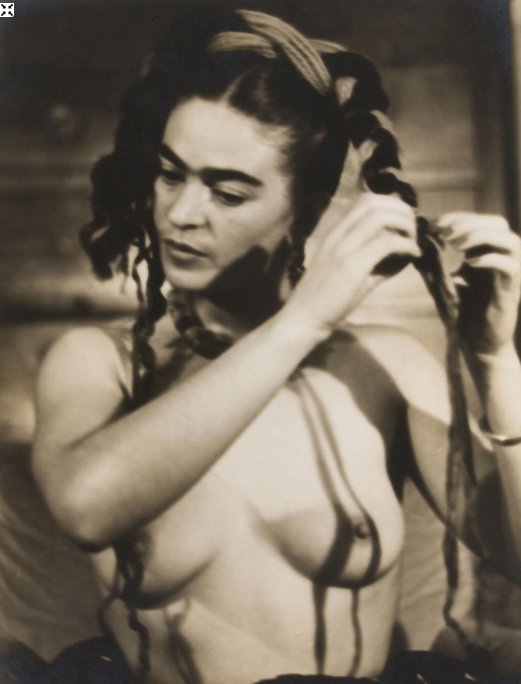
Nude Portrait of Frida Kahlo by Julien Levy

Nude Portrait of Frida Kahlo by Julian Levy

In the end, after she died, Frida’s fame only grew, such that her work is more recognized today than that of any of her contemporaries. If ever I should return to Mexico City, I would like to visit the Casa Azul, the Blue House, in Coyoacán, where she was born and where she died. Today it is a museum dedicated to her life and work.
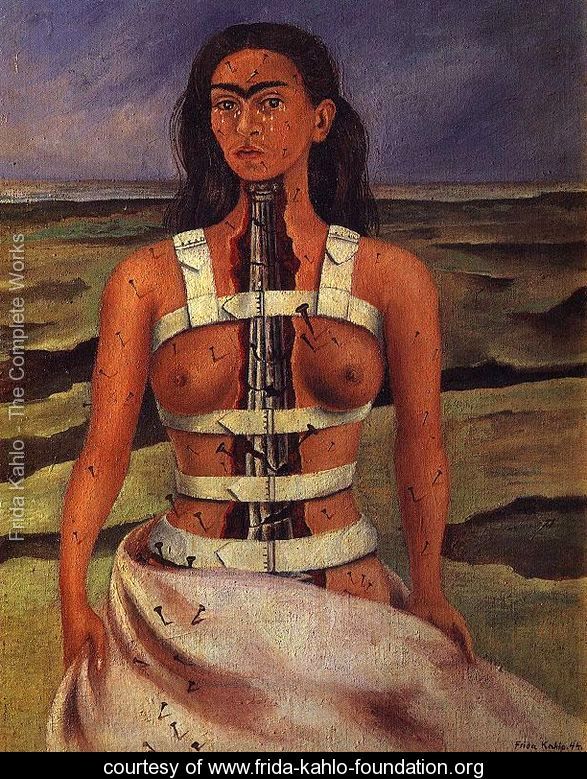
Frida’s Self Portrait with Broken Column

Frida’s Self Portrait with Broken Column and Nails


Asked why she appears as the subject of so many of her paintings, the artist said “I paint myself because I am so often alone and because I am the subject I know best.”

Divisive Politics and Friendship

Even Greater Than Before

Even Greater Than Before

Alexandre Dumas Père wrote several novels starring the D’Artagnan and the Three Musketeers. The original novel was The Three Musketeers (1844)—in which all the musketeers were in their youth—followed by Twenty Years After (1845) and the multiple volumes of The Vicomte de Bragelonne (1847-1850).

I am currently re-reading Twenty Years After and find that D’Artagnan and the Musketeers have not only grown older by twenty years: They have also matured in other ways. The novel takes place during the Wars of the Fronde (1648-1653) in which the nobility resists the penny-pinching Cardinal Mazarin, who with Anne of Austria (widow of Louis XIII) is acting as regent for the young Louis XIV.

As lieutenant of the King’s Musketeers, D’Artagnan is pledged to support the royal party. Mazarin discovers how the Musketeers has performed so valiantly two decades earlier and requests that D’Artagnan bring together his former companions. But time has passed. He succeeds in recruiting Porthos to his cause, especially as all he really wants is to become a Baron.

But Aramis and Athos are loyal to the Fronde. Even D’Artagnan’s old servant Planchet is of that party. What I find so interesting in this sequel is that the political disunity does not dissolve the old friendship: It is still “all for one and one for all.” I am constantly reminded of parallels to our own political situation in this grisly Presidential Election of 2016. The vagaries of national politics seem to have no effect on the friendship of these four valiant fighters.

Even though Twenty Years After is more crowded with incident than The Three Musketeers, I find it to be a better novel, if for no other reason than its insight into the nature of friendship—especially of friendships that last.

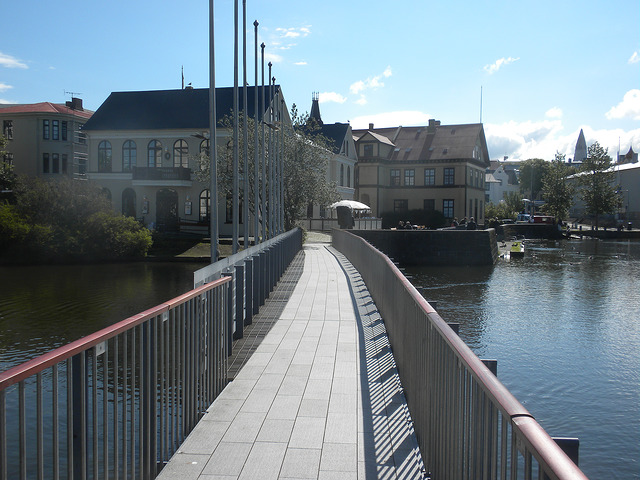
Reykjavík

“Downtown” Reykjavík Scene

“Downtown” Reykjavík Scene

As I write this, my friends Bob Alonzi and Suzanne Holland are spending a few days touring in Iceland. And, as for me, I cannot think about Iceland without wishing to return—and soon. There is something about a brave little country, whose total population is some 330,000, which has had such an outsize influence on world history:

  • An Icelander, Leif Ericsson, landed in and colonized the New World some 500 years before Columbus.
  • The Icelandic sagas were probably the greatest European literature of the time, with the exception of the Italian Dante Alighieri.
  • The “Cod Wars” against Britain in the 1970s led to Iceland winning, without a single bullet fired. Subsequently, most countries joined Iceland in declaring a 200-mile coastal sovereignty limit.
  • The Iceland soccer football team defeated powerful England 2-1 (before losing honorably to France).

One of the things that keeps me going is my love for so many lesser-known parts of the world, parts that are wild and fascinating, as Iceland surely is.

Serendipity: Books and Brain Pickings

“A Marvellously Noble and Transcendent Chimera”

“A Marvelously Noble and Transcendent Chimera”

I do not follow many blog sites; though every once in a while, I find one that is superb. Such is Brain Pickings, which I have now included among my links.

The following observation on reading comes from Hermann Hesse’s My Belief: Essays on Life and Art, by way of Brain Pickings:

The great and mysterious thing about this reading experience is this: the more discriminatingly, the more sensitively, and the more associatively we learn to read, the more clearly we see every thought and every poem in its uniqueness, its individuality, in its precise limitations and see that all beauty, all charm depend on this individuality and uniqueness — at the same time we come to realize ever more clearly how all these hundred thousand voices of nations strive toward the same goals, call upon the same gods by different names, dream the same wishes, suffer the same sorrows. Out of the thousandfold fabric of countless languages and books of several thousand years, in ecstatic instants there stares at the reader a marvelously noble and transcendent chimera: the countenance of humanity, charmed into unity from a thousand contradictory features.

A Book of Essays I Will Have to Read

A Book of Essays I Will Have to Read

Good books lead everywhere, but especially to places worth going.


Belgian Cats Against Terrorism

General Bonkers Will Explain the Situation

General Bonkers Will Explain the Situation

When Brussels was placed under a terrorism alert in November, security officials requested that the public remain silent regarding ongoing counter-terrorism operations lest they alert potential targets of police raids. So how did the Belgians react? With cat pictures … hundreds of them! All relate in one way or another to the terror alert, but with a sense of humor that no one knew the Belgians had.

They Said to Stay Inside!

They Said to Stay Inside!

These are just three images for your enterrainment. For more images, I suggest you click here.

All Clear Yet?

All Clear Yet?


I wish to thank Martine for bringing these pictures to my attention.

Travelers, Wild and Tame

Freya Stark (1893-1993)

Freya Stark (1893-1993)

For over forty years (except for a brief interlude when she was married), Freya Stark spent some 40 years traveling by herself in the Middle East. I have just finished reading her first book, Baghdad Sketches (1932), consisting of columns written for the Baghdad Times plus some 8 pieces added later for the British edition.

I am amazed that she was able to not only survive traveling in a difficult part of the world roughly between 1928 and 1970, but she lived to the age of 100.

She is not the first to do so. Gertrude Bell (who died in Baghdad just a couple years before Freya arrived there), also covered much of the same ground. Still, I cannot imagine in this period of violent jihad and xenophobia that their travels could be duplicated without a military escort.

Freya had interesting attitudes about solitude and travel. On the former, she wrote that “solitude is the one deep necessity of the human spirit to which adequate recognition is never given in our codes. It is looked upon as a discipline or penance, but almost never as the indispensable, pleasant ingredient it is to ordinary life.” For the modern traveler, she felt with distaste that its purpose “is to give people a glimpse of the exotic places without the least bit of inconvenience to themselves.”

In Baghdad Sketches, she gives a picture of a much more diverse population than exists now in the era of ISIS/ISIL/Daesh. Stark frequently visited among the Kurds, Yezidis, Shi’as, and Eastern Christians living in Iraq during the 1930s.

Among her books that I have read with pleasure, in addition to Baghdad Sketches, are:

  • The Valleys of the Assassins and Other Persian Travels (1934)
  • The Southern Gates of Arabia: A Journey to the Hadhramaut (1938)
  • Alexander’s Path: From Caria to Cilicia (1958)—about Turkey

Many of her books are still in print.


I’m Not Finished with Argentina!

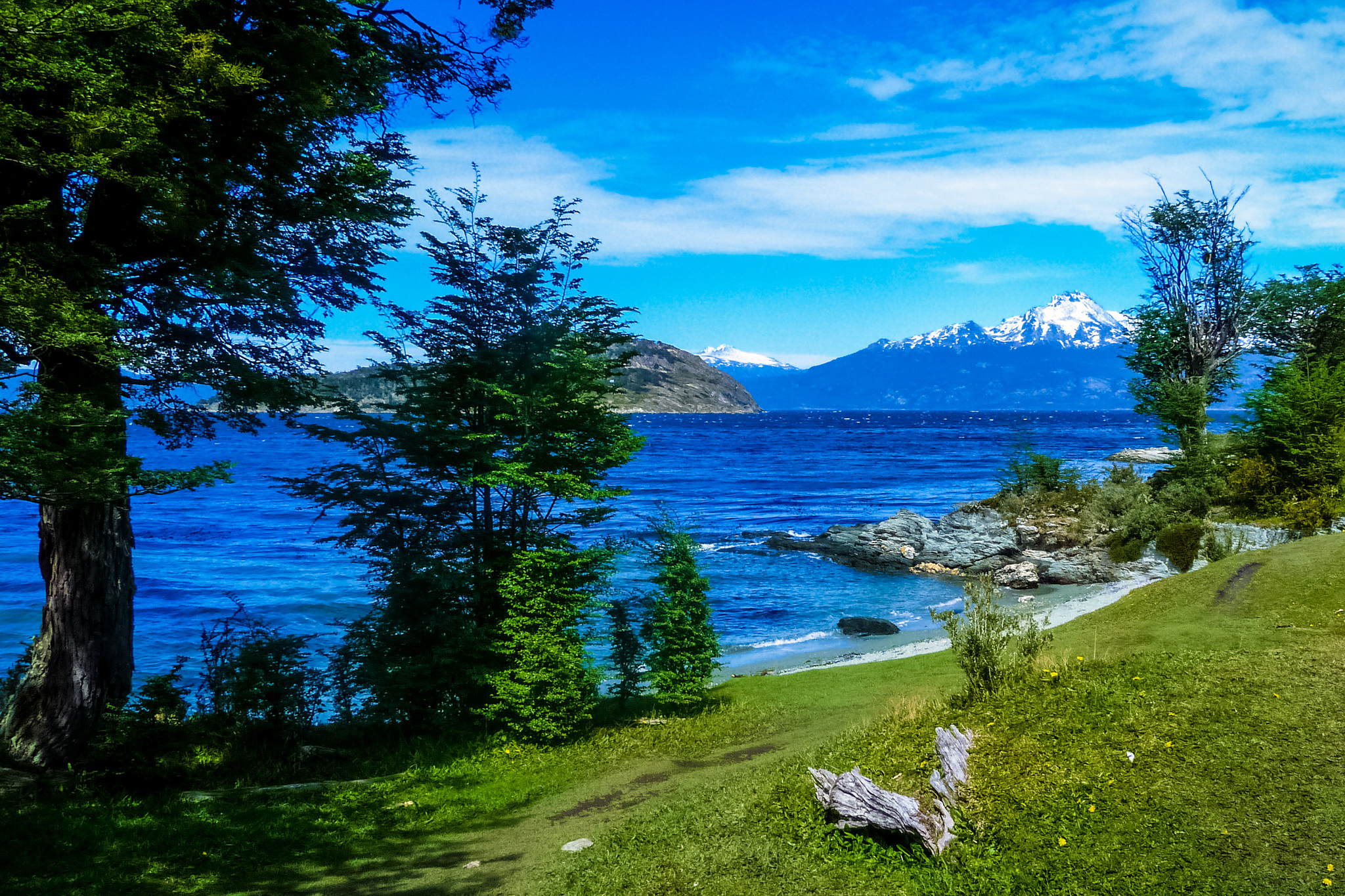
The South Atlantic Near Ushuaia

The South Atlantic Near Ushuaia

Even while I am planning my Ecuador trip, I am hinking of returning to Argentina. It is almost like another home to me, after three visits. This time, I am interested in traveling down RN 3 along the South Atlantic from Buenos Aires all the way down to Tierra del Fuego and Ushuaia (in Argentina) and Punta Arenas (in Chile). That is slightly over 3,000 kilometers. I may even fly to Puerto Williams in Chile, the absolute southernmost inhabited town in the world. Then I would fly back to Buenos Aires.

Along the way there would be the following stops:

  • Bahia Blanca with its famous Museo del Puerto de Ingeniero White.
  • The twin cities of Carmen de Patagones and Viedma, separated by the Rio Negro.
  • Puerto Madryn, which I visited with Martine in 2011 and perhaps some of the Welsh colonies around Trelew and Gaiman.
  • Comodoro Rivadavia, the industrial port from which Argentina launched the 1982 Falklands (Malvinas) war.
  • Puerto Deseado, visited by Magellan and Charles Darwin, called by naturalist Francisco Perito Moreno “the most picturesque place on the eastern Patagonian coast.”
  • Puerto San Julian, where both Magellan and Sir Francis Drake suppressed mutinies by executing the ringleaders.
  • Rio Gallegos, a key southern transportation hub and an old wool and petroleum shipment center. From here I can go to Punta Arenas (Chile) and see the Torres del Paine and the Fitzroy Massif. And from there, I could fly to Puerto Williams (a bit pricey, but comes with great bragging rights).
  • Ushuaia, the southernmost city in the world, where I’ve been twice and which I love. I’ll even stay at the same place, the Posada del Fin del Mundo owned by my friend Ana Bermudez.
The South Atlantic Is Not for Swimmers

The South Atlantic Is Not for Swimmers

Now that I’ve come to understand the long distance buses in Argentina, I know I’ll be able to travel in comfort and at a relatively low price. The longest stretches would be between Rio Gallegos and Ushuaia and between Buenos Aires and Bahia Blanca.

Except for Buenos Aires, Puerto Madryn, and Ushuaia, most of the above cities are off the tourist route. I could live with that.

You Can, But You Won’t

E-Readers Are OK, but Smart Phones Are Not

E-Readers Are OK, but Smart Phones Are Not

Once I saw a website somewhere about all the devices that smart phones will render obsolete. On the list were e-readers, such as Kindle and Nook. I do not believe, however, that people with smart phones will be reading Proust’s In Search of Lost Time (in seven volumes) anytime soon. I do not even think that they will be reading many shorter books, such as 10 Haikus for the Next Millennium.

Just because you can read books on a smart phone does not mean that you will ever want to. There are four reasons for this:

  • You can only see so many words on a page. Excessive page-turning will render the reading experience too clumsy.
  • If your device is backlit, it will bother your eyes to read for any length of time. E-book readers like Nook and Kindles use a technology that does not glare at you.
  • People past a certain age (and I am already there) have trouble reading words on small screens.
  • Smart phones are so small that the reading experience is psychologically different from cradling a physical book in your hands.

I remember when Gutenberg and other websites put the complete texts of thousands of books online. In the last ten years, I have succeeded in reading only one book online: Sir Richard F. Burton’s Falconry in the Valley of the Indus. It is a relatively short book, and I can tell you it was a real chore, what with the glareback from my monitor. I believe this may also be a problem on iPads and other pad devices.

Over the years, I have long suspected that those people staring at their cellphone screens while walking are probably not reading Moby Dick.


L.A. Writer: John Fante

John Fante, L.A. Novelist, Short Story Writer, and Scriptwriter

John Fante, L.A. Novelist, Short Story Writer, and Scriptwriter

This is a series about writers whose work is predominantly set in Los Angeles.Last Month, I wrote about Eve Babitz (who is still alive).  I am wondering whether to open this series up to people who came from other countries, such as Aldous Huxley or Raymond Chandler, who have written works that have added to the Southern California scene. Omitted will be writers like Nathanael West (The Day of the Locust) who are primarily oddities or one-shots.

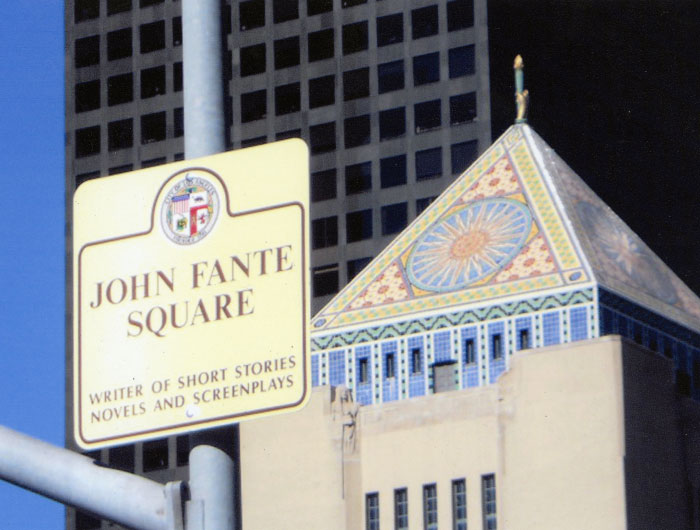
At the corner of West 5th Street and South Grand Avenue, hard by the Los Angeles Central Library, is a sign commemorating John Fante Square (see below), just on the edge of the old Bunker Hill neighborhood made famous by the writer’s Arturo Bandini novels. These include:

  • Wait Until Spring, Bandini (1938)
  • The Road to Los Angeles (1936, Published 1985)
  • Ask the Dust (1939)
  • Dreams from Bunker Hill (1982)

The best of them that I have read is Ask the Dust, which I finished reading this morning in the Central Library just outside the foot of Bunker Hill, where Fante and his hero Bandini lived.

Sign Commemorating John Fante Square with the Tower of the Central Library

Sign Commemorating John Fante Square with the Tower of the Central Library

Arturo Bandini wanted more than anything else to be a great writer, but we see him on the edge of poverty and trying unsuccessfully to find a love interest—in the worst possible way. His choice in Ask the Dust is a hophead Mexican waitress named Camilla Lopez with whom he has a love/hate relationship that ends badly. He is torn between his Italian Catholic upbringing and the glitzy Hollywood life of famous writers and film people.

It is in no way a Hollywood novel. In fact, Bandini and Lopez don’t even drive through Hollywood or have any interest in seeing films together.

Today, Bunker Hill is no longer a ghetto of cheap boarding houses; rather, it is full of high rise banks and corporate headquarters that tower over the lowlands of Downtown L.A. The old funicular, Angel’s Flight, which rises to the top of Bunker Hill from Hill Street across from the Grand Central Market is still in existence, though it is not presently in operation.

The life of John Fante has a particular interest for me because the end of his life was characterized by severe diabetes. In 1978, he went blind. Subsequently, he lost both of his legs to the disease. He died in 1983 at the age of 74.


My Japanese Years

Mifune Toshiro in Hiroshi Inagaki’s Duel at Ichijoji Temple

Toshiro Mifune in Hiroshi Inagaki’s Duel at Ichijoji Temple

It all came back to me while I had a Japanese meal with Martine at the Aki Restaurant in West Los Angeles. When I first came to Los Angeles in late 1966 I quickly became a Nipponophile. I lived for a while on Mississippi Avenue in the middle of the Sawtelle neighborhood, the old Japanese plant nursery district. Even before I started my explorations of Mexican food, I started becoming a Japanese foodie. I even thought the little tofu cubes in my miso soup were shark’s fin. (I marveled at my sophistication in eating “shark’s fin” soup.)

Since i was a graduate student in film at UCLA, I made a point of seeing as many Japanese films as I could. I remember taking the MTA #81 bus down Wilshire Boulevard to La Brea and walking a couple blocks south to the old Toho La Brea theater. The first films I saw there were Hiroshi Inagaki’s Miyamato Musashi (based on Eiji Yoshikawa’s novel) trilogy: Samurai (1954), Duel at Ichijoji Temple (1955), and Duel at Ganryu Island (1956). I fancied myself falling love with the sweet Kaoru Yachigusa, who played the part of Otsu; and of course I hero-worshipped Toshiro Mifune as the hero of he saga.

The Toho La Brea theater had a clock over the left emergency exit that was illuminated with the words Sumitomo Bank. All features were preceded by an Asahi Shimbun newsreel in Japanese without subtitles. Although I couldn’t understand a word, I looked forward to the newsreels.

A few years later, I joined with my film freak friends in visiting the other Japanese theaters in town: the Kokusai and Sho Tokyo (both Daiei studio), Kabuki (Shochiku), and the Linda Lea (Tohei). Today all five Japanese theaters are gone.

By the way, ever wonder why I call this website Tarnmoor? That was a pseudonym I used along with two of my friends in a UCLA Daily Bruin column entitled “The Exotic Filmgoer,” which was mostly about these Japanese theaters.